


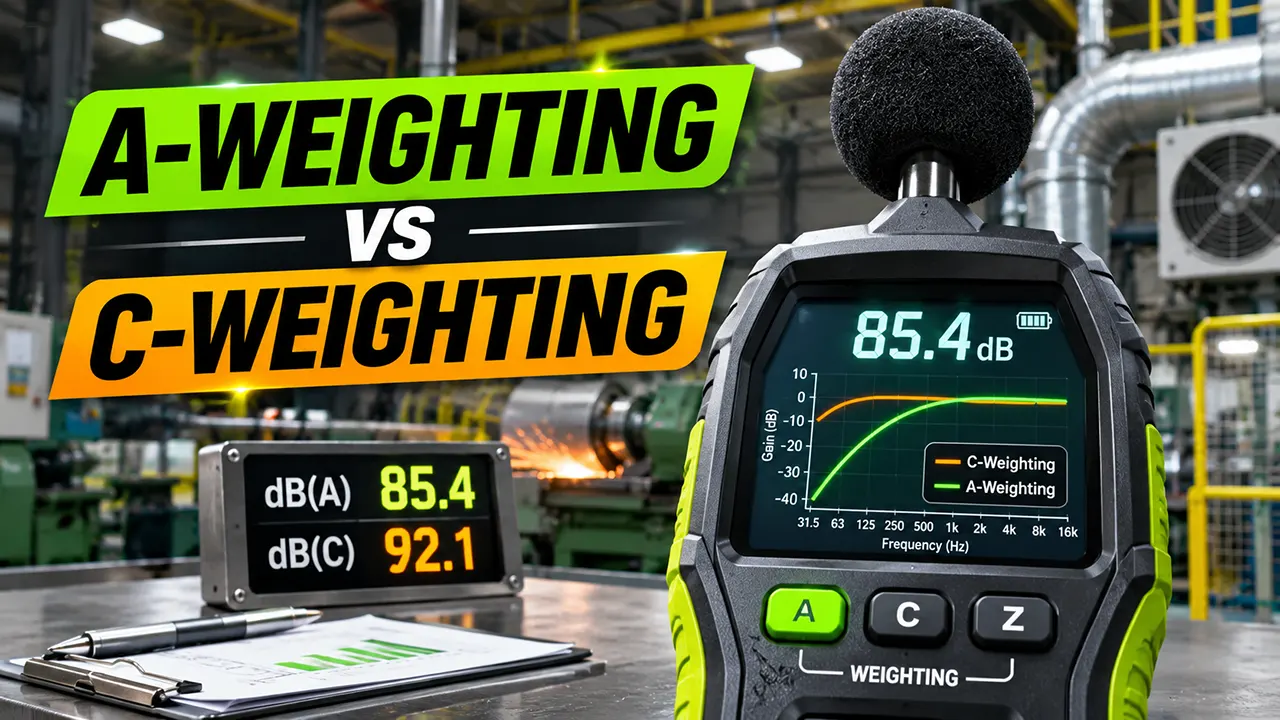
When the need exists to assess noise at a particular site such as an office, industrial premises, or construction site, an equally great need exists to properly understand how sound is measured and interpreted.
One of the key things that distinguishes the various sound measurement instruments available on the market, is the different frequency weighting options they offer. Of these settings, the two most commonly used are A-weighting and C-weighting.
However, not every prospective user of a sound level meter will necessarily fully grasp what these measurement approaches are, how they differ from each other, and the aspects they need to think about when choosing a setting for their intended noise assessment process.
Ultimately, making the right choice of frequency weighting will be critical if a given user is to achieve meaningful results that reflect how humans actually perceive sound and how equipment responds to it. So, this guide aims to provide clarity on the subject.
What Is Meant by The Term ‘Frequency Weighting’?
Sound consists of pressure variations travelling through the air at different frequencies, with these being perceived by the human ear as different pitches. However, human hearing does not respond in the same way to every frequency.
The human ear is generally more sensitive to sounds in the mid-frequency range (approximately 500 Hz to 6 kHz), and less sensitive to very low and very high frequencies. This is especially the case at typical everyday listening levels.
Frequency weighting is therefore used in sound measurement to adjust how a decibel reader (otherwise known as a “sound level meter”) responds to different frequencies.
This means the noise measuring instrument doesn’t simply record the physical sound pressure level across the entire frequency spectrum; it applies a standardised weighting curve. As a result, the measurement produced by the device reflects a particular assessment purpose, better matching either human hearing or other requirements.
A-weighting and C-weighting aren’t the only frequency weighting systems. Nonetheless, they are the two most often used weightings in day-to-day sound level measurements, differing from each other in how they treat different parts of the frequency spectrum.
What Is A-Weighting (dBA)?
A-weighting is designed to approximate the frequency sensitivity of human hearing at relatively low sound levels (around 40 phon).
It heavily attenuates low frequencies (below roughly 500 Hz), in addition to reducing (to a lesser extent) the contribution of very high frequencies. Results are expressed in decibels A-weighted, written as dB(A) or dBA.
Typical applications of A-weighting range from workplace noise risk assessments and environmental noise surveys to construction-site noise monitoring, product noise labelling, and general outdoor ambient noise measurements.
What Is C-Weighting (dBC)?
C-weighting is another standardised frequency weighting system, albeit one that applies a much flatter response across the audible frequency range than A-weighting. Specifically, it is almost flat between around 31.5 Hz and 8 kHz.
This means it retains significantly more of the low-frequency sound energy that A-weighting reduces, and more closely follows the ear’s response at higher sound levels (approximately 100 phon). Results are expressed as dB(C) or dBC.
C-weighting is used to assess peak sound pressure levels for hearing protection selection, in accordance with the Control of Noise at Work Regulations in the UK. Other common applications encompass the evaluation of low-frequency noise or the potential for building structures to vibrate, as well as the measurement of high sound levels at entertainment venues, nightclubs, and live music events.
A-Weighting vs C-Weighting: Key Practical Takeaways
So, what does all this mean for a human user who is looking to begin sound level measurements at a particular site? It certainly means they should take care to always select the correct weighting on their decibel reader before they start.
Most of the latest available Class 1 and Class 2 meters compliant with the BS EN 61672 standard offer A, C, and often Z (zero/flat) weighting simultaneously. Indeed, for legal or compliance work, it is essential to use a meter of the appropriate accuracy class, in addition to keeping calibration certificates up to date.
Whatever the nature of the given noise assessment task, understanding the difference between A-weighting and C-weighting, and selecting the right one on the sound level meter, will help ensure the subsequent measurements taken are technically correct and relevant to the applicable regulations and guidance.
