


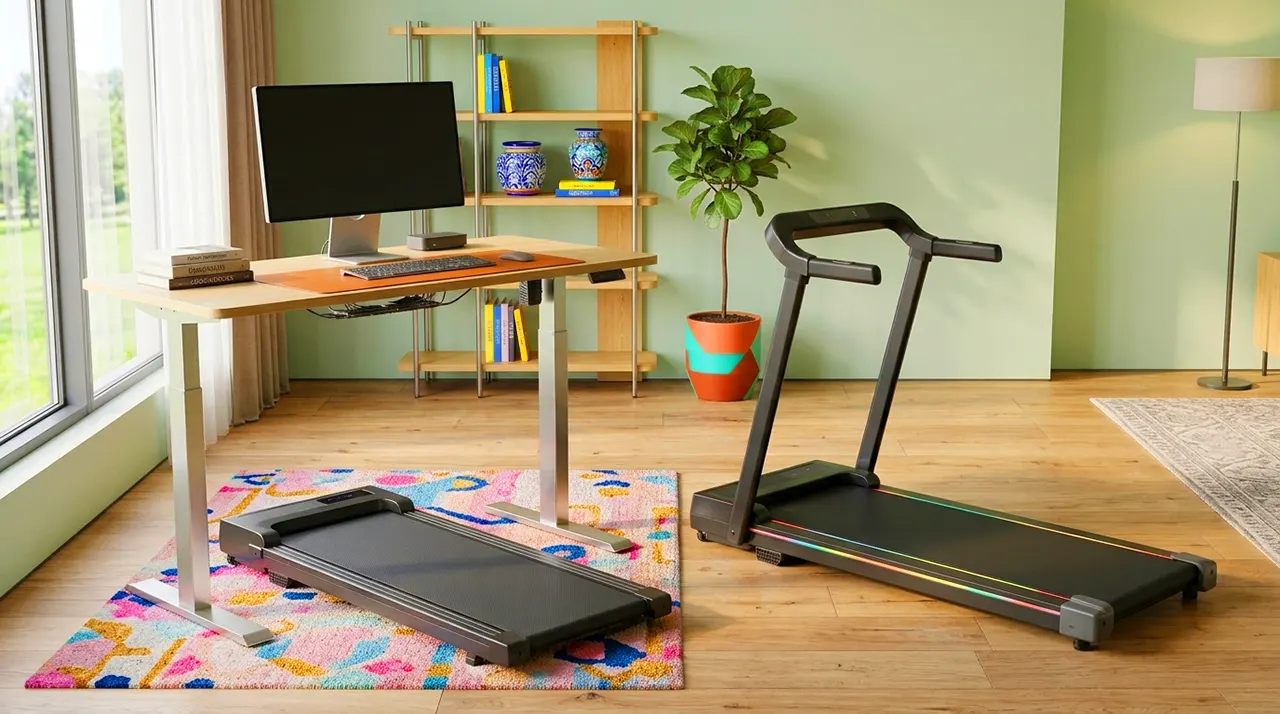
A walking pad and an under-desk treadmill may look like two different types of exercise equipment, but the distinction is not always that simple. In many cases, they describe the same basic machine: a compact electric treadmill designed primarily for walking.
The main difference is often how the machine is designed, configured, and marketed. Some walking pads have a slim, rail-free frame that fits beneath a standing desk. Others include folding handrails, automatic incline, higher speed limits, and features for jogging or running. An under-desk treadmill can also have some of these features, depending on its design.
So, which one should you buy?
If you want to walk while working, a low-profile model without bulky rails may be easier to fit under your desk. If you want a machine for both office walking and home workouts, a folding model with handrails and incline may offer more flexibility.
Let’s compare their features, practical differences, and buying considerations so you can choose the right machine for your space and fitness goals.
What Is a Walking Pad?
A walking pad is a compact, motorized treadmill designed mainly for walking indoors. It usually has a smaller frame and a lower profile than a traditional treadmill.
Unlike many full-size treadmills, a basic walking pad may not have a large upright console or fixed handrails. Most models use a remote control to adjust speed, while some include an LED display, mobile app, Bluetooth connectivity, or other smart features.
The compact design makes walking pads useful in apartments, bedrooms, small home gyms, and home offices.
Common Walking Pad Configurations
Walking pads are available in several designs.
1. Flat walking pads
These are slim machines with no upright handrails. They are often designed to slide beneath a standing desk or fit under furniture when not in use.
2. Walking pads with folding handrails
These models include a handlebar that can be raised during exercise and folded down for storage. Some also support higher speeds or additional workout modes.
3. Incline walking pads
Some walking pads include manual or automatic incline. This allows users to walk on a sloped surface instead of a completely flat belt.
4. Multi-function walking pads
Some compact treadmills support walking, jogging, and running. They may include handrails, a larger display, app controls, and more powerful drive systems.
The important point is that the term walking pad does not describe one fixed design. Always check the individual machine’s specifications.
What Is an Under-Desk Treadmill?
An under-desk treadmill is a compact treadmill designed or configured to fit beneath a standing desk.
Its main purpose is to let someone walk at a comfortable speed while working, reading, attending virtual meetings, or performing other desk-based activities.
Most dedicated under-desk models have a low-profile frame. Many do not have permanent upright handrails because these can interfere with desk clearance.
However, not every under-desk treadmill is completely rail-free. Some models include removable or foldable handrails.
Common Features of Under-Desk Treadmills
A typical under-desk treadmill may include:
- A compact frame with a low deck height.
- A walking belt designed for steady indoor walking.
- A remote control for speed adjustments.
- An LED display for basic workout information.
- Transport wheels for easier movement.
- A relatively simple control system.
Some premium models also include incline adjustment, app connectivity, Bluetooth features, and wider walking surfaces.
The most important requirement is desk compatibility. The treadmill must fit beneath the desk without interfering with the user’s walking posture or available legroom.
Walking Pad vs Under-Desk Treadmill: Key Differences

The easiest way to understand the difference is to compare their intended use and physical configurations.
| Feature | Walking Pad | Under-Desk Treadmill |
|---|---|---|
| Main purpose | Indoor walking and general exercise | Walking while working |
| Design | Slim, folding, or rail-equipped | Usually low-profile |
| Handrails | May have none or folding rails | Often rail-free, but not always |
| Speed | Depends on model | Usually focused on walking speeds |
| Incline | Available on selected models | Available on selected models |
| Belt size | Varies by configuration | Often designed for steady walking |
| Storage | May fit under furniture | Usually designed for compact storage |
| Desk compatibility | Model-dependent | Primary design consideration |
| Running capability | Selected models support running | Depends on manufacturer specifications |
| Price | Varies widely | Varies widely |
These are general design tendencies, not strict technical rules. A walking pad can be an excellent under-desk treadmill, and an under-desk treadmill can also be marketed as a walking pad.
1. Intended Use
The most meaningful distinction is the intended use.
A basic walking pad is designed for indoor walking. You can use it while watching television, exercising in a small room, or walking during your free time.
An under-desk treadmill is specifically intended to support walking during desk-based activities.
For example, imagine working from home for several hours each day. You raise your adjustable desk, position a compact treadmill underneath it, and walk slowly while answering emails.
That is the typical under-desk treadmill experience.
However, you can use a suitable walking pad in exactly the same way. The label alone does not determine whether a machine is appropriate for office use.
Which is better?
Choose according to your intended activity. If you mainly want to walk while working, prioritize desk clearance, low-profile construction, and convenient speed controls.
If you also want separate exercise sessions, consider a model with additional workout features.
2. Speed Range and Running Capability
Speed is another important comparison factor.
Many dedicated under-desk treadmills focus on slow and moderate walking. They are designed to help users maintain a steady pace while working.
Walking pads have a wider range of configurations. Some are limited to walking speeds, while others support brisk walking, jogging, or running.
For example, the WELLFIT TM037 Pro has a manufacturer-listed speed range of 0.6 to 7.6 MPH. Its folding handrails, automatic incline, and higher speed ceiling make it different from a basic rail-free walking pad.
By comparison, the CYBERGOING T10 is listed with a maximum speed of 4 MPH, making it more focused on walking.
The distinction is not simply walking pad versus under-desk treadmill. It is the actual speed range and the activities the manufacturer supports.
Before buying, check the maximum speed in the user manual. Do not assume that a machine supports running just because its product title includes the word treadmill.
3. Walking Surface and Belt Dimensions
The walking surface affects comfort and stability.
A narrow or short belt may be sufficient for slow walking, but it can feel restrictive when you increase your speed or take longer steps.
A wider belt provides more room for natural foot placement. A longer belt can also be useful for people with longer strides.
Consider these two examples from your product shortlist:
- The WELLFIT TM037 Pro has a manufacturer-listed 40 x 16-inch walking surface.
- The CYBERGOING T10 is listed with a 36 x 15-inch belt.
The difference is worth considering when choosing between a compact office-focused machine and a more versatile walking treadmill.
However, a larger belt also increases the machine’s footprint. Measure your available floor space before choosing a wider model.
4. Handrails and Safety Features
Handrails are among the most visible differences between some walking pad designs.
A basic walking pad may have no upright handrails. This creates a cleaner, lower-profile design that can fit more easily beneath a desk.
Other walking pads have folding handrails that provide a place to hold during exercise.
Some under-desk treadmills also include removable or foldable rails. Therefore, it is incorrect to assume that every walking pad lacks handrails or that every under-desk treadmill is rail-free.
Check the following features before buying:
- Fixed or folding handrails.
- Emergency stop or safety key.
- Stable frame construction.
- Accessible speed controls.
- Manufacturer-rated weight capacity.
- Clear operating and safety instructions.
Handrails can provide additional support, but they do not replace proper treadmill operation. Users should start at a low speed and understand how to stop the machine safely.
5. Incline and Workout Options
Incline is another feature that can make one compact treadmill very different from another.
A flat walking pad is suitable for basic walking. An incline model allows users to introduce uphill walking without moving to a larger traditional treadmill.
There are two common incline systems.
Manual incline: The user adjusts the incline using a physical mechanism or included supports. Some models have a fixed slope that cannot be changed during exercise.
Automatic incline: An electric mechanism changes the deck angle through the treadmill’s controls.
The WELLFIT TM037 Pro provides an example of a walking pad with automatic incline. Its manufacturer lists six adjustable levels from 0% to 12%.
The CYBERGOING T10 provides a different configuration, with a fixed 7% incline according to its product listing and independent review.
These examples show why product specifications matter more than category names.
If you want to use a treadmill beneath a desk for extended work sessions, a flat walking surface may be more practical. Incline is generally better suited to dedicated exercise sessions when you can focus on walking rather than desk tasks.
6. Size, Folding, and Storage
Both walking pads and under-desk treadmills are designed to save space, but their storage systems differ.
A slim walking pad may slide beneath a bed, sofa, or standing desk. Some models have transport wheels that make it easier to move between rooms.
Folding walking pads can include raised handrails that fold down when the machine is not in use.
Before purchasing, check three measurements:
- Operating dimensions: The space required when the machine is ready for use.
- Folded dimensions: The space required when the machine is stored.
- Deck height: The vertical clearance needed beneath furniture or a desk.
Do not rely only on a product’s advertised folded height. A treadmill may fold flat but still require considerable floor space because of its length and width.
Also check the machine’s weight. A compact treadmill is not necessarily lightweight.
7. Noise and Vibration
Noise matters when you share a workspace, live in an apartment, or attend online meetings.
A walking treadmill produces noise from several sources:
- Motor operation.
- Walking belt movement.
- Footsteps.
- Frame vibration.
- Contact with the floor.
A quieter motor does not automatically mean the entire machine will be quiet.
The walking surface, user weight, walking speed, floor construction, and maintenance can all influence the noise level.
Look for independent noise measurements when available. Treat manufacturer noise figures as product claims rather than guaranteed results in every home.
A suitable treadmill mat may help reduce floor contact noise and protect the flooring, but it cannot eliminate all vibration.
8. Standing Desk Compatibility
Desk compatibility is one of the most important factors when choosing an under-desk treadmill.
A machine can be compact and still be unsuitable for your workspace.
Check these points:
- Minimum and maximum standing desk height.
- Available legroom.
- Treadmill deck height.
- Distance between desk legs.
- Walking belt dimensions.
- Clearance around the moving belt.
- Position of cables and power outlets.
Your desk should be high enough to support a comfortable working posture while you walk.
You should not need to lean forward, raise your shoulders, or stretch your arms unnaturally to reach your keyboard.
If you use a treadmill during work, begin slowly and reserve demanding tasks for times when you are standing still or sitting. Walking can affect typing accuracy and concentration.
Which Is Better: A Walking Pad or an Under-Desk Treadmill?
Neither category is automatically better. The right choice depends on how you plan to use the machine.
Best for Working at a Standing Desk
A low-profile, rail-free walking pad or dedicated under-desk treadmill is usually the practical choice.
Look for:
- Compact dimensions.
- A suitable walking speed range.
- Easy remote controls.
- Low deck height.
- A comfortable walking surface.
- Compatible desk dimensions.
You do not necessarily need automatic incline or running capability for everyday office walking.
For more options, see our guide to best under-desk treadmills for office use.
Best for General Home Exercise
A walking pad with additional workout features may be more suitable.
Look for a model with:
- A suitable speed range.
- A comfortable belt.
- Stable construction.
- Appropriate handrails.
- Useful incline options.
- Convenient storage.
A folding model can be a good option when you want to walk or exercise without dedicating an entire room to a traditional treadmill.
Explore our best walking pads for home use for more product options.
Best for Small Apartments
A slim, rail-free walking pad can be easier to store in a small apartment.
However, check the complete dimensions rather than relying on the word compact.
A folding model may also work if you have enough space to raise the handrails and operate the machine safely.
Consider the machine’s weight, transport wheels, storage position, and access to a suitable power outlet.
Best for Incline Walking
If you want uphill walking as part of your exercise routine, choose a model with a verified incline system.
An automatic incline system allows you to change the slope through the controls. A manual incline system may require physical adjustment before starting.
Check the maximum incline, adjustment levels, and whether the machine can return to a flat position.
See our guide to best walking pads with incline for more options.
What to Check Before Buying
Before purchasing either type of treadmill, use this checklist.
1. Confirm the actual product configuration
Check whether the machine has handrails, incline, running modes, and the controls you need. Do not rely solely on the product title.
2. Check the walking belt
Compare belt length and width with your stride and intended walking speed.
3. Verify weight capacity
Choose a machine with a manufacturer-rated capacity that comfortably accommodates the intended user. Do not exceed the stated limit.
4. Measure your workspace
Measure the available floor area, desk height, leg clearance, and storage space.
5. Check the warranty
Review the warranty for the frame, motor, electrical components, and other parts. These may have different coverage periods.
6. Review safety information
Read the user manual, inspect the emergency stop system, and check applicable product recalls or safety notices.
7. Consider maintenance
Walking belts need proper care. Follow the manufacturer’s instructions for lubrication, belt alignment, cleaning, and maintenance.
Final Verdict: Walking Pad vs Under-Desk Treadmill
Walking pads and under-desk treadmills are not necessarily two different categories of equipment. They often describe overlapping compact treadmill designs.
The main difference is the intended use and configuration.
A slim walking pad can be an excellent choice for walking beneath a standing desk. A folding walking pad with handrails, incline, and a higher speed range may be more versatile for home exercise.
If your main goal is to stay active while working, prioritize desk compatibility, a comfortable walking surface, and simple speed controls.
If you want a machine for both office walking and dedicated exercise, compare models with suitable handrails, incline, and speed capabilities.
Ultimately, choose the machine that fits your workspace, walking habits, and fitness goals. The product’s actual specifications matter far more than whether the manufacturer calls it a walking pad or an under-desk treadmill.
