


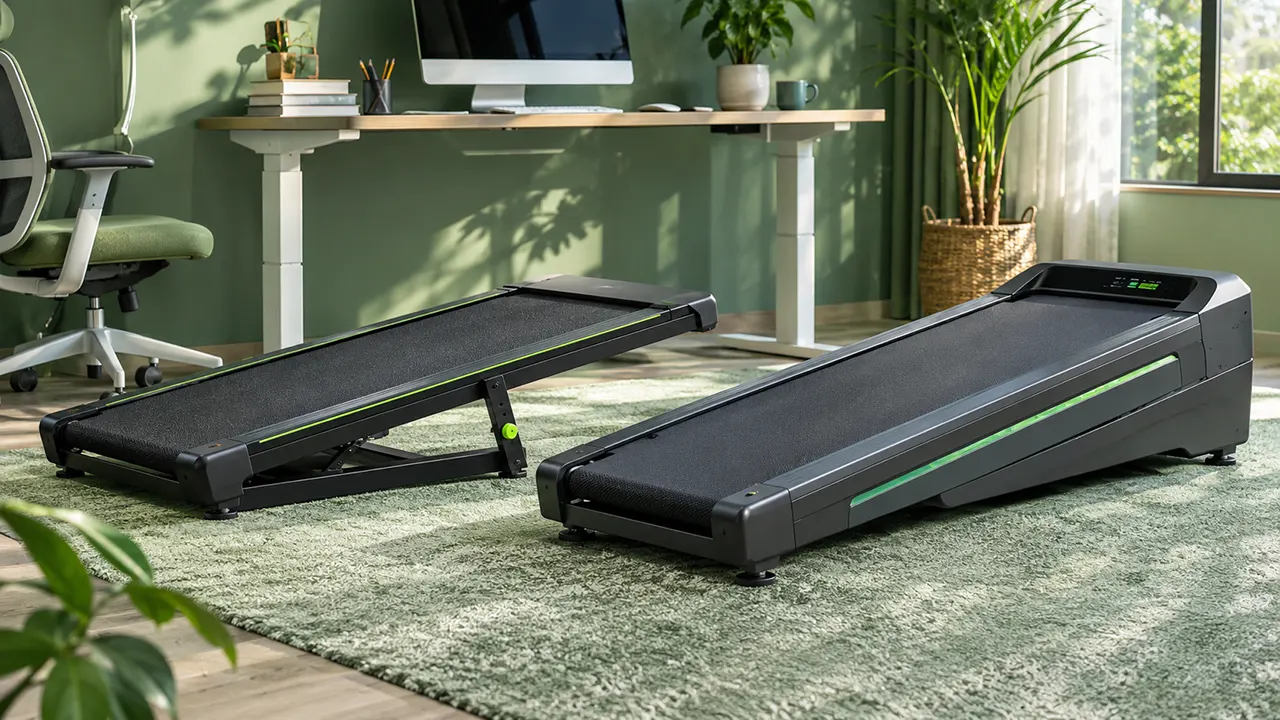
A manual incline walking pad is a good choice if you are comfortable setting the slope before your workout. An automatic incline walking pad lets you change the slope electronically, often without stopping. A fixed-incline model offers a permanent slope without adjustment. Your best choice depends on convenience, budget, workout needs, and available desk clearance.
Choosing an incline walking pad is not just about getting a higher walking angle. The adjustment mechanism affects how you use the machine, how easily you change workout intensity, and how much vertical space the raised deck needs.
For example, a walking pad that fits neatly under your standing desk when flat may become too tall when you activate its incline. This is an important detail that many buyers overlook.
In this guide, we compare manual, automatic, and fixed-incline walking pads, examine five representative products, and explain what to measure before buying.
Affiliate disclosure: This article may contain affiliate links. ToolGuider may earn a commission if you purchase through qualifying links, at no additional cost to you. The product comparisons are based on manufacturer documentation, available product specifications, and published shopping information, not hands-on testing by our team.
Manual vs Automatic Incline Walking Pads: The Main Difference
The main difference is how you change the walking surface’s slope.
A manual incline walking pad requires physical adjustment. You normally change its support position before starting your workout. An automatic incline walking pad uses an electric mechanism to raise or lower the deck through supported controls.
There is also a third option: a fixed-incline walking pad. It has a permanent slope that you cannot adjust between flat and inclined positions.
| Feature | Manual adjustable | Automatic motorized | Fixed incline |
|---|---|---|---|
| Incline adjustment | Physical | Electric motor | No adjustment |
| Change during walking | Normally no | Depends on model | No |
| Flat walking option | Usually available | Usually available | No |
| User convenience | Requires preparation | More convenient | Simple, but permanent |
| Mechanical design | Manual support mechanism | Additional powered mechanism | Fixed frame design |
| Desk compatibility | Depends on setting | Depends on selected level | Depends on permanent slope |
| Best for | Planned incline sessions | Frequent incline changes | Buyers who prefer one fixed slope |
The important distinction is that manual adjustable and fixed incline are not the same thing. A walking pad advertised with a 7% fixed incline does not necessarily allow you to select a lower grade.
How Manual Incline Walking Pads Work
A manual incline walking pad uses physical support components to change the angle of its walking deck. Depending on the design, you may need to reposition support feet, adjustable blocks, or other mechanical components.
You generally need to stop the walking belt and follow the manufacturer’s instructions before changing the incline.
Advantages of Manual Incline
Manual adjustment has several practical benefits.
- Simple operation: You do not need an electronic incline motor to change the deck position.
- Planned workouts: You can choose your preferred slope before walking.
- Potentially lower complexity: The incline adjustment system does not require the same powered lifting function as an automatic system.
- Less dependence on electronic controls: Incline positioning does not rely on a motorized adjustment command.
However, a simpler mechanism does not automatically mean a more reliable treadmill. Frame construction, motor quality, materials, warranty coverage, and maintenance requirements still matter.
Limitations of Manual Incline
The biggest limitation is convenience. If you want to change the slope during a workout, you will normally need to stop, get off the walking pad, and adjust the support mechanism according to its instructions.
This can interrupt your walking routine.
Manual adjustment can also be less suitable for people who want to alternate between different incline levels frequently.
Example: TOPUTURE TP3 Walking Pad
The TOPUTURE TP3 is a representative example of a manually adjustable incline walking pad.
Its manufacturer lists:
| Specification | Published information |
|---|---|
| Incline | 0-9%, manual |
| Adjustment | Two incline settings |
| Motor | 2.5 HP |
| Speed range | 0.6-6.2 mph |
| Walking belt | 40 × 16 inches |
| Weight capacity | 300 lb |
| Product weight | 41.9 lb |
The manufacturer’s documentation describes a physical adjustment system rather than an electric incline motor. It also describes a two-position incline arrangement. Toputure TP3+2
One detail deserves attention: the manufacturer’s product page and available manual descriptions use different angle descriptions for the adjustment positions. Therefore, check the exact model manual and Amazon listing before relying on a particular incline percentage.
Who should consider it? Buyers who want a manually adjustable incline and do not need to change the slope frequently during a walking session.
How Automatic Incline Walking Pads Work
An automatic incline walking pad uses an electric adjustment mechanism to change the deck’s elevation.
The user selects an available incline level through a remote, console, or compatible app. The motorized mechanism then raises or lowers the walking surface.
Depending on the model, you may be able to adjust the incline while walking. However, this is not universal. Check the manufacturer’s operating instructions before assuming that every automatic model supports adjustment during use.
Advantages of Automatic Incline
Automatic incline offers greater convenience for people who frequently change workout intensity.
- Change supported incline levels through electronic controls.
- Alternate between flatter and steeper walking sessions more easily.
- Avoid physically repositioning support components.
- Use preset incline levels where the manufacturer provides them.
The most useful advantage is not simply reaching a steeper slope. It is being able to change the slope without manually repositioning the machine.
Limitations of Automatic Incline
Automatic systems introduce additional mechanical and electronic components.
The incline motor, lifting mechanism, control system, and related components may require maintenance or repair. The design can also affect the product’s weight, cost, and overall height.
An automatic incline model may also have a limited number of adjustment levels. A 12% maximum incline does not necessarily mean the machine offers every percentage between zero and twelve.
Three Automatic Incline Walking Pads Worth Comparing
1. MERACH UltraWalk W60
| Specification | Information |
|---|---|
| Automatic incline | Up to 12% |
| Walking belt | 41.3 × 16.5 inches |
| Speed | 0.6-4.0 mph |
| Motor | 1.25 CHP continuous / 3.5 HP peak |
| Capacity | 330 lb sustained / 400 lb peak |
MERACH revised its published capacity in October 2026. The 400 lb figure represented peak load, while 330 lb is the revised sustained-load rating based on more stringent testing conducted with SGS. Buyers should use the sustained rating when evaluating normal operating suitability.
Your supplied Amazon listing showed $349.99 and a 4.4-star rating from 163 reviews. These are shopping-snapshot figures, not guaranteed current prices.
Best suited to: Buyers who want automatic incline, app connectivity, and a relatively long walking surface.
2. UREVO CyberPad Smart Walking Pad
The UREVO CyberPad offers up to 14% automatic incline, making it an interesting option for buyers who want a greater maximum slope.
The official CyberPad for Home specifications include:
| Specification | Information |
|---|---|
| Automatic incline | 0-14% |
| Incline selection | 9 levels |
| Walking area | 43.3 × 16.5 inches |
| Speed | 0.6-4.0 mph |
| Capacity | 350 lb |
| Overall dimensions | 47.6 × 23.6 × 8.7 inches |
| Product weight | 70.6 lb |
There is an important model distinction. UREVO sells both Home and Office versions. The Office version has a lower 6.3-inch profile, while the Home version is listed at 8.7 inches. Their incline systems also differ in how they achieve the maximum incline. Do not mix their specifications when comparing products. UREVO.US
Your Amazon listing showed a $449.99 coupon price and 4.2 stars from approximately 1,300 reviews.
Best suited to: Buyers who prioritize a higher automatic incline and want a larger walking surface.
3. DeerRun Z10
The DeerRun Z10 is a lower-priced automatic incline alternative.
Its manufacturer lists:
| Specification | Information |
|---|---|
| Automatic incline | Up to 12% |
| Incline control | Remote |
| Speed | 0.6-3.8 mph |
| Capacity | 300 lb |
| Walking belt | 35.43 × 15.9 inches |
| Product weight | 51.59 lb |
Your supplied Amazon listing showed $199.99 and a 4.2-star rating from 103 reviews.
One consideration is its shorter walking belt compared with the MERACH W60 and UREVO CyberPad. Buyers should consider walking space alongside incline functionality.
Best suited to: Buyers who want motorized incline without moving into the higher price range of some premium models.
Manual vs Automatic Incline Walking Pads: Full Comparison
Both mechanisms can make walking workouts more challenging. The better choice depends on how often you adjust the incline and what you expect from the machine.
| Comparison factor | Manual incline | Automatic incline |
|---|---|---|
| Adjustment method | Physical repositioning | Electric adjustment |
| Workout interruption | Usually required | Often unnecessary |
| Adjustment convenience | Lower | Higher |
| Electronic components | Fewer incline-control components | Additional motor and controls |
| Mechanical complexity | Generally simpler | More complex |
| Maintenance | Follow manual and frame instructions | Includes powered incline components |
| Available incline levels | Depends on support design | Depends on motor and controls |
| Flat walking | Usually possible | Usually possible |
| Price | Varies by model | Varies by model |
| Desk compatibility | Check each physical setting | Check maximum raised position |
Does Automatic Incline Always Cost More?
Not necessarily. Product prices depend on the manufacturer, motor, frame, belt size, weight capacity, electronics, and other features.
The prices are close enough in some cases that buyers should compare the actual features rather than assume manual incline is always the cheaper option.
Is Automatic Incline More Reliable?
There is no reliable basis for making that general claim.
An automatic system contains additional powered components, but that alone does not establish how long the machine will last. Similarly, a manually adjustable system can have problems with its supports, locking components, or frame.
Before purchasing, examine the warranty, replacement-part availability, maintenance instructions, and manufacturer support.
How Incline Changes Walking Pad Height and Desk Clearance
Important buying consideration
This is one of the most overlooked details when choosing a walking pad for a home office.
A walking pad may fit beneath your standing desk when the deck is flat. However, raising the deck changes its position relative to the desk.
The higher position can reduce the space available between your walking surface and the underside of your desk.
Why Flat Deck Height Can Be Misleading
Manufacturers often publish overall product dimensions. These measurements are useful, but they do not always tell you the exact deck-to-floor height at every incline level.
For example, a product listed as 6.3 inches high does not necessarily have a walking surface that stays 6.3 inches above the floor when its incline is raised.
You need to distinguish between:
- Overall product height: The machine’s total vertical dimension.
- Deck-to-floor height: The height of the walking surface above the floor.
- Maximum raised deck height: The highest position of the walking surface at its maximum incline.
These measurements answer different questions.
Example: Sunny Health & Fitness Pacer
The Sunny Health & Fitness Pacer provides a useful example of published deck-height information.
Its manufacturer lists:
| Measurement | Height |
|---|---|
| Flat deck height | 4.1 inches |
| Maximum incline deck height | 5.7 inches |
| Height difference | 1.6 inches |
Sunny Health & Fitness
That 1.6-inch difference can matter when a walking pad sits beneath a desk with limited vertical clearance.
The important point is that incline percentage alone does not tell you how much space the machine needs above its deck.
How to Calculate Your Standing Desk Clearance
You can estimate available vertical space using this formula:
Available clearance = Desk underside height – Maximum deck height
Consider this example:
- Desk underside height: 27 inches.
- Maximum deck height: 5.7 inches.
27 – 5.7 = 21.3 inches
CALCULATED VERTICAL CLEARANCE
21.3 inches
Example using a 27-inch desk clearance and 5.7-inch maximum deck height.
This is the space between the desk underside and the walking surface. It does not establish whether the setup provides enough room for your body, arms, keyboard, or comfortable walking posture.
What to Measure Before Buying
Follow this checklist before ordering an incline walking pad for your office.
- Measure the distance from the floor to the underside of your desk.
- Find the walking pad’s deck-to-floor height when flat.
- Ask the manufacturer for its maximum raised deck height.
- Check the clearance at the incline level you plan to use.
- Consider your standing posture and keyboard position.
- Check whether the desk legs, crossbars, or other structures interfere with the machine.
For a manual model, check the height at each supported position. For an automatic model, use the maximum raised position as your starting point.
A useful buying rule: If the manufacturer does not publish maximum raised deck height, ask customer support before purchasing. Do not assume the flat product height is sufficient.
Which Incline Type Is Better for Different Buyers?
There is no universal winner. Your daily routine should determine which mechanism makes sense.
Choose Manual Incline If…
A manually adjustable walking pad may suit you if:
- You normally use one incline setting throughout a workout.
- You do not mind stopping before changing the slope.
- You prefer physical adjustment over electronic controls.
- You have a fixed workout routine.
- You want to compare products with fewer powered incline components.
The TOPUTURE TP3 is a representative product to investigate in this category.
Choose Automatic Incline If…
Automatic incline is worth considering if:
- You frequently alternate between flat and inclined walking.
- You want to change the slope using a remote or compatible controls.
- You prefer more convenient workout adjustments.
- You want multiple preset incline levels.
- You are comfortable with the additional mechanical and electronic components.
The MERACH W60, UREVO CyberPad, and DeerRun Z10 represent different price and feature positions.
Consider Fixed Incline If…
A fixed-incline walking pad may suit you if:
- You prefer one permanent walking angle.
- You do not need a flat walking option.
- You want to avoid adjusting the incline.
- You have checked that its permanent deck height works with your workspace.
The CYBERGOING T10 is an example of this design. Its Amazon listing describes a fixed 7% incline, so do not treat it as an adjustable manual model.
Which Is Better for Under-Desk Walking?
For under-desk use, the most important issue is not simply whether the incline is manual or automatic.
You should prioritize:
- Maximum deck height.
- Walking belt dimensions.
- Walking speed range.
- Desk and keyboard clearance.
- Stability on your floor.
- Whether you can maintain a comfortable standing posture.
A low-profile automatic model may fit a desk better than a taller manual model. The opposite can also be true.
For a home office, I would prioritize a suitable flat walking position and verified maximum deck clearance before paying extra for a higher incline.
What to Check Before Buying an Incline Walking Pad
Do not choose a walking pad based only on its maximum incline percentage. Several other specifications affect how useful it will be in your home or office.
1. Maximum Incline and Adjustment Levels
Check the actual incline range and the number of available settings.
A 12% automatic incline does not necessarily offer 12 different levels. Some models provide a small number of presets, while others offer more adjustment options.
2. Walking Belt Dimensions
The walking surface should provide enough room for your natural stride.
Compare belt length and width rather than relying on the machine’s overall dimensions.
For example, the MERACH W60 has a 41.3 × 16.5-inch walking surface, while the DeerRun Z10 has a shorter 35.43 × 15.9-inch belt.
3. Weight Capacity
Check the manufacturer’s rated user capacity, not an advertised peak-load figure.
The MERACH W60’s revised 330 lb sustained rating is a useful example of why this distinction matters.
4. Remote and App Controls
Check exactly what the remote and app can control.
Some remotes change speed only. Others support speed and incline adjustments.
Do not assume that a walking pad has automatic incline simply because it includes a remote or smartphone app.
5. Warranty and Maintenance
Read the warranty before purchasing. Also check the manufacturer’s maintenance instructions, especially for walking belt lubrication, alignment, and powered incline components.
A good warranty and accessible replacement parts can be more useful than an impressive feature list.
FAQs: Manual vs Automatic Incline Walking Pads
Is automatic incline worth it on a walking pad?
Automatic incline is worth considering if you regularly change the walking surface angle during workouts. It offers convenient electronic adjustment without requiring you to physically reposition the deck. If you normally use one incline setting, manual adjustment may provide sufficient functionality.
Can you change manual incline while walking?
Normally, no. Most manually adjustable walking pads require you to stop the belt and physically reposition the support mechanism. Always follow the manufacturer’s instructions for your specific model.
Does a remote-controlled walking pad always have automatic incline?
No. A remote may control speed, start, stop, and other functions without controlling incline. Check the product specifications to confirm that the incline itself is motorized and remotely adjustable.
Is a fixed-incline walking pad adjustable?
No. A fixed-incline walking pad has a permanent slope built into its frame. You cannot select a flat position or change the grade unless the manufacturer specifically provides an adjustment mechanism.
Does automatic incline increase walking pad height?
Yes, raising the walking deck can increase its vertical height. The exact difference depends on the product’s design and selected incline level. Check the maximum raised deck height rather than relying only on the flat product dimensions.
Which incline type is better for a standing desk?
Neither type is automatically better. A low-profile model with verified deck-height measurements may be more suitable than a taller model. Check the maximum raised position, desk clearance, and your standing posture before buying.
Final Buying Recommendation
Manual and automatic incline walking pads serve different needs. If you prefer to set your walking angle before starting, a manual model such as the TOPUTURE TP3 is worth considering. If you want convenient electronic adjustment, compare the MERACH W60, UREVO CyberPad, and DeerRun Z10.
The CYBERGOING T10 offers another option for buyers who prefer a permanent 7% slope rather than adjustable incline.
For a home office, make one measurement your priority: maximum deck height at your intended incline. A walking pad that fits under your desk when flat may not provide the same clearance when raised.
Explore our best walking pads with incline guide to compare more models, features, and buying options before making your decision.
