


Published on: September 22, 2025 | Updated on: October 21, 2026
While the dream of striking gold in your backyard is exciting, the reality is complex. This article breaks down the legalities, geological possibilities, and practical methods to determine if your property holds any hidden treasure, offering essential breakthroughs for aspiring backyard prospectors.
The glint of gold has captivated humanity for millennia, sparking dreams of instant wealth. For many, this dream begins at home, with the tantalizing question: can I mine gold in my backyard? It’s a thought that crosses the minds of many who live on older properties or in regions with historical mining activity. While the idea of unearthing precious metal right outside your door is thrilling, it’s important to approach this with realistic expectations and solid information. This guide will walk you through everything you need to know, from understanding the geology to navigating the legal maze, so you can make an informed decision about your own backyard prospecting adventure.
Unearthing the Possibilities: Is Your Backyard Gold Country?
So, you’re wondering, can I mine gold in my backyard? The answer hinges on one crucial factor: your location’s geological history. Gold isn’t found everywhere; it typically forms in specific geological environments over millions of years. Understanding the bedrock and geological formations beneath your property is the first step in assessing any potential for gold.
Geological Clues: Where Gold Hides

Gold deposits are often associated with specific rock types and geological events. Ancient riverbeds (placer deposits) can carry gold eroded from its source, while lodes (hard rock deposits) occur within veins of quartz or other minerals deep within the earth. Researching your area’s mining history and geological surveys can reveal if it’s been a known gold-producing region.
Historical Mining Records: A Treasure Trove of Information
Digging into historical records is like panning for clues. Many regions have archives detailing past mining claims, production figures, and geological reports. Websites like the U.S. Geological Survey (USGS) or your local geological survey department are excellent starting points for this research.
Consulting Experts: Geologists and Prospecting Groups
If historical data is scarce or inconclusive, consider consulting a local geologist. They can interpret geological maps and provide insights into your property’s potential. Joining local prospecting or metal detecting clubs is also invaluable; experienced members often share knowledge about regional gold occurrences and prospecting techniques.
Legal Labyrinth: Do You Own the Gold Beneath Your Feet?
Understanding property rights is paramount before you even think about digging. Can I mine gold in my backyard? Legally, it’s not as simple as owning the surface. Mineral rights can be complex and may be separate from surface ownership.
Surface Rights vs. Mineral Rights
In many places, the owner of the land’s surface rights does not automatically own the mineral rights below. These rights may have been severed and sold separately in the past, especially in areas with a history of resource extraction. It’s crucial to determine who holds the mineral rights to your property.
Checking Your Deed and Title Records
Your property deed and title records are the primary documents to consult. They should clearly state whether mineral rights are included with your surface ownership or if they are reserved by a previous owner or entity. If the wording is unclear, a title company or real estate attorney can help clarify.
Government Regulations and Permits
Even if you own the mineral rights, local, state, and federal regulations will likely apply. Mining, even on a small scale, often requires permits, environmental impact assessments, and adherence to specific operational standards. These regulations are designed to protect the environment and prevent unauthorized resource extraction.
Understanding Land Use Restrictions
Zoning laws and land use restrictions can also impact your ability to prospect. Some areas may prohibit any form of mining or excavation, regardless of mineral rights ownership. Always check with your local planning and zoning department for applicable rules.
The Science of Gold: Where and How It Forms
To truly understand can I mine gold in my backyard, we need to look at how gold forms and where it’s typically found. Gold is a dense element, and its formation is a slow, geological process.
Hydrothermal Veins: The Source of Lode Gold
Much of the world’s gold originates from hydrothermal veins. These are fissures in the earth’s crust where hot, mineral-rich water circulates, depositing gold and other minerals as the water cools. These veins can be found in various rock types, often associated with volcanic or tectonic activity.
Placer Deposits: Gold on the Move
When gold-bearing rocks erode, the liberated gold particles can be transported by water. Gravity causes the dense gold to settle in specific locations, forming placer deposits. These are commonly found in stream beds, gravel bars, and ancient river channels.
Identifying Gold Indicators
Certain geological features and minerals can indicate the presence of gold. Look for quartz veins, iron staining (limonite), and specific rock types like granite or metamorphic rocks in areas with a history of gold. The presence of “indicator minerals” can also point towards a nearby lode deposit.
Practical Prospecting: Tools and Techniques for Your Yard
If your research suggests a possibility, you might be asking, can I mine gold in my backyard using practical methods? For small-scale, hobbyist prospecting, the tools are often simple, but effective.
Metal Detectors: The Modern Gold Pan
High-quality gold-specific metal detectors are your best friends. These machines are designed to detect the faint signals of gold nuggets, which can be tricky for general-purpose detectors. Look for features like adjustable discrimination, ground balancing, and specific frequencies optimized for gold.
Hand Tools: Digging and Sampling
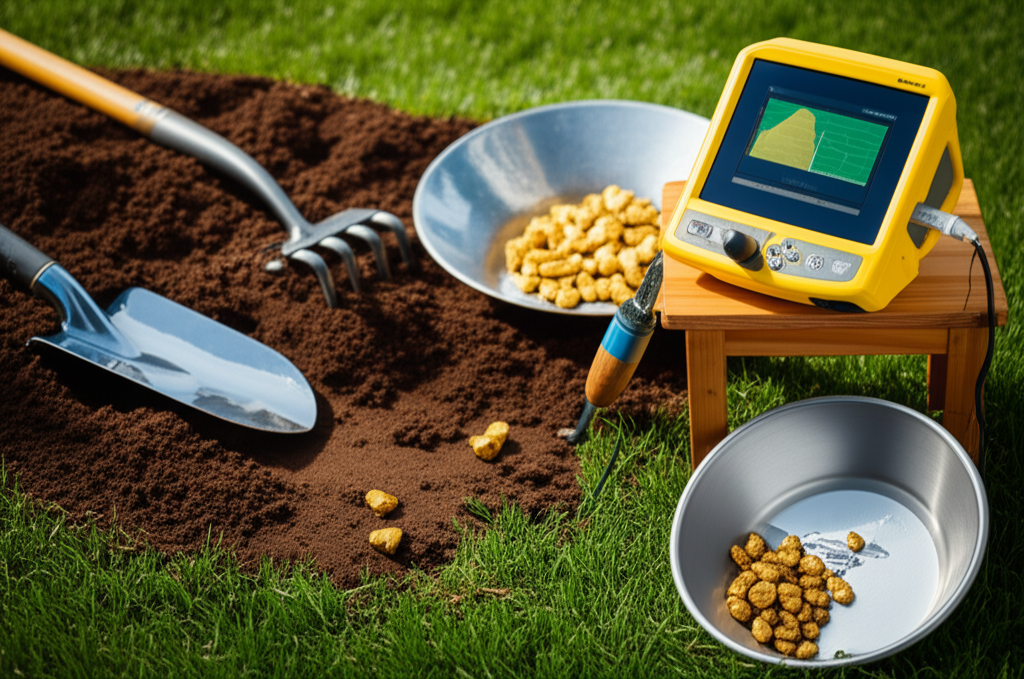
Even with a detector, you’ll need digging tools. A sturdy shovel, a hand trowel, and a pinpointer are essential for pinpointing and extracting targets. For sampling potential placer deposits, a gold pan, classifier, and a sluice box can be employed.
The Art of Panning: Separating Gold from Dirt
Gold panning is a fundamental skill for placer prospecting. By carefully swirling water and sediment in a pan, you can use gravity to separate the lighter materials from the heavier gold. It requires practice but is a rewarding way to find small gold particles.
Sluicing: Increasing Your Panning Power
A sluice box is a more efficient way to process larger amounts of material than hand panning. It’s a channel with riffles that trap heavy materials like gold as water flows through it. This can significantly increase your recovery rate if you find a promising area.
Testing Your Property: A Step-by-Step Approach
Before you invest heavily, a systematic approach is best. Let’s outline how you can test your property to answer, can I mine gold in my backyard?
1. Initial Research: Thoroughly investigate geological maps, historical mining records, and local legends related to your property’s location.
2. Surface Reconnaissance: Walk your property, looking for geological indicators like quartz veins or unusual rock formations. Note any areas where water naturally collects or flows.
3. Metal Detector Sweep: Use a gold-capable metal detector to sweep promising areas. Pay close attention to any signals that might indicate metallic objects.
4. Target Verification: If your detector finds a target, use a pinpointer to precisely locate it. Carefully dig the target and identify it. If it’s not gold, analyze the surrounding soil.
5. Soil and Gravel Sampling: Collect samples of soil, gravel, and sediment from different locations, especially near water sources or depressions.
6. Panning Samples: Pan your collected samples to check for any fine gold particles. Even a few specks can indicate a potential placer deposit.
7. Consultation and Refinement: Based on your findings, consult with experts or experienced prospectors. Refine your search areas and techniques accordingly.
Common Misconceptions and Realistic Expectations
Many people envision striking large gold nuggets instantly. The reality of backyard gold prospecting is often far more subtle. It’s important to manage your expectations when asking, can I mine gold in my backyard?
Small Scale vs. Commercial Mining
Backyard prospecting is typically a hobby, focused on finding small nuggets, flakes, or dust. It’s highly unlikely to yield commercially viable quantities of gold without significant geological potential and investment. Commercial mining involves extensive exploration, heavy machinery, and large-scale operations.
The Patience Game
Gold prospecting, even in your backyard, requires immense patience and persistence. Finding gold is often a matter of luck, combined with diligent searching and the right techniques. Don’t get discouraged by initial lack of success; every outing is a learning experience.
Understanding Gold Purity and Size
The gold found in placer deposits is often eroded and can be in the form of fine dust, flakes, or small nuggets. Lode gold, found within quartz veins, can sometimes be larger but is much harder to access without specialized equipment and knowledge.
Essential Gear for Backyard Prospectors
Equipping yourself correctly is vital. Beyond the metal detector, here’s a breakdown of essential gear to help you answer, can I mine gold in my backyard?
Metal Detector Considerations
Frequency: Higher frequencies (15 kHz and above) are generally better for detecting small gold.
Ground Balance: Crucial for filtering out mineralization in the soil.
Sensitivity: The ability to pick up faint signals.
Coil Size: Smaller coils are better for pinpointing and maneuvering in tight spots.
Digging and Recovery Tools
Sturdy Shovel: For excavating larger areas.
Hand Trowel/Digger: For precise digging around targets.
Pinpointer: Essential for locating targets within excavated soil.
Collection Vials: To store your finds.
Placer Prospecting Tools (If Applicable)
Gold Pan: A standard 14-inch pan is a good start.
Classifier: A sieve to sort gravel sizes.
Sluice Box: For processing larger volumes of material.
Magnifying Glass: To examine small flakes.
Legal Considerations for Specific Regions
The legality of prospecting can vary significantly. Can I mine gold in my backyard? The answer depends heavily on your local jurisdiction and specific property agreements.
Federal and State Mining Laws
In many countries, including the United States, federal and state laws govern mining activities. The General Mining Law of 1872, for instance, still influences mineral rights on federal lands. Understanding these overarching laws is crucial.
Local Ordinances and HOA Rules
Beyond state and federal laws, local ordinances and Homeowners Association (HOA) rules can impose further restrictions. Some communities have strict regulations on digging, excavation, or even the use of metal detectors. Always check with your city or county government.
Claim Staking and Mining Rights
If you discover a potentially significant deposit, you might consider staking a mining claim. This process involves legally defining an area and establishing your right to extract minerals. However, this is a complex legal procedure typically reserved for more serious prospecting efforts.
Case Studies and Real-World Examples
Learning from others’ experiences can provide invaluable insights. While specific backyard gold finds are rare and often not publicized, historical mining in many residential areas offers context.
Historical Gold Rushes in Residential Areas
Many towns and cities were founded due to gold discoveries. While the main commercial operations have long ceased, small pockets of gold can sometimes remain. These areas, even if developed, might still hold overlooked placer deposits in older stream beds or disturbed ground.
Hobbyist Success Stories
Online forums and prospecting communities are filled with stories of hobbyists finding small amounts of gold in unexpected places, sometimes even on their own property. These successes are often the result of extensive research, persistent effort, and the use of specialized equipment. They underscore that while rare, the possibility exists.
Frequently Asked Questions
Can I mine gold in my backyard if I live in a city?
It’s highly unlikely. Most city ordinances strictly prohibit excavation or mining activities due to safety, infrastructure, and zoning regulations. Always check with your local planning and building department first.
Do I need a permit to metal detect in my backyard for gold?
Generally, for personal hobby use on your own private property where you own the mineral rights, a specific mining permit is not required. However, if you plan to excavate or process significant amounts of material, permits might become necessary, and local laws must be followed.
What is the best metal detector for backyard gold prospecting?
Gold-specific detectors from brands like Minelab, Garrett, or Fisher, with high frequencies and excellent ground balancing, are ideal. Models like the Minelab GPX series or Garrett AT Gold are popular choices for serious prospectors.
How do I know if my soil has gold?
The best way is through sampling and testing. Use a gold pan to process soil and gravel from different areas of your property. If you find even fine gold flakes, it indicates potential, though not necessarily a commercially viable amount.
Can I use a regular metal detector for gold?
While some general-purpose detectors can find larger gold nuggets, they are often not sensitive enough for the smaller flakes and dust common in placer deposits. Gold-specific detectors are designed with the right frequencies and discrimination to target gold effectively.
What if my property has a history of mining? Does that guarantee gold?
A history of mining significantly increases the possibility, but it doesn’t guarantee gold. Old mines may have been depleted, or the gold might be in areas not accessible or detectable with hobbyist equipment. Further research and testing are still essential.
Conclusion: Your Backyard Gold Quest
The question, can I mine gold in my backyard? is more complex than a simple yes or no. It’s a journey that begins with thorough research into your property’s geology and legal standing. While the dream of striking it rich in your own yard is enticing, it’s crucial to approach it with realistic expectations, the right knowledge, and appropriate tools. Understanding the legal framework, geological indicators, and prospecting techniques empowers you to make an informed decision. Whether you find a few flakes or just enjoy the thrill of the hunt, backyard gold prospecting can be a rewarding adventure. Remember to always prioritize safety, legality, and environmental responsibility in your quest.
