


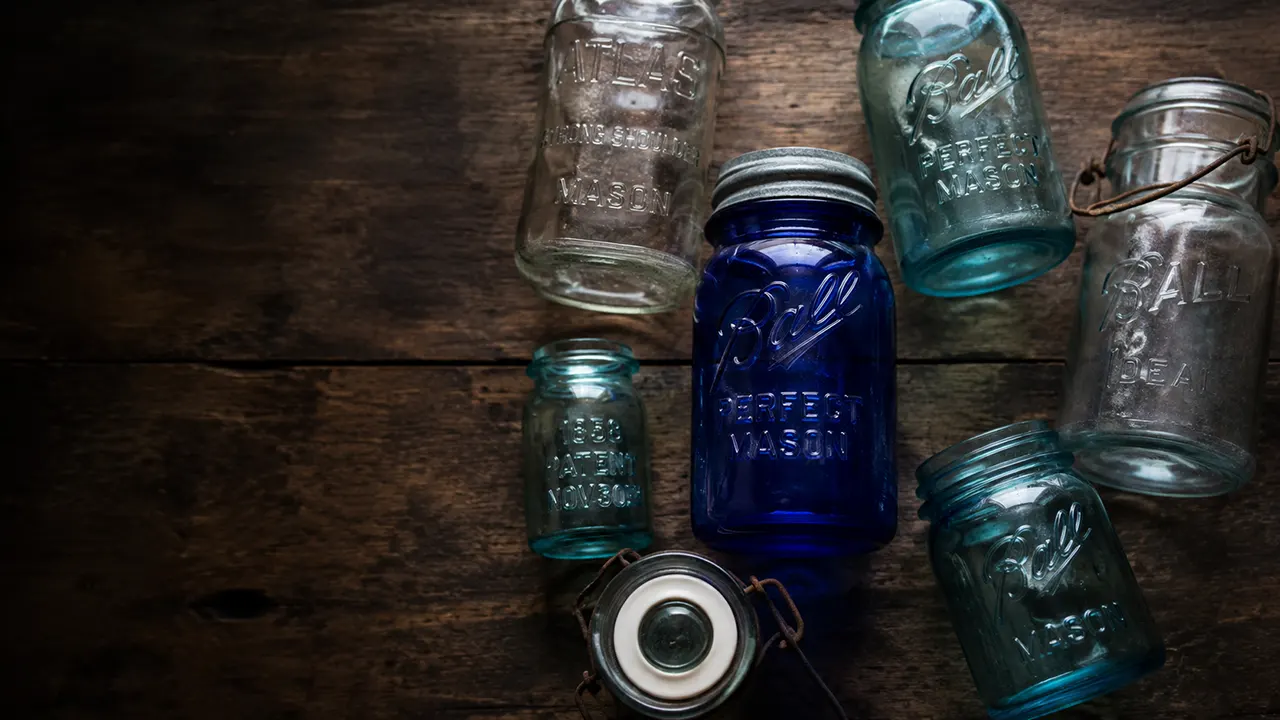
You spot an aqua-blue glint beneath the barn floorboards.
You brush away decades of dirt, revealing an embossed glass surface. Is it a worthless modern reproduction, or a rare antique mason jar worth hundreds? The difference lies in the glass color, the logo’s serif, and the lid style. This guide decodes the exact markers, dates, and values you need to identify your vintage finds.
The 1858 Mason Jar Patent: Where It Started
The antique mason jar traces its origin to John Landis Mason’s 1858 patent for a threaded zinc cap. This threading created an airtight seal, revolutionizing home food preservation. Jars bearing the “Patent Nov 30th 1858” embossing are the foundational artifacts of vintage canning.
The 3 Gallon Mason Jar 1858
The 3 gallon mason jar 1858 represents the pinnacle of early cache storage. While standard quarts and half-gallons were common for pantry canning, a 3-gallon jar served a different purpose: bulk storage or hiding valuables. These massive jars feature heavy hand-blown glass, prominent pontil marks on the base, and thick zinc or glass lids secured by wire bails.
Let’s be honest: Most “1858” jars were actually made decades after the patent expired. The patent date remained on molds well into the 1910s. The true value of a 3-gallon variant lies in its survival rate—few farmers could afford or needed such massive glass, making them exceptionally rare today.
In 15 years of exploring homesteads, a 3-gallon jar is a once-in-a-decade find. Detectorists often locate them using deep-seeking pulse induction machines that hit the massive zinc lid at three feet deep.
How to Date Antique Mason Jars by Logo
You date antique mason jars primarily by analyzing the embossed logo style. The Ball Brothers Glass Manufacturing Company changed their logo five times between 1886 and 1962. Each variation provides an exact production window for your jar.
Ball Mason Jar Value Guide: The Logo Timeline
The Ball Mason jar value guide hinges on the third “L” in the logo. From 1900 to 1933, the third “L” featured a distinctive downward loop or “tail.” This script style is the most reliable indicator of a genuine antique.
✅ 1886-1892: Block letters. “BALL” is printed in straight, sans-serif block text.
✅ 1892-1896: First script logo. The letters are uneven, with the “B” and final “L” slanting backwards.
✅ 1896-1910: Distinctive third “L”. The final “L” drops below the baseline, forming a distinct tail.
✅ 1910-1923: Added underscore. The script logo features a line extending from the final “L” under the rest of the word.
✅ 1923-1933: Two-loop “L”. The final “L” drops down and loops back up, connecting to the underscore.
💡 Key Takeaway: If your Ball jar lacks a script logo, or if the third “L” does not drop below the baseline, the jar was likely manufactured after 1962 and holds standard utilitarian value.
Disregard the Number on the Bottom
The number embossed on the base of an antique mason jar identifies the mold position on the factory assembly line. The number does not indicate the manufacturing year, the jar’s capacity, or its rarity. A “3” on the bottom of a jar does not make it more valuable than a “5.”
The Mason Jar Value Chart: What Drives Prices
Antique mason jars value is determined by four factors: color, embossing, lid type, and manufacturing flaws. Common clear or aqua jars sell for $3 to $15. Rare colors and error jars command prices exceeding $500.
Most Valuable Antique Mason Jars by Color
The most valuable antique mason jars share one trait: unusual glass color. Manganese used in early glass batches turned purple under prolonged UV exposure, while cobalt and amber were produced in very limited runs for specific products.
Cobalt Blue
Extremely rare. Often used for poisons or quack medicines. Value: $200 – $1,000+.
Amethyst / Sun-Purpled
Manganese glass exposed to sunlight. Common but collectible. Value: $15 – $50.
Amber / Olive Green
Produced for mineral water and coffee. Very scarce. Value: $50 – $300.
The #13 Jar: Moonshine Superstition
The #13 mason jar ranks among the most sought-after antique mason jars due to a Prohibition-era superstition. Moonshiners believed the number 13 brought bad luck and destruction, so they routinely smashed any jar embossed with a “13” on the bottom. This deliberate destruction makes #13 jars significantly rarer than #12 or #14 jars.
Warning: Modern reproductions of the #13 jar exist. Authenticate by checking for mold seams that stop at the lip (indicating hand-blown/antique) versus seams running over the lip (machine-made post-1915).
Lid Styles: Zinc, Glass, and Wire Bails
Antique mason jars with lids command higher prices when the original closure system remains intact. The lid style dictates both the jar’s age and its functionality. Zinc caps, glass inserts, and wire bail systems evolved distinctly over 60 years.
Vintage Mason Jars with Glass Lids Value
Vintage mason jars with glass lids value hinges on the presence of the original glass insert and the zinc band. The 1858 patent utilized a zinc lid with a porcelain-lined glass insert to prevent food contamination. Complete sets with unchipped glass inserts sell for 30% more than zinc-only caps.
Let’s be honest: Antique zinc lids often fuse shut. Never force a vintage lid with pliers; you will shatter the glass lip. Soak the sealed jar in warm water for 24 hours to release the vacuum safely.
The Lightning Bail Jar
The Lightning bail jar, patented by Henry William Putnam in 1883, features a wire clamp that snaps down over a glass lid. You identify these by the distinct wire yoke stretching over the top. Antique Lightning jars with intact glass lids and functional wire mechanisms are highly desirable to collectors.
IMAGE: [Macro Photography] Glass Lid Zinc Band – Close up of porcelain-lined glass insert inside zinc threaded cap
Beyond Ball: Valuable Jar Brands
While Ball dominates the market, several other manufacturers produced highly collectible antique mason jars. Atlas, Kerr, and Mason branded jars feature unique embossing and closure systems that rival Ball in rarity and value.
Atlas E-Z Seal Jars
Atlas E-Z Seal jars utilize a round wire bail instead of a threaded metal lid. The Hazel-Atlas Glass Company produced these from the 1900s through the 1950s. You identify authentic Atlas jars by the “HA” symbol overlapping on the glass base. Strong-shouldered Atlas jars in amber or cornflower blue hold significant value.
Kerr Self-Sealing Jars
Kerr self-sealing jars introduced the modern two-piece lid system. Alexander Kerr founded the company in 1903. Early Kerr jars feature embossed economic slogans and heavy glass bases. The vintage Kerr jars with straight sides and flat glass lids predate the modern screw-band style and attract premium prices.
Finding Buried Jars: The Cache Hunter’s Advantage
Antique mason jars frequently surface during metal detecting and bottle digging. During the 19th and early 20th centuries, people buried jars full of coins and valuables near fence posts, barn foundations, and root cellars. A deep-seeking metal detector locates the large zinc lids or the mass of silver coins inside the glass.
Detecting the 3-Gallon Cache
A 3-gallon mason jar buried at 3 feet deep registers as a massive, jumpy iron signal on a standard VLF detector. The thick zinc lid overloads the machine. You must use a pulse induction metal detector to punch through the iron mask and identify the high-conductive silver hoard hidden beneath the lid inside the jar.
💡 Key Takeaway: Never ignore a loud, shallow iron signal in a high-traffic vintage area. The iron could be a mason jar lid shielding hundreds of silver coins beneath the surface.
Antique Mason Jars for Sale: Buying Tips
When reviewing antique mason jars for sale, inspect the glass for tight hairline cracks under UV light. Chips on the rim destroy the jar’s value, whereas minor interior scratches from normal use do not. Always verify authenticity by matching the logo style to established production years before purchasing.
Your Next Step to Uncovering History
Identifying antique mason jars requires sharp eyes and a knowledge of historical production markers. You now hold the logic to decode the 1858 patent, date the Ball logo loops, and spot the rare #13 moonshine jar. Do not let rusted zinc lids fool you into walking away from a potential cache. Grab your detector, study the logo charts, and start unearthing glass history today.
FAQs
How can you tell if old Mason jars are valuable?
Old Mason jars are valuable if they feature rare glass colors like cobalt blue or amber, possess manufacturing errors like off-center embossing, or have intact original lids. Check the logo style; Ball jars with the distinctive third ‘L’ dropping below the baseline indicate pre-1933 production and higher value.
What are the most rare Mason jars?
The most rare Mason jars include the #13 jar (destroyed by superstitious moonshiners), cobalt blue Ball jars, amber Atlas E-Z Seal jars, and jars with distinct manufacturing errors like upside-down embossing. The 3-gallon 1858 jars are also exceptionally rare due to low survival rates.
How can you tell how old a Mason Jar is?
You tell how old a Mason jar is by examining the mold seams and the embossed logo. If the mold seam stops before the jar’s lip, it was hand-blown and likely pre-1915. Match the logo style to known timelines, such as the Ball logo’s third ‘L’ variations, to pinpoint the decade of manufacture.
Why are 13 Mason jars rare?
Number 13 Mason jars are rare because moonshiners during Prohibition considered the number 13 highly unlucky. They routinely smashed any jar embossed with a 13 on the bottom mold number to avoid bad fortune, drastically reducing the surviving population of these specific jars.
What do the numbers on the bottom of old Mason jars mean?
The numbers on the bottom of old Mason jars identify the mold position on the factory assembly line. These numbers helped quality control track defective molds. They do not indicate the manufacturing year, the jar’s capacity, or its rarity.
What year did they stop making blue Mason jars?
Manufacturers stopped making the distinctive deep aqua or blue Mason jars in the late 1930s. They transitioned to clear glass because sand with lower iron content became cheaper, and clear glass allowed consumers to see the food inside without opening the jar.

2 Comments
I found 2 quart and 2 pint blank Ball canning jars (only with a small “Ball” on the bottom.) The “Ball” dates them as 1933-1962 jars. I can’t find any other information on these type of jars. Are vintage blank jars common or of value? Thank you.
Blank Ball jars from that period are not especially rare, especially if they only have the small Ball marking on the base. Their value is usually modest unless they have an unusual mold, color, condition, or other identifying features. The 2-quart jars may attract a little more interest because larger sizes can be harder to find. If you can share clear photos of the jars and their bases, I’d be happy to help narrow down the age and value.