


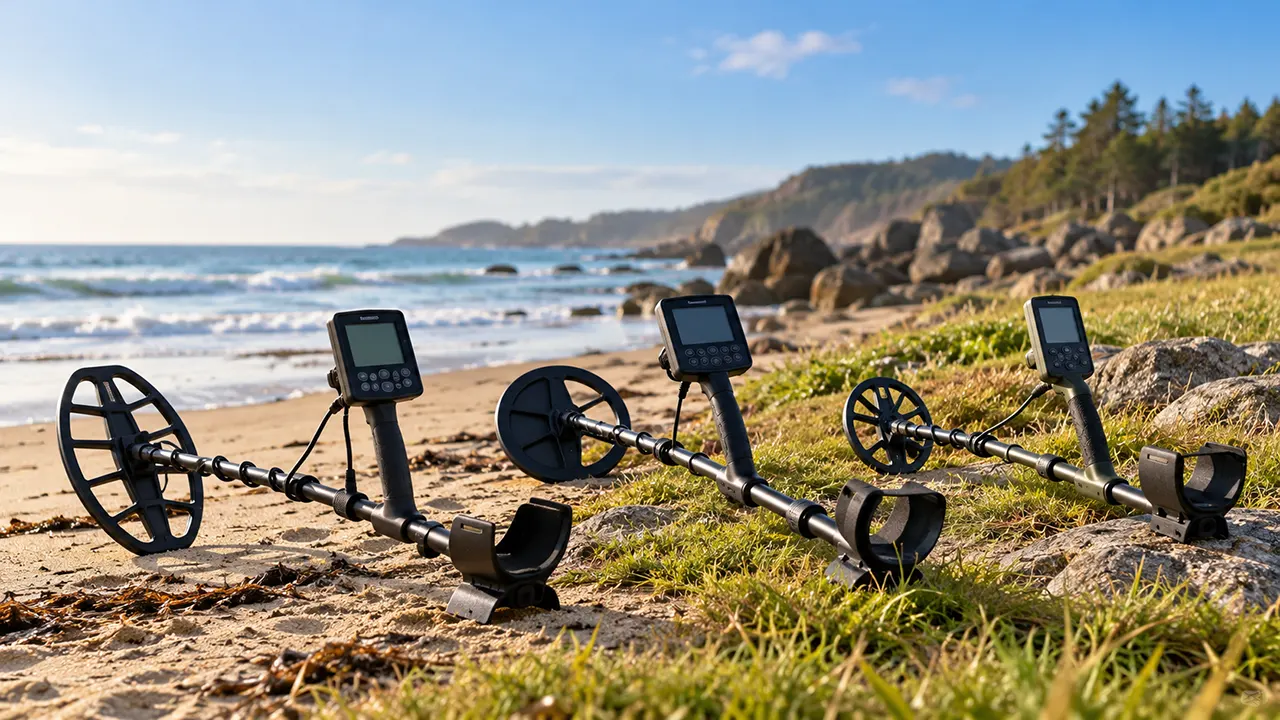
A metal detector uses electromagnetic signals to detect metal objects hidden in the ground, sand, or water. For most beginners, a very low frequency (VLF) detector is a practical starting point. A simultaneous multi-frequency detector offers greater flexibility across different conditions, while pulse induction (PI) can be useful in heavily mineralized ground and specialized gold or beach hunting. The right choice depends on your targets, terrain, budget, and need for discrimination.
Choosing a metal detector becomes easier when you start with where you plan to search. A detector for coins in a local park has different priorities from one used for gold prospecting or saltwater beach hunting. The technology matters, but so do the search coil, controls, water protection, and comfort.
This guide explains the main metal detector types, what their controls actually do, and how to match a detector to your needs. It also covers realistic depth expectations and important US land-access rules.
Affiliate disclosure: This article is intended to help you make an informed equipment decision. It may contain affiliate links when relevant products are added. ToolGuider may earn a commission from qualifying purchases at no additional cost to you.
How Metal Detectors Work
A metal detector sends an electromagnetic signal into the ground through its search coil. When the signal interacts with a conductive metal object, the object produces a response that the detector’s electronics can detect and interpret.
The detector then alerts you through a sound, visual indicator, vibration, or a combination of these features. More advanced models may estimate a target’s conductivity or provide a numerical target ID, but these readings are clues rather than guaranteed identifications.
How a search coil detects metal
The search coil is the part you sweep over the ground. Depending on the detector design, the coil transmits an electromagnetic field, receives the target’s response, or performs both functions.
When the coil passes over a buried object, the detector analyzes the returning signal. The strength and characteristics of that signal depend on several factors, including the object’s size, shape, orientation, metal properties, burial depth, and surrounding soil.
For example, a large metal object may produce a stronger response than a small object at the same depth. However, a larger object does not guarantee a particular detection depth because soil conditions and detector design also matter.
What a detector can tell you about a target
A detector may estimate conductivity, assign a target ID number, or indicate a probable category. These features help you decide whether to investigate a signal.
However, a target ID is not a reliable guarantee that the object is a coin, gold ring, or piece of iron. Different objects can produce similar signals, especially when they are deep, corroded, tilted, or close to other metal objects.
Practical tip: Learn how your detector responds to known targets before relying on target ID numbers in the field. A simple test garden with several safely buried metal objects can help you understand its signals.
VLF vs. PI vs. Simultaneous Multi-Frequency Metal Detectors
The three main technology options for hobby metal detecting are single-frequency VLF, simultaneous multi-frequency, and pulse induction. Each uses a different approach to processing signals, and each has trade-offs.
| Feature | Single-frequency VLF | Simultaneous multi-frequency | Pulse induction (PI) |
|---|---|---|---|
| Operating principle | Uses one operating frequency | Transmits and processes multiple frequencies together | Sends pulses and analyzes the returning signal |
| General-purpose coin hunting | Often a strong choice | Also suitable, depending on model | Usually less convenient when discrimination is important |
| Mineralized ground | Performance depends on the detector and settings | Often offers better versatility | Often handles challenging mineralization well |
| Wet saltwater beaches | Some models struggle with conductive salt | Many models offer effective saltwater operation | Often suitable for difficult salt conditions |
| Target discrimination | Commonly provides useful target ID and discrimination | Commonly provides target ID and discrimination | Usually less effective for conventional target classification |
| Cost | Entry-level and midrange options are available | Often carries a higher purchase price | Varies by specialization and model |
| Main trade-off | Optimized for a particular frequency and conditions | More flexibility, but potentially greater cost and complexity | Can require more digging because target identification is limited |
These are general tendencies, not guarantees. Detector design, coil selection, software, and operating settings can change the results.
Single-frequency VLF detectors
Very low frequency detectors are widely used for general-purpose metal detecting. They transmit a signal at one operating frequency and analyze the response from metal targets.
Many VLF detectors offer discrimination, target ID, adjustable sensitivity, and ground balance. These features make them useful for people searching for coins, jewelry, and other common targets in parks, fields, and similar locations where detecting is permitted.
The operating frequency affects how a detector responds to different targets, but it does not determine performance by itself. Coil design, electronics, ground conditions, and signal processing also matter.
Choose VLF if: You want a practical first detector for general hobby use, particularly when target identification is important and your usual search locations do not present unusually difficult ground conditions.
Pulse induction detectors
Pulse induction detectors send short electrical pulses through a coil and analyze the returning signal as it decays. This approach can make them effective in heavily mineralized ground and environments where conductive salt complicates detection.
PI detectors are used in some gold prospecting and specialist beach applications. Their limitations depend on the model, but conventional PI designs often provide less useful discrimination than comparable general-purpose VLF detectors.
That can mean digging more unwanted targets. It may be an acceptable trade-off when the ground is difficult enough to make another technology less practical.
Choose PI if: Your main activity involves highly mineralized ground or another specialist application where its operating characteristics offer a clear advantage. Do not assume that every PI detector will outperform every VLF detector in depth or sensitivity.
Simultaneous multi-frequency detectors
A simultaneous multi-frequency metal detector transmits and processes multiple frequencies together. This lets the detector use information from more than one frequency rather than relying on a single operating frequency.
Some models are designed to handle changing conditions across parks, fields, and beaches. They can be attractive to people who want one detector for several types of detecting.
However, the term multi-frequency can also describe detectors that let you select between individual frequencies. Selectable-frequency operation is not the same as simultaneous multi-frequency operation.
Choose simultaneous multi-frequency if: You expect to search varied terrain, especially when wet salt sand or changing soil conditions are part of your routine, and the additional cost fits your budget.
A multi-frequency detector is not automatically the best choice for everyone. A capable single-frequency detector may be all you need for occasional coin hunting in mild soil.
Metal Detector Controls Explained
A detector’s controls can affect how easily you interpret signals and how well the machine operates in your chosen environment. Understanding them helps you avoid paying extra for features you will rarely use.
Discrimination and target ID
Discrimination allows the detector to reduce or reject responses associated with selected target characteristics. Target ID provides an estimate of a target’s likely category or conductivity.
These features can help when searching in places with lots of unwanted metal. However, rejecting too many target categories may cause you to miss desirable objects that produce overlapping signals.
For example, a small gold ring and a piece of aluminum may produce similar responses on some detectors. No discrimination setting can reliably separate every desirable target from every unwanted one.
Best practice: Start with moderate discrimination and learn the detector’s responses. Avoid rejecting broad ranges of targets until you understand what you might be missing.
Ground balance
Ground balance helps a detector compensate for the signal produced by naturally occurring minerals in the soil. Without suitable compensation, mineralized ground can cause unstable responses or make useful targets harder to distinguish.
Depending on the model, ground balance may be automatic, manually adjustable, or available in both forms. Some detectors provide tracking that adjusts compensation as conditions change.
Automatic ground balance is convenient for beginners, while manual adjustment can help experienced users fine-tune performance. The best approach depends on the detector and the ground you encounter.
Sensitivity, noise cancellation, and recovery speed
These settings serve different purposes:
- Sensitivity: Adjusts how strongly the detector responds to signals. Increasing it too far can create noise and unstable responses.
- Noise cancellation: Helps reduce interference from electrical sources or other detectors, depending on the model.
- Recovery speed: Controls how quickly the detector can process successive target responses. Faster recovery can help separate nearby objects, although the effects on depth and target response vary by detector.
A useful starting point is a stable setting rather than the highest possible sensitivity. A detector that produces constant false signals can be less useful than one operating at a lower, more stable setting.
Metal Detector Coil Types and Sizes
The search coil influences ground coverage, target separation, handling, and the detector’s response to buried objects. A compatible coil can sometimes improve a particular task more effectively than upgrading the entire detector.
DD vs. concentric coils
DD and concentric coils have different electromagnetic field geometries.
| Coil type | Typical strengths | Considerations |
|---|---|---|
| DD coil | Often useful in mineralized ground and available in many sizes | Performance depends on coil design and detector compatibility |
| Concentric coil | Can provide a focused detection pattern and intuitive pinpointing behavior | May be more affected by some ground conditions, depending on the detector |
Neither coil type is universally superior. Compare the manufacturer’s specifications and guidance for your particular detector.
Small coils vs. large coils
Smaller coils can be easier to maneuver in cluttered areas and may help separate closely spaced targets. They are useful around rocks, roots, and areas with dense metal trash.
Larger coils generally cover more ground per sweep and may respond strongly to larger targets under suitable conditions. However, they can be heavier and harder to maneuver in tight spaces.
A larger coil does not guarantee deeper detection. The result depends on the target, ground, detector, and operating conditions.
Check coil compatibility before buying
Not every coil fits every detector. Even coils from the same manufacturer may use different connectors, electronics, or compatibility requirements.
Before purchasing a replacement or accessory coil, confirm the supported detector models, connector type, operating compatibility, and any restrictions stated by the manufacturer.
Waterproof Ratings and Water Use
A waterproof metal detector is not necessarily suitable for underwater searching at any depth. Some detectors have waterproof search coils but control boxes that must remain dry.
Before using a detector near water, check the manufacturer’s exact specifications for the complete unit, control box, headphones, connectors, and other accessories.
Waterproof coil vs. waterproof detector
A waterproof coil can be submerged while the rest of the detector remains above water, if the manufacturer permits that configuration. A fully submersible detector is designed for use underwater within its stated depth and operating limits.
Do not assume that rain resistance, a sealed coil, or a water-resistant label means the entire detector can be submerged.
IP ratings and maximum submersion depth
An Ingress Protection (IP) rating describes protection against the entry of dust and water under specified test conditions. The rating alone should not replace the manufacturer’s instructions for underwater operation.
Look for an explicit maximum submersion depth when planning to search underwater. Also check whether the manufacturer permits use in saltwater and whether the headphones or accessories have separate restrictions.
Water pressure increases with depth, and an unsuitable detector may suffer damage even if some components are water-resistant.
Freshwater, dry sand, wet sand, and saltwater
Dry sand and many freshwater locations can be relatively straightforward environments for suitable detectors. Wet salt sand can be more challenging because conductive salt contributes to the signal the detector must process.
Simultaneous multi-frequency detectors and PI detectors may be useful in these conditions, but performance depends on the particular model and its saltwater settings.
Always rinse equipment according to the manufacturer’s care instructions after exposure to saltwater. Check connectors, seals, and charging ports before storing or reusing the detector.
How to Match a Metal Detector to Your Terrain
Your search location should guide your technology choice. A detector optimized for one environment may not be the most practical option somewhere else.
Parks, lawns, and coin hunting
For permitted coin and jewelry hunting in parks, lawns, and similar locations, a general-purpose VLF detector is often a sensible starting point.
Prioritize clear target ID, adjustable discrimination, comfortable handling, and a coil that works well around nearby targets. You may not need specialist gold prospecting features if you plan to search only ordinary park soil.
Always check whether the specific park allows metal detecting before starting.
Beaches and conductive saltwater sand
For dry beach sand, many general-purpose detectors can work well. Wet salt sand can be more demanding because the salt contributes a conductive response.
If you regularly search wet beaches, consider a detector specifically designed to handle salt conditions. Simultaneous multi-frequency and PI models are both worth evaluating, depending on your need for discrimination and underwater use.
A beach detector must also have the appropriate water protection for the way you plan to use it.
Gold prospecting and mineralized soil
Gold prospecting can involve highly mineralized soil, small targets, and difficult ground conditions. Detector choice depends on whether you are searching for small natural gold nuggets or larger metal objects in a gold-bearing area.
Some VLF detectors are designed for small gold targets, while PI detectors can be useful in highly mineralized ground. Multi-frequency models may also be appropriate for certain prospecting applications.
Before buying, confirm that the specific model is designed for your target size and terrain. A general-purpose coin detector is not automatically a suitable gold prospecting detector.
Relic hunting and iron-contaminated sites
Relic hunting may involve iron debris, nails, and other unwanted metal close to potentially interesting targets. Target separation and useful discrimination can be particularly important in these environments.
A detector with adjustable recovery speed, target ID, and suitable coil options may help you investigate signals in cluttered ground. However, detector readings cannot establish an object’s age or historical importance.
Research site permissions and cultural-resource restrictions before detecting at historical locations. Do not disturb protected archaeological sites or remove artifacts where prohibited.
How to Choose a Metal Detector for Beginners
A good beginner detector should be easy to understand, comfortable to use, and suitable for the places you can legally search. The most expensive model is not necessarily the best starting point.
Features worth paying for first
Prioritize features that match your planned use:
- Clear audio and an understandable target ID display.
- Ground balance suitable for the soil you expect to search.
- A comfortable shaft, manageable weight, and suitable coil size.
- Waterproof construction that meets your actual needs.
- Simple controls and accessible instructions.
- A suitable warranty and compatible replacement accessories.
For a beginner who mainly searches ordinary parks and fields, a basic VLF detector may be sufficient. Someone who frequently visits wet saltwater beaches may benefit more from a detector designed for those conditions.
Features you may not need yet
Advanced wireless accessories, specialist prospecting functions, multiple search profiles, and expensive replacement coils can be useful, but they are not essential for every beginner.
Start by identifying your primary target and terrain. Then compare the features that directly improve that activity.
A detector with fewer settings can be a better learning tool if it lets you understand target responses without unnecessary complexity.
Budget, weight, warranty, and accessory compatibility
Compare the total cost of ownership, not just the advertised detector price. Depending on your needs, you may also require headphones, a digging tool, a pinpointer, batteries, or additional coils.
Check current prices and warranty terms with the manufacturer or an authorized retailer before buying. Prices and included accessories can change, so avoid relying on an old product listing.
For more help getting started, visit the ToolGuider Metal Detecting category.
What Affects Metal Detector Depth?
There is no single detection depth that applies to every metal detector or target. The result depends on the detector’s design, coil, settings, target characteristics, and surrounding ground.
Target size, shape, orientation, and conductivity
A large metal object may be detected at a greater distance than a small object under otherwise similar conditions. However, conductivity, shape, orientation, and the way the target responds to the detector’s signal can all affect the result.
A thin object positioned at an unfavorable angle may produce a different response from a solid object of similar mass. This is one reason that simple depth claims can be misleading.
Soil conditions, coil design, and interference
Mineralized soil can interfere with target detection. Conductive salt, nearby electrical equipment, and other sources of interference can also affect performance.
Coil size and geometry influence coverage and response, while ground balance and sensitivity settings affect how the detector handles the signal. A larger coil or higher sensitivity setting does not automatically deliver better results in every environment.
Why advertised depth is not a universal guarantee
Manufacturer specifications and demonstrations may describe performance under particular conditions. They should not be interpreted as a guarantee for every buried object or soil type.
When comparing detectors, look for the conditions behind any depth claim. Prefer realistic, clearly explained evidence over unsupported promises of extraordinary depth.
For more detail, see ToolGuider’s realistic metal detector depth guide.
US Public-Land Rules Before You Detect
Metal detecting is not allowed everywhere in the United States. Rules depend on the managing agency, land designation, local restrictions, the type of object being recovered, and whether digging or collecting is permitted.
National parks: The National Park Service prohibits possessing or using metal detectors in areas under its jurisdiction, subject to the regulatory exceptions. Review the NPS archaeology FAQs before visiting.
Bureau of Land Management (BLM) land: Rules vary by location and activity. Check the relevant field office and land-specific restrictions before detecting or removing anything. Start with the BLM recreation website.
National forests: Do not assume that every national forest permits the same activities. Check the local forest and district requirements through the US Forest Service.
State parks, beaches, and local parks: State and local agencies establish their own restrictions. Some places may prohibit detecting, digging, or removing objects, while others may allow certain activities under specified conditions.
Private property: Obtain the owner’s permission before detecting. Also check applicable laws governing protected archaeological resources, historical objects, and the removal of finds.
Before each outing, verify that detecting is allowed, determine whether digging and recovery are permitted, and respect any restrictions on protected or historically significant objects.
Common Metal Detector Buying Mistakes
Avoid these mistakes when comparing detectors:
- Buying based on depth claims alone: Real-world performance depends on several interacting factors.
- Confusing selectable frequency with simultaneous multi-frequency: Confirm the actual operating modes in the manufacturer’s documentation.
- Paying for specialist features you will rarely use: Match the technology to your normal terrain and targets.
- Assuming every waterproof detector can be submerged: Verify the complete unit’s specified water protection and depth limit.
- Using excessive discrimination: You may reject potentially useful targets along with unwanted ones.
- Ignoring weight and comfort: A detector that is uncomfortable to swing can make longer sessions less enjoyable.
- Forgetting land-access rules: Confirm permission before searching, digging, or recovering objects.
Metal Detector Types: FAQs
Is VLF or PI better for most beginners?
For general coin and jewelry hunting, VLF is often the more practical starting point because many models offer useful target ID and discrimination. PI can be valuable in heavily mineralized ground or specialist applications, but conventional PI detectors may provide less target classification. Choose based on your usual terrain rather than assuming one technology is always superior.
Is a multi-frequency detector worth the extra cost?
It can be worth the additional cost if you search several types of terrain or regularly encounter challenging wet salt sand. For someone who mainly detects in mild soil, a suitable single-frequency VLF detector may provide everything needed. Compare the specific model’s features and performance rather than paying more for the multi-frequency label alone.
Can a metal detector find gold in any soil?
No. Detection depends on the target’s size, depth, orientation, soil mineralization, and the detector’s capabilities. Some detectors are designed for small gold nuggets, while others are better suited to general-purpose detecting. Check whether the model is intended for gold prospecting before buying it for that purpose.
Does a waterproof metal detector work in saltwater?
Not necessarily. Waterproofing describes protection against water entry, while saltwater performance depends on the detector’s design and operating modes. A detector may be safe to submerge but still struggle with conductive salt sand. Verify both the manufacturer’s water-use limits and its guidance for saltwater operation.
Can you use a metal detector on public land in the US?
Sometimes, but permission varies by agency and location. The National Park Service generally prohibits metal detectors within its jurisdiction, while BLM land, national forests, and state or local recreation areas have different rules. Always check the relevant managing authority before detecting, digging, or removing objects.
Choose Your Next Metal-Detecting Guide
The best metal detector is the one suited to your actual targets, terrain, and experience level. Start with a general-purpose VLF detector if you want to learn coin and jewelry hunting in ordinary conditions. Consider simultaneous multi-frequency for greater versatility across changing terrain, or PI for specialist environments where its advantages justify its trade-offs.
Before purchasing, verify the specifications and water protection of the exact model you are considering. Then explore the ToolGuider Metal Detecting category for related guides on equipment, techniques, and responsible detecting.