


What Is the Best Generator for a House?
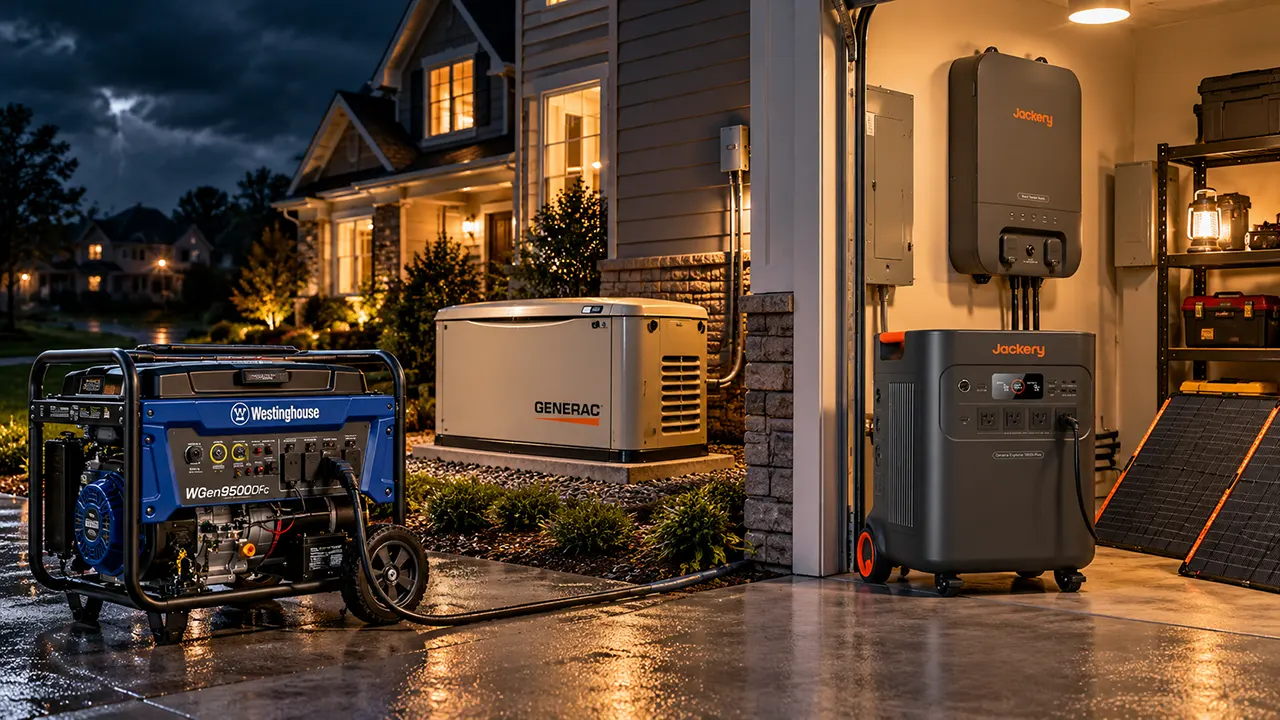
The best generator for a house depends on what you need to power and how you want backup power to work. A portable generator is usually the flexible, lower-cost choice. A standby generator is better for automatic whole-home backup. A battery backup is quieter and produces no combustion exhaust, but its stored energy is limited.
Choosing Backup Power for Your House
A power outage can turn a simple problem into a serious one when the refrigerator stops cooling, a sump pump stops working, the heating or cooling system shuts down, or essential medical equipment loses power. The right home backup system depends less on buying the biggest generator and more on matching the system to your actual electrical loads.
For most homeowners, the decision comes down to three choices: a portable generator, a permanently installed standby generator, or a battery backup system. Each solves the outage problem differently.
This guide compares those options, explains how to size a generator, covers safe connection methods, and highlights several current products worth considering.
Affiliate disclosure: ToolGuider may earn a commission when you purchase through qualifying affiliate links. See our affiliate disclosure for details.
Portable vs Standby vs Battery Backup
There is no single best backup power system for every house. Your best option depends on four questions: how much power you need, how long outages usually last, whether you want automatic backup, and how much installation work you are willing to accept.
| Feature | Portable Generator | Standby Generator | Battery Backup |
|---|---|---|---|
| Installation | Low to moderate | Professional installation usually required | Low to moderate, depending on system |
| Automatic backup | Usually no | Yes | Possible with compatible equipment |
| Fuel/energy | Gasoline, propane or both | Natural gas or propane | Stored electricity |
| Long outages | Strong option if fuel is available | Excellent | Limited by battery capacity and recharge |
| Noise | Moderate to high | Moderate | Very quiet |
| Exhaust | Yes | Yes | None |
| Maintenance | Regular engine maintenance | Regular maintenance | Less mechanical maintenance |
| Whole-home backup | Depends on size and connection | Designed for this use | Depends on inverter and system design |
| Best for | Flexible emergency backup | Automatic whole-home protection | Quiet essential-load backup |
The key difference is the source of stored energy. A fuel generator can continue producing electricity as long as it has an adequate fuel supply and can operate safely. A battery system has a finite stored capacity unless it can be recharged from the grid, solar panels, or another compatible source.
Consumer Reports’ current 2026 generator coverage includes portable, inverter, standby and portable power station categories, reflecting the wider range of home backup choices available today.
What Size Generator Does a House Need?
The generator size a house needs depends on the electrical loads you want to run at the same time. You should consider both running watts and starting watts before buying a generator.
Running watts are the power appliances need while operating normally. Starting watts are the temporary extra power some motor-driven appliances need when they start.
Running Watts vs Starting Watts
A refrigerator, freezer, sump pump, well pump, air conditioner and other motor-driven equipment may require more power when starting than when running.
For example, a generator that has enough continuous output for several appliances may still struggle if multiple motors start at the same time.
That is why simply adding the wattage printed on a few appliances can produce an inaccurate result.
How to Estimate Your Generator Size
Start by making a list of the equipment you want to operate during an outage.
Consider:
- Refrigerator and freezer
- Lights
- Wi-Fi router and networking equipment
- Television and computers
- Furnace
- Sump pump
- Well pump
- Microwave
- Water heater
- Window or portable air conditioner
- Central air conditioner
- Medical equipment
- Garage door opener
Then determine the running wattage and starting requirement for each important load. Appliance nameplates, manufacturer specifications and electrician load calculations are more reliable than generic internet wattage charts.
For a simple emergency setup, you may only need enough capacity for refrigeration, lighting, communications and a few essential appliances. A house with central air conditioning, electric heating, a well pump or several large motors can require substantially more capacity.
The biggest sizing mistake is buying based on the home’s square footage instead of its electrical load.
Portable Generator for House
A portable generator makes sense when you want backup power without permanently installing a generator beside your house. It can also be a good choice when you want to move the generator between different applications.
The trade-off is convenience. A portable generator normally needs to be started manually or remotely, fueled, monitored and positioned safely outdoors.
For larger homes and heavier emergency loads, a high-output dual-fuel portable model can provide considerable flexibility.
Westinghouse WGen9500DFc – High-Output Portable Backup
The Westinghouse WGen9500DFc is designed as a high-output portable home-backup generator.
Westinghouse rates it at up to 9,500 running watts and 12,500 peak watts on gasoline, or 8,500 running watts and 11,200 peak watts on propane. It supports gasoline and propane, includes electric and remote start, and has 120/240V output. Westinghouse also lists CO sensing with automatic shutdown.
This type of generator is particularly interesting if you want substantial portable capacity and the flexibility of two fuel options.
Best fit: homeowners who want high portable output without committing to a permanent standby installation.
Honda EU7000iS – Premium Portable Inverter
The Honda EU7000iS takes a different approach.
Honda rates it at 5,500 watts rated output and 7,000 watts maximum output at 120/240V. It uses electronic fuel injection, has electric start, CO-MINDER carbon monoxide detection, and is rated at 58 dB(A) at rated load and 52 dB(A) at one-quarter load. Honda lists a 5.1-gallon fuel tank and up to 16 hours of operation at one-quarter load.
It is a premium choice when lower noise, inverter technology and refined operation matter more than maximizing raw wattage per dollar.
Best fit: homeowners who want a premium portable inverter generator for substantial backup loads.
Honda EU2200i – Compact Essential-Load Backup
The Honda EU2200i is much smaller.
Honda rates it at 1,800 watts rated output and 2,200 watts maximum output. Honda specifically lists refrigerators or freezers, microwaves, lights, fans, televisions, computers and garage door openers among possible applications, while warning that the listed applications cannot necessarily all operate simultaneously.
This makes it better suited to essential loads than whole-home backup.
Best fit: homeowners who need compact emergency power for selected appliances rather than the entire house.
Standby Generator for a House
A standby generator is the better fit when your priority is automatic backup.
Unlike a portable generator that you normally bring out and start when the power fails, a standby system is permanently installed and connected to the home’s electrical system through appropriate transfer equipment.
When utility power fails, the system can detect the outage and start automatically.
Generac Guardian – Automatic Whole-Home Backup
The Generac Guardian standby generator is designed for permanent residential backup.
Generac’s current Guardian range includes models from smaller residential systems through high-capacity units. Its 26 kW Guardian model, for example, supports natural gas or LP fuel and can be paired with a 200-amp service-rated transfer switch. Generac lists Wi-Fi connectivity and a five-year limited warranty for that model.
A standby generator is especially attractive when you want the system to remain ready without storing and moving a portable generator every time an outage occurs.
Best fit: homeowners who prioritize automatic operation and broad household backup.
Kohler Home Standby – Premium Alternative
The Kohler home standby option is another option to investigate if you want a permanent home backup system.
Standby generators should be evaluated as complete systems rather than as generator boxes alone. Installation, transfer equipment, fuel availability, electrical service, local requirements and maintenance all affect the final cost and performance.
Best fit: homeowners comparing premium permanent standby systems.
Battery Backup for a House
Battery backup systems have changed the home-backup decision.
They produce no combustion exhaust while operating, are much quieter than fuel-burning generators, and can be useful for electronics and essential household circuits. Some systems can also connect to solar panels or home transfer equipment.
The major limitation is energy capacity.
A fuel generator continues making electricity as long as it has fuel and can safely operate. A battery starts with a fixed amount of stored energy.
EcoFlow DELTA Pro 3 – Flexible Battery Backup
The EcoFlow DELTA Pro 3 is a high-capacity portable power station aimed at serious home backup.
EcoFlow lists a 4,096Wh capacity, 4,000W continuous AC output, up to 6,000W with X-Boost, and 120/240V capability. The system can be expanded substantially with additional batteries, and EcoFlow lists connection options including an inlet box, manual transfer switch and Smart Home Panel 2.
This makes it more capable than a small power station intended only for phones and laptops.
Best fit: homeowners who value quiet operation, battery storage and the ability to recharge from solar or other sources.
Jackery Explorer/Plus – Expandable Battery Option
The Jackery Explorer/Plus option represents another battery-based approach.
Battery systems should be compared by both output watts and stored watt-hours. Output determines what equipment the inverter can power at once. Capacity determines how long the battery can provide that power.
That distinction is easy to miss when shopping for a portable power station.
Best fit: homeowners who want rechargeable battery backup and may value solar integration or expandable storage.
How to Choose a Generator for House
Use your priorities rather than starting with a brand name.
If You Only Need the Essentials
If your outage plan is limited to a refrigerator, freezer, lights, Wi-Fi, phones, computers and a few small appliances, a compact portable generator or battery backup may be enough.
The Honda EU2200i is an example of the compact-generator category.
If You Need Several Essential Circuits
A larger portable generator makes more sense when you need several appliances operating together.
The Westinghouse WGen9500DFc and Honda EU7000iS occupy very different positions within this category, so compare their actual output, fuel needs, noise and connection options against your load.
If You Want Automatic Backup
Choose a standby generator when manually setting up backup power during every outage is something you want to avoid.
A properly installed standby system can monitor utility power and automatically switch to generator power when the grid fails.
If Quiet Operation Is a Priority
Battery backup is the obvious category to investigate when noise and combustion are major concerns.
A battery system can also be attractive for electronics and short-duration outages where you do not need the extended fuel runtime of an engine generator.
If You Expect Long Outages
For outages lasting several days, compare the energy supply rather than only the generator’s maximum wattage.
A fuel generator can continue operating after refueling. A battery needs sufficient stored capacity or a reliable recharge source.
Generator Transfer Switch vs Backfeeding
A generator should never be connected to a home’s electrical system by improvised backfeeding.
A transfer switch isolates the generator supply from the utility supply and provides a controlled way to transfer selected circuits or the home’s electrical service to backup power.
Backfeeding can energize utility lines that workers may believe are disconnected. OSHA warns that a generator should not be attached directly to a building’s electrical system unless a qualified electrician has installed a transfer switch.
For a portable generator, your installation may involve a transfer switch, approved interlock equipment, a generator inlet and appropriately rated wiring. The exact configuration depends on the electrical system and applicable local requirements.
Never attempt to energize household wiring by plugging a generator into a standard wall outlet.
If you want a portable generator connected to your home’s electrical panel, have the system designed and installed by a qualified professional.
Generator CO Safety
Carbon monoxide is one of the most important safety issues when using a fuel-burning generator.
CPSC warns that portable generators can produce deadly levels of carbon monoxide. Its 2026 hurricane-season guidance says generators should never be operated inside homes, garages, basements, crawlspaces, sheds or other enclosed areas, even when doors or windows are open. CPSC recommends operating them outdoors at least 20 feet from homes and buildings, with exhaust directed away from windows, doors and vents.
That distance is not a substitute for following the specific generator manufacturer’s instructions and local requirements.
Before operating a portable generator:
- Keep it outdoors in an open area.
- Keep it at least 20 feet from the house unless the manufacturer and applicable requirements specify otherwise.
- Point exhaust away from doors, windows and vents.
- Keep carbon monoxide alarms working inside the home.
- Never operate the generator in a garage or basement.
- Keep the generator dry and follow the manufacturer’s wet-weather instructions.
- Do not overload the generator.
- Refuel only according to the owner’s manual and safe fueling procedures.
- Look for models with a verified CO shutoff feature.
CPSC specifically recommends considering portable generators equipped with carbon monoxide shutoff features.
For more detail, see ToolGuider’s guide to UL 2201 generator CO shutoff.
Do You Need Whole-Home Surge Protection?
Whole-home surge protection can be worth considering as part of a broader electrical protection strategy, especially in areas where storms and utility disturbances are common.
But surge protection and backup power solve different problems.
A generator or battery system provides electricity when the utility supply is unavailable. Surge protection helps protect connected electrical equipment from voltage transients.
If you are planning a permanent generator installation, discuss the complete electrical setup with a qualified electrician rather than treating the generator as an isolated appliance.
See our guide to whole-home surge protection for the separate protection question.
Which Generator Is Best for Your House?
The best choice becomes much clearer when you start with the outcome you want.
| Your priority | Best category to consider |
|---|---|
| Lowest-cost flexible backup | Portable generator |
| High portable power | Large portable generator |
| Quiet essential-load backup | Battery backup |
| Automatic whole-home backup | Standby generator |
| Dual-fuel flexibility | Dual-fuel portable generator |
| Premium quiet portable operation | Inverter generator |
| Multi-day outage with available fuel | Fuel generator |
| Rechargeable, solar-compatible backup | Battery system |
For a large portable setup, the Westinghouse WGen9500DFc is a strong category match because of its high output and dual-fuel capability.
For a premium portable inverter, the Honda EU7000iS combines 120/240V output, inverter technology, electronic fuel injection and CO-MINDER.
For small essential loads, the Honda EU2200i is much easier to move and is designed around a lower-power class of applications.
For automatic whole-home backup, a properly installed Generac Guardian or Kohler standby system is the category to investigate.
For quiet battery-based backup, the EcoFlow DELTA Pro 3 offers 4,000W rated output and expandable battery capacity.
The right answer is therefore not simply the generator with the highest wattage. It is the system that matches your home’s loads, outage pattern, installation constraints, fuel or charging options, and safety requirements.
Frequently Asked Questions
What size generator do I need for a house?
There is no universal size because homes have different electrical loads. Start by identifying the appliances and circuits you want to operate simultaneously, then calculate their running and starting requirements. Central air conditioning, electric heating, well pumps and other motor-driven equipment can substantially increase the required capacity.
Can a portable generator power an entire house?
A sufficiently powerful portable generator can supply many household loads when connected through properly installed transfer equipment, but that does not mean every portable generator can power an entire house. The generator’s output, electrical service, selected circuits and starting loads all matter.
Can a generator run central air conditioning?
Some larger generators can run central air conditioning, but the answer depends on the air conditioner’s running and starting requirements and the generator’s available output. Check the equipment specifications and account for other loads that may operate at the same time.
Is a standby generator better than a portable generator?
A standby generator is better when automatic, permanent backup is the priority. A portable generator can be better when you want lower installation commitment, portability or more flexibility. The best option depends on how you value convenience, cost, capacity and installation.
Can a battery backup replace a generator?
A battery backup can replace a fuel generator for some homes and outage scenarios, particularly when quiet operation and short-duration backup are important. It is less straightforward for long outages with heavy loads unless the system has sufficient storage and a dependable recharge source.
Do I need a transfer switch for a portable generator?
If you want to connect a portable generator to your home’s electrical system, appropriate transfer equipment or another code-compliant method is required. OSHA warns against directly connecting a generator to a building electrical system without a properly installed transfer switch.
Can you plug a generator into a wall outlet?
No. Plugging a generator into a household wall outlet to energize home wiring can create dangerous backfeeding conditions. Use an approved connection method designed for the generator and electrical system, installed by a qualified professional when required.
How far should a portable generator be from a house?
CPSC’s 2026 guidance says portable generators should be operated outdoors at least 20 feet from homes and buildings, with exhaust directed away from windows, doors and vents. Always also follow the generator manufacturer’s instructions and applicable local requirements.
Is a dual-fuel generator worth it?
A dual-fuel generator can be useful when you want the option to operate on gasoline or propane. The value depends on your fuel availability, storage plans, expected outages and whether the generator’s output changes between fuel types.
The Bottom Line
The best generator for house is the one that fits the home’s actual electrical needs and the way you expect to handle outages.
Choose a portable generator when flexibility and lower installation complexity matter most. Choose a standby generator when you want automatic, permanent backup. Choose a battery backup when quiet operation, rechargeable energy and zero combustion exhaust during operation are priorities.
Before buying, calculate your essential loads, account for starting watts, decide whether you need whole-home or essential-circuit backup, and plan the electrical connection before choosing the generator.
Then compare the products that fit your category rather than buying the largest system simply because it produces more watts.
For a high-output portable option, check the Westinghouse WGen9500DFc. For premium portable inverter backup, compare the Honda EU7000iS. For smaller essential loads, consider the Honda EU2200i. For automatic whole-home backup, investigate the Generac Guardian or Kohler home standby system. For quiet battery backup, compare the EcoFlow DELTA Pro 3 and Jackery Explorer/Plus option.
