


What Does a UL 2201 Generator CO Shutoff Mean?
A UL 2201 generator CO shutoff is a safety system designed to reduce the risk of carbon monoxide poisoning by combining controlled CO emissions with automatic generator shutdown when specified CO conditions are detected. UL 2201 is not permission to operate a portable generator indoors. Safe placement outdoors remains essential.
If you are comparing portable generators, the important question is not simply whether a product says “CO shutoff.” You also need to understand which standard it references, what the standard covers, and whether the specific generator model actually complies with it.
That distinction matters because UL 2201 and ANSI/PGMA G300-2023 overlap in generator CO safety but are not identical standards.
What Is UL 2201?
UL 2201 is a safety standard for portable engine-generator assemblies. Its approach to carbon monoxide safety has two important parts: controlling the generator’s CO emission rate and providing a CO shutoff system.
This makes UL 2201 different from a simple requirement that a generator contain a CO sensor. The standard addresses the generator’s CO performance and the protective response when dangerous CO concentrations are detected.
What UL 2201 Actually Tests
UL 2201 uses a two-part approach to CO risk reduction.
First, the generator’s CO emissions are limited.
The standard specifies a maximum weighted CO emission rate of 150 grams per hour under its applicable testing methods.
Second, the generator must provide CO shutoff protection.
The shutoff system is evaluated against specified CO concentrations around the generator. The UL 2201 thresholds referenced in federal regulatory analysis are:
- 400 ppm instantaneous CO concentration
- 150 ppm 10-minute rolling average
The important point is that these requirements address different parts of the risk.
Lower emissions reduce the amount of CO produced by the generator. Automatic shutdown provides another protective layer if CO accumulates around the machine.
What Does the 150 g/h UL 2201 Limit Mean?
The 150 g/h figure is an emission-rate requirement, not a statement that the air around every UL 2201 generator will always contain less than a particular CO concentration.
It is a laboratory-based performance requirement for the generator’s CO emissions under the specified test methods.
That distinction is easy to miss. CO emission rate and ambient CO concentration are not the same measurement.
A generator can produce relatively low CO emissions and still create a dangerous concentration if it is operated in an enclosed or poorly ventilated space.
What Is ANSI/PGMA G300-2023?
ANSI/PGMA G300-2023 is the Portable Generator Manufacturers Association standard titled Safety and Performance of Portable Generators.
It covers a broader range of portable-generator safety and performance requirements than a simple CO shutoff specification.
Its CO shutoff provisions also specify automatic engine shutdown when measured CO reaches defined limits.
For G300-2023, the relevant CO shutoff acceptance criteria include:
- 600 ppm instantaneous CO concentration
- 400 ppm 10-minute rolling average
The standard also contains requirements concerning the CO shutoff control system, sensing element, testing, system behavior and fault conditions.
What Changed With G300-2023?
One important reason to identify the edition of the standard is that older generator information may refer to earlier versions of PGMA G300.
G300-2023 should therefore not be treated as interchangeable with every older reference to “PGMA G300.”
For a buyer, the practical lesson is simple: look for the exact standard edition in the manufacturer’s documentation rather than relying on a generic marketing statement such as “G300 compliant.”
UL 2201 vs PGMA G300-2023: What Is the Difference?
The two standards address overlapping portable-generator CO risks, but they approach the problem from different scopes and requirements.
| Feature | UL 2201 | ANSI/PGMA G300-2023 |
|---|---|---|
| Main focus | Portable generator safety with specific CO emission and shutoff requirements | Broader portable-generator safety and performance |
| CO shutoff | Yes | Yes |
| Instantaneous CO criterion | 400 ppm | 600 ppm |
| 10-minute rolling-average criterion | 150 ppm | 400 ppm |
| UL 2201 weighted CO emission-rate requirement | 150 g/h | No equivalent UL 2201 150 g/h requirement |
| CO sensing/control requirements | Addressed through the UL 2201 safety approach | Detailed CO shutoff system requirements |
| Self-monitoring and system behavior | Addressed within the applicable UL framework | More explicit G300 system requirements |
| Best way to evaluate a product | Check the specific UL 2201 claim and certification documentation | Check the specific G300-2023 compliance claim and documentation |
The most important takeaway is not that one standard is automatically “better.” They are standards with overlapping safety goals and different requirements.
A generator buyer should look at the exact standard, edition, certification or listing information, and manufacturer documentation for the model being considered.
What Does a Generator CO Shutoff Actually Do?
A generator CO shutoff system monitors carbon monoxide conditions around the generator and can automatically stop the engine when specified conditions are reached.
The basic concept is:
CO sensing -> dangerous condition detected -> shutdown signal -> generator stops
The system is intended to add protection when a generator is being operated in conditions where CO can accumulate.
CO Sensing
A sensor or sensing element monitors carbon monoxide conditions according to the design and requirements applicable to the generator’s safety system.
The sensor is not simply a replacement for proper generator placement.
Its job is to detect a dangerous CO condition and trigger the protective response specified by the system.
Automatic Engine Shutdown
When the applicable shutoff condition is reached, the control system sends a signal that stops the generator engine.
The exact implementation can depend on the generator design. For example, G300-2023 defines the engine as shut off when the ignition device is turned off for spark-ignited engines or the fuel supply is shut off for compression-ignition engines.
Shutoff Notification
Some systems also provide an indication that a CO-related shutdown has occurred.
That information can be useful because a generator that suddenly stops should not simply be restarted without understanding why it shut down.
If CO caused the shutdown, the surrounding conditions need to be treated as a safety problem first.
System Faults Matter Too
A good CO protection system is more than a sensor and a shutdown command.
Modern generator standards also consider issues such as sensing-system reliability, testing conditions, system faults and the behavior of the generator after a shutdown event.
That is one reason a named standard can provide more useful information than a product page that only says “CO sensor included.”
Reduced CO Emissions vs CO Shutoff: They Are Not the Same
This is one of the most important distinctions when comparing generators.
Reduced CO emissions means the generator is designed and tested to produce less carbon monoxide.
CO shutoff means the generator has a system designed to stop the engine when specified CO conditions are detected.
These are complementary safety measures, not synonyms.
Think of them as two different points in the risk chain:
Produce less CO -> reduce the potential CO burden
Detect dangerous CO -> stop the generator
UL’s portable-generator safety approach specifically describes reduced emissions as one safeguard and shutoff technology as another.
This is why a buyer should not assume that a generator advertised as “low CO” automatically has the same protection as a generator with an independently documented automatic CO shutoff system.
Likewise, the presence of a CO shutoff does not tell you by itself how much CO the generator produces during normal operation.
Does a CO Shutoff Make a Generator Safe Indoors?
No. A CO shutoff does not make a portable fuel-burning generator safe to operate indoors, in a garage, or in another enclosed space.
This is the safety point that should override every marketing claim about CO technology.
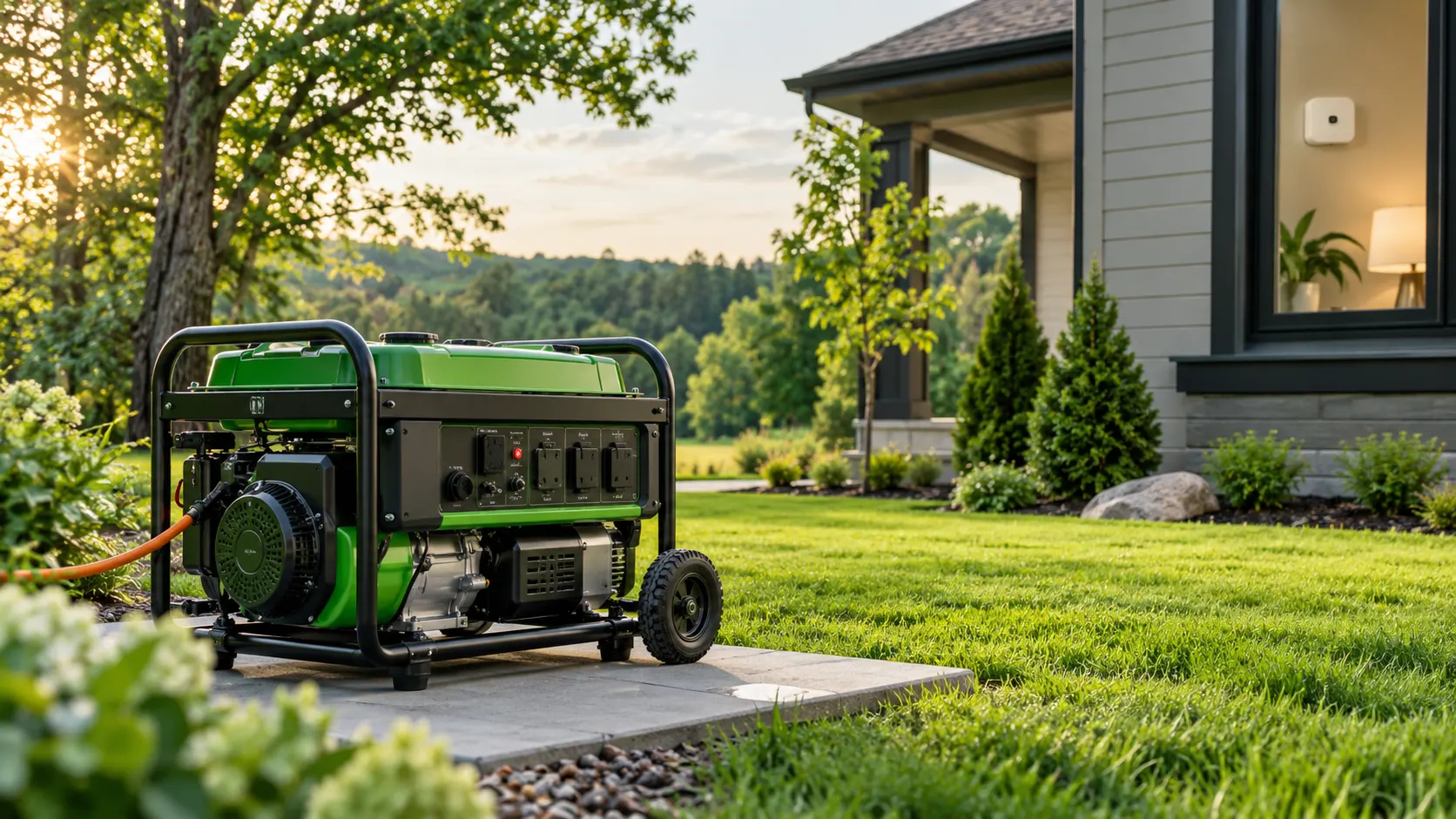
The U.S. Consumer Product Safety Commission says portable generators should be operated outdoors only, at least 20 feet from the home or building, with exhaust directed away from windows, doors and vents.
CPSC also specifically warns against operating portable generators inside homes, garages, basements, crawlspaces, sheds or other enclosed areas, even when doors or windows are open.
Why a Garage Is Still Unsafe
A garage can allow carbon monoxide to accumulate rapidly.
Opening the garage door does not transform the space into an outdoor operating environment. Air movement can vary, exhaust can enter the home, and CO can accumulate in areas that are not immediately obvious.
A generator’s automatic shutdown system is an additional protective measure. It is not a ventilation system.
Why Opening a Door or Window Is Not Enough
Carbon monoxide is colorless and odorless. You cannot reliably judge a safe CO concentration by looking, smelling or feeling the air.
CPSC specifically warns that opening doors and windows does not provide enough ventilation to prevent lethal CO buildup when a portable generator is operated indoors.
Why 20 Feet Matters
The 20-foot recommendation creates physical separation between the generator’s exhaust and occupied spaces.
Placement also matters. The exhaust should be directed away from windows, doors and vents.
A generator with excellent CO technology can still be positioned incorrectly.
The best CO shutoff system cannot compensate for fundamentally unsafe placement.
Generator CO Shutoff vs Home CO Alarm
A generator CO shutoff and a household carbon monoxide alarm serve different purposes.
| Feature | Generator CO Shutoff | Home CO Alarm |
|---|---|---|
| Primary location | On or integrated with the generator | Inside the home |
| Primary purpose | Protect against dangerous CO conditions around the generator | Warn occupants about CO inside the home |
| Automatically stops generator | Yes, when applicable shutoff conditions are reached | No |
| Warns people inside the home | Not necessarily | Yes |
| Replaces the other device | No | No |
A generator CO shutoff should therefore be viewed as one layer of protection.
CPSC also recommends having working CO alarms in the home.
The two systems address different parts of the problem.
Do All Portable Generators Have CO Shutoff?
No. CO safety features vary by generator model, manufacturer and market.
Even when a manufacturer offers CO protection across a product line, do not assume that every model has the same system or complies with the same standard.
This is especially important when shopping through large marketplaces where product descriptions, model numbers and older listings can sometimes be confusing.
Check the exact model number.
Then verify the manufacturer’s specifications and owner’s manual.
If a listing says only “CO Sensor,” “CO Alert” or “CO Detection,” that does not tell you enough to determine which standard or automatic shutdown requirements apply.
How to Verify a Generator’s CO Safety Claim Before Buying
A generator’s CO safety claim is worth investigating before you click the Buy button.
Use this checklist.
1. Find the Exact Model Number
Do not evaluate a product only by its brand or product family.
The safety configuration can vary between models.
2. Identify the Named Standard
Look for specific references such as:
- UL 2201
- ANSI/PGMA G300-2023
- Another clearly identified safety standard
A vague phrase such as “advanced CO protection” is less useful than a named, documented standard.
3. Check the Standard Edition
For PGMA G300 in particular, look for the edition.
A product page that simply says “G300” leaves an important question unanswered.
4. Read the Manufacturer’s Documentation
Check the owner’s manual and technical specifications.
Look for information about:
- CO shutoff
- CO sensing
- shutdown behavior
- warning indicators
- restart requirements
- placement
- maintenance
5. Check Certification or Listing Information
Where applicable, look for verifiable certification or listing information associated with the specific product.
Do not assume that a standard name printed in a retailer description automatically proves compliance.
6. Verify the Actual SKU
If you are buying through Amazon or another retailer, compare the marketplace model number with the manufacturer’s official model number.
This simple step can prevent you from comparing the wrong product.
7. Check the Safety Instructions
Even a generator with documented CO shutoff protection should have clear outdoor-use instructions.
If a product’s marketing appears to imply that its CO technology makes indoor operation acceptable, treat that claim as a major warning sign.
Recommended: Whole Home Surge Protection After a Generator Install: Panel vs Point-of-Use
What Should You Look for When Buying a Portable Generator?
CO protection should be one part of a broader generator evaluation.
CO Safety Technology
Look for documented CO shutoff technology rather than a vague sensor claim.
Applicable Standards
Check whether the manufacturer identifies UL 2201, PGMA G300-2023 or another applicable standard.
Documentation
A good manufacturer should provide clear specifications, an owner’s manual and safety instructions for the exact model.
Automatic Shutdown
If CO safety is a priority, verify that the system actually shuts the generator down rather than merely displaying a warning.
CO Notification
A clear indication of a CO-related shutdown can make it easier to understand what happened and prevent an unsafe immediate restart.
Electrical Safety
CO protection does not address every generator hazard.
Also consider electrical protection, grounding requirements, transfer-switch requirements where applicable, overload protection and safe connection practices.
Placement Requirements
The generator must still be operated according to manufacturer instructions and CPSC safety guidance.
CO technology should never be treated as a substitute for correct placement.
What to Do If a Generator Shuts Down Because of CO
Treat a CO-related shutdown as a warning, not an inconvenience.
- Do not immediately restart the generator in the same conditions.
- Move people away from the generator and into fresh air if CO exposure is suspected.
- Do not enter an enclosed area to investigate a running generator.
- Check the generator’s placement and exhaust direction from a safe location.
- Follow the manufacturer’s instructions for a CO shutdown.
- If anyone has symptoms that could indicate CO poisoning, seek emergency medical assistance immediately.
- Do not bypass, disable or tamper with the CO safety system.
A shutdown tells you that the protective system detected a condition that needs attention.
It should not be treated as a nuisance feature that needs to be defeated.
The 2026 Status of Portable Generator CO Standards
Portable-generator CO safety remains an active area of consumer-safety policy.
The important distinction is that UL 2201 and PGMA G300 are industry standards, while federal regulation is a separate question.
CPSC has continued its portable-generator safety work, and current CPSC consumer guidance continues to emphasize outdoor operation, 20-foot separation and CO safety technology.
For buyers, that means the best practice is to verify the current documentation for the exact generator model rather than relying on an old article, retailer description or outdated product listing.
Standards can be revised, manufacturers can update product lines, and regulatory requirements can change.
Frequently Asked Questions About UL 2201 Generator CO Shutoff
1. What is UL 2201 on a generator?
UL 2201 is a safety standard for portable engine-generator assemblies that includes requirements addressing carbon monoxide emissions and CO shutoff protection. It is more meaningful than simply saying that a generator has a CO sensor because the standard addresses defined performance and protective requirements.
2. Does UL 2201 mean a generator has automatic CO shutoff?
UL 2201 includes CO shutoff requirements as part of its CO safety approach. However, buyers should still verify the exact model’s documentation and certification or listing information rather than assuming every generator described with a similar marketing phrase has the same compliance status.
3. What is the difference between UL 2201 and PGMA G300?
UL 2201 includes specific CO emission-rate and CO shutoff requirements for portable generators. PGMA G300-2023 is a broader portable-generator safety and performance standard that also includes CO shutoff requirements. The standards use different CO shutoff acceptance criteria, so they should not be treated as identical.
4. What CO level causes a UL 2201 generator to shut off?
UL 2201’s shutoff criteria referenced in federal regulatory analysis include a 400 ppm instantaneous concentration or a 150 ppm 10-minute rolling average. These are test and compliance criteria, not recommended indoor operating limits.
5. What is the PGMA G300-2023 CO shutoff threshold?
PGMA G300-2023 specifies a CO shutoff acceptance criterion of 600 ppm instantaneous CO concentration or a 400 ppm 10-minute rolling average under its specified test procedures.
6. Does UL 2201 mean a generator produces less CO?
UL 2201 includes a CO emission-rate requirement, so reduced CO emissions are part of its safety approach. However, emission rate and ambient CO concentration are different measurements. A generator should still be operated outdoors and positioned according to safety instructions.
7. Can I run a UL 2201 generator in my garage?
No. UL 2201 CO protection does not make indoor or garage operation safe. CPSC says portable generators should be operated outdoors only, at least 20 feet from the home or building, with exhaust directed away from openings.
8. Is a generator CO shutoff the same as a home CO alarm?
No. A generator CO shutoff is designed to stop the generator when specified CO conditions are detected around the generator. A home CO alarm warns occupants when dangerous CO is detected inside the living environment. They provide different layers of protection.
9. How can I verify that a generator really complies with UL 2201?
Start with the exact model number. Then check the manufacturer’s official specifications, owner’s manual and applicable certification or listing information. Do not rely only on a retailer’s generic description or a phrase such as “CO protected.”
10. What should I do if my generator shuts down because of CO?
Do not simply restart it under the same conditions. Treat the shutdown as a safety warning, move people away from potential CO exposure, verify safe outdoor placement and follow the manufacturer’s instructions. If anyone may have been exposed to CO or has symptoms, seek emergency assistance.
The Buying Decision: What the Standard Can Tell You – and What It Cannot
A generator safety standard can tell you a great deal about how a product was designed and tested.
It cannot tell you that the generator is safe to operate anywhere.
When comparing portable generators, give more weight to a specific, documented standard and model-level information than to a generic CO marketing label.
The strongest combination is straightforward:
documented CO safety technology + identifiable standard + clear manufacturer documentation + correct outdoor placement.
If you are shopping for a portable generator, use the standard as a verification tool rather than as a substitute for safe operating practices.
Most importantly, never interpret a CO shutoff as a green light for indoor use. The safest generator is still one that is operated outdoors, away from the home, with its exhaust directed away from people and building openings.
