


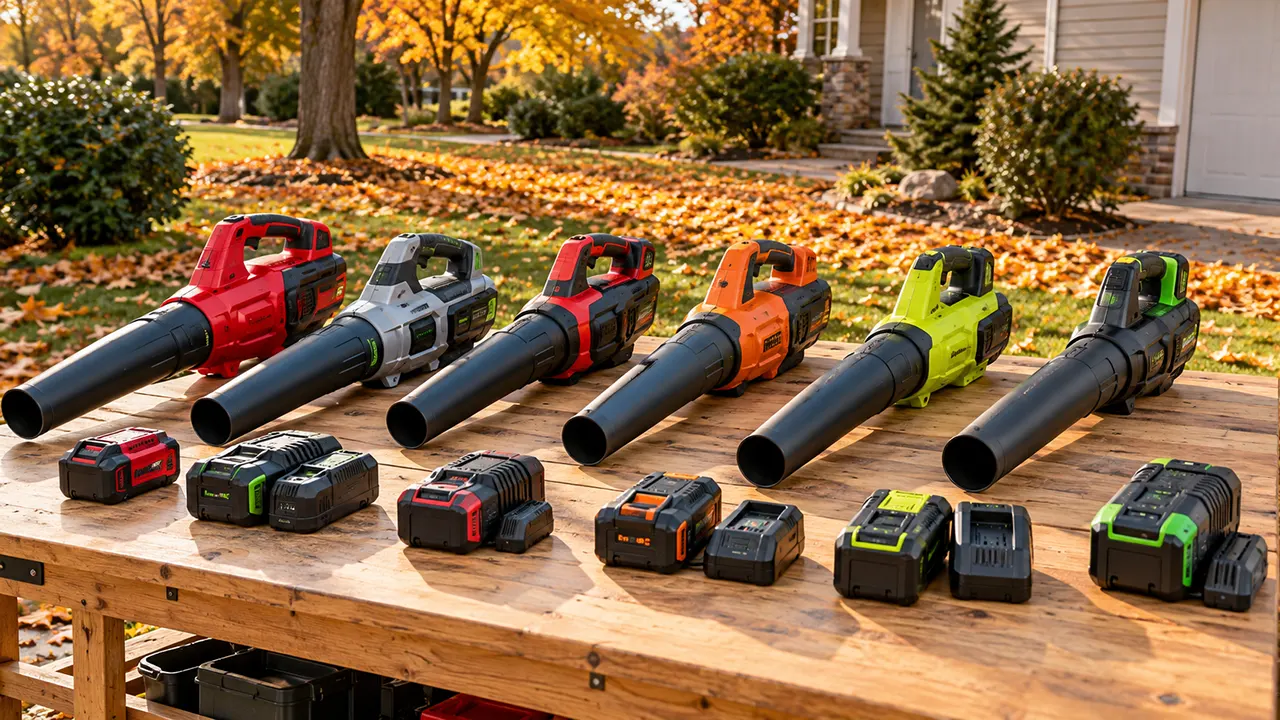
A battery leaf blower should move leaves efficiently without forcing you to buy more power, battery capacity, or weight than your yard needs. The best choice depends on airflow, blowing force, runtime, noise, and total ownership cost. This guide compares six cordless models using manufacturer specifications and independent testing published by other reviewers.
Affiliate disclosure: ToolGuider may earn a commission when you purchase through qualifying affiliate links in this article, at no additional cost to you. Recommendations are based on published specifications and third-party testing, not hands-on testing by ToolGuider.
Which battery leaf blower is best for your yard?
The best battery leaf blower depends on your cleanup needs. A smaller yard with dry leaves may not require an 800 CFM model, while a large property with heavy leaf fall may benefit from greater airflow and a larger battery. Buyers who already own compatible batteries should also consider their existing tool platform before purchasing a new kit.
Here is how the six models in this guide fit different needs.
| Model | Best suited for | Main consideration |
|---|---|---|
| Toro 60V MAX 605 CFM | Everyday residential cleanup | Confirm the exact battery and charger included |
| EGO POWER+ LB8803-2 | High-airflow cleanup | Premium price and short high-power runtime |
| SKIL PWR CORE 40 BL0650C-15 | Value-focused buyers | Strong runtime potential with the 6.0 Ah battery |
| Husqvarna Leaf Blaster 350iB | Extended cleanup sessions | Higher initial purchase cost |
| RYOBI 40V HP WHISPER SERIES 800 CFM | Existing RYOBI 40V owners | Tool-only purchase requires a compatible battery |
| Greenworks 80V 770 CFM | Buyers wanting a high-airflow kit | Verify runtime under demanding conditions |
These are use-case recommendations based on available specifications and published reviews. They are not a ranking from ToolGuider’s own product tests.
Compare six battery leaf blowers at a glance
The specifications below combine manufacturer information with third-party measurements where available. Runtime and noise results come from different test setups, so they should not be treated as a perfectly controlled head-to-head comparison.
| Model | Advertised airflow | Battery configuration | Published runtime | Published price reference |
|---|---|---|---|---|
| Toro 60V MAX 51820 | 605 CFM, 120 MPH | 2.5 Ah stated in supplied product listing; verify kit | Not independently verified here for this exact kit | $239.99 for a 4.0 Ah configuration in Toro’s 2026 pricing document |
| EGO POWER+ LB8803-2 | 880 CFM in turbo | Two 4.0 Ah batteries | Just over 11 minutes on high in WIRED testing | $379 |
| SKIL BL0650C-15 | 650 CFM in turbo | 6.0 Ah kit | Just over 33 minutes on high in WIRED testing | $199 |
| Husqvarna 350iB | 800 CFM in turbo | 7.7 Ah kit | Just over 33 minutes on high in WIRED testing | $379 |
| RYOBI 40V HP WHISPER SERIES | 800 CFM | Supplied affiliate product is tool-only | About 12 minutes on high in WIRED’s kit test | $219 tool-only listing; kit price varies |
| Greenworks 80V 770 CFM | 770 CFM | 4.0 Ah kit | About 15 minutes on high in Popular Mechanics testing of its Greenworks 80V option | Around $190 sale price reported for a tested option |
Sources: WIRED’s 2026 product testing, Popular Mechanics’ 2026 buying guide, and Toro’s 2026 pricing document. The exact Greenworks configuration and Toro kit must be confirmed before treating these prices and runtime figures as direct comparisons.
What the comparison tells you
The highest CFM rating does not automatically make a blower the best purchase. The EGO model delivers substantial airflow, but its high-power runtime is relatively short. The SKIL and Husqvarna models offer longer reported high-mode runtime in WIRED’s testing, making them worth considering when cleanup takes longer.
Noise measurements also vary with test method. Compare the operating mode and measurement distance before deciding that one model is quieter than another.
How much CFM and MPH do you need in a leaf blower?
CFM measures airflow volume, while MPH describes airspeed. Both matter, but neither provides a complete picture of how effectively a blower moves leaves. Blowing force, nozzle design, debris conditions, and the way the tool is operated also affect practical performance.
CFM vs. MPH: airflow volume versus airspeed
CFM stands for cubic feet per minute. A higher CFM rating indicates that a blower can move a greater volume of air under the manufacturer’s stated test conditions.
MPH stands for miles per hour. It describes airspeed, often measured at or near the nozzle under specified conditions.
Use these figures as a starting point:
- Small yards and patios: A moderate-airflow blower may be sufficient for dry leaves, dust, and grass clippings.
- Typical suburban lawns: A model with adjustable speed and adequate airflow offers flexibility for lawns, driveways, and garden beds.
- Large properties: Higher airflow can help move larger piles and cover more ground, provided the battery can sustain the required power.
- Wet or matted leaves: Prioritize demonstrated blowing force and suitable nozzle design instead of relying on CFM alone.
What blowing force in newtons tells you
Newton measurements express force and can help compare a blower’s ability to push resistant debris. Husqvarna lists 23.5 N of maximum blowing force for the 350iB. That is useful specification data, but it should not be compared directly with another model’s measurement unless the testing methods are consistent.
A practical buying rule is to choose the least powerful model that can reliably handle your heaviest regular cleanup job. You can save money and battery capacity by avoiding unnecessary maximum performance.
How long does a battery leaf blower run on one charge?
Battery leaf blower runtime depends on the battery, power setting, airflow demand, and working conditions. A manufacturer may advertise a long maximum runtime based on a lower-power setting, while an independent reviewer may measure continuous operation on high or turbo. Those figures describe different workloads.
Runtime on high and turbo settings
WIRED’s published tests provide useful examples of how differently models can perform:
- The EGO POWER+ 880 CFM blower ran for just over 11 minutes on high.
- The SKIL PWR CORE 40 650 CFM blower ran for just over 33 minutes on high.
- The Husqvarna 350iB also ran for just over 33 minutes on high.
- The tested RYOBI 40V HP 800 CFM kit ran for just over 12 minutes on high.
These are results reported by WIRED, not ToolGuider measurements. They should not be used as guarantees of runtime for every battery, weather condition, or cleanup task.
How battery capacity affects working time
Battery capacity is commonly expressed in amp-hours (Ah). Within a compatible battery platform, a higher-capacity battery can often provide longer runtime, but it may cost more and add weight.
Voltage and amp-hours serve different purposes. Voltage describes the battery system’s electrical potential, while Ah indicates charge capacity. Neither figure alone tells you exactly how long a blower will run at maximum power.
Check the exact battery supplied with the product. A blower sold as a kit may come with a different battery capacity from the bare-tool version or another kit sold under a similar name.
When a second battery is worth buying
A spare battery can be useful if you have a large property or need to finish a cleanup without waiting for a recharge. It is less compelling for short jobs that can be completed on one charge.
Before buying a spare, compare its current price with the cost of a larger-capacity kit. Sometimes buying the correct kit initially is better value than purchasing the tool and battery separately.
Are battery leaf blowers quiet enough for residential use?
Battery-powered leaf blowers can reduce noise exposure compared with fuel-powered equipment, but they are not silent. Maximum-power settings can still produce substantial noise, so operators should follow manufacturer safety guidance and use hearing protection when appropriate.
How to compare dBA readings fairly
Decibels using the A-weighting scale, written dBA, are commonly used for noise measurements. The distance from the tool, operating mode, surroundings, and measurement method affect the result.
WIRED measured the EGO 880 CFM blower at about 89.7 dBA at a distance of 30 inches while using turbo. Its SKIL test recorded 78.6 dBA on high. These results are useful within their reported testing context, but they should not be treated as a definitive comparison unless the conditions match.
What NIOSH research says about battery-powered landscaping equipment
A 2025 study published in the Journal of Occupational and Environmental Hygiene examined noise exposure among landscaping workers. It reported mean noise exposure of 96.9 dBA for workers using gas leaf blowers and 86.4 dBA for those using battery-powered leaf blowers in the study. These are workplace exposure measurements, not sound readings taken at a fixed distance from each tool.
The study found that battery-powered equipment reduced noise exposure, but average exposure from battery-powered leaf blowers could still exceed the NIOSH recommended exposure limit. Battery power should therefore not be treated as a substitute for hearing protection.
Read the NIOSH noise prevention guidance and OSHA’s noise and hearing conservation guidance for additional context.
How much does a battery leaf blower really cost?
The purchase price is only one part of the ownership cost. A kit may include a battery and charger, while a bare tool requires you to purchase compatible components separately. Existing battery-platform owners may get better value from a tool-only product than someone starting from scratch.
Battery-and-charger kits versus bare tools
Toro 60V MAX 605 CFM: Toro’s 2026 pricing document lists $239.99 for the 51820 605 CFM configuration with a 4.0 Ah battery. The supplied product title describes a 2.5 Ah kit, so verify the actual Amazon listing before relying on that price for the linked configuration.
EGO POWER+ LB8803-2: A current published listing for the kit with two 4.0 Ah batteries and a standard charger shows $379.
SKIL PWR CORE 40 BL0650C-15: WIRED lists $199 for the tested 6.0 Ah kit. Check the exact kit and charger configuration at checkout.
Husqvarna 350iB: The battery-and-charger kit has a published MSRP of $379.99.
RYOBI 40V HP WHISPER SERIES: The supplied affiliate product is tool-only. WIRED reports a $279 sale price for the kit in its review, while an official tool-only listing has shown $219. These are different purchase configurations, not directly interchangeable prices.
Greenworks 80V 770 CFM: Confirm the exact 4.0 Ah kit and current price before purchasing. Published sale prices can differ by model, retailer, and promotion.
Replacement batteries and compatible platforms
Replacement battery costs are not consistently verified for all six exact configurations, so this guide does not invent a single ownership-cost figure.
Before purchasing, check:
- The price of a compatible replacement battery.
- Whether the charger is included.
- Whether your existing batteries work with the selected blower.
- The warranty terms for the tool and battery.
- Whether a higher-capacity battery adds too much weight for comfortable use.
A battery platform becomes more valuable when you already own compatible tools. However, do not assume that batteries from different voltage families within the same brand are interchangeable.
Which of these six battery leaf blowers should you buy?
The following assessments reflect published specifications and independent reviews, not hands-on testing by ToolGuider. Confirm the exact model, kit contents, and current price before ordering.
Toro 60V MAX 605 CFM: a residential all-rounder candidate
The Toro 51820 is rated for 605 CFM and 120 MPH, with a brushless motor, variable-speed trigger, and turbo boost. It is worth considering for homeowners who need more than a basic patio blower but do not necessarily need an 800 CFM-class model.
Check the battery capacity carefully because the supplied product title specifies a 2.5 Ah battery, while Toro’s 2026 pricing document lists the 51820 with a 4.0 Ah battery. Those configurations should not be treated as identical.
EGO POWER+ LB8803-2: a premium high-airflow candidate
The EGO POWER+ LB8803-2 advertises up to 880 CFM in turbo mode and comes with two 4.0 Ah batteries in the reviewed kit. WIRED found that it delivered strong clearing performance, but its high-mode runtime was just over 11 minutes.
This model may suit buyers who want substantial airflow and can benefit from alternating between two batteries. It is less compelling for buyers who prioritize long continuous runtime above maximum performance.
SKIL PWR CORE 40 BL0650C-15: a value-oriented candidate
The SKIL PWR CORE 40 offers 650 CFM in turbo mode and comes in a 6.0 Ah kit configuration. WIRED reported just over 33 minutes of high-mode runtime and measured 78.6 dBA on high during its testing. It is an interesting option for buyers who want useful performance without paying premium-blower prices.
The trade-off is lower maximum airflow than some higher-end models. For routine residential cleanup, that may be a reasonable compromise.
Husqvarna Leaf Blaster 350iB: a high-force, long-runtime candidate
Husqvarna lists 800 CFM in turbo mode, 200 MPH maximum airspeed, and 23.5 N maximum blowing force for the 350iB. The battery-and-charger kit includes a 7.7 Ah battery, and WIRED reported just over 33 minutes of high-mode runtime.
This is worth considering for longer cleanup sessions and buyers who value the Husqvarna battery platform. The higher purchase price and battery-system commitment deserve consideration before choosing it over a less expensive kit.
RYOBI 40V HP WHISPER SERIES 800 CFM: a battery-platform candidate
The RYOBI 40V HP WHISPER SERIES blower is rated for 800 CFM and 180 MPH in the supplied product description. WIRED’s review of the related 800 CFM kit found about 12 minutes of high-mode runtime and measured 84.1 dBA on high.
The strongest reason to choose RYOBI may be compatibility with other 40V outdoor tools you already own. The linked product is tool-only, so buyers who do not have a compatible battery and charger must include those costs in their budget.
Greenworks 80V 770 CFM: a high-airflow kit candidate
The Greenworks 80V blower is advertised at 770 CFM and 180 MPH, with a 4.0 Ah battery and charger in the supplied kit description. Greenworks lists runtime of up to 80 minutes for its product, but maximum advertised runtime should not be assumed to represent continuous high-power operation.
Popular Mechanics has reported about 15 minutes of high-mode runtime for a tested Greenworks 80V option. Verify that the exact tested configuration matches the 770 CFM kit before using that number as a direct comparison.
What should you check before buying a cordless leaf blower?
Use this checklist to narrow your options before comparing retailer prices.
- Match the tool to your yard. Decide whether you mainly clear patios, lawns, driveways, or heavy seasonal leaf piles.
- Check performance beyond the headline CFM. Look for airspeed, blowing force, variable speed, and turbo or boost controls.
- Check realistic runtime. Look for independent measurements on the settings you expect to use.
- Weigh the complete tool. A larger battery can extend runtime but also increase fatigue during longer jobs.
- Calculate the full kit cost. Include the battery, charger, and any replacement battery you may need.
- Verify the exact product listing. Make sure the model number, battery capacity, charger, and affiliate destination all match the product being discussed.
Frequently asked questions about battery leaf blowers
Is CFM or MPH more important for moving leaves?
Neither number tells the whole story. CFM measures airflow volume, while MPH measures airspeed. Blowing force and nozzle design also affect how effectively a blower moves debris. Compare all available performance data and prioritize independent tests that reflect your intended cleanup tasks.
Are battery leaf blowers powerful enough to replace gas models?
Many modern battery blowers can handle common residential cleanup, and independent reviewers have documented strong clearing performance from high-output models. Whether a battery blower can replace a particular gas model depends on the workload, required runtime, debris conditions, and available battery capacity. Heavy professional work may demand different equipment from occasional home use.
How long does a leaf blower battery last before it needs replacement?
Battery lifespan depends on charging habits, storage conditions, temperature, usage, and the battery’s design. Runtime on one charge is different from the total service life of the battery. Follow the manufacturer’s charging and storage guidance, and check the battery warranty before purchasing.
Is an 800 CFM leaf blower too powerful for a small yard?
Not necessarily, but it may cost more and provide more airflow than you need. A high-output blower with adjustable speed can still work for smaller spaces, although a lighter, less expensive model may offer better value for routine patio and lawn cleanup.
Can a battery leaf blower move wet leaves?
Some high-output blowers can move damp leaves, but wet, matted debris generally requires more effort than dry leaves. Look for independent clearing tests and consider blowing force rather than relying on the advertised CFM alone. Extremely wet piles may be better handled with a rake or another cleanup method.
Can you use one battery across different tools from the same brand?
Often, but only when the tools use compatible batteries from the same platform. Voltage families and battery designs can differ within one brand. Check the manufacturer’s compatibility information before buying a bare tool or an additional battery.
Choose for your actual cleanup needs
For everyday residential cleanup, prioritize comfortable handling, adjustable airflow, and a battery that can complete your usual work. For larger properties, compare independent runtime results and replacement battery costs alongside maximum performance. Before buying, verify the exact kit and current price rather than choosing a model solely because its CFM rating is higher.
Next step: Compare the current prices and kit contents of the models that match your yard, then check that the retailer listing corresponds to the exact model reviewed above.
