


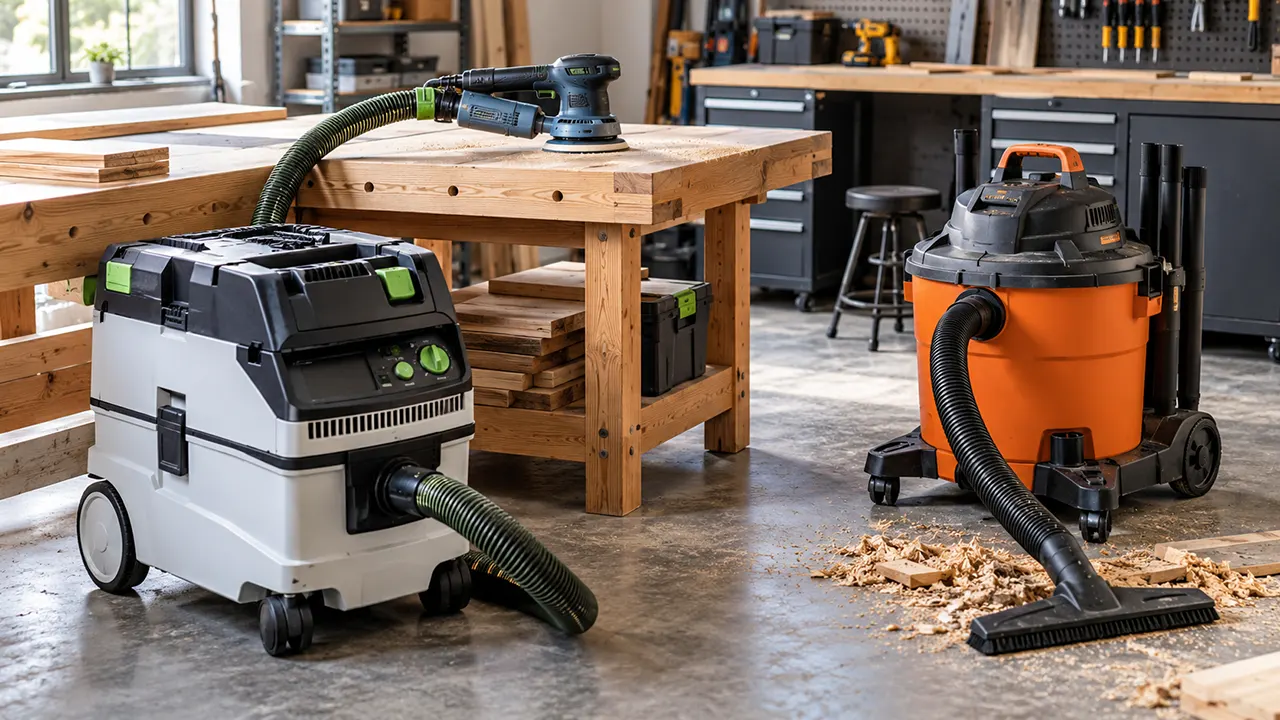
Choose a dust extractor if you regularly sand wood, grind concrete, or connect power tools that produce fine dust. Choose a wet/dry shop vac if you mainly clean garages, collect ordinary debris, and handle occasional spills. For hazardous dust, verify that the complete collection setup meets the requirements for your specific task.
A dust extractor is usually the better choice for frequent power-tool use, fine-dust collection, and jobs that need automatic filter cleaning. A shop vac is often the more economical option for general cleanup, spills, and occasional DIY work. The right choice depends on your dust type, filtration needs, tool compatibility, and budget.
This guide compares the two options using manufacturer specifications, product documentation, and authoritative safety guidance. It does not claim hands-on testing.
Affiliate disclosure: ToolGuider may earn a commission from qualifying purchases made through affiliate links added to this article. This does not affect our product comparisons or recommendations.
What Is the Difference Between a Dust Extractor and a Shop Vac?
A dust extractor is designed to collect dust generated by tools and other work processes. A shop vac, also called a wet/dry vacuum, is designed primarily for general cleanup, including common workshop debris and, on suitable models, liquid spills.
The categories overlap. Some professional dust extractors can handle both wet and dry pickup, while some shop vacs support fine-dust filters and power-tool adapters. The difference lies in the complete system, not simply the product name.
How a dust extractor captures fine dust from power tools
A dust extractor connects to a tool’s dust port or extraction shroud. It draws dust toward the collection system as the tool generates it, reducing the amount that escapes into the surrounding workspace.
Many professional models add automatic filter cleaning, tool-triggered operation, compatible hose connections, and high-efficiency filtration. These features are particularly useful during repeated sanding, grinding, drilling, and cutting.
What a wet/dry shop vacuum is designed to handle
A conventional shop vac is a practical choice for cleaning sawdust, dirt, wood chips, garage debris, and certain liquids when the manufacturer permits wet pickup.
Many models cost less than dedicated extractors and offer larger containers for general cleanup. However, a standard cartridge filter and a large motor rating do not automatically establish that a vacuum is suitable for fine or hazardous dust.
When the two categories overlap
A shop vac can serve as a power-tool vacuum when its filtration, airflow, hose, adapter, and operating instructions suit the application. Likewise, a wet/dry dust extractor can handle general cleanup when configured for the material being collected.
The important question is whether the entire setup performs the job safely and effectively.
Dust Extractor vs. Shop Vac: Key Differences Compared
| Feature | Dust extractor | Conventional shop vac |
|---|---|---|
| Primary purpose | Tool-connected dust collection | General workshop and garage cleanup |
| Fine-dust control | Often designed for sustained dust extraction | Depends on the filter, bag, seals, and configuration |
| Automatic filter cleaning | Available on selected models | Less common on conventional models |
| Tool-triggered operation | Common on professional models | Available on selected models or through compatible accessories |
| Hose and tool connections | Often designed around power-tool ports and adapters | May require additional adapters |
| Wet pickup | Supported by selected models | Supported by many wet/dry models |
| Container capacity | Varies by model and design | Often available in larger capacities |
| Initial cost | Generally higher for professional models | Often lower |
| Best fit | Frequent sanding, grinding, and tool-connected work | General cleanup and occasional DIY tasks |
These are category-level tendencies, not universal rules. Check the specifications of the exact model before buying.
Which Machine Provides Better Fine-Dust Filtration?
A dust extractor often has an advantage for fine-dust work because its filtration, dust collection, and filter maintenance features are designed around that use. However, a properly configured shop vac can also provide effective fine-dust collection when its complete system is suitable for the application.
HEPA filter ratings versus whole-machine performance
HEPA filtration is an important specification, but it does not tell the whole story.
A HEPA filter is generally rated to capture at least 99.97% of particles measuring 0.3 microns under the applicable test conditions. Bosch lists this efficiency for the VAC090AH, and Makita lists the same rating for the main HEPA filter in the VC4210L.
The distinction is between the filter and the complete vacuum system. Air leakage around a filter, poorly sealed connections, unsuitable bags, or incorrect assembly can undermine dust containment. A filter rating alone does not prove that an entire machine meets every applicable filtration or hazardous-dust requirement.
Filter bags, cartridge filters, and dust leakage
The bag and filter work together. A suitable collection bag can contain dust during disposal and prevent some debris from reaching the main filter, while a properly maintained cartridge filter handles the remaining airborne particles.
Always check the manufacturer’s approved filter and bag combinations. Emptying a container or removing a loaded filter can release dust even when the vacuum collected it effectively during operation.
When a HEPA shop vac may be sufficient
A shop vac with an appropriate HEPA filtration system may suit some home renovation and workshop applications. For example, someone collecting ordinary drywall dust during occasional repairs may not need the features of a professional extractor for every task.
However, the correct configuration depends on the dust, the work, and the required exposure controls. For regulated construction work, use the applicable OSHA requirements rather than assuming that adding a HEPA filter makes any shop vac compliant.
For a more specific comparison, see ToolGuider’s guide to choosing a HEPA shop vac for drywall dust.
Does an Auto-Clean Dust Extractor Make a Difference?
An auto-clean dust extractor can reduce interruptions during demanding dust collection. Its cleaning mechanism removes accumulated material from the filter at intervals or through a programmed cycle, helping maintain airflow as the filter loads.
The benefit depends on the material collected, the filter design, and how continuously the machine operates.
How automatic filter cleaning works
Consider three examples from the approved product shortlist:
- Bosch VAC090AH: Bosch specifies automatic filter cleaning every 15 seconds.
- Makita VC4210L: Makita specifies an automatic filter-cleaning system.
- DEWALT DWV010: DEWALT specifies alternating automatic filter-cleaning pulses every 30 seconds.
These intervals describe the manufacturers’ cleaning mechanisms. They do not prove that one model will maintain more airflow than another under every working condition.
When manual filter maintenance may be enough
For occasional cleanup, short sanding sessions, or jobs that produce relatively little fine dust, a conventional shop vac may be adequate. Manual filter cleaning can be manageable when the vacuum is used intermittently and the manufacturer permits the relevant maintenance procedure.
Frequent filter clogging, repeated interruptions, and declining collection performance are reasons to consider a dedicated extractor with automatic cleaning.
Filter bags, replacement filters, and operating costs
Automatic cleaning does not eliminate maintenance. Bags still need replacement, filters have service limits, and the cleaning mechanism itself must be maintained according to the manual.
Compare the price and availability of replacement bags and filters before purchasing. A lower initial price may be less attractive if compatible consumables are expensive or difficult to obtain.
Which Is Better for Power Tools?
For frequent power-tool use, a dust extractor is usually the more convenient option. Many models include a tool-activated outlet, compatible hose fittings, and features designed to support sustained collection.
A shop vac can also work well when the tool’s dust port and the vacuum’s hose, filter, and airflow are compatible.
Sanders, routers, circular saws, and track saws
These tools can generate substantial amounts of fine wood dust. A suitable vacuum connection helps capture dust at the source rather than allowing it to spread across the bench or workshop.
Before connecting a shop vac, check the tool’s dust-port diameter and the vacuum’s hose size. A compatible adapter can improve the physical connection, but it cannot compensate for inadequate airflow or unsuitable filtration.
For frequent sanding or routing, a dedicated extractor with tool-triggered operation can simplify the workflow. The vacuum starts with the connected tool and stops after the tool is switched off, depending on the model’s control system.
Concrete grinders and other high-dust applications
Concrete grinding requires more careful consideration because the work can generate respirable crystalline silica. The collection system must be suitable for the grinder, shroud, dust load, and applicable exposure-control requirements.
For example, Bosch describes the VAC090AH as part of its PRO+GUARD dust-control system, while Makita identifies the VC4210L for selected applications under the conditions specified by the manufacturer. These statements should not be interpreted as blanket approval for every concrete-grinding setup.
See ToolGuider’s concrete grinding dust extraction guide for more detailed task-specific guidance.
Tool-triggered outlets, hose sizes, and adapters
Check three things before buying:
- The tool’s dust port and the vacuum hose must connect securely.
- The vacuum must provide the airflow required for the tool and application.
- Any automatic starting feature must be compatible with the tool and the manufacturer’s operating instructions.
A larger hose is not automatically better, and a universal adapter does not guarantee that the resulting system will collect dust effectively.
Airflow vs. Suction: Which Specifications Matter?
Airflow and suction describe related but different aspects of vacuum performance. Both matter when choosing a power-tool vacuum, and neither should be used alone to predict real-world collection performance.
What CFM tells you about airflow
CFM means cubic feet per minute. It describes the volume of air moving through a system under specified conditions.
For example, Bosch lists the VAC090AH at a maximum of 150 CFM, while Makita lists the VC4210L at 148 CFM. These are manufacturer-published figures, not independent measurements of airflow at a connected tool.
Actual airflow changes with hose restrictions, filters, adapters, and operating conditions. A high advertised CFM number does not guarantee that a vacuum will collect dust effectively from every tool.
What static water lift tells you about suction
Static water lift measures the vacuum’s ability to generate negative pressure under a specified test condition. It helps describe suction capability, but it is not interchangeable with CFM.
A vacuum with strong static water lift may handle restrictive hose arrangements differently from a model with higher free-airflow ratings. For tool-connected collection, evaluate both specifications alongside the manufacturer’s compatibility guidance.
Why tool-port size and hose restrictions matter
A poorly matched hose or adapter can restrict airflow and reduce collection effectiveness. Long hoses, tight bends, clogged filters, and unsuitable connections can also affect performance.
Prioritize a secure, compatible connection and the airflow recommended for the application instead of selecting a vacuum by motor horsepower alone.
Which Costs Less Over Time?
A conventional shop vac generally costs less upfront than a professional dust extractor. However, the long-term difference depends on how often you use the machine, the required filtration, and the cost of bags, filters, and accessories.
Purchase price and included accessories
The following prices are reference points from observed US listings or catalog prices, not guaranteed current offers.
| Model | Published or observed price | Main reason to consider it |
|---|---|---|
| Bosch VAC090AH | $632.87 at Home Depot when checked | Automatic cleaning, HEPA filter, tool activation |
| Makita VC4210L | $819 at Acme Tools when checked | 11-gallon gross capacity, HEPA filtration, automatic cleaning |
| DEWALT DWV010 | $499 at Acme Tools when checked | Automatic cleaning, tool activation, included HEPA filters |
| Festool CT 26 EI HEPA | Previously observed at $899 | Compact premium system with tool-triggered operation |
| RIDGID VAC1200 | Check current Amazon listing | General wet/dry cleanup and detachable blower |
Prices and availability can change. Recheck the relevant retailer before publishing or purchasing. Bosch’s current product specifications and Home Depot listing provide the reference for its features and observed price.
The RIDGID VAC1200 is the conventional shop-vac example in this comparison. Its supplied Amazon product description identifies a 12-gallon capacity, 5.0 peak horsepower, a detachable blower, a cartridge filter, and a pro-grade hose. Verify the current listing for its price and exact package contents.
Filter, bag, and maintenance expenses
Compare the recurring costs of approved bags, replacement filters, and compatible hoses. Also consider the time spent cleaning filters, emptying containers, and dealing with dust during disposal.
A professional extractor can be worth the extra cost when frequent filter maintenance interrupts paid work. For occasional garage cleanup, those features may provide little practical value.
When a dust extractor’s higher price is justified
The additional cost is easier to justify when the machine is used regularly with dust-producing tools, when automatic cleaning saves repeated interruptions, or when a particular task requires a specified collection system.
If the main job is cleaning a garage, picking up ordinary debris, and handling permitted liquid spills, a conventional wet/dry vacuum is often the more sensible purchase.
Which Machine Should You Choose for Your Work?
The best choice depends on the dust source, frequency of use, and any task-specific requirements.
| Your work | Starting point | What to check |
|---|---|---|
| Garage and vehicle cleanup | Wet/dry shop vac | Capacity, accessories, wet-pickup instructions |
| Occasional home woodworking | Shop vac or entry-level extractor | Filter suitability, hose compatibility |
| Frequent sanding and routing | Dust extractor | Tool connection, filtration, automatic cleaning |
| Drywall renovation | Suitable fine-dust or HEPA-equipped system | Complete filtration setup and dust-handling instructions |
| Concrete grinding | Task-appropriate dust extractor and collection setup | Shroud, required airflow, silica controls |
| Large stationary woodworking machines | Dedicated dust collector may be preferable | Machine airflow needs, ducting, system design |
What about a dust collector?
A dust collector is often designed for stationary woodworking equipment, multiple machine connections, or larger volumes of wood chips and dust. A portable extractor is generally more convenient for moving between handheld power tools and job locations.
The distinction is not absolute. Some workshops use both: a dust collector for stationary machines and a portable extractor for sanding, routing, and renovation tasks.
For a broader overview, read ToolGuider’s dust collection systems guide.
How to Choose the Right Model
Before buying, evaluate the exact machine and the job it must perform.
Check filtration requirements before comparing features
Identify the material you intend to collect. Ordinary sawdust, drywall dust, and silica-containing concrete dust do not necessarily have the same control requirements.
Read the manufacturer documentation for the filter, bags, dust shroud, and complete system. Do not assume that a HEPA label alone makes a machine suitable for every hazardous material.
Match the hose, port, and airflow to the tool
Confirm that the hose and adapter fit the tool’s dust port. Check the required airflow and the manufacturer’s instructions for the intended application.
If the machine will be used for several tools, consider whether the available accessories support all of them without introducing excessive restrictions.
Check capacity, cleaning, and consumable availability
A larger container can reduce emptying frequency, but it may make the machine bulkier. Automatic cleaning can be valuable for sustained fine-dust work, while a simpler model may be sufficient for occasional cleanup.
Before committing, check replacement filters, bags, hose availability, warranty coverage, and the manufacturer’s maintenance instructions.
Compare the five approved models
Bosch VAC090AH: A strong candidate for users who want a 9-gallon extractor with HEPA filtration, automatic filter cleaning every 15 seconds, and power-tool activation. Bosch publishes a maximum airflow of 150 CFM and static water lift of 97.3 inches.
Makita VC4210L: A professional wet/dry extractor with 11-gallon gross capacity, automatic filter cleaning, a tool-activated outlet, and a certified HEPA main filter. Makita lists 148 CFM and 92 inches of water lift.
DEWALT DWV010: An 8-gallon extractor with automatic filter cleaning, tool actuation, and an anti-static hose. DEWALT states that its EPA lead-related renovation rule claim applies only when the specified DWV9330 filters are used. Do not generalize that statement to other applications.
Festool CT 26 EI HEPA: A compact premium option with a 6.9-gallon container, 138 CFM maximum volume flow, and 96 inches of maximum static water lift. Its built-in Bluetooth interface supports starting the extractor with compatible cordless tools or an optional remote control.
RIDGID VAC1200: The conventional wet/dry vacuum in this comparison. Its detachable blower and 12-gallon capacity suit general cleanup needs, but do not assume that the included cartridge filter makes it equivalent to a dedicated HEPA dust extractor.
These products are not ranked by hands-on performance. The right model depends on the reader’s application, compatibility requirements, and budget.
What to Check Before Using a Vacuum for Hazardous Dust
Hazardous dust requires more than choosing a vacuum with a promising specification.
Verify the exact task-specific requirements
OSHA’s construction silica standard, 29 CFR 1926.1153, specifies exposure-control methods for listed tasks. Where an employer follows Table 1, the required engineering controls, work practices, and respiratory protection must be fully and properly implemented. Other tasks may require a different exposure-control approach.
Read the applicable requirements for the exact tool and operation before selecting equipment.
Check the complete collection setup and maintenance instructions
Verify the dust shroud, collection system, filter efficiency, required airflow, and maintenance procedures. Check whether the manufacturer identifies the specific model and configuration for the intended task.
Do not substitute a generic shop vac or an unverified filter combination for a system specified by the applicable requirements.
Understand the limits of filter labels and product marketing
Terms such as HEPA, auto-clean, and professional dust extractor describe features, but they do not independently establish compliance with every workplace rule.
For additional guidance, consult the official OSHA respirable crystalline silica standard and ToolGuider’s OSHA Silica Table 1 tools guide.
Frequently Asked Questions
1. Is a dust extractor better than a shop vac?
A dust extractor is usually better for frequent power-tool use and sustained fine-dust collection because many models include compatible tool connections, high-efficiency filtration, and automatic filter cleaning. A shop vac is often more economical for general cleanup. The better option depends on the material, filtration requirements, and intended use.
2. Can a shop vac be used as a power tool vacuum?
Yes, if the shop vac has suitable filtration, sufficient airflow, compatible hose connections, and operating instructions that permit the application. A compatible adapter can connect the vacuum to a tool’s dust port, but it cannot compensate for inadequate collection performance or unsuitable filtration.
3. Is a HEPA shop vac as good as a dust extractor?
A properly configured HEPA shop vac may perform well for some fine-dust applications. However, filter efficiency alone does not establish whole-machine performance. The filter housing, seals, bags, connections, and maintenance procedures all matter. For regulated work, verify the complete system against the applicable requirements.
4. Is an auto-clean dust extractor worth the extra cost?
It can be worthwhile for frequent sanding, grinding, or other sustained fine-dust work where filter loading interrupts collection. Automatic cleaning can reduce manual interruptions, but it does not eliminate filter and bag maintenance. For occasional cleanup, a simpler vacuum may provide better value.
5. Can a shop vac collect concrete dust?
A shop vac should not be assumed suitable for concrete dust simply because it can collect dry debris or accepts a fine-dust filter. Concrete work can generate respirable crystalline silica, which requires appropriate exposure controls. Verify the exact task requirements and the complete dust collection setup before using any vacuum for this work.
6. Do all dust extractors meet OSHA requirements?
No. Suitability depends on the exact task, equipment configuration, required airflow and filtration, work practices, and applicable exposure-control requirements. A manufacturer’s statement about one approved configuration should not be generalized to every model or hazardous-dust application.
7. When should you buy a dust collector instead?
Consider a dedicated dust collector when your main need is collecting larger volumes of wood chips and dust from stationary machinery or a multi-machine workshop system. A portable dust extractor is generally more convenient for handheld power tools and moving between work locations.
Make the Right Choice for Your Workshop
If your work involves frequent sanding, grinding, or tool-connected dust collection, prioritize a suitable extractor with compatible connections and filtration. If you mainly need a vacuum for garage cleanup, debris, and occasional spills, a conventional wet/dry shop vac may be all you need.
Before purchasing, compare the exact specifications, compatible accessories, replacement-filter costs, and task requirements. Then choose the least complicated system that safely meets your needs.
Your next step: Compare the approved Bosch, Makita, DEWALT, Festool, and RIDGID models against your actual tools and budget. Add the relevant Amazon affiliate links to the product mentions after verifying the current listing and package contents.
