


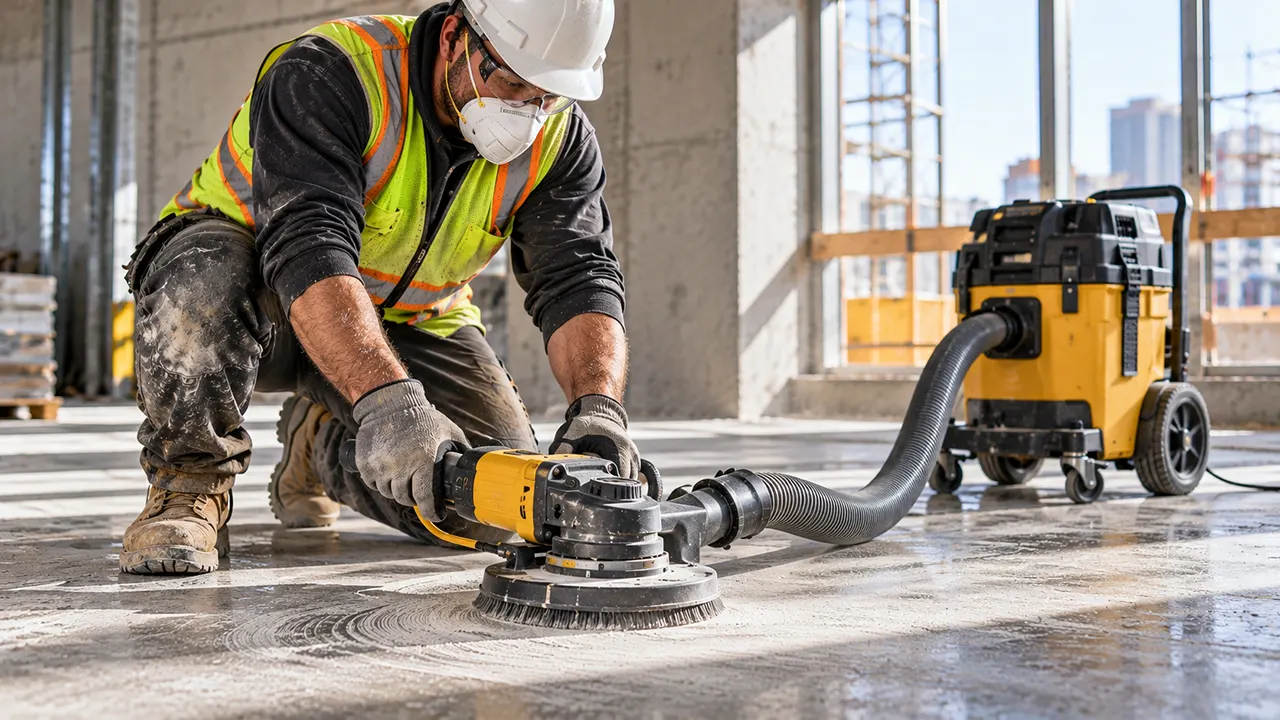
Concrete grinding dust extraction works best when the grinder, dust shroud, hose, and extractor function as one system. For US construction work, the correct setup also depends on the grinding task and the applicable OSHA silica-control requirements. This guide explains how to choose compatible equipment, assess airflow, compare professional extractors, and avoid common dust-collection mistakes.
Affiliate disclosure: ToolGuider may earn a commission from qualifying purchases made through affiliate links. Product recommendations are based on manufacturer documentation and technical analysis, not hands-on testing.
Build a Concrete Grinding Dust Extraction System That Works
A concrete grinding dust extraction system captures dust close to the grinding wheel, transports it through a hose, and collects it in an appropriate dust extractor. Its performance depends on the complete setup, not simply the vacuum’s advertised power.
Concrete and mortar can contain crystalline silica. Grinding these materials can release respirable crystalline silica, which can penetrate deep into the lungs. OSHA regulates occupational exposure through its construction silica standard, 29 CFR 1926.1153.
How a grinder, shroud, hose, and extractor work together
The four main components have different jobs:
- Grinder: Removes concrete, mortar, coatings, or other surface material.
- Dust shroud: Surrounds the grinding area and directs airborne dust toward the extraction opening.
- Extraction hose: Carries dust-laden air from the shroud to the collector.
- Dust extractor: Separates and retains dust using its collection system and filters.
A mismatch in any component can reduce dust capture. For example, a compatible vacuum connected through an undersized adapter, a kinked hose, or a poorly fitted shroud may fail to capture dust effectively.
Why dust capture at the grinding point matters
Capturing dust at the source helps prevent it from spreading through the work area. This is especially important indoors, where dust can accumulate on floors, tools, nearby surfaces, and workers’ clothing.
For indoor or enclosed work performed under OSHA Table 1, employers must provide a means of exhaust as needed to minimize the accumulation of visible airborne dust.
The practical lesson is simple: choose the shroud and extraction setup before starting the job, rather than relying on a general-purpose vacuum to clean up dust after it escapes.
Choose the Right Concrete Grinder Dust Shroud
A concrete grinder dust shroud must fit the grinder, accommodate the intended wheel, and provide effective dust capture during the specific operation. A shroud designed for a 5-inch surface-grinding wheel should not automatically be treated as suitable for a larger grinder or a cutting application.
Surface grinding shrouds versus cutting guards
Surface-grinding shrouds typically surround a grinding wheel or diamond cup wheel. A brush skirt or similar edge helps maintain contact with the work surface while directing dust toward the extraction connection.
Cutting applications may require a different guard or dust-collection attachment. Never install an incompatible blade or attachment simply because it fits physically. Follow the grinder manufacturer’s instructions and use accessories approved for the intended operation.
For example, the Bosch GWS-5SG is designed for specified Bosch grinder families and 4-, 4.5-, and 5-inch wheels. Bosch documents a replaceable brush ring, tool-free installation, and a rotating opening for flush grinding.
Brush skirts, convertible edges, and flush grinding
Consider these features when comparing shrouds:
- Brush skirts: Help maintain contact with the surface and contain dust near the wheel.
- Convertible or removable edges: May allow grinding closer to walls or other obstructions.
- Hose connections: Must match the extraction hose directly or through an approved adapter.
- Wheel clearance: Must accommodate the specified wheel diameter and accessory.
- Mounting compatibility: Must match the grinder’s housing, spindle arrangement, or specified attachment system.
A shroud advertised as universal may still have limitations. Confirm the exact grinder model and the manufacturer’s compatibility information before ordering.
How to verify grinder and shroud compatibility
Before buying, check the grinder model number, wheel diameter, intended grinding operation, shroud mounting arrangement, and extraction connection. Also verify whether the attachment permits flush grinding and whether any parts must be removed or repositioned for edge work.
The U.S. SAWS SX65807U is a candidate for larger grinders. The manufacturer describes a universal mounting system for many 7- and 9-inch grinders. Its listed price in the researched manufacturer information was $131.50, but current pricing and availability should be confirmed before purchase.
Calculate the Airflow Your Grinder Needs
Airflow requirements depend on the task and the applicable control method. Under OSHA Table 1, the specified dust-collection option for handheld grinders used for mortar removal and handheld grinders used for other purposes requires at least 25 cubic feet per minute (CFM) per inch of wheel diameter, a filter with at least 99% efficiency, and a cyclonic pre-separator or filter-cleaning mechanism. The respirator requirements differ by task and work duration.
OSHA airflow calculations for handheld grinders
For the applicable Table 1 dust-collection provisions, multiply the wheel diameter in inches by 25 CFM.
| Wheel diameter | Calculated minimum airflow |
|---|---|
| 4.5 inches | 112.5 CFM |
| 5 inches | 125 CFM |
| 7 inches | 175 CFM |
| 9 inches | 225 CFM |
These figures are arithmetic calculations from OSHA’s stated minimum. They are not universal requirements for every concrete-grinding task, and they do not independently establish that an extractor complies.
Maximum CFM, static pressure, and airflow under load
An extractor’s maximum advertised CFM is not necessarily the airflow delivered at the grinder. Actual performance can be affected by hose length, hose diameter, bends, adapters, filter loading, leaks, and the resistance of the connected shroud.
Static pressure or water lift describes another aspect of an extractor’s performance. It should not be treated as interchangeable with airflow. A higher maximum CFM rating alone does not prove that a setup will capture dust effectively.
Consider the following manufacturer-listed specifications:
| Extractor | Advertised maximum airflow | Practical interpretation |
|---|---|---|
| Bosch VAC090AH | 150 CFM | Its maximum rating exceeds the calculated 125 CFM figure for a 5-inch wheel, but this does not prove actual airflow at the shroud. |
| Makita VC4210L | 148 CFM | The same caution applies; verify the complete setup and applicable task requirements. |
| Husqvarna DE 120 H | 241 CFM | Its higher advertised airflow makes it a candidate for evaluating larger-tool applications, subject to application-specific verification. |
Bosch and Makita publish their respective airflow specifications in manufacturer documentation.
+1 Husqvarna’s manufacturer documentation should be consulted to confirm the DE 120 H specifications and compatibility for the intended job before purchase.
Buying rule: Do not select an extractor solely because its advertised CFM exceeds a calculated minimum. Verify the manufacturer’s recommended dust collector, the airflow available under operating conditions, the filter requirements, and the compatibility of the complete system.
Hose length, diameter, adapters, and restrictions
A hose that is too narrow, unnecessarily long, kinked, or fitted with restrictive adapters can reduce airflow. Leaks at the shroud or connection can also allow dust to escape before it reaches the collector.
Use the manufacturer’s recommended hose and fittings where specified. Avoid improvised connections that reduce the extraction path or interfere with the shroud’s intended operation.
Choose a Dust Extractor With the Right Filtration
A suitable concrete dust extractor needs more than a powerful motor. Its filter efficiency, filter-cleaning method, collection capacity, and compatibility with the grinder all affect its usefulness on the job.
Filter efficiency and HEPA filtration
OSHA Table 1 specifies a filter efficiency of at least 99% for the applicable handheld grinder dust-collection methods. That requirement is not identical to a HEPA filter rating.
A HEPA filter is generally rated to capture at least 99.97% of particles at 0.3 microns under the applicable test method. However, the presence of a HEPA filter alone does not establish that the complete grinder and extractor setup meets every OSHA requirement. The task, shroud, airflow, filter arrangement, and operating method still matter.
When comparing equipment, verify the actual supplied filter configuration. Do not assume that every version of a vacuum uses the same filter or that an optional HEPA filter is included in the base package.
Automatic filter cleaning versus manual cleaning
Fine concrete dust can accumulate on a filter and restrict airflow. Automatic filter-cleaning mechanisms periodically dislodge accumulated dust, while manually cleaned filters require the operator to follow the manufacturer’s specified cleaning procedure.
Automatic cleaning is useful for contractors who grind frequently or perform extended jobs. It can reduce interruptions, but it does not eliminate filter maintenance or guarantee constant airflow under all conditions.
Under the applicable OSHA Table 1 handheld grinder dust-collection provisions, the collector must have either a cyclonic pre-separator or a filter-cleaning mechanism. Check the specific requirement for the task instead of assuming that any automatic cleaning feature automatically establishes compliance.
When to use a cyclonic pre-separator
A pre-separator removes a portion of the incoming dust before it reaches the main filter. A cyclonic design uses airflow to separate heavier particles and collect them in a separate container.
A pre-separator may help when grinding large areas or producing substantial quantities of debris. However, it adds another container, connection, and potential leak point. It must be configured according to the extractor and separator manufacturers’ instructions.
A pre-separator is not a substitute for the required final filtration. Empty and maintain all collection components using the appropriate procedures for hazardous dust.
Bags, collection capacity, and safe dust disposal
Choose a collection system that can handle the expected debris volume without frequent interruptions. Verify the correct dust bags, filters, and disposal accessories for the selected extractor.
Do not dry-sweep accumulated silica-containing dust or use compressed air for cleaning when those methods could increase exposure, unless the compressed-air method is used with the ventilation system and other conditions permitted by the applicable standard. Follow OSHA’s housekeeping requirements and the equipment manufacturer’s instructions.
Understand OSHA Silica Dust-Control Requirements
OSHA’s construction silica standard does not impose one identical extraction specification on every concrete-grinding task. Table 1 identifies task-specific engineering controls, work practices, and respiratory protection. Alternatively, an employer may use the exposure-assessment and control method in paragraph (d) when the standard’s requirements are met.
The following distinctions are essential for choosing equipment and explaining compliance accurately.
Handheld grinders used for mortar removal
Mortar removal, often called tuckpointing, has a specific Table 1 entry. The grinder must use a commercially available shroud and dust-collection system, and the dust collector must provide at least 25 CFM per inch of wheel diameter. The collector must also have a filter with at least 99% efficiency and a cyclonic pre-separator or filter-cleaning mechanism.
Under this entry, the required respiratory protection is APF 10 for tasks performed for four hours or less per shift and APF 25 for tasks lasting more than four hours per shift.
APF means assigned protection factor. It describes the level of respiratory protection expected when the respirator is properly selected and used within an effective respiratory protection program. A respirator rating should not be confused with a filter-efficiency percentage.
Handheld grinders used for purposes other than mortar removal
For other handheld grinding tasks, Table 1 permits specified alternatives. When the work is performed outdoors, the listed methods include a grinder equipped with an integrated water-delivery system that continuously feeds the grinding surface, or a grinder with a commercially available shroud and dust-collection system that meets the specified requirements.
For the dust-collection option, the collector must provide at least 25 CFM per inch of wheel diameter, have a filter with at least 99% efficiency, and include a cyclonic pre-separator or filter-cleaning mechanism. Table 1 does not require respiratory protection for this dust-collection option outdoors, but it does require APF 10 respiratory protection indoors or in an enclosed area.
These provisions apply when the employer fully and properly implements the specified Table 1 controls. If an alternative compliance method is used, its separate requirements must be met.
Walk-behind floor grinders
Walk-behind floor grinders have a different Table 1 entry. The machine must use an integrated water-delivery system that continuously feeds the cutting surface, or a dust-collection system recommended by the machine manufacturer.
For the dust-collection option, the collector must provide the airflow recommended by the manufacturer or greater and have a filter with at least 99% efficiency and a filter-cleaning mechanism. When the work is indoors or in an enclosed area, a HEPA-filtered vacuum must be used to remove loose dust between passes.
Do not automatically apply the handheld grinder’s 25 CFM-per-inch formula to a walk-behind floor grinder. The applicable Table 1 provision specifies manufacturer-recommended airflow for that task.
Table 1 versus alternative exposure-control methods
Employers who do not fully and properly implement the applicable Table 1 controls must follow the requirements of paragraph (d), including assessing employee exposure and implementing the controls required by that method. This is not a shortcut that allows a contractor to choose whichever equipment specification is easiest to meet.
OSHA also imposes requirements relating to exposure assessment, written exposure control plans, housekeeping, and respiratory protection where applicable. Contractors should review the complete standard and obtain qualified safety guidance for their actual work conditions.
Compare Concrete Grinding Dust Extraction Equipment
The following five products are candidates for comparison based on manufacturer documentation. This is not a hands-on product review, and the list does not establish that every combination is suitable for every grinder or task.
Compact professional extractors
Bosch VAC090AH
Bosch’s published specifications list up to 150 CFM airflow, automatic filter cleaning, and a HEPA filter rated at 99.97% efficiency for particles 0.3 microns and larger.
Best considered for: Compatible handheld grinding setups where the actual airflow and complete system meet the task requirements.
Limitation: Its maximum airflow rating alone does not establish suitability for every wheel diameter or operating condition.
Makita VC4210L
Makita specifies 148 CFM airflow, 92 inches of water lift, automatic filter cleaning, and a HEPA filter rated at 99.97% efficiency for particles 0.3 microns and larger. The manufacturer identifies concrete dust extraction as an intended application.
Best considered for: Contractors seeking a professional extractor with tool-activated operation and a published concrete-dust application.
Limitation: Verify the specified grinder, shroud, hose, and operating conditions against the intended task.
Higher-airflow contractor alternative
Husqvarna DE 120
Manufacturer information lists 241 CFM airflow and describes the unit for professional dust extraction with surface-preparation equipment. Its published airflow makes it a candidate to investigate for larger-tool applications.
Best considered for: Contractors who need to investigate a higher-airflow extraction system for compatible equipment.
Limitation: Confirm the exact model specifications, electrical requirements, filtration configuration, and manufacturer’s recommended use for the intended grinder. Do not infer OSHA compliance from the CFM rating alone.
Choose a compatible shroud
Bosch GWS-5SG
Bosch documents compatibility with specified grinder families, 4-, 4.5-, and 5-inch wheels, a replaceable brush ring, and flush-grinding capability.
Best considered for: Compatible Bosch grinders used for surface grinding.
Limitation: Check the exact grinder model and wheel specification before ordering.
U.S. SAWS SX65807U
This shroud is listed for many 7- and 9-inch grinders. The manufacturer listing reviewed for this guide showed a price of $131.50.
Best considered for: Larger compatible grinder models that require a suitable surface-grinding dust shroud.
Limitation: Universal mounting does not guarantee compatibility with every grinder.
How to make the final purchase decision
Before purchasing any of these products, verify four things: the exact model and its current availability, compatibility with the grinder and shroud, the manufacturer’s recommended airflow and filtration for the task, and the applicable OSHA control method.
Fix Common Concrete Grinding Dust-Collection Problems
When dust escapes the extraction system, stop and identify the cause rather than continuing to grind with a visibly ineffective setup. Follow the equipment manufacturer’s safe shutdown and maintenance procedures before inspecting the system.
| Problem | Possible cause | What to check |
|---|---|---|
| Dust escapes around the shroud | Worn brush ring, poor fit, incorrect shroud, or excessive gap | Inspect the shroud, brush skirt, wheel clearance, and work-surface contact. |
| Suction drops during grinding | Loaded filter, full collection bag, hose restriction, or leak | Check the filter-cleaning mechanism, collection capacity, hose, and connections. |
| Extractor runs but captures little dust | Incompatible fittings, incorrect airflow setup, or damaged hose | Verify the complete extraction path and the manufacturer’s recommended configuration. |
| Shroud drags or catches on the surface | Incorrect fit, damaged skirt, or unsuitable attachment | Check wheel clearance and shroud compatibility before restarting. |
| Dust appears during emptying | Poor disposal technique, damaged bag, or unsuitable collection container | Follow the manufacturer’s dust-disposal procedure and applicable silica-control requirements. |
Dust escaping around the shroud
Inspect the brush skirt, mounting points, hose connection, and wheel clearance. A damaged or incompatible shroud can allow dust to escape even when the extractor is operating normally.
If the shroud is designed for a specific grinder or wheel size, do not modify it in a way that compromises the manufacturer’s intended dust-control arrangement.
Falling suction and clogged filters
Check whether the filter-cleaning mechanism is operating correctly. Inspect the collection bag and hose for restrictions, and follow the manufacturer’s instructions for cleaning or replacing filters.
Never open a dust collector or clean a filter in a way that exposes workers to accumulated respirable silica. Use the appropriate protective procedures for the task.
Shroud drag, hose leaks, and incompatible fittings
Check whether the shroud moves freely across the intended surface and whether the hose and adapters match the specified connections. Replace damaged components with compatible parts instead of improvising a connection that restricts airflow.
If visible dust persists after correcting the equipment, stop work and reassess the dust-control method before resuming.
Concrete Grinding Dust Extraction Checklist
Use this checklist before starting a concrete-grinding job.
Pre-grinding checklist
0 of 8Identify the grinding task and determine the applicable OSHA silica-control method.Verify the grinder model, wheel diameter, and intended attachment.Confirm that the shroud fits the grinder and provides suitable dust capture.Check the extractor manufacturer’s recommended airflow and filter configuration.Verify the hose, adapters, and connections are compatible and undamaged.Check the filter-cleaning mechanism and available collection capacity.Confirm that the required respiratory protection and other work practices are in place.Establish a safe procedure for cleaning and disposing of collected dust.
Frequently Asked Questions
1. What size dust extractor do I need for concrete grinding?
Start with the specific grinder, wheel diameter, and task. For the applicable OSHA Table 1 handheld grinder dust-collection provisions, the minimum is 25 CFM per inch of wheel diameter. You must also verify filter efficiency, the required pre-separator or filter-cleaning mechanism, and the extractor’s actual performance in the complete setup. A maximum CFM rating alone is not enough.
2. Is a regular shop vac sufficient for concrete grinding?
Not necessarily. A general-purpose shop vacuum may lack the required filter efficiency, filter-cleaning mechanism, or airflow for the intended task. Before using one, verify its specifications and the applicable OSHA provisions. A vacuum described as HEPA-equipped is not automatically suitable for every concrete-grinding application.
3. Does a concrete dust extractor need a HEPA filter?
Not for every dust-collection task under OSHA Table 1. The applicable handheld grinder provisions specify a filter with at least 99% efficiency, while the floor-grinder entry specifies manufacturer-recommended airflow, at least 99% filter efficiency, and a filter-cleaning mechanism. Additional requirements, including the use of a HEPA-filtered vacuum for loose dust between indoor or enclosed floor-grinding passes, apply where specified.
4. Does OSHA require a respirator for every concrete-grinding task?
No. Respiratory protection depends on the task, work setting, duration, and applicable compliance method. For example, Table 1 specifies different respiratory-protection requirements for mortar removal and for other handheld grinding tasks. Employers must implement the applicable provisions correctly or meet the alternative method’s requirements under paragraph (d).
5. Can I use one dust extractor with different grinders?
Sometimes, but compatibility must be verified separately for each grinder. Check the required airflow, hose and adapter dimensions, shroud compatibility, filter configuration, and manufacturer instructions. A setup that is suitable for one 5-inch grinder is not automatically suitable for a 7-inch grinder or a walk-behind floor grinder.
Make the Right Equipment Decision Before You Buy
The best concrete grinding dust extraction setup is the one that matches the actual task, fits the grinder correctly, and delivers the required dust control under operating conditions. Begin with the grinder and shroud, verify the extractor against the manufacturer’s recommendations and applicable OSHA requirements, and then choose equipment that meets those needs.
For additional guidance, see ToolGuider’s OSHA Silica Table 1 Tools and Dust Collection Systems Guide.
