


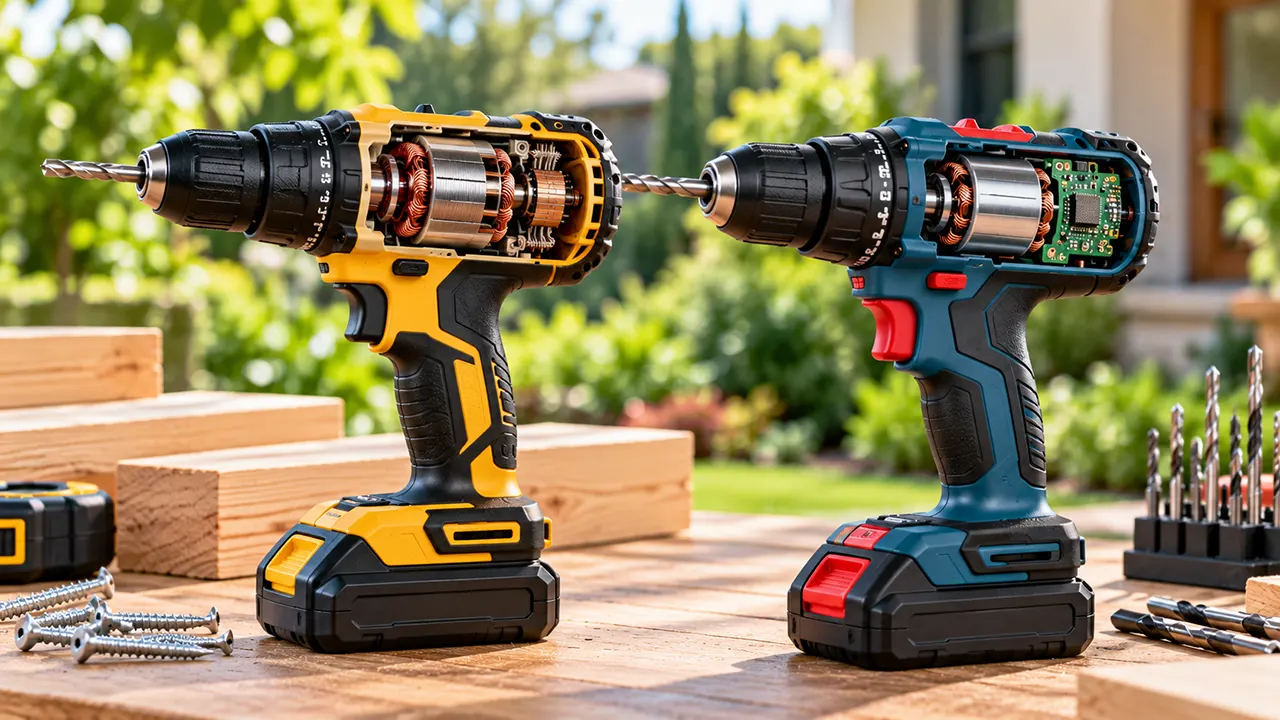
A brushless drill is usually better for frequent or demanding work because it is more efficient, produces less motor friction, and eliminates carbon-brush wear. A brushed drill is often the better budget choice for occasional DIY and light-duty tasks. The right choice depends on your workload, battery needs, tool quality, and budget.
Affiliate Disclosure
ToolGuider participates in the Amazon Services LLC Associates Program and may earn a commission when readers purchase qualifying products through affiliate links. This does not change the price you pay. See the full for details.
Brushless vs Brushed Drill: Key Difference Between Brushless and Brushed Drill
| Feature | Brushed Drill | Brushless Drill |
|---|---|---|
| Motor switching | Physical brushes and commutator | Electronic control |
| Friction inside motor | Higher | Lower |
| Heat from motor friction | Generally higher | Generally lower |
| Motor maintenance | Brushes can wear and require replacement | No carbon brushes to replace |
| Battery efficiency | Generally lower | Generally higher |
| Runtime potential | Generally lower under comparable conditions | Generally higher under comparable conditions |
| Long-term motor wear | Brush and commutator wear | Less motor wear from brush contact |
| Upfront cost | Usually lower | Usually higher |
| Best fit | Occasional and budget-focused use | Frequent, demanding, or long-term use |
The important point is that brushless does not automatically mean the entire drill is better. A drill is a complete system. Its gearbox, chuck, clutch, battery, ergonomics, speed range, construction, and warranty also affect its value.
How a Brushed Drill Motor Works
A brushed motor uses carbon brushes that make physical contact with a rotating commutator. That contact helps switch electrical current through the motor windings as the armature turns. DEWALT explains that this contact creates friction, heat, and some energy loss.
What the Carbon Brushes and Commutator Do
Think of the brushes as electrical contacts that maintain the connection while the motor spins. The commutator changes which windings receive current, allowing the magnetic forces inside the motor to keep producing rotation.
The design is relatively straightforward and has been used in power tools for decades. It also has a practical advantage: when the brushes eventually wear, they can be replaced on tools designed to accept replacement brushes.
That simplicity can make a brushed drill attractive when purchase price matters more than maximum efficiency.
Why Friction Creates Heat and Wear
The brushes physically contact the spinning commutator. That contact creates mechanical friction and electrical losses, which contribute to heat and component wear.
The important ownership consequence is simple: the motor contains a consumable wear component.
For someone who uses a drill occasionally, that may not matter much. A homeowner who drills a few holes every few months may never reach the point where brush replacement becomes an important concern.
How a Brushless Drill Motor Works
A brushless motor removes the physical brushes and commutator used for mechanical switching. Instead, electronic circuitry controls current through the motor windings.
The result is less friction at the electrical switching point. DEWALT describes this as allowing a more efficient, cooler motor with less wear, while Bosch highlights reduced friction, efficient runtime, and reduced heat and noise in its brushless professional tools.
Electronic Switching Replaces Physical Brushes
In a brushless design, the motor’s electronics determine when current should be supplied to the windings. The rotor can therefore turn without carbon brushes rubbing against a commutator.
That changes the motor’s operating characteristics, but it does not magically increase every aspect of a drill’s performance.
A high-quality brushed drill can still be more useful than a poorly designed brushless drill if the rest of the tool is better suited to the job.
Why Brushless Motors Can Run Cooler and More Efficiently
Removing brush-to-commutator contact eliminates an important source of friction and wear. Manufacturers therefore commonly associate brushless motors with better efficiency, lower heat, longer motor life, and longer runtime.
However, avoid treating one manufacturer’s runtime claim as a universal rule. Actual runtime depends on the battery, material, bit, load, speed, temperature, and tool design.
The useful takeaway is not a single percentage. It is that brushless technology gives the motor a more efficient electrical and mechanical architecture under comparable operating conditions.
Brushless vs Brushed Drill: Where You Notice the Difference
The motor difference becomes useful only when it changes what you experience while working.
Battery Runtime
Brushless motors can use battery energy more efficiently because they eliminate the friction and electrical losses associated with physical brush contact. Bosch specifically describes its brushless drill technology as providing better power efficiency and longer operation per charge.
DEWALT currently states that its brushless motors deliver up to 57% more runtime than its standard brushed motors. That is a useful manufacturer benchmark, but it applies to DEWALT’s stated comparison and should not be presented as the expected gain for every brand or drill.
Your actual runtime can also change dramatically with the work. Drilling large holes in hardwood puts a very different load on a motor than driving small screws into softwood.
The practical rule: If you frequently work through several batteries during a project, efficiency becomes much more valuable.
Power and Torque Under Load
Brushless motors are often associated with stronger and more consistent performance, but motor type alone does not determine how much torque a drill produces.
Gear ratios, motor design, electronics, battery capability, and the manufacturer’s tuning all matter. For example, Bosch’s GSR 18V-50 brushless drill specifies up to 50 Nm of torque, but that number belongs to that particular drill rather than to brushless motors as a category.
This distinction matters when shopping.
Do not compare two drills by reading only the word brushless. Compare their actual specifications and intended applications.
Heat and Comfort
Heat becomes more important when a drill works continuously or under heavy load.
Because brushless motors eliminate brush friction, manufacturers commonly emphasize cooler operation. Bosch specifically lists less noise and heat among the characteristics of its brushless system.
For short household jobs, you may barely notice this advantage. During repeated drilling or fastening, however, better heat management can become much more meaningful.
Durability and Maintenance
A brushed motor has brushes that eventually wear. Brushless motors eliminate that specific wear component.
That does not mean a brushless drill cannot fail. Bearings, electronics, gears, switches, batteries, and other components can still wear or fail.
The more accurate conclusion is:
Brushless reduces one important source of motor wear; it does not make the entire drill indestructible.
Is a Brushless Drill Worth the Extra Cost?
For many frequent users, yes. For occasional users, not necessarily.
The value depends on how much you will use the advantages rather than whether brushless technology is technically superior.
When the Higher Price Makes Sense
A brushless drill becomes easier to justify when you:
- Use a drill every week
- Frequently perform long projects
- Drill or drive under heavier loads
- Care about maximizing battery runtime
- Want to minimize brush-related maintenance
- Expect to keep the tool for many years
- Already own batteries in a compatible brushless tool ecosystem
If the drill is an important working tool rather than something that sits in a toolbox for months, the efficiency and reduced brush wear can have more practical value.
When a Brushed Drill Saves Money Without Giving You Less Than You Need
A brushed drill can be a sensible purchase when:
- You use it only occasionally
- Most jobs are light-duty
- Your projects are short
- Initial price is your biggest concern
- You do not need maximum battery efficiency
- A particular brushed model has the features and performance you need
For example, hanging shelves, assembling furniture, installing hardware, and performing occasional household repairs may not justify paying substantially more simply for brushless technology.
The cheapest option is not automatically the best value, but neither is the most advanced motor automatically the best value.
Which Drill Motor Is Better for Different Users?
Occasional Homeowner
Brushed is often enough.
If your drill comes out of the toolbox only a few times a year, spending extra for brushless technology may produce little noticeable benefit. Focus instead on getting a reliable drill with appropriate speed, torque, chuck quality, battery capacity, and comfortable handling.
Weekend DIYer
Either can make sense.
If your projects are mostly furniture assembly, shelves, picture hanging, and small repairs, a good brushed drill can do the job. If your DIY work is becoming more frequent or includes larger projects, brushless becomes more attractive.
Frequent DIY User
Brushless is usually the stronger long-term choice.
Frequent use gives efficiency, heat management, and reduced brush wear more opportunities to provide value.
Woodworker or Remodeler
Brushless deserves serious consideration.
Repeated drilling and fastening can put greater demands on a cordless drill. Battery efficiency and sustained operation become more important when the tool is working repeatedly throughout a project.
Still, choose based on the complete drill rather than the motor label alone.
Professional Contractor
Brushless is generally the more appropriate starting point.
Professionals may use drills far more frequently than occasional DIY users, making efficiency, runtime, heat management, durability, and reduced maintenance more consequential.
The specific tool should still be selected based on the trade, workload, battery platform, ergonomics, and required performance.
What Matters More Than Brushless vs Brushed?
The motor is important, but it is only one part of the buying decision.
Battery Platform and Capacity
If you are building a cordless tool collection, battery compatibility can become more important than the motor label.
A drill that shares batteries with your existing tools can reduce the need to buy additional battery packs and chargers.
Battery capacity also affects runtime. A highly efficient motor cannot overcome every limitation of a small or heavily loaded battery.
Chuck, Gearbox and Clutch Quality
The motor generates rotation, but the drill still has to transfer that power effectively.
Look at:
- Chuck type and capacity
- Gearbox design
- Number of speed settings
- Clutch positions
- Maximum torque
- Maximum RPM
- Intended materials
A brushless motor paired with a poor overall tool design is not automatically a better purchase.
Speed and Torque Range
Different jobs require different combinations of speed and torque.
High speed can be useful for certain drilling tasks, while lower speed and higher torque can be more appropriate for demanding fastening or larger bits.
The best drill is the one whose operating range matches your work.
Ergonomics and Tool Weight
If you use a drill for hours, weight and balance matter.
A tool that feels comfortable in your hand can be more useful than one with a theoretically superior motor that is awkward or tiring to use.
Bosch, for example, specifically highlights compactness and balanced ergonomics alongside the brushless motor in its professional drill specifications.
Common Brushless vs Brushed Drill Buying Mistakes
Assuming Brushless Automatically Means Better
Brushless is an important motor technology, not a complete quality rating.
Compare the whole drill.
Comparing Motor Type Without Comparing the Battery
Runtime is a system-level issue. Battery capacity, load and operating conditions all matter.
Paying for Brushless Technology You Will Rarely Use
If your drill handles a handful of small household jobs each year, the premium may deliver little practical benefit.
Ignoring the Tool Ecosystem
If you already own compatible batteries and chargers, staying within that platform may be more valuable than switching brands simply to obtain a particular motor type.
Treating Advertised Torque as the Entire Performance Story
Torque specifications are useful, but they do not tell you everything about how a drill will feel or perform in a particular application.
Consider speed range, gearbox, clutch, battery, ergonomics, chuck and intended workload together.
DEWALT 20V MAX Brushless Cordless Drill Driver Set
Frequently Asked Questions
Is a brushless drill better than a brushed drill?
A brushless drill is generally the better choice for frequent or demanding use because its motor eliminates carbon brushes and their associated friction and wear. Manufacturers also associate brushless designs with improved efficiency, lower heat and longer runtime. A brushed drill can still be the better value for occasional, light-duty users who prioritize a lower purchase price.
Do brushless drills last longer?
A brushless motor can have a longer service life because it does not contain carbon brushes that wear through physical contact with a commutator. However, the complete drill still contains other components that can fail or wear. Therefore, brushless technology can reduce motor wear, but it should not be interpreted as a guarantee that every brushless drill will outlast every brushed drill.
Do brushless drills have better battery life?
Generally, brushless motors can use battery energy more efficiently than comparable brushed motors because they eliminate brush-related friction and losses. Bosch specifically describes efficient runtime as an advantage of its brushless drills, while DEWALT reports up to 57% more runtime for its brushless motors versus its standard brushed motors. Actual results vary by tool, battery and workload.
Are brushed drills still worth buying?
Yes. A brushed drill can be a sensible choice for occasional household repairs, light DIY work and buyers who want to minimize upfront cost. If the drill will spend most of its life in a toolbox, the additional efficiency and reduced brush wear of a brushless model may not justify a substantial price difference.
Are brushless drills more powerful?
Not automatically. Brushless motors can provide efficiency and performance advantages, but the power and torque of a particular drill depend on its motor, electronics, gearbox, battery and overall design. Always compare the actual specifications of the drills you are considering instead of assuming that every brushless model will outperform every brushed model.
Is brushless worth the extra money for DIY?
For frequent DIY, brushless is often worth considering because you have more opportunities to benefit from efficiency, runtime and reduced brush wear. For occasional DIY, a quality brushed drill can provide all the performance you need at a lower initial cost. Your usage frequency should be the starting point for the decision.
Can you replace the brushes in a brushed drill?
On models designed with serviceable brushes, worn carbon brushes can generally be replaced. The exact procedure and availability of replacement parts depend on the tool. Brush replacement is therefore a maintenance consideration rather than an automatic reason to avoid brushed motors.
Do brushless drills require maintenance?
Brushless motors do not require carbon-brush replacement because they do not use those brushes. However, a brushless drill still needs normal care, including keeping it clean, protecting it from inappropriate conditions, maintaining its battery correctly, and following the manufacturer’s instructions.
Are brushless drills quieter?
Removing brush-to-commutator contact can reduce some motor noise. Bosch specifically lists reduced noise and heat as characteristics of its brushless system. However, the total noise produced by a drill also comes from gears, bearings, airflow, the work material, and the drilling process itself.
What should I choose for occasional home use?
Choose a good brushed drill if keeping the initial cost low is important and your projects are light and infrequent. Choose brushless if you expect to use the drill regularly, want better efficiency, or plan to build a cordless tool collection around a brushless platform.
The Bottom Line: Match the Motor to the Work
For most frequent users, brushless is the better long-term choice because it removes brush wear and can improve efficiency, heat management and runtime. For occasional homeowners and budget-focused DIYers, a quality brushed drill can still be a perfectly sensible purchase.
The smartest approach is not to ask, “Which motor is best?” Ask, “Which motor gives me enough benefit for the way I actually use my drill?”
Before buying, compare the complete tool – motor, battery platform, torque, speed, chuck, gearbox, clutch, weight, warranty and price. If you use a drill regularly, brushless technology is easier to justify. If the drill mostly sits in your toolbox, spending less on a capable brushed model may be the better value.
When you are ready to compare actual drills, focus first on models that match your workload and battery platform rather than choosing solely by the brushless label.
