


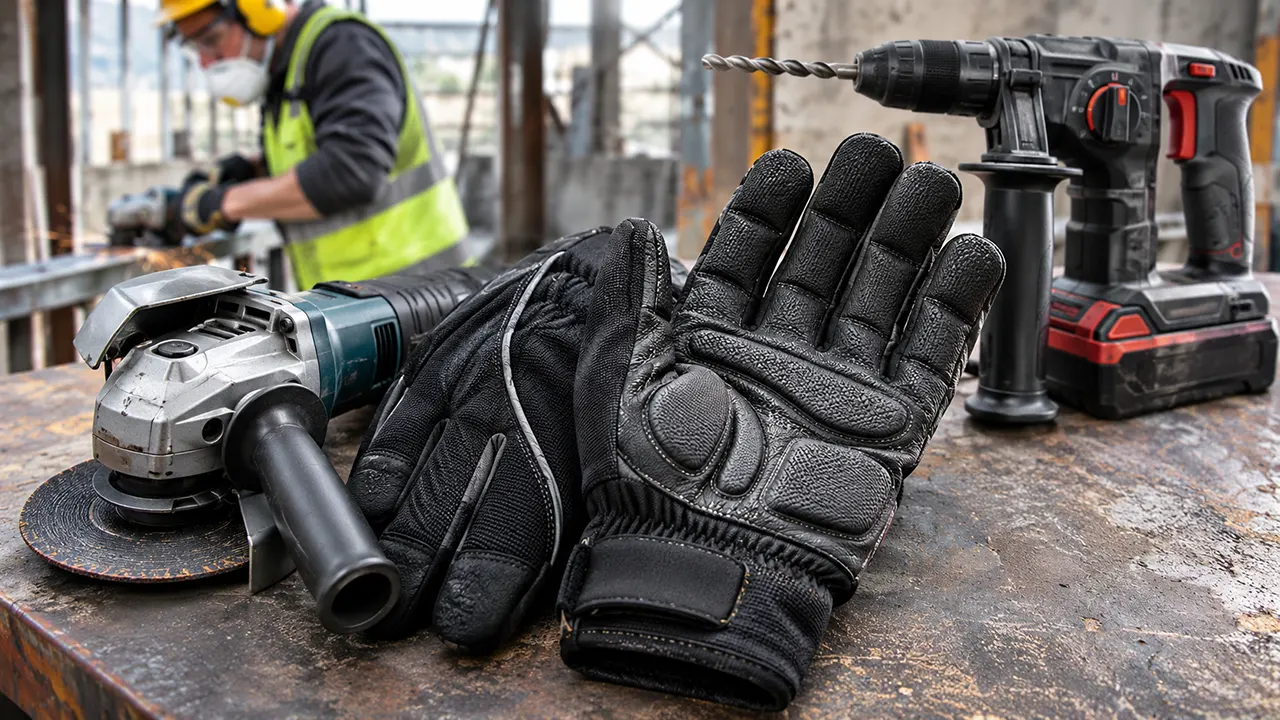
Anti-vibration gloves can reduce some vibration frequencies transmitted to the hands, but they cannot reliably prevent hand-arm vibration syndrome (HAVS). Their effectiveness depends on vibration frequency, direction, glove construction, and working conditions. Workers should prioritize low-vibration tools, proper maintenance, and exposure management rather than relying on gloves alone.
Power tools make demanding jobs faster, but they also expose workers to repeated vibration. Angle grinders, impact wrenches, hammer drills, and concrete breakers can transmit vibration directly through the hands and arms.
Anti-vibration gloves appear to offer a simple solution. Their padded palms promise to absorb vibration and make tools more comfortable to operate. However, the actual protection is more complicated.
A glove can pass a laboratory vibration-transmission test without providing complete protection during everyday work. Understanding this difference is important before choosing protective equipment.
This guide examines the science behind anti-vibration gloves, explains ISO 10819 and ISO 5349, and identifies more effective ways to manage vibration exposure.
Why Anti-Vibration Gloves Are Not a Complete Safety Solution
Anti-vibration gloves may reduce certain components of hand-transmitted vibration, but they cannot eliminate the risk of HAVS. Their performance varies with vibration frequency, direction, tool design, and contact conditions. NIOSH specifically advises against relying on gloves alone to reduce vibration exposure.
The main problem is that vibration is not a single, uniform force. Different power tools generate different vibration patterns, and protective materials do not respond equally to every frequency.
A padded glove might reduce vibration in one direction while allowing substantial vibration to pass through in another.
There is also a difference between reducing vibration at the palm during a laboratory test and reducing a worker’s total daily exposure.
For this reason, anti-vibration gloves should be treated as supplementary hand protection, not a substitute for effective workplace vibration controls.
What Are Anti-Vibration Gloves and How Do They Work?
Anti-vibration gloves are protective work gloves designed with materials in the palm and other contact areas to reduce certain vibration components transmitted from tools to the hands.
Unlike ordinary work gloves, they typically include specialized padding intended to isolate the hand from vibrating handles and surfaces.
Materials Used in Vibration-Reducing Gloves
Manufacturers use different materials and construction methods to provide cushioning and vibration attenuation.
Common design elements include:
- Gel padding: Adds cushioning between the hand and the tool handle.
- Foam padding: Provides compression and impact absorption.
- Rubber compounds: Create flexible contact surfaces and cushioning.
- Specialized elastomers: Provide vibration-control properties at selected frequencies.
- Reinforced palm panels: Protect areas exposed to repeated contact and pressure.
However, thicker padding does not automatically provide better vibration protection.
A material that performs well at one frequency may perform poorly at another. The glove must also fit properly and allow the worker to maintain safe control of the tool.
Full-Finger vs. Fingerless Anti-Vibration Gloves
Both designs appear in the work-glove market, but they serve different practical needs.
| Feature | Full-finger gloves | Fingerless gloves |
|---|---|---|
| Finger coverage | Complete | Partial |
| Grip and dexterity | Depends on construction | Often better fingertip access |
| Palm cushioning | Depends on model | Depends on model |
| Hand protection | More coverage | Less coverage |
| Best consideration | General hand protection | Tasks requiring exposed fingertips |
Neither design automatically offers better vibration reduction. Check the actual certification and test documentation rather than choosing based on appearance.
How Power Tools Transmit Harmful Vibration
Power tools generate mechanical movement that travels through their handles and contact surfaces. When a worker holds the tool, some of that movement transfers into the hands and arms.
This is called hand-transmitted vibration.
The amount of exposure depends on several factors:
- The tool’s vibration magnitude.
- Vibration frequency and direction.
- How long the worker operates the tool.
- Grip and contact force.
- Tool condition and maintenance.
- The material and surface being worked on.
Understanding Vibration Frequency and Magnitude
Vibration frequency describes how many oscillations occur per second and is measured in hertz (Hz).
Vibration magnitude describes the strength of the vibration, commonly expressed as acceleration in meters per second squared (m/s²).
These measurements help explain why two power tools that feel similar may produce different exposure patterns.
A glove designed to reduce one frequency range may not provide the same attenuation at another.
Why Grip Force and Contact Conditions Matter
How a worker holds a tool affects vibration transmission.
Gripping a vibrating tool too tightly can increase the force transmitted through the hand. However, workers must maintain enough grip to control the equipment safely.
NIOSH recommends allowing the tool to do the work and avoiding unnecessarily tight gripping. It also recommends maintaining tools and considering alternative processes where practical.
The practical lesson is simple: do not sacrifice safe tool control to achieve a supposedly lighter grip.
What Is Hand-Arm Vibration Syndrome (HAVS)?
Hand-arm vibration syndrome (HAVS) is an occupational health condition associated with repeated exposure to vibration from handheld tools and other vibrating equipment.
HAVS can affect blood vessels, nerves, muscles, and other structures in the hands and arms. Some effects can become permanent after prolonged or intensive exposure.
Workers who regularly use vibrating equipment should understand its early warning signs.
Vibration White Finger and Circulation Problems
Vibration white finger is a circulatory condition associated with occupational vibration exposure.
Repeated vibration can affect the small blood vessels supplying the fingers. During an attack, affected fingers may become unusually pale or white, particularly in cold conditions.
Other symptoms can include:
- Fingers becoming unusually cold.
- Changes in finger color.
- Tingling or pins-and-needles sensations.
- Pain during or after exposure.
Cold and wet working conditions can make circulation-related symptoms more noticeable.
Nerve Damage and Loss of Sensation
HAVS can also affect the nerves responsible for sensation.
Workers may experience numbness, reduced sensitivity, tingling, and difficulty distinguishing textures or handling small objects.
In more advanced cases, loss of grip strength and reduced hand coordination can interfere with everyday activities.
Early Warning Signs Workers Should Recognize
Pay attention to recurring symptoms such as:
- Tingling during or after using vibrating equipment.
- Fingers becoming white or unusually pale.
- Persistent numbness.
- Reduced sensitivity in the fingertips.
- Pain or unusual coldness in the hands.
These symptoms deserve medical evaluation, especially when they occur repeatedly after occupational vibration exposure. Workers should report suspected symptoms through their workplace health and safety process.
Do Anti-Vibration Gloves Actually Work?
Yes, some anti-vibration gloves can reduce certain components of vibration transmission under specific conditions. However, research does not support treating all anti-vibration gloves as equally effective or assuming that they prevent HAVS.
The most important issue is frequency-specific performance.
A glove’s ability to attenuate vibration depends on the relationship between the vibration generated by the tool and the mechanical properties of the glove.
What Laboratory Research Demonstrates
Research published in Ergonomics examined vibration transmission through anti-vibration gloves in three orthogonal directions.
The researchers found that the tested gloves were generally more effective at reducing vibration along the forearm direction. They did not effectively attenuate vibration along the handle’s axial direction.
This finding demonstrates why a single laboratory measurement cannot describe every aspect of real-world glove performance.
Another study published in Applied Ergonomics in 2021 examined vibration exposure during grinding of handheld workpieces. Its results indicated that vibration-reducing gloves could reduce vibration measured at the palm, back of the hand, and wrist in the experimental conditions. CDC Stacks
These findings are not contradictory. They examine different work conditions, measurement locations, and vibration characteristics.
Why Results Vary Between Gloves and Tools
Several factors influence glove performance:
- Frequency: Padding may attenuate some frequencies more effectively than others.
- Direction: Vibration can travel through different axes of the hand and tool.
- Tool design: Handle geometry and vibration characteristics influence transmission.
- Grip force: Changes in contact conditions can affect how vibration reaches the hand.
- Glove construction: Padding material, thickness, and placement influence performance.
- Fit: A poorly fitting glove can interfere with safe handling and control.
This is why a glove that performs well in one test should not automatically be considered suitable for every power tool.
Can Anti-Vibration Gloves Make Vibration Worse?
Under certain conditions, a glove may amplify particular vibration components rather than reduce them.
This can happen because padding changes the mechanical interaction between the hand and the vibrating handle. The result depends on the vibration frequency and the glove’s mechanical characteristics.
The important point is that vibration attenuation is not guaranteed across every frequency and direction.
Workers should not assume that thicker padding always means greater protection.
Why Increased Grip Force Can Undermine Effectiveness
A bulky or poorly fitting glove can make it harder to maintain a secure grip.
If a worker compensates by squeezing the handle more tightly, the resulting increase in contact force may undermine the intended benefit.
A glove should allow adequate dexterity and secure tool control. If it makes operating the equipment more difficult, it may be unsuitable for that particular task.
ISO 10819 vs. ISO 5349: Understanding the Difference
ISO 10819 and ISO 5349 address different aspects of hand-arm vibration.
ISO 10819 evaluates vibration transmission through gloves, while ISO 5349 provides a method for measuring and evaluating human exposure to hand-transmitted vibration.
Understanding this distinction helps workers avoid confusing a glove’s test result with proof of personal safety.
What ISO 10819 Tests in Anti-Vibration Gloves
ISO 10819:2013
This standard specifies laboratory methods for measuring and evaluating vibration transmissibility through gloves at the palm of the hand.
The standard examines vibration transmitted from a handle through a glove to the palm.
It covers one-third-octave frequency bands with center frequencies from 25 Hz to 1,250 Hz. ISO+1
The standard was reviewed and confirmed in 2024, and ISO identifies the 2013 edition as current. It also has two amendments.
The important limitation is that passing this test does not demonstrate that a glove will prevent HAVS under every working condition.
What ISO 5349 Measures in Human Vibration Exposure
ISO 5349-1:2001
This standard establishes general requirements for measuring and evaluating human exposure to hand-transmitted vibration.
ISO 5349-1 considers how vibration reaches the hand and how exposure can be evaluated.
The standard was reviewed and confirmed in 2026, so the 2001 edition remains current according to ISO. Part 1: General requirements
It provides a framework for assessing exposure rather than testing the protective performance of a particular glove.
ANSI/ASA S2.73 and US Certification Terminology
US readers may also encounter ANSI/ASA S2.73-2014 (R2024).
This is the US national adoption of ISO 10819:2013. The CDC’s PPE-Info database identifies it as a test method for measuring glove vibration transmissibility. Standard Details
When evaluating a product, check whether the manufacturer provides genuine documentation identifying the applicable standard and test results.
Why Certification Does Not Guarantee HAVS Prevention
A certification establishes that a glove has been evaluated under a defined test method.
It does not establish that:
- The glove eliminates vibration exposure.
- Every power tool produces the same result.
- The worker can safely use the glove for unlimited periods.
- The glove prevents all circulation and nerve damage.
- The worker no longer needs workplace exposure controls.
Remember: ISO 10819 certification is evidence of tested glove performance, not a guarantee of protection against HAVS.
Why Anti-Vibration Glove Performance Changes Between Power Tools
Power tools differ in vibration frequency, magnitude, direction, handle design, and operating conditions. Therefore, one glove may perform differently when used with different equipment.
The following comparison helps explain why tool-specific evaluation matters.
| Power tool | Important consideration | Glove selection concern |
|---|---|---|
| Angle grinder | Rotational vibration and handle contact | Secure grip and suitable padding |
| Orbital sander | Repeated surface vibration | Palm contact and vibration frequency |
| Impact wrench | Repeated impact and torque | Grip stability and dexterity |
| Hammer drill | Percussive vibration | Tool control and hand positioning |
| Jackhammer | Intensive percussive exposure | Exposure reduction takes priority |
| Chainsaw | Engine and cutting-system vibration | Grip, control, and task-specific protection |
| Concrete breaker | Heavy repeated vibration | Equipment selection and exposure management |
This table describes practical considerations, not measured glove-performance rankings.
Angle Grinders and Orbital Sanders
Angle grinders and orbital sanders have different vibration characteristics.
An angle grinder may expose workers to vibration associated with its rotating components, tool condition, and contact with the workpiece.
An orbital sander produces repeated movement through its sanding mechanism and contact surface.
Workers should select gloves that preserve grip and control while following the tool manufacturer’s safety instructions.
Impact Wrenches and Hammer Drills
Impact wrenches and hammer drills generate repeated mechanical impacts.
Their vibration characteristics differ from those of continuously rotating tools. A glove’s laboratory performance should not be interpreted as proof that it offers equivalent attenuation during impact-tool operation.
Tool maintenance, correct accessories, and appropriate work practices remain essential.
Jackhammers and Concrete Breakers
Jackhammers and concrete breakers can expose workers to substantial hand-arm vibration.
For these applications, reducing exposure at the source is particularly important.
Workers and employers should evaluate equipment vibration information, actual operating time, and opportunities to use alternative equipment or processes.
Chainsaws and Other Vibrating Equipment
Chainsaws produce hand-transmitted vibration that can contribute to HAVS.
OSHA identifies tool vibration, operating time, grip position, maintenance, and cold or wet conditions as relevant risk factors. Occupational Safety and Health Administration
Gloves should never interfere with the operator’s ability to maintain safe control or operate required safety features.
Better Ways to Reduce Hand-Arm Vibration Exposure
The most effective strategy is to reduce vibration exposure before it reaches the worker’s hands.
NIOSH recommends redesigning jobs to minimize vibrating-tool use and applying engineering, work-practice, and administrative controls where vibrating equipment cannot be eliminated.
Choose Low-Vibration Power Tools
Tool selection can make a significant difference.
Before purchasing equipment, compare manufacturer vibration-emission information where available. Consider tools designed with vibration-damping handles, isolation systems, or other vibration-reduction features.
For larger workplaces, involve a qualified safety professional in evaluating equipment and exposure conditions.
A tool with a lower stated vibration emission may be a better choice, but actual workplace exposure also depends on how the equipment is used.
Maintain Tools, Blades, Bits and Attachments
Poorly maintained equipment can produce unnecessary vibration.
Check equipment regularly for:
- Worn bearings and damaged components.
- Unbalanced rotating parts.
- Damaged grinding wheels.
- Worn cutting blades.
- Dull drill bits and cutting accessories.
- Loose handles or damaged mounting components.
OSHA identifies poor maintenance, worn cutting equipment, and unbalanced rotating components as potential contributors to excessive vibration.
Follow the manufacturer’s maintenance schedule and replace damaged accessories promptly.
Reduce Unnecessary Trigger Time
Trigger time is the actual time a worker spends operating a vibrating tool.
It is different from the total time spent at work.
For example, a worker may spend eight hours on a construction site but operate a vibrating tool for only part of that period.
Exposure assessment should consider the actual duration and magnitude of vibration rather than relying only on the length of the work shift.
Where practical, organize tasks to reduce unnecessary continuous exposure.
Use Appropriate Grip and Working Techniques
Workers should maintain secure control without applying unnecessary grip force.
Useful practices include:
- Allowing the tool to do the work.
- Avoiding excessive pressure.
- Maintaining a comfortable working position.
- Using the correct accessory for the task.
- Keeping hands warm and dry.
- Avoiding damaged or poorly maintained equipment.
These measures can improve tool handling and support exposure management.
Introduce Exposure Monitoring and Health Surveillance
Employers should identify jobs involving regular hand-arm vibration exposure and assess the associated risks.
Depending on the workplace, this may involve:
- Reviewing manufacturer vibration-emission data.
- Measuring vibration exposure using appropriate methods.
- Estimating daily exposure using actual operating times.
- Training workers to recognize early symptoms.
- Arranging appropriate occupational health surveillance.
- Reviewing equipment and work practices when problems arise.
ISO 5349 provides a recognized framework for evaluating hand-transmitted vibration exposure.
A newer related development is ISO/TS 22270:2026, which provides practical guidance for monitoring and measuring vibration on the hand, wrist, or forearm. It complements rather than replaces the ISO 5349-1 measurement framework.
How to Choose Appropriate Anti-Vibration Work Gloves
Anti-vibration gloves should be selected according to the task, tool, fit, and applicable safety requirements.
A certification claim is a useful starting point, but it should not be the only purchasing consideration.
Check Genuine ISO 10819 Documentation
Look for manufacturer documentation that identifies:
- The applicable standard and edition.
- The glove model covered by the certification.
- The relevant conformity or test documentation.
- The intended application.
- Any stated limitations.
Do not assume that every glove marketed as vibration-reducing has passed ISO 10819 testing.
Evaluate Fit, Grip and Finger Dexterity
A suitable glove should fit securely without restricting movement.
Check whether the padding creates excessive bulk or interferes with the tool’s controls.
A glove that compromises grip or dexterity may introduce additional operational risks.
Consider Full-Finger Coverage
Full-finger gloves provide coverage across the fingers and palm. Fingerless models leave parts of the fingers exposed.
Choose the design according to the task’s hand-protection requirements, tool manufacturer’s instructions, and workplace risk assessment.
Match Glove Characteristics to the Application
Consider the following before purchasing:
| Selection factor | What to check |
|---|---|
| Certification | Genuine ISO 10819 documentation |
| Fit | Secure without excessive tightness |
| Grip | Maintains safe tool control |
| Dexterity | Allows proper operation of controls |
| Padding | Suitable construction and coverage |
| Durability | Appropriate for the working environment |
| Compatibility | Does not conflict with tool safety requirements |
Example: Ergodyne ProFlex 9002
Manufacturer-listed standards: ANSI/ASA S2.73-2014 / ISO 10819:2013
- Full-length AVC palm padding.
- Gripping palm.
- Reinforced fingertips and thumb saddle.
- Neoprene knuckle pad.
- EN 388: 2121X.
The ProFlex 9002 is one example of a commercially available glove with documented ISO 10819 compliance.
Ergodyne lists a regular price of $77.85, while Home Depot lists different prices depending on size. For example, the medium size was listed at $53.68 during research. Prices and availability can change.
Important purchasing consideration: This product’s certification does not mean it prevents HAVS or provides adequate protection for every power tool. Evaluate its fit, application, and workplace requirements before buying.
FAQs: Anti Vibration Gloves power tools
1. Do anti-vibration gloves prevent HAVS?
No. Anti-vibration gloves cannot be relied upon to prevent hand-arm vibration syndrome. Some designs may attenuate particular vibration components, but their effectiveness depends on frequency, direction, and working conditions. Workers should prioritize low-vibration equipment, proper maintenance, and exposure management.
2. Are ISO 10819-certified gloves worth buying?
They can be worth considering when workers need suitable hand protection and want documented vibration-transmission testing. However, certification should not be confused with proof of HAVS prevention. Check the manufacturer’s documentation, glove fit, grip, dexterity, and suitability for the actual task.
3. Can anti-vibration gloves make vibration worse?
Some gloves may amplify particular vibration components under certain conditions. Their mechanical properties interact with the vibration generated by the tool. This is why glove performance cannot be judged by padding thickness alone. Look for actual test documentation and avoid assuming that every padded glove reduces every vibration frequency.
4. Do anti-vibration gloves work with impact drills?
They may attenuate some vibration components, but their performance with impact drills cannot be assumed from a general certification claim. Impact tools produce different vibration patterns from continuously rotating equipment. Select gloves that maintain safe tool control and prioritize equipment designed to reduce vibration exposure.
5. Are anti-vibration gloves required by OSHA?
There is no universal federal OSHA requirement specifically mandating ISO 10819-certified anti-vibration gloves for every power-tool user. OSHA provides task-specific guidance on vibration hazards and protective practices. Employers must evaluate applicable workplace hazards and follow relevant PPE and safety requirements.
6. What is the difference between vibration-reducing and ordinary work gloves?
Ordinary work gloves primarily address hazards such as abrasion, cuts, dirt, and contact injuries. Vibration-reducing gloves incorporate specialized materials intended to attenuate certain vibration components. However, marketing terminology alone does not establish tested performance. Check whether the specific model has appropriate certification documentation.
7. What should workers do when they experience numbness or tingling?
Workers should report recurring numbness, tingling, finger blanching, or unusual coldness to their supervisor and seek medical evaluation. They should not assume that changing gloves will solve the problem. Continued exposure may worsen vibration-related injuries, so the workplace risk assessment and exposure controls should be reviewed promptly.
Make Vibration Reduction Your First Priority
Anti-vibration gloves can have a place in workplace hand protection, but they should never become the main strategy for managing harmful vibration exposure.
Before buying a pair, evaluate the tool, the working conditions, the certification, and the glove’s practical suitability.
If you regularly operate vibrating power tools, start by reviewing equipment vibration levels and maintenance practices. Those decisions are more important than relying on padded gloves to solve the problem.
For additional guidance, read ToolGuider’s NIOSH Buy Quiet Power Tools guide.
