


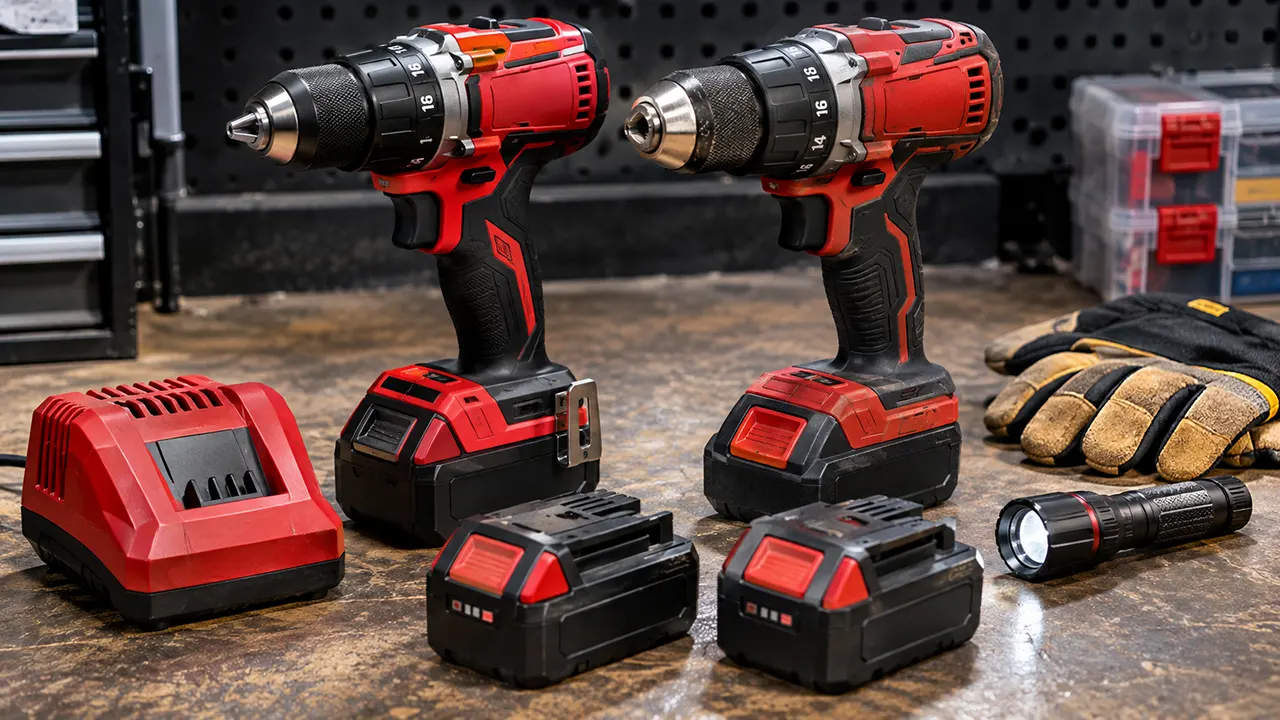
Counterfeit power tools can look surprisingly similar to genuine Milwaukee, DEWALT, and Makita products. Some even copy original logos, packaging, model numbers, and battery designs. However, a convincing appearance does not guarantee genuine components, reliable performance, or safe operation. Buyers should verify the seller, product information, construction, and manufacturer support before trusting a cordless tool.
This guide explains how to identify counterfeit power tools, inspect suspicious batteries, compare genuine and fake products, and verify popular cordless tool brands before buying. It also includes a practical inspection checklist for online purchases and newly delivered tools.
Affiliate disclosure: This article contains affiliate links. ToolGuider may earn a commission when you purchase through these links, at no additional cost to you. Product links are provided as optional examples of genuine manufacturer models. Always verify the seller, listing details, and product condition before purchasing.
1. What Are Counterfeit Power Tools?
Counterfeit power tools are products falsely presented as genuine tools from established manufacturers. They may copy brand names, logos, model numbers, packaging, and product designs without authorization.
These products can include cordless drills, impact drivers, impact wrenches, circular saws, batteries, and chargers. Some counterfeit products closely resemble genuine tools, making identification difficult without careful inspection.
Counterfeit vs. knockoff vs. compatible tools
These terms describe different products. Understanding the differences helps buyers avoid incorrectly labeling every non-original product as counterfeit.
| Product type | What it means |
|---|---|
| Counterfeit tool | A product falsely presented as genuine branded equipment |
| Knockoff tool | A product that imitates another product’s appearance or design |
| Third-party compatible battery | A battery made by another manufacturer and marketed for compatibility |
| Refurbished tool | A previously used tool restored for resale |
| Gray-market genuine tool | An authentic product sold outside the manufacturer’s intended distribution channel |
| Unauthorized genuine product | A genuine product sold by a retailer without authorized dealer status |
A third-party battery is not automatically counterfeit. The important distinction is whether the seller falsely represents its origin, branding, certification, or compatibility.
Counterfeit cordless tools vs. gray-market genuine products
A gray-market tool may be manufactured by the actual brand but imported or sold outside its authorized distribution network.
It may have different packaging, regional specifications, or warranty limitations.
A counterfeit product, however, falsely claims an identity or origin it does not have.
Buyers should verify the actual product and its warranty eligibility instead of assuming that an unfamiliar retailer automatically sells fake equipment.
Which power tool brands are commonly targeted?
Popular professional tool brands are attractive targets because buyers recognize their names and established battery platforms.
Commonly imitated brands include:
- Milwaukee, especially its M18 and M12 cordless systems.
- DEWALT, particularly its 20V MAX product range.
- Makita, including its 18V LXT cordless platform.
- Bosch Professional power tools.
- Other established manufacturers with recognizable product designs.
The presence of a familiar logo does not establish authenticity.
2. Why Are Fake Cordless Tools Becoming a Concern?
Online shopping makes it easier to compare power tools and find attractive discounts. However, it also creates opportunities for fraudulent sellers to advertise products using copied photographs, misleading descriptions, and unauthorized brand names.
Online marketplaces and fraudulent seller websites
Counterfeit products can appear through independent websites, third-party marketplace sellers, social media advertisements, and suspicious online stores.
Some sellers use genuine manufacturer photographs even when the delivered product is not genuine.
A listing may also display a legitimate brand name while providing incomplete manufacturer information or an unusually attractive price.
Remember that a genuine Amazon product page does not automatically mean every seller offering that product is authorized.
Check the actual seller, fulfillment information, product condition, and return terms.
Why counterfeit tools can look convincing
Counterfeit manufacturers may reproduce several external details:
- Brand logos and color combinations.
- Battery housing designs.
- Model numbers and product labels.
- Packaging and instruction manuals.
- Charger designs and accessory layouts.
These similarities can make a quick visual inspection unreliable.
The problem becomes more serious when internal components, battery cells, electrical protection systems, or mechanical assemblies differ from the genuine product.
Why batteries and chargers deserve special attention
A cordless tool is part of an electrical system. Its battery and charger affect how the equipment operates.
A suspicious battery may have misleading capacity claims, poor internal construction, or inadequate protection against electrical and thermal problems.
A charger that looks compatible may also lack the expected electrical protections or manufacturer-specific communication features.
Therefore, inspect the complete tool system rather than focusing only on the drill or impact driver.
3. How to Spot Counterfeit Power Tools Before Buying
The best way to identify a suspicious power tool is to evaluate several independent warning signs.
No single characteristic proves that a product is counterfeit. A low price, unusual package, or unfamiliar serial number should trigger further verification rather than an immediate conclusion.
Unusually low prices
Compare the advertised price with established retailers and the manufacturer’s recommended purchasing channels.
Be particularly cautious when a supposedly new professional cordless drill costs substantially less than comparable genuine products.
Before purchasing, check:
- Whether the discount is consistent with legitimate promotions.
- Whether the seller has a verifiable business identity.
- Whether the listing describes a new, refurbished, or used product.
- Whether batteries and chargers are included.
- Whether the price applies to the complete kit or only the bare tool.
An old model can legitimately sell at a discount. A clearance offer alone does not establish counterfeiting.
Suspicious packaging, logos, and product photographs
Examine the packaging carefully.
Look for inconsistent branding, incorrect product names, poor printing, unusual typography, spelling mistakes, and mismatched model information.
Compare listing photographs with manufacturer photographs whenever possible.
Pay attention to:
- Logo placement and proportions.
- Packaging colors and printed details.
- Model number placement.
- Included accessories.
- Battery and charger designs.
- Product labels and warning information.
However, packaging differences can also result from regional variations, older production runs, or legitimate changes in manufacturer packaging.
Incorrect model numbers and specifications
Model-number verification is one of the most useful checks.
Search the exact model number on the manufacturer’s official website. Compare the product description, specifications, included accessories, and compatible battery platform.
For example, a listing advertising a Milwaukee M18 drill should match the manufacturer’s M18 platform documentation.
Likewise, a DEWALT 20V MAX drill should have specifications consistent with its actual model.
Be careful with model numbers that differ by only one or two characters. Some variations indicate different kits, battery configurations, or regional packages.
Poor housing and finishing
Inspect the tool’s external construction.
Possible warning signs include:
- Uneven housing seams.
- Poorly fitted components.
- Loose switches or buttons.
- Misaligned labels.
- Inconsistent molded details.
- Rough edges or damaged-looking plastic.
- Unusual chuck movement.
Compare the product with official photographs and documentation.
A genuine older tool may show wear, and manufacturing variations can occur. Therefore, finishing quality should support other evidence rather than determine authenticity by itself.
Suspicious battery and charger construction
Battery inspection deserves special attention because the battery contains electrical components that affect tool operation and safety.
Look for:
- Incorrect brand or platform markings.
- Model numbers that do not match official documentation.
- Poorly fitted battery housings.
- Unusual terminal arrangements.
- Misleading capacity labels.
- Missing safety information.
- Charger specifications inconsistent with the manufacturer.
Do not open a suspicious lithium-ion battery to investigate its internal construction. Damaged or improperly assembled battery packs can create electrical and fire hazards.
Missing or questionable certification information
Some power tools and chargers carry safety certification marks, such as UL or CSA markings.
However, the presence of a printed certification logo does not prove that the actual product has been evaluated or certified.
For additional verification, consult the appropriate certification organization’s database.
The UL Product iQ database can help users investigate certification information using available manufacturer and product identifiers.
Also consult CSA Group certification resources when relevant.
Do not confuse the absence of a particular mark with automatic proof of counterfeiting. Certification requirements and applicable standards depend on the product and market.
Seller identity, warranty, and return policy
A legitimate-looking product from an unverified seller still presents purchasing risks.
Before ordering, check:
- The seller’s business name and contact information.
- Its authorized retailer status.
- The product’s warranty eligibility.
- The return and refund policy.
- Whether the listing clearly identifies the manufacturer and model.
- Whether the seller provides a valid invoice.
A manufacturer’s warranty may not apply to products purchased through unauthorized channels. Verify the applicable terms directly with the manufacturer.
The two-stage power tool inspection checklist

Use this checklist before ordering and again after delivery.
Stage 1: Before purchase
- Verify the seller’s business identity.
- Compare the price with established retailers.
- Examine listing photographs.
- Confirm the exact model number.
- Compare specifications with official documentation.
- Check battery and charger details.
- Review warranty eligibility.
- Read the return policy.
Stage 2: After delivery
- Inspect packaging and printed information.
- Check the product rating label.
- Examine housing and assembly quality.
- Compare model numbers and markings.
- Inspect battery and charger compatibility.
- Check for damage or suspicious alterations.
- Contact the manufacturer if authenticity remains uncertain.
| Inspection area | What to examine |
|---|---|
| Price | Unusually low prices compared with established retailers |
| Packaging | Printing quality, spelling, and model information |
| Model number | Match with official manufacturer documentation |
| Battery | Housing, terminals, markings, and compatibility |
| Seller | Authorized retailer status and verifiable business information |
| Warranty | Manufacturer warranty eligibility |
Treat multiple warning signs as a reason to investigate further. Manufacturer verification provides stronger evidence than appearance alone.
4. Genuine vs. Counterfeit Power Tools: What Performance Tests Reveal
A counterfeit cordless tool may look like a genuine product, but its performance can tell a different story.
Independent testing helps buyers understand how suspicious products compare with genuine tools under specific conditions.
Project Farm’s 2026 counterfeit impact-tool comparison
In September 2026, Project Farm published a comparison involving genuine and counterfeit impact tools from Milwaukee, DEWALT, and Makita.
The investigation included several performance measurements:
- No-load rotational speed.
- Bit movement.
- Time required to drive five-inch screws.
- Lag bolt installation and removal.
- Maximum torque measurements.
The testing provides useful comparative evidence about how selected counterfeit products performed against genuine alternatives.
Ohio Power Tool covered this investigation in its September 30, 2026 article, Counterfeit vs. REAL Power Tools: Is Saving Money Really Worth It?
Genuine vs. counterfeit cordless battery testing
Project Farm also published a battery investigation in August 2026.
The comparison examined genuine, counterfeit, and knockoff batteries associated with major cordless tool brands.
Important testing areas included battery capacity, tool performance, and internal construction.
This distinction matters because a third-party compatible battery is not necessarily counterfeit. Its manufacturer, actual specifications, construction, and safety protections must be evaluated separately.
What the test results actually establish
Performance tests can reveal meaningful differences between individual products.
For example, a test may show that one counterfeit impact wrench produces less torque than its genuine comparison model. Another counterfeit product may perform surprisingly well in a particular test.
Neither result establishes the performance of every counterfeit tool.
Consider the limitations:
- A small sample cannot represent every counterfeit product.
- Different battery capacities can influence performance.
- Tool condition and testing methods affect results.
- A short test cannot establish long-term durability.
- Performance measurements cannot independently verify certification or manufacturing origin.
The best approach is to treat independent testing as supporting evidence, not a universal verdict.
Why performance alone cannot prove authenticity
A tool can perform reasonably well and still be counterfeit.
Likewise, an authentic tool can perform poorly because of battery degradation, mechanical damage, or incorrect operating conditions.
Authenticity requires a broader evaluation involving model verification, seller information, manufacturer support, and product identification.
5. Why Counterfeit Tools Can Be Dangerous
Counterfeit power tools can create safety concerns when their electrical, mechanical, or battery components do not meet the expected design and manufacturing requirements.
The actual risk depends on the product’s construction and condition. Not every counterfeit product will fail, but buyers should not assume that copied equipment offers the same protection as genuine products.
Electrical and mechanical safety concerns
Potential problems include inadequate insulation, poor wiring connections, weak mechanical components, and unreliable electronic controls.
These defects can increase the risk of malfunction, overheating, or unexpected tool behavior.
For equipment used in professional workshops or construction environments, an unexpected failure can also create hazards for nearby workers.
Counterfeit lithium-ion battery risks
Lithium-ion batteries require appropriate cell selection, electrical protection, thermal management, and manufacturing quality.
A poorly manufactured battery may have problems involving:
- Overcharging protection.
- Over-discharge protection.
- Short-circuit protection.
- Temperature monitoring.
- Cell balancing.
- Internal electrical connections.
A damaged or defective battery can overheat, leak, ignite, or enter thermal runaway.
Do not continue using a battery that becomes unusually hot, swells, leaks, produces an unusual smell, or shows physical damage.
Follow the manufacturer’s safety instructions and applicable battery disposal guidance.
Battery, charger, and tool compatibility
Battery compatibility involves more than whether the pack physically slides into the tool.
Different cordless platforms use specific battery designs, electrical characteristics, and communication systems.
For example:
- Milwaukee M18 batteries belong to the M18 platform.
- DEWALT 20V MAX batteries belong to the corresponding 20V MAX platform.
- Makita 18V LXT batteries are designed for compatible LXT equipment.
Manufacturers may use electronic protection and communication features to manage charging, temperature, and operating conditions.
Avoid assuming that a battery is safe simply because its connector fits.
Fake UL and CSA certification markings
A printed safety certification mark can be copied onto a counterfeit product.
The US Consumer Product Safety Commission has addressed counterfeit safety certification marks through its 2026 enforcement initiative.
Buyers should verify certification information through the relevant organization’s official resources instead of trusting a logo printed on packaging.
A legitimate certification record must correspond to the relevant manufacturer and product. Even then, certification verification does not establish that every individual item is genuine.
Warranty and repair limitations
Counterfeit products may not qualify for manufacturer warranty service or authorized repairs.
Replacement parts can also be difficult to obtain because the internal construction may differ from genuine equipment.
This creates additional ownership costs when a tool fails.
6. How to Buy Genuine Power Tools Online
The safest purchasing strategy is to begin with the manufacturer’s official website and follow its authorized retailer recommendations.
How to identify authorized power tool retailers
Use official manufacturer resources to identify recognized sellers.
Useful starting points include:
These resources can help buyers identify legitimate purchasing channels.
How to verify online marketplace sellers
When purchasing through Amazon or another marketplace, check the actual seller rather than relying only on the product title or brand logo.
Pay attention to:
- Seller identity.
- Business history and feedback.
- Product condition.
- Model number.
- Return eligibility.
- Warranty information.
- Whether the seller is an authorized retailer.
Marketplace fulfillment and manufacturer authorization are different things. A product fulfilled by a marketplace is not automatically guaranteed to be manufacturer-authorized.
How to check manufacturer warranty eligibility
Contact the manufacturer using its official website or customer support channel.
Provide the model number, serial number if available, purchase receipt, and seller information.
Ask whether the product is eligible for warranty service and whether the manufacturer can help verify its identification details.
A serial number alone should not be treated as proof of authenticity.
Genuine cordless drill models worth considering
If you are replacing a suspicious drill, these are three manufacturer models worth comparing. They are not independently tested or ranked by ToolGuider. Their inclusion does not authenticate any particular Amazon seller or listing.
1. Milwaukee M18 18V Lithium-Ion 1/2-Inch Cordless Drill Driver Compact Kit 2606-21CT
The Milwaukee 2606-21CT is a compact M18 cordless drill/driver kit. Its manufacturer-recognized 2606 drill platform offers a useful example of a genuine Milwaukee model to compare against suspicious listings.
- Model: 2606-21CT.
- Battery platform: Milwaukee M18.
- Chuck: 1/2 inch.
- Manufacturer-listed 2606 platform torque: 500 in-lbs.
Check the exact kit contents and battery configuration on the listing before ordering.
2. DEWALT 20V MAX XR Brushless Cordless Drill Driver Kit DCD801H1
The DEWALT DCD801H1 is a brushless 20V MAX XR drill/driver kit designed for demanding drilling and fastening applications.
Its important features include:
- 1/2-inch metal ratcheting chuck.
- Brushless motor.
- Two-speed transmission.
- Anti-Rotation system.
- Three-position LED worklight.
- 5Ah POWERSTACK battery.
The manufacturer lists a maximum no-load speed of 2,000 RPM in the high-speed setting.
3. Makita XFD131 18V LXT Brushless Cordless 1/2-Inch Driver-Drill Kit
The Makita XFD131 is an 18V LXT brushless driver-drill kit with a 3.0Ah battery.
Its manufacturer-listed specifications include:
- 440 in-lbs maximum torque.
- Two-speed transmission.
- 0-500 RPM low speed.
- 0-1,900 RPM high speed.
- 1/2-inch chuck.
- Brushless motor.
The kit includes a battery, charger, and tool bag.
Important buying note: These are genuine manufacturer model numbers, but that does not establish the authenticity, condition, or seller authorization of the specific marketplace listings. Verify the actual seller and product details before purchasing.
7. How to Verify a Milwaukee or DEWALT Tool
Brand-specific verification is useful because each manufacturer has its own product identification systems, battery platforms, and warranty procedures.
How to verify a genuine Milwaukee M18 tool
Start by locating the model number on the tool and comparing it with Milwaukee’s official product documentation.
Check:
- Whether the model belongs to the M18 platform.
- Whether its physical design matches official photographs.
- Whether the specifications match the manufacturer’s records.
- Whether the battery and charger correspond to the advertised kit.
- Whether Milwaukee can provide further identification or service assistance.
Use Milwaukee’s official website and authorized distributor information rather than relying on seller descriptions alone.
How to verify a genuine DEWALT 20V MAX tool
For DEWALT tools, check the model number, battery platform, product label, and included accessories.
Compare the tool with the manufacturer’s official product page.
For example, the DCD801H1 should correspond to DEWALT’s 20V MAX XR brushless drill/driver kit.
Its manufacturer documentation identifies the POWERSTACK battery, charger, and kit bag included in the package.
A listing that claims to sell this model but describes a different battery configuration deserves further investigation.
How to verify a genuine Makita 18V LXT tool
Makita provides official product documentation for its 18V LXT range.
Check the exact model number, battery system, motor type, chuck size, and listed kit contents.
For example, the XFD131 is an 18V LXT brushless driver-drill kit with a 3.0Ah battery.
Makita also recommends using genuine batteries and chargers designed for its cordless equipment.
How to contact manufacturers for authentication
If you remain uncertain, contact the manufacturer through its official support channel.
Prepare:
- Product model number.
- Serial number, if available.
- Photographs of the rating label.
- Packaging photographs.
- Purchase receipt.
- Seller information.
- Battery and charger model numbers.
Ask whether the manufacturer can verify the product identification and confirm warranty eligibility.
Do not assume that a serial number appearing in a manufacturer’s system automatically proves that the physical product is genuine. Counterfeiters may copy identification numbers from legitimate products.
8. What to Do If You Accidentally Buy a Counterfeit Tool
If you suspect that a newly purchased tool is counterfeit, avoid using it until the manufacturer or another qualified source can assess the concern.
This is particularly important when the battery, charger, or electrical construction appears suspicious.
Stop using a suspected unsafe tool or battery
Do not continue operating equipment that shows signs of electrical damage, overheating, swelling, leakage, or unusual behavior.
Do not attempt to repair or open a suspicious battery pack.
Follow the manufacturer’s safety instructions. If a battery is smoking or actively overheating, keep away and contact emergency services when necessary.
Document the product and seller information
Keep evidence before returning or disposing of the product.
Record:
- The product listing.
- Order confirmation.
- Seller information.
- Product model number.
- Serial number, if present.
- Packaging and rating-label photographs.
- Communication with the seller.
- Manufacturer verification responses.
This information may help with a refund request or fraud investigation.
Contact the seller and manufacturer
Contact the marketplace or seller through its official support system.
Explain why you suspect the product is counterfeit and provide supporting evidence.
Also contact the manufacturer to request assistance with product identification and warranty verification.
Avoid making public accusations without sufficient evidence.
Request a refund and report fraudulent listings
If the seller refuses to resolve the issue, use the marketplace’s buyer protection and dispute procedures.
In the United States, consumers can also report suspected fraud through the Federal Trade Commission’s ReportFraud resource.
For unsafe consumer products, consult the US Consumer Product Safety Commission reporting resources.
Where to report suspected consumer fraud in the US
Choose the appropriate reporting channel:
| Problem | Where to report |
|---|---|
| Suspected online shopping fraud | Federal Trade Commission |
| Unsafe power tool or battery | Consumer Product Safety Commission |
| Marketplace counterfeit listing | Relevant marketplace reporting system |
| Suspected trademark infringement | Brand owner’s official reporting channel |
Reporting a suspicious listing helps create a record of the concern. It does not guarantee that the seller will be prosecuted or that a refund will be issued.
9. Frequently Asked Questions
1. How can you tell if a cordless power tool is fake?
Check the seller, price, model number, packaging, product construction, battery, and warranty information. Compare these details with the manufacturer’s official documentation. Contact the manufacturer if something does not match. A single unusual feature does not prove counterfeiting, but several independent inconsistencies justify further investigation.
2. Are counterfeit Milwaukee tools common?
Milwaukee products are among the established cordless tool brands that counterfeit sellers may imitate. However, a reliable current US-wide prevalence figure is not established here. Buyers should use Milwaukee’s authorized distributor resources and verify the exact model and seller before purchasing.
3. How do I check whether a DEWALT battery is genuine?
Check the battery model, platform markings, physical construction, and compatibility against DEWALT’s official documentation. Compare the seller and purchase information as well. If authenticity remains uncertain, contact DEWALT with photographs and identification details. Do not open a lithium-ion battery to inspect its internal components.
4. Can counterfeit batteries damage genuine power tools?
A poorly designed or incompatible battery can cause electrical problems, unreliable operation, or overheating. Some batteries may also lack appropriate protection systems. However, the risk depends on the actual product and its construction. Use batteries approved for the relevant tool platform and follow the manufacturer’s compatibility instructions.
5. Are third-party power tool batteries always counterfeit?
No. Third-party batteries are not automatically counterfeit. Some are openly sold as compatible products under their own brands. Counterfeiting occurs when a product falsely claims to be genuine or misrepresents its manufacturer, origin, certification, or identity. Buyers should evaluate safety, compatibility, and seller transparency separately.
6. Can fake power tools have genuine-looking certification labels?
Yes. A counterfeit product can display a copied UL or CSA logo. The printed mark alone does not establish certification. Check the relevant certification organization’s official database and verify that its records correspond to the actual manufacturer and product. A certification record also does not independently authenticate every individual item.
7. Can manufacturers verify a tool using its serial number?
Manufacturers may use model numbers, serial numbers, purchase information, and product photographs to assist with identification and warranty questions. However, a matching serial number does not always prove authenticity because counterfeiters may copy identification details. Contact the manufacturer directly for the strongest available verification.
8. Can you return a counterfeit power tool purchased online?
You may be able to request a refund through the seller or marketplace’s return and buyer protection procedures. Preserve the listing, receipt, seller information, and product photographs. If the seller refuses to resolve the issue, consider reporting the suspected fraud to the appropriate US consumer protection authority.
Make Your Next Power Tool Purchase With Confidence
A convincing logo, familiar battery design, or attractive discount cannot establish that a cordless tool is genuine.
The most reliable approach is to verify the seller and product information before purchasing, then inspect the delivered equipment and contact the manufacturer whenever important details remain uncertain.
Choose established purchasing channels, use manufacturer-approved batteries and chargers, and do not take unnecessary risks with suspicious electrical equipment.
Before buying your next cordless drill, verify the model and seller first. A little checking can prevent a much more expensive mistake.
