


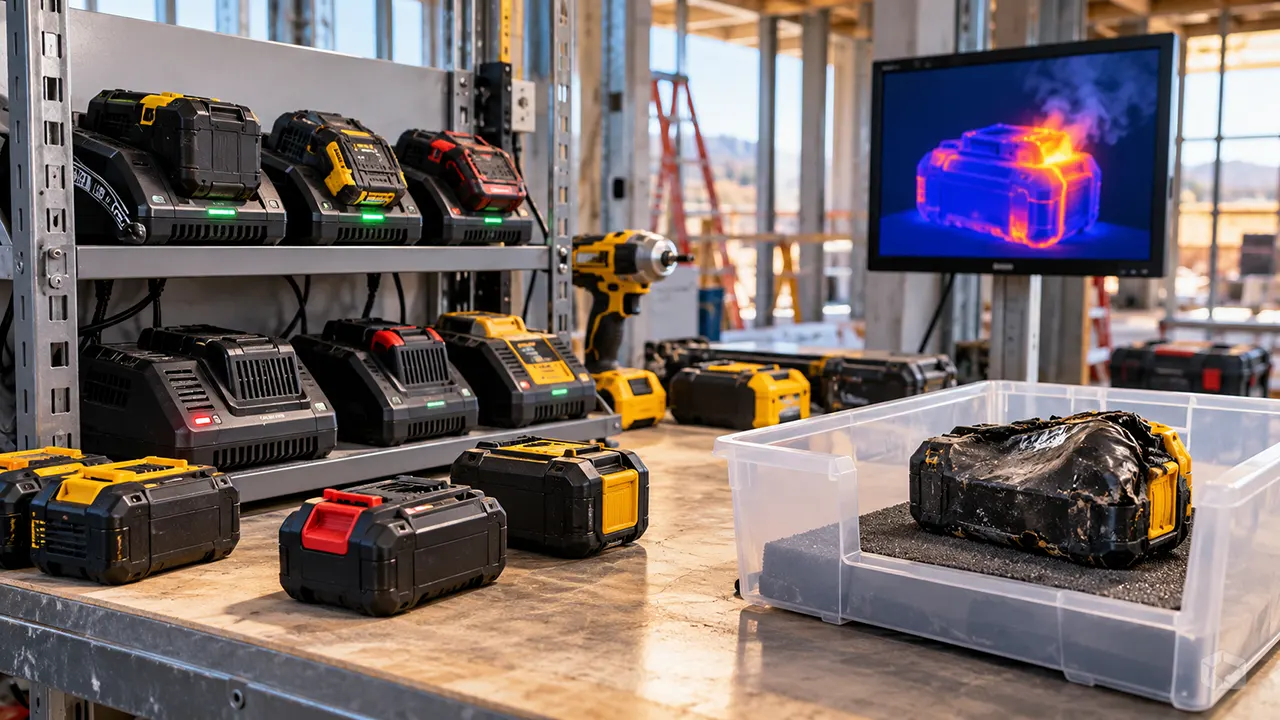
Lithium-ion batteries have transformed cordless power tools, but the same high energy density that makes them useful can create serious fire, burn, chemical, and explosion hazards when batteries are damaged, improperly charged, overheated, or used with incompatible equipment. OSHA identifies internal defects, mechanical damage, extreme temperatures, and improper charging as potential triggers for thermal runaway.
For contractors, electricians, builders, maintenance teams, and fleet managers, lithium-ion battery safety should be treated as a system rather than a collection of charging tips. The safest approach is to control the battery’s entire lifecycle: selection, inspection, charging, storage, transport, quarantine, incident response, disposal, and recall monitoring.
Why Lithium-Ion Power Tool Batteries Need a Safety System
A cordless tool battery stores a large amount of energy in a compact package. Under normal conditions, the battery, tool, and charger are designed to control that energy. Problems can occur when the battery is damaged, exposed to unsuitable conditions, charged incorrectly, or paired with equipment that is not designed for it.
Thermal runaway is one of the most important hazards to understand. It is a chain reaction in which heat released by one failing cell damages nearby cells, producing additional heat. Depending on the battery design and failure mode, the event can produce smoke, fire, pressure, combustible gases, or other hazardous byproducts.
The risk is not limited to visibly defective batteries. A battery can suffer internal damage after an impact or other event without immediately showing an obvious external problem. Power Tool Institute guidance therefore recommends inspecting batteries for crushing, cuts, punctures, leaking, swelling, deformation, and other damage, and says batteries that have received a sharp blow or been dropped should not be used.
For a professional cordless-tool fleet, the goal is simple: keep healthy batteries in service and remove questionable batteries from the normal workflow before they become an incident.
How Lithium-Ion Power Tool Batteries Become Hazardous
Physical damage can create an internal problem
Crushing, punctures, sharp impacts, drops, and other mechanical damage can compromise a battery pack. The visible housing does not always tell the complete story.
Never use a battery as a striking tool, modify its housing, open the pack, or attempt an unauthorized repair. Power Tool Institute guidance specifically warns against modifying, disassembling, or tampering with lithium-ion power tool batteries.
Heat can increase the risk
Excessive heat can contribute to battery failure and thermal runaway. OSHA recommends storing lithium-ion batteries in dry, cool locations and following the manufacturer’s temperature limits for storage, use, charging, and maintenance.
Do not assume that one temperature rule applies to every battery. The manufacturer determines the operating and charging limits for its particular battery system.
Short circuits can release stored energy rapidly
A battery terminal can short if a conductive object bridges positive and negative contacts. Keys, screws, nails, coins, paper clips, and other metal objects can therefore become a hazard when stored against exposed battery contacts.
This is especially important when spare batteries are carried in tool bags, trucks, storage bins, or other areas containing loose hardware.
Charging problems can create a fire hazard
Charging should use the battery and charger system specified by the manufacturer. Do not improvise with incompatible chargers or damaged equipment.
The risk is not theoretical. In July 2026, the U.S. Consumer Product Safety Commission announced a recall involving approximately 554,780 Kobalt yard power tools because charging certain lithium-ion batteries through a USB-C port while the batteries were inserted in the tools could cause a short circuit and fire hazard.
That example illustrates why battery safety instructions should be tied to the exact battery and charging system rather than generic internet advice.
How to Charge Power Tool Batteries Safely
Safe charging starts before the charger is plugged in. Workers should inspect the battery and charger and confirm that the equipment is approved for the specific tool system.
Inspect the battery and charger before charging
Do not charge a battery that shows signs of damage, swelling, cracking, leakage, deformation, unusual heating, or other abnormal behavior.
Also inspect the charger, cable, contacts, and housing for damage. A damaged charging system should be removed from service rather than improvised around.
Use the correct battery and charger
Use the charger recommended for the battery system. Power Tool Institute explains that manufacturers design their tool, battery, and charger systems so their electronics can communicate and monitor functions such as cell balance, energy flow, and temperature.
For workplace fleets, this makes battery compatibility a procurement and safety-control issue, not merely a convenience issue.
Create a controlled charging area
A jobsite charging area should be organized so batteries are protected from unnecessary heat, impact, moisture, and combustible materials.
Keep charging locations clean and dry. Do not place charging batteries next to piles of sawdust, paper, solvents, fuel, or other combustible materials. Follow the manufacturer’s requirements for ventilation and charging conditions.
PTI guidance also recommends charging in a dry location and away from combustible materials.
Do not charge damaged batteries
A battery that has been hit, dropped, or damaged should not simply be placed on a charger to “see if it still works.” PTI specifically advises against charging a damaged battery pack.
Instead, remove the battery from the normal charging workflow and follow your damaged-battery procedure.
How to Store Cordless Tool Batteries Safely
Battery storage should protect packs from damage, extreme temperatures, moisture, and accidental short circuits.
OSHA recommends dry, cool storage and following manufacturer instructions. Its guidance also recommends appropriate controls for larger storage operations, including ventilation and, where applicable, monitoring for flammable or toxic gases.
Protect battery terminals
Do not throw loose batteries into a container with screws, nails, keys, coins, or other conductive objects.
For fleet operations, use organized storage that prevents battery terminals from contacting loose metal hardware. Follow the manufacturer’s recommendations for protective covers, cases, or storage accessories.
Keep batteries away from extreme temperatures
Do not store batteries in locations that expose them to excessive heat or cold beyond the manufacturer’s stated limits.
A vehicle parked in direct summer sunlight can become a particularly challenging storage environment. If a battery has been exposed to extreme conditions, follow the manufacturer’s instructions before putting it back into service.
Follow the specific battery manual
Do not publish one universal rule such as “always store every lithium-ion battery at 50% charge.” Battery systems differ.
The manufacturer’s instructions should control storage charge level, temperature limits, charging procedure, inspection requirements, and long-term storage procedures.
How to Inspect a Power Tool Battery Before Use
A simple pre-use inspection can prevent a questionable battery from entering the work cycle.
Look for:
- Swelling or bulging
- Cracks or deformation
- Cuts or punctures
- Crushing or impact damage
- Leaking fluid
- Corrosion or unusual residue
- Unusual odor
- Abnormal temperature
- Hissing or other unusual sounds
- Smoke
- Damage to terminals or housing
OSHA specifically identifies bulging, cracking, hissing, leaking, rising temperature, and smoking as signs requiring attention. Its guidance says a battery or device showing these signs should be immediately removed from service and placed away from flammable materials.
When should a battery leave service?
A battery should leave the normal workflow when its condition is questionable or when it has experienced an event that the manufacturer identifies as potentially hazardous.
The key fleet-management principle is:
When workers are unsure whether a battery is safe, the answer should not be “try it.” The answer should be “remove it from normal service and follow the inspection or disposition procedure.”
What to Do If a Power Tool Battery Is Dropped or Damaged
A dropped battery deserves attention even when the housing appears intact.
Power Tool Institute guidance says not to use a battery that has received a sharp blow, been dropped, or been damaged.
For a workplace fleet, use a consistent process:
- Stop using the battery.
- Do not put it on a charger.
- Inspect it from a safe position for visible damage or abnormal behavior.
- Identify it as a suspect battery.
- Move it out of the normal battery pool according to your site procedure.
- Keep it away from combustible materials.
- Contact the manufacturer or follow the manufacturer’s disposal or service instructions.
- Document the incident when required by your workplace procedure.
Do not open the pack to inspect its internal cells. Do not attempt to replace individual cells unless you are following an appropriate manufacturer-authorized repair process.
How to Quarantine a Damaged Lithium-Ion Battery
A damaged-battery quarantine process gives workers a clear alternative to the dangerous habit of putting a questionable battery back into circulation.
A practical fleet workflow is:
Identify -> Stop use -> Isolate -> Notify -> Follow manufacturer guidance -> Dispose or service -> Document
The quarantine location should be selected and managed according to the manufacturer’s instructions, site emergency plan, applicable fire-safety requirements, and the nature of the battery condition.
OSHA guidance recommends removing damaged lithium batteries from service and placing them in an appropriate fire-resistant container or other suitable controlled location, away from flammable materials, followed by disposal according to applicable regulations and recycling guidance.
Do not create a homemade quarantine procedure that conflicts with the battery manufacturer’s instructions or local requirements.
How to Prevent Power Tool Battery Fires on a Jobsite
Fire prevention begins with controlling the conditions that can turn battery damage into a larger incident.
Keep batteries away from metal objects
Prevent terminal-to-terminal contact and keep batteries separated from loose conductive hardware.
Control heat
Do not leave batteries exposed to excessive heat or direct sunlight. Follow the manufacturer’s temperature limits.
Keep charging areas clean
Do not allow combustible debris to accumulate around charging equipment.
Separate suspect batteries
A swollen, damaged, leaking, unusually hot, or otherwise abnormal battery should not remain mixed with normal batteries.
Train workers to report abnormal batteries
Workers should know exactly who to tell when a battery is damaged or behaving abnormally. A safety program fails if workers understand the hazard but have no practical reporting path.
Monitor recalls
Battery safety does not end when a product leaves the factory. Manufacturers and regulators can discover defects after products reach the market.
CPSC’s recall database is updated as new recalls are announced, making it useful for fleet managers who need to monitor equipment safety notices.
What to Do During Thermal Runaway or a Battery Fire
Thermal runaway can develop when a failing cell generates enough heat to damage neighboring cells. OSHA explains that the resulting chain reaction can produce smoke, heat, fire, explosion, and hazardous combustion byproducts.
Warning signs
Potential warning signs include:
- Rapid or unusual heating
- Swelling
- Hissing
- Smoke
- Leaking
- Unusual odor
- Fire or visible flames
If a battery shows signs of an active thermal event, workers should follow the site’s emergency procedures and manufacturer guidance. The priority is to protect people, not save the battery.
Do not treat a battery incident as an ordinary equipment malfunction. Establish evacuation, notification, emergency-response, and fire-protection procedures before an incident occurs.
OSHA recommends following manufacturer guidance for extinguishing small battery fires and notes that appropriate methods can vary according to the battery and situation.
For larger or escalating incidents, workers should follow the site’s emergency action plan and summon emergency responders as required. Do not improvise an emergency procedure based on an internet article.
OEM vs Aftermarket Power Tool Batteries: What Is Safer?
Battery selection is a major part of power tool battery safety.
Power Tool Institute recommends using original manufacturer battery systems and warns about counterfeit and knock-off batteries. Its guidance explains that tool, battery, and charger systems use proprietary control circuitry to monitor important functions such as cell balance, energy flow, and temperature.
Why compatibility matters
A battery that physically fits a tool is not necessarily a battery that the manufacturer has approved for that tool.
For professional fleets, verify:
- Tool compatibility
- Battery model
- Charger compatibility
- Manufacturer approval
- Seller authenticity
- Applicable certification or listing information
- Recall status
Be careful with counterfeit batteries
Counterfeit batteries may imitate the appearance of an OEM product without providing the same internal design, controls, testing, or certification.
PTI recommends purchasing batteries through authorized dealers and distributors and warns that some counterfeit and knock-off batteries can be difficult to distinguish from genuine products.
For a contractor managing dozens or hundreds of batteries, procurement controls can therefore become a meaningful safety control.
How to Dispose of Lithium-Ion Power Tool Batteries
Do not treat lithium-ion batteries as ordinary household waste.
OSHA recommends designated recycling facilities and says lithium-ion batteries and devices containing them should not be placed in municipal trash or recycling bins.
Normal end-of-life batteries
Follow the manufacturer’s recycling instructions and use an appropriate battery-recycling or hazardous-waste channel.
Damaged batteries
Damaged batteries may require different handling from normal end-of-life batteries. Contact the appropriate recycling or hazardous-waste facility before transporting a damaged battery.
Recalled batteries
A recalled battery can have special disposal instructions.
For example, CPSC’s October 2026 recall guidance for certain rechargeable lithium-ion hand warmers specifically warns consumers not to place recalled batteries in ordinary trash, general recycling, or common retail battery-recycling boxes. Instead, it directs consumers toward applicable local and state hazardous-waste procedures.
The lesson for power-tool fleets is simple: always read the recall remedy before moving a recalled battery into your normal recycling process.
What OSHA Says About Lithium-Ion Battery Safety
OSHA’s lithium-ion battery guidance focuses on controlling workplace hazards rather than treating lithium-ion batteries as a single standalone hazard category.
Its recommendations include following manufacturer instructions, using appropriately tested equipment, storing batteries in cool and dry locations, inspecting batteries for damage, removing damaged batteries from service, and establishing appropriate emergency procedures.
OSHA also emphasizes the workplace risks associated with lithium-ion batteries, including fires, explosions, and exposure to hazardous chemicals.
The 2026 OSHA development
In January 2026, OSHA issued a letter of interpretation concerning recordkeeping requirements involving workplace injuries associated with personal rechargeable lithium-ion batteries. OSHA subsequently highlighted the issue in its January 2026 safety communication.
This is an important freshness point for employers, but it should not be described as a new standalone “OSHA lithium-ion battery safety standard.” The article should distinguish recordkeeping interpretations from broader workplace hazard-control requirements.
Build a Power Tool Battery Safety SOP for Your Fleet
A strong employer SOP should tell workers what to do before, during, and after normal battery use.
1. Battery procurement
Purchase batteries and chargers through approved channels. Verify compatibility and maintain records of approved battery models.
2. Incoming inspection
Inspect new batteries for damage and verify model information before putting them into the fleet.
3. Pre-use inspection
Workers should check battery condition before use and report abnormalities.
4. Charging procedure
Use approved chargers in designated locations and follow manufacturer instructions.
5. Storage procedure
Store batteries in appropriate dry, cool locations and protect terminals from accidental short circuits.
6. Damaged-battery procedure
Immediately remove questionable batteries from normal service and move them through the site’s quarantine process.
7. Incident reporting
Define who must be notified after a battery is dropped, overheats, smokes, leaks, catches fire, or shows other abnormal behavior.
8. Disposal and recycling
Identify the approved recycling or hazardous-waste channel and establish separate procedures for damaged or recalled batteries.
9. Recall monitoring
Assign responsibility for checking manufacturer and CPSC safety notices.
10. Worker training
Train workers on battery inspection, charging, storage, reporting, emergency response, and disposal procedures.
OSHA’s Connecticut consultation program provides a useful real-world example of this training approach. CONN-OSHA reports that one contractor used its lithium-ion battery training materials to train more than 200 employees across 20 active jobsites. OSHA also reports an estimate that a typical construction crew may handle 40 to 60 lithium-ion batteries per shift, illustrating why fleet-level controls can matter.
Power Tool Battery Safety Checklist
Use this checklist as a starting point for a workplace battery-safety program.
Before use
- Battery is the correct model for the tool
- Battery housing is intact
- No swelling or deformation is visible
- No cracks, cuts, punctures, or crushing are visible
- No leakage or unusual residue is present
- Terminals are clean and undamaged
- Battery has not been subjected to a known damaging event
- Battery is not subject to a known recall
Before charging
- Correct manufacturer-approved charger is being used
- Charger is undamaged
- Battery is not damaged
- Charging location is dry
- Combustible materials are controlled
- Temperature is within manufacturer limits
- Charging area is accessible and organized
During fleet management
- Damaged batteries are removed from normal service
- Suspect batteries are clearly identified
- Quarantine procedures are available
- Workers know the reporting process
- Emergency procedures are documented
- Disposal and recycling channels are established
- Recall information is periodically checked
- Battery safety training is current
Lithium-Ion Battery Safety Updates for 2026
This article should remain evergreen, but this section should be updated whenever an important safety development occurs.
OSHA updates
Monitor new OSHA interpretations, publications, consultation materials, and workplace safety guidance.
CPSC recalls
Check CPSC recalls for power tools, batteries, chargers, and related products. CPSC’s recall database is updated weekly as new recall information is published.
Manufacturer safety notices
Monitor the manufacturers represented in your cordless-tool fleet. A manufacturer-specific notice can change the correct handling procedure for a particular battery or charger.
Standards and safety developments
Review significant developments affecting battery testing, certification, workplace use, charging, storage, transportation, and emergency response.
A current example of why this section matters is the 2026 Kobalt recall involving approximately 554,780 yard power tools with USB-C batteries. The recalled configuration created a short-circuit and fire hazard under a particular charging condition.
Lithium-Ion Battery Safety FAQ
Can power tool batteries catch fire?
Yes. Lithium-ion power tool batteries can catch fire when cells fail or when batteries are damaged, overheated, improperly charged, short-circuited, or otherwise subjected to hazardous conditions. OSHA identifies thermal runaway as a chain reaction that can produce heat, smoke, fire, or explosion.
Can you charge a damaged lithium-ion battery?
No. A battery that is damaged, swollen, cracked, leaking, or otherwise abnormal should not be placed on a charger. Remove it from normal service and follow the manufacturer’s damaged-battery and disposal instructions. PTI specifically advises against charging a battery pack that has been hit, dropped, or damaged.
What should you do if a power tool battery is dropped?
Stop using it and do not immediately put it back on the charger. Inspect it for damage and follow your workplace damaged-battery procedure and the manufacturer’s instructions. PTI advises not using batteries that have received a sharp blow or been dropped.
What are the warning signs of a failing lithium-ion battery?
Warning signs can include swelling, bulging, cracking, leaking, hissing, unusual heating, smoke, or other abnormal behavior. OSHA identifies several of these conditions as signs requiring immediate removal from service.
Should power tool batteries be stored fully charged?
There is no single storage-charge rule that applies to every power tool battery. Follow the specific manufacturer’s instructions for long-term storage, including the recommended charge level and temperature limits.
Can you leave a power tool battery on the charger?
Follow the instructions for the specific battery and charger system. Do not assume that a charger or battery from another manufacturer has the same charging behavior. Use the manufacturer’s recommended charging system and follow its instructions.
Can you use aftermarket power tool batteries?
Compatibility depends on the specific tool system and manufacturer. Power Tool Institute recommends original manufacturer batteries and warns about counterfeit and knock-off products because the tool, battery, and charger are designed as a coordinated system.
What is thermal runaway?
Thermal runaway is a chain reaction in which heat released by a failing lithium-ion cell damages nearby cells, creating additional heat. The resulting event can produce smoke, fire, explosion, and hazardous chemical byproducts.
Can lithium-ion batteries go in the trash?
Lithium-ion batteries should not be placed in ordinary municipal trash or recycling bins. Use an appropriate battery-recycling or hazardous-waste channel and follow special instructions for damaged or recalled batteries.
Does OSHA have one specific lithium-ion battery safety standard?
OSHA’s lithium-ion battery guidance addresses hazards through applicable workplace safety requirements and recommendations rather than one universal lithium-ion battery standard. Employers should evaluate the specific hazards in their workplace and follow applicable OSHA requirements, manufacturer instructions, and emergency procedures.
The Safest Battery-Fleet Rule
The most useful rule for a cordless-tool fleet is simple: do not let a questionable battery become somebody else’s problem. Inspect batteries, use the correct charging system, control storage conditions, remove damaged packs from service, maintain a clear quarantine process, and keep recall information current.
For contractors and fleet managers, battery safety becomes much easier to enforce when every worker knows the same sequence: inspect, use correctly, charge correctly, isolate damage, report problems, and follow the manufacturer’s instructions.
That approach turns lithium-ion battery safety from a collection of warnings into a repeatable workplace system.
