


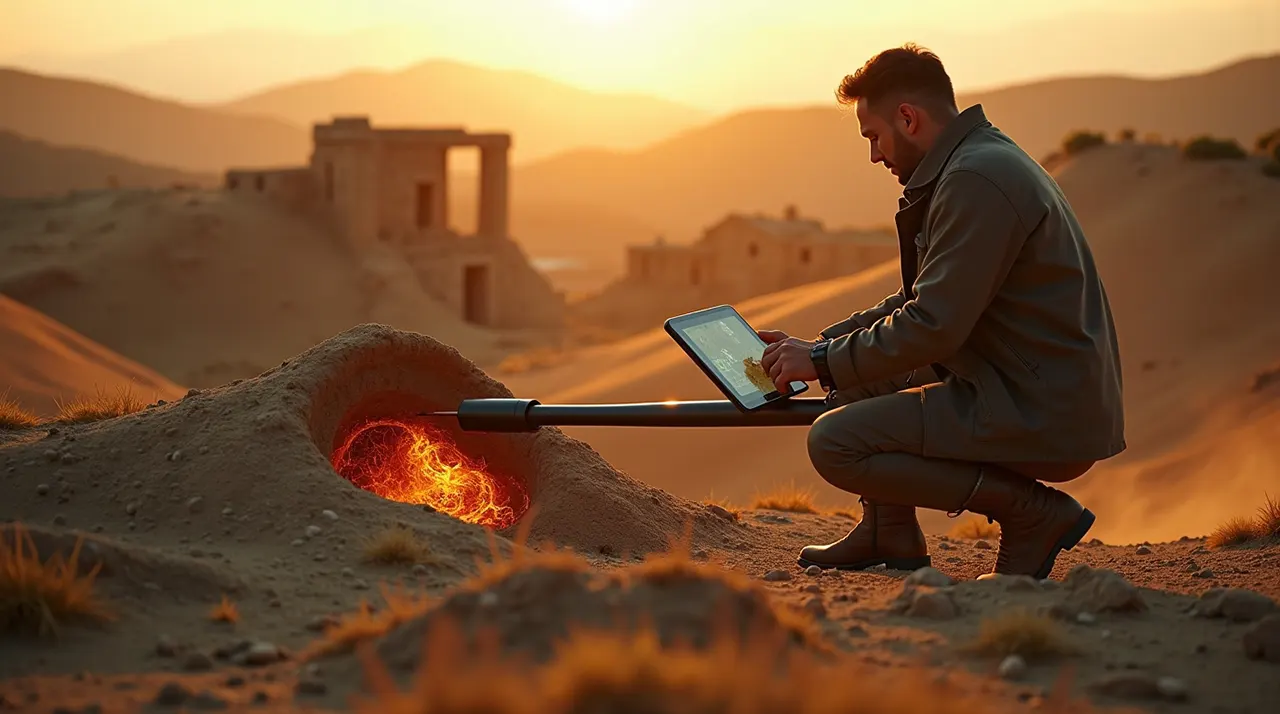
The OKM metal detector is a high-tech 3D ground scanner that finds gold, relics, and tunnels up to 25 meters deep. Unlike basic detectors, it creates 3D images of the ground on a tablet or computer. This helps you see the size, shape, and depth of a treasure before you start digging.
Metal detecting is a fun hobby, but it can be frustrating. Most standard detectors only find things a few inches deep. You might spend hours digging up old nails or bottle caps because the machine cannot tell what is under the soil. If you want to find deep treasure chests, ancient gold, or hidden caves, a standard tool often is not enough.
An OKM metal detector solves these problems by using advanced German sensors. These machines scan deep into the earth and show you a picture of what is there. This means you do not waste time digging in the wrong spots. In this guide, I will show you how these powerful tools work and which one is right for your next adventure.
What is an OKM Metal Detector?
An OKM metal detector is a professional-grade 3D ground scanner made in Germany. These devices do not just beep when they find metal; they use special sensors to “see” through the ground. They are famous for reaching incredible depths that other brands cannot touch. While a normal hobby detector might reach 1 foot deep, an OKM can reach over 80 feet.
These machines are built for serious treasure hunters, archaeologists, and gold seekers. They use a technology called “3D Ground Scan” to map the soil. You walk in a grid pattern, and the device sends data to a tablet or laptop. The software then builds a 3D model of the underground area.
- Deep Detection: Reaches up to 25 meters (82 feet).
- 3D Visualization: Shows the shape and size of the target.
- Multi-Purpose: Finds gold, silver, cavities, and water.
- German Engineering: Built with high-quality, durable parts.
Using an OKM feels like having X-ray vision for the ground. You can spot a hidden treasure chest or an ancient tomb without moving a single shovelful of dirt. This technology makes your hunt faster and much more successful.
Expert Secrets: The “Ferromagnetic Signature”
One uncommon but vital tip for using an OKM metal detector is understanding the “Ferromagnetic Signature.” In the Visualizer 3D software, iron objects often show both a red and a blue pole right next to each other. This is a “dipole” signal. If you see a bright red spot immediately followed by a blue spot of the same size, it is almost certainly a piece of iron, like an old pipe or a cannonball.
Pros also use the “Control Scan” rule. If you find a target, you must scan the area three times. If the target stays in the exact same place in all three scans, it is real. If it moves or changes shape, you are likely seeing “mineralized soil” or ground noise.
- Look for Dipoles: Red next to blue usually means iron/trash.
- Verify with Three Scans: Real targets never move on the map.
- Check Background Colors: Identify the “normal” soil color (usually green) to spot anomalies faster.
By mastering these subtle visual cues, you avoid the “empty hole” syndrome that plagues many beginners. Understanding the physics of magnetic poles makes you a much more effective hunter.
Top OKM Models for Every Level
Choosing the right OKM metal detector depends on what you want to find and how much you want to spend. OKM makes several different models, from entry-level scanners to professional imaging systems. Each one is designed for a specific type of treasure hunting.
| Model | Best For | Max Depth | Unique Feature |
| Fusion Light | Beginners | 8 Meters | SRIS Coil for small targets |
| Rover UC | Secret Hunting | 20 Meters | Disguised as a Hiking Pole |
| Rover C4 | Gold & Relics | 21 Meters | LED Orbit Signal Feedback |
| eXp 6000 | Professionals | 25 Meters | Wireless “Telescopic” Probes |
| Delta Ranger | Long Range | Miles | Thermo Scan for hidden rooms |
The Rover C4 features an “LED Orbit,” which is a ring of lights that changes color as you walk. This gives you instant feedback before you even look at the tablet. For those searching for hidden rooms behind stone walls, the Delta Ranger uses “Thermo Scan” to find temperature differences in the rock.
No matter which model you choose, you are getting a machine that is much more powerful than a standard “beep-and-dig” detector. These tools are investments that can lead to life-changing finds.
3D Ground Scan vs. Standard Metal Detecting
Many people ask why they should buy an OKM metal detector instead of a regular brand. The main reason is the difference between “hearing” and “seeing.” A standard detector gives you a sound or a number on a screen. An OKM gives you a high-resolution 3D picture.
Standard detectors struggle with “mineralized” soil, which has a lot of salt or iron. This causes false beeps. OKM scanners are designed to filter out the ground noise. They focus only on the real objects buried deep below the surface.
- Standard: Only detects metal; misses caves and tunnels.
- OKM: Detects metal AND empty spaces (cavities).
- Standard: Hard to tell if a target is a big piece of iron or a small gold coin.
- OKM: Clearly shows the size and shape of the object.
If you are looking for large hoards or deep structures, a standard machine will never find them. The OKM technology is built specifically to go where other detectors stop. This is why professionals use them for big projects like finding lost cities or gold mines.
Setting Up Your First OKM Scan
Using an OKM metal detector for the first time might seem scary, but it is actually very simple. Most models have a “Quick Start” mode. This allows you to start scanning with just a few button presses. The most important part is how you walk while you scan.
An expert secret is to avoid all electronics on your body. Do not just put your phone in your pocket; leave it 50 feet away. Even a smartwatch or steel-toed boots can cause “phantom signals” that appear as treasure on your screen.
- Calibrate: Set the device to the local ground conditions.
- Mode Select: Choose “3D Ground Scan” for the best detail.
- Field Size: Tell the device how many lines and steps you will walk.
- Analyze: Send the data to your tablet to see the results.
It is a good idea to practice in an area where you know something is buried. This helps you learn what the colors mean. You will soon be able to tell the difference between a buried pipe and a chest of coins.
Advanced Data: Interpreting the “Blue” Voids
In an OKM metal detector scan, the color blue is just as important as red. While red means metal, blue means a “void” or an empty space. This is how pros find ancient tombs, hidden bunkers, and escape tunnels.
However, a “faint blue” might just mean the earth was dug up and replaced years ago. A “solid dark blue” usually means a hollow room with air inside. If you see a long, straight blue line, you have likely found a tunnel or a pipeline.
- Compact Blue Blocks: High chance of a tomb or burial chamber.
- Long Blue Lines: Tunnels, old walls, or drainage pipes.
- Light Blue Smudges: Disturbed soil or old dig sites.
Understanding voids allows you to find treasures that are hidden inside stone boxes or rooms. Standard metal detectors cannot “see” the room; they only see the metal inside, which might be too deep to trigger a beep.
Tips for Deep Treasure Hunting Success
To get the most out of your OKM metal detector, you need more than just the machine. You need a good plan. Deep treasure is rarely found by accident. You should research the history of your area to find the best spots to scan.
Always make sure your batteries are fully charged. OKM machines use a lot of power because of their advanced sensors. Also, keep the probe perfectly vertical. If you tilt the probe even a few degrees while walking, the software will show a “zigzag” error in the 3D image.
- Keep a steady hand: Don’t swing the probe; hold it still and vertical.
- Scan twice: If you find something, scan it again from a different direction.
- Watch the heat: Do not leave your OKM in a hot car trunk; heat can damage the sensitive sensors.
I always tell new detectorists to be patient. Learning to read the scans takes a little time. But once you “click” with the machine, you will never want to go back to a basic detector.
FAQs: Common Questions About OKM Detectors
Can an OKM metal detector find gold nuggets?
Yes, but they are best at finding gold “hoards” or larger deposits. For tiny nuggets near the surface, use the “Mineral Scan” mode available on models like the Rover C4 or eXp 7000.
Is the software hard to learn?
No, the Visualizer 3D software is made for hobbyists. It has a simple interface. You can learn the basics in about 30 minutes by watching the official OKM tutorials.
Do I need a computer in the field?
Not necessarily. Many newer models, like the eXp 6000, come with a built-in tablet or work with an Android app. You can see your results instantly without a laptop.
How deep can it really go?
Under perfect conditions, some models can reach 25 meters (82 feet). Depth depends on how big the object is and how long it has been in the ground.
Are OKM detectors waterproof?
Most OKM control units are not waterproof. The probes are usually “splash-proof,” but you should not submerge them in water or use them in heavy rain.
Why does my scan look like a “zigzag”?
This usually happens if you are walking too fast or if you are turning the probe at the end of each scan line. Keep the probe facing the same direction at all times.
Final Verdict on the OKM Metal Detector
The OKM metal detector is not just a tool; it is a professional system for serious discovery. It offers depth and visualization that standard brands simply cannot match. While it costs more, the ability to see 3D images and identify “Ferromagnetic Signatures” is a massive advantage in the field.
If you are tired of finding only surface trash and want to hunt for real history, an OKM is the way to go. It is built to last, easy to use after a little practice, and reaches deeper than almost anything else on the market. Whether you are searching for gold or ancient ruins, this German-made technology will give you the best chance of success.
Would you like me to create a step-by-step checklist for your first field scan with an OKM device?
