


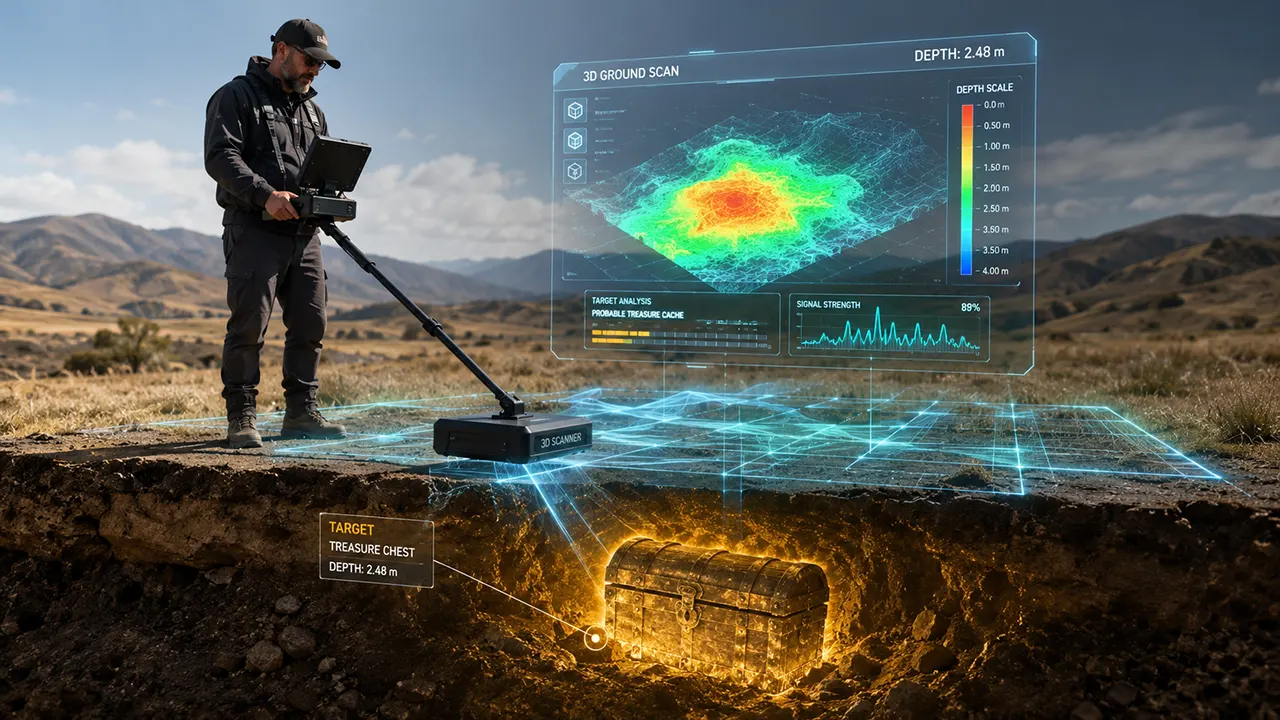
Most metal detectors tell you something is underground. A 3D metal detector tries to show you what it might be before you start digging.
That promise has made 3D metal detectors one of the most talked-about technologies in treasure hunting. Manufacturers claim they can locate gold, buried caches, tunnels, caves, and archaeological structures at impressive depths. Some systems even display colorful underground maps on a tablet or laptop.
But do 3D metal detectors actually work? The answer is yes – with important limitations. Some systems provide valuable underground imaging, while others rely on exaggerated marketing claims.
This guide explains how 3D metal detectors work, how they compare to traditional detectors, realistic depth expectations, common myths, and whether they are worth the investment for your type of detecting.
Affiliate Disclosure: This article may contain affiliate links. If you purchase through these links, we may earn a commission at no extra cost to you. Learn more on our disclosure page.
What Are 3D Metal Detectors?
3D metal detectors are advanced ground-scanning systems that collect underground data and convert it into a visual representation of what may be buried below the surface. Unlike conventional metal detectors that rely mainly on sound and target ID numbers, 3D systems create maps that help users estimate target depth, size, shape, and position.
Most modern 3D systems combine multiple technologies, including magnetometers, ground scanners, pulse induction systems, and specialized software. The software analyzes signal variations and displays the results as color-coded images or three-dimensional models.
The primary goal is not simply to detect metal. The goal is to understand what exists underground before excavation begins.
The biggest misconception is that a 3D metal detector works like an underground camera. It does not. It creates a computer-generated interpretation of underground anomalies based on collected data.
Common Uses of 3D Metal Detectors
3D metal detectors are commonly used by treasure hunters, archaeologists, surveyors, prospectors, and professional search teams. Their ability to visualize underground anomalies makes them useful for applications beyond simple coin and relic hunting.
- Locating buried treasure caches
- Finding gold-bearing targets
- Mapping underground tunnels
- Detecting hidden chambers and voids
- Archaeological site investigation
- Underground utility exploration
Many users choose a 3D scanner when standard metal detectors cannot provide enough information about large or deep targets.
How Do 3D Metal Detectors Work?
3D metal detectors work by collecting data from a defined search area and converting that information into a visual underground model. The process typically involves scanning, recording measurements, processing data, and generating a digital map.
While the technology varies between manufacturers, most systems follow the same basic workflow.
Ground Scanning Technology
Ground scanning technology measures changes in the earth’s magnetic field or electromagnetic responses. When buried objects disrupt these natural conditions, the scanner records the differences.
These differences are known as anomalies. An anomaly may represent a metal object, a tunnel, a cavity, a stone structure, or another underground feature.
The quality of a 3D scan depends heavily on soil conditions, scanning technique, target size, and software interpretation. Better equipment does not eliminate operator skill requirements.
Data Collection Process
A 3D scan begins by creating a search grid. The operator slowly walks across the grid while carrying the scanner. Each pass records data points that are stored inside the system.
The larger the search area, the more data points are collected. High-quality scans often require precise movement and multiple passes across the same location.
Imagine mowing a lawn in straight lines. A 3D metal detector works similarly. Each pass adds another layer of underground information until the software has enough data to build a visual model.
3D Visualization Software
After data collection, specialized software converts raw measurements into a visual map. Different colors typically represent varying densities or signal strengths beneath the ground.
The software attempts to estimate the location, shape, and depth of underground anomalies. Advanced systems can display cross-sectional views, layered depth maps, and three-dimensional models.
These visualizations help users decide whether a target deserves further investigation.
Why They’re Called “3D”
3D metal detectors earn their name because they display underground information across three dimensions: width, length, and depth. Traditional detectors provide signals from a single point, while 3D systems attempt to create a larger picture of what exists below the surface.
This added layer of visualization helps users estimate target characteristics before digging. In some situations, it can save significant time and effort by helping eliminate false targets.
However, a 3D image is still an interpretation. It should be viewed as a guide rather than proof of what lies underground.
For many treasure hunters, the ability to visualize underground anomalies is the biggest advantage of investing in a 3D scanning system instead of a conventional detector.
3D Metal Detector vs Regular Metal Detector
A 3D metal detector and a regular metal detector serve different purposes. Traditional detectors excel at locating coins, jewelry, relics, and small targets. A 3D detector focuses on mapping underground anomalies and identifying large or deep targets before excavation begins.
Neither technology is automatically better. The right choice depends on your goals, budget, and the types of targets you want to find.
Detection Method
Regular metal detectors use electromagnetic signals to detect conductive metals. Most hobby detectors provide audio tones, target IDs, and simple visual indicators.
3D metal detectors collect multiple underground measurements across a grid and use software to build a visual representation of subsurface anomalies.
💡 Key Takeaway: Traditional detectors focus on finding targets. 3D systems focus on understanding targets before digging.
Depth Differences
Standard hobby detectors typically perform best on shallow to moderate depths. Coins, jewelry, and relics are usually found within the first few inches to a few feet of soil.
Large-scale 3D scanners are designed to investigate much deeper targets. Some professional systems claim depths exceeding 20 feet, 40 feet, or even more under ideal conditions. Real-world results vary significantly based on target size and soil conditions.
Depth claims often create unrealistic expectations. A detector that can locate a car-sized object at 30 feet may not detect a coin anywhere close to that depth.
Accuracy Differences
Traditional detectors provide immediate feedback and are often more reliable for locating small metallic objects. They require less interpretation and are easier for beginners to learn.
3D systems can provide additional information about shape and depth, but results depend heavily on scanning technique and software analysis.
An inaccurate scan can produce misleading images that appear convincing but do not represent the actual underground structure.
Cost Differences
The cost gap between these technologies is enormous. Many excellent hobby detectors cost between $200 and $2,000.
Professional 3D metal detectors commonly start above $1,500 and can exceed $25,000 for advanced systems with ground-scanning software and multiple sensors.
For most hobbyists, a quality VLF or pulse induction detector delivers a better return on investment.
What Can 3D Metal Detectors Detect?
3D metal detectors can identify more than buried metal. Many systems are designed to reveal underground anomalies that differ from surrounding soil conditions.
This broader capability explains why archaeologists, surveyors, and treasure hunters often use them for specialized projects.
Gold Targets
Large gold objects can create detectable anomalies, especially when buried at moderate depths. However, many people misunderstand the capabilities of 3D gold detectors.
Small gold nuggets are usually better detected using dedicated gold detectors such as pulse induction or high-frequency VLF machines.
For readers interested in dedicated gold-hunting equipment, see our guide to gold metal detectors.
Large buried gold caches are where 3D systems potentially offer an advantage.
Silver and Buried Treasure Caches
Silver coins, treasure chests, and large metallic deposits often create strong anomalies. Many treasure hunters purchase 3D scanners specifically to search for historic caches and hidden valuables.
The larger the target mass, the easier it becomes for advanced scanners to identify underground disturbances.
Tunnels and Voids
One major advantage of some 3D systems is their ability to detect non-metallic underground structures. Hidden tunnels, chambers, caves, and voids can sometimes appear as distinct anomalies within scan results.
This capability separates many 3D scanners from traditional hobby detectors.
Archaeological teams often use underground imaging systems to identify buried structures before excavation begins, reducing unnecessary digging and site disturbance.
Archaeological Features
Walls, foundations, burial chambers, and ancient structures can create detectable differences in soil density and composition.
Professional archaeologists frequently combine scanning technologies with historical research and field surveys to improve site investigation accuracy.
Do 3D Metal Detectors Really Work?
Yes, 3D metal detectors can work when used correctly and within realistic expectations. Professional-grade systems can successfully identify underground anomalies, estimate depth, and help locate large buried objects.
The problem is not whether the technology works. The problem is that marketing claims often create unrealistic expectations.
Some advertisements suggest that users can locate tiny gold objects dozens of feet underground. Real-world physics does not support those claims.
A well-trained user with a quality system can produce valuable underground maps. An inexperienced user can easily misinterpret the same data.
Before investing in any scanner, learn the difference between marketing claims and measurable performance.
Understanding metal conductivity is also important when evaluating target responses. You can learn more in our guide to metal detector metal types.
Advantages of 3D Metal Detectors
3D metal detectors offer capabilities that traditional detectors cannot easily match. Their biggest advantage is the ability to visualize underground anomalies before digging, helping users make more informed decisions in the field.
Visual Underground Mapping
The most obvious benefit is the ability to create visual underground maps. Instead of relying solely on audio signals, users can analyze scan results and identify patterns that may indicate buried objects or structures.
This extra information often reduces unnecessary digging and helps prioritize promising targets.
Large Target Detection
Large metallic objects, treasure caches, underground chambers, and structural remains often produce stronger anomalies than small targets.
Many deep-search enthusiasts choose 3D systems specifically for locating large buried objects beyond the practical reach of hobby detectors.
Depth Estimation
Most advanced systems attempt to estimate target depth. While depth readings are not always perfect, they provide a useful starting point for evaluating whether a target deserves further investigation.
💡 Key Takeaway: The real value of a 3D detector is not simply finding metal. It is reducing uncertainty before excavation begins.
Disadvantages of 3D Metal Detectors
Despite their impressive capabilities, 3D metal detectors are not the perfect solution for every detectorist. They come with significant limitations that buyers should understand before spending thousands of dollars.
High Cost
Price is the biggest obstacle. Even entry-level 3D systems cost far more than most hobby metal detectors.
A beginner can purchase an excellent detector for less than $1,000, while many 3D scanners start above that price and quickly move into professional territory.
Steep Learning Curve
Interpreting underground scans takes practice. Beginners often assume colorful graphics provide clear answers, but scan interpretation is rarely that simple.
Misreading data can lead to wasted time, unnecessary excavation, and false expectations.
Marketing Hype
Some manufacturers publish depth claims that sound impressive but lack real-world context. Large objects may be detectable at significant depths, but small targets often behave very differently.
Treat any advertised depth figure as a best-case scenario rather than a guaranteed result. Soil conditions, target size, mineralization, and user skill all affect performance.
The best detectorists are skeptical of extraordinary depth claims. They trust field results, not advertising slogans.
How Deep Can 3D Metal Detectors Detect?
The depth of a 3D metal detector depends on target size, soil composition, scanner technology, and operator skill. There is no universal depth figure that applies to every situation.
Many professional systems advertise depths ranging from 10 feet to more than 100 feet. However, those claims usually refer to large underground structures rather than small metallic targets.
A buried coin, ring, or small relic behaves very differently than a tunnel, chamber, or large metal cache. The larger the object, the greater the likelihood of detection at depth.
3D Metal Detector Price Guide
3D metal detector prices vary dramatically based on scanning technology, software capabilities, depth performance, and included accessories.
Budget Systems
Entry-level scanners generally fall between $1,200 and $3,000. These systems provide basic underground imaging and are often targeted at hobbyists exploring deep-search technology for the first time.
Examples include selected Groundtech models and entry-level scanning systems.
Mid-Range Systems
Mid-range systems typically cost between $3,000 and $7,000. They often include better software, more sensors, improved target analysis, and deeper scanning capabilities.
Many serious treasure hunters shop within this category because it balances capability and cost.
Professional Systems
Professional-grade equipment often exceeds $7,000 and can surpass $30,000. These systems target archaeological teams, survey professionals, and advanced treasure hunters.
The added investment usually buys better software, more advanced sensors, and improved imaging quality.
Best 3D Metal Detectors
The best 3D metal detector depends on your budget, experience level, and search objectives. The models below are among the most recognized names in the deep-search market.
Nokta Jeohunter 3D Dual System
Known for combining metal detection and cavity detection. Popular among treasure hunters looking for a balance of price and capability.
One of the most advanced consumer-facing systems with real-time visual target analysis and artificial intelligence-assisted processing.
An entry-level 3D ground scanner designed for users entering the underground imaging market.
OKM eXp 6000
A premium scanner aimed at professional users who need advanced imaging, deep scanning, and extensive data analysis capabilities.
Before purchasing any system, compare independent field tests, training resources, software support, and real-world user feedback rather than relying solely on manufacturer specifications.
Can You Use a Phone as a 3D Metal Detector?
No, a smartphone cannot function as a true 3D metal detector. While some mobile apps claim to detect metal or gold, they only use the phone’s built-in magnetometer, which is designed for navigation and compass functions.
A smartphone lacks the transmitting coils, scanning sensors, signal processing hardware, and imaging software needed to perform genuine underground scanning.
Metal detector apps can sometimes identify large metal objects located very close to the phone. However, they cannot detect buried treasure, gold nuggets, tunnels, or deep underground targets.
If an app claims it can turn your phone into a professional 3D gold detector, treat that claim with extreme skepticism.
A smartphone app may help you find a metal filing cabinet or a steel beam. It will not replace a specialized underground scanning system.
Are 3D Metal Detectors Worth It?
A 3D metal detector can be worth the investment for the right user. However, it is not the best choice for every detectorist.
These systems shine when searching for large, deep targets, underground chambers, archaeological features, and treasure caches. They provide information that traditional detectors often cannot deliver.
For coin shooting, jewelry hunting, beach detecting, and general hobby use, a high-quality VLF or pulse induction detector is usually the smarter purchase.
GOOD FIT
Deep-search treasure hunters, archaeological researchers, professional surveyors, and users seeking large underground structures.
POOR FIT
Beginners, casual hobbyists, coin hunters, and anyone expecting guaranteed treasure discoveries.
💡 Key Takeaway: Buy a 3D metal detector because you need underground mapping capabilities, not because you expect deeper treasure by default.
Who Should Buy a 3D Metal Detector?
A 3D metal detector makes the most sense when your search goals involve large targets, deep targets, or underground structures that require additional analysis before excavation.
- Treasure hunters searching for caches and hoards
- Professional surveyors
- Archaeological teams
- Researchers investigating tunnels and chambers
- Advanced detectorists looking for deep-search capabilities
These users can often justify the cost because the technology provides information that standard detectors cannot easily produce.
Who Should Avoid a 3D Metal Detector?
Many detectorists will achieve better results by investing in a quality traditional detector rather than a 3D scanning system.
- Beginners entering the hobby
- Coin and jewelry hunters
- Beach detectorists
- Users with limited budgets
- Anyone seeking a simple plug-and-play experience
A modern VLF or pulse induction detector will often provide faster learning, better value, and more successful recoveries for these users.
Final Thoughts
3D metal detectors represent one of the most advanced technologies available to treasure hunters and underground survey professionals. They provide visual insight that goes far beyond the simple audio alerts offered by traditional detectors.
At the same time, these systems are not magic. Success depends on realistic expectations, quality equipment, proper training, and careful interpretation of scan data.
If your goal is locating deep caches, underground chambers, or large buried objects, a 3D scanner may be a valuable investment. If your goal is finding coins, jewelry, and everyday relics, a traditional detector will usually be the better choice.
Before spending thousands on a 3D detector, compare it against modern VLF and pulse induction machines, study independent field tests, and choose the technology that matches your actual detecting goals.
Continue your research with our guides on metal detector metal types and the best gold metal detectors to find the right equipment for your next hunt.
Frequently Asked Questions
1. Do 3D metal detectors work?
Yes. Professional systems can identify underground anomalies and provide visual scan data. However, performance depends on target size, soil conditions, equipment quality, and operator skill.
2. Is it worth buying a 3D scanner?
A 3D scanner is worth considering if you need underground imaging, deep-search capability, or archaeological surveying functions. For general hobby detecting, a traditional detector often provides better value.
3. Can I use my phone to detect gold?
No. Smartphones lack the hardware required to detect buried gold effectively. Mobile apps can only measure magnetic field changes at very close range.
4. How deep can a 3D metal detector scan?
Depth varies greatly. Large underground structures may be detectable much deeper than small objects. Always evaluate depth claims carefully and consider target size.
5. What is the best 3D metal detector?
Popular options include the Nokta Invenio, Nokta Jeohunter, OKM Fusion Light, and OKM eXp 6000. The best choice depends on your budget and intended use.
