


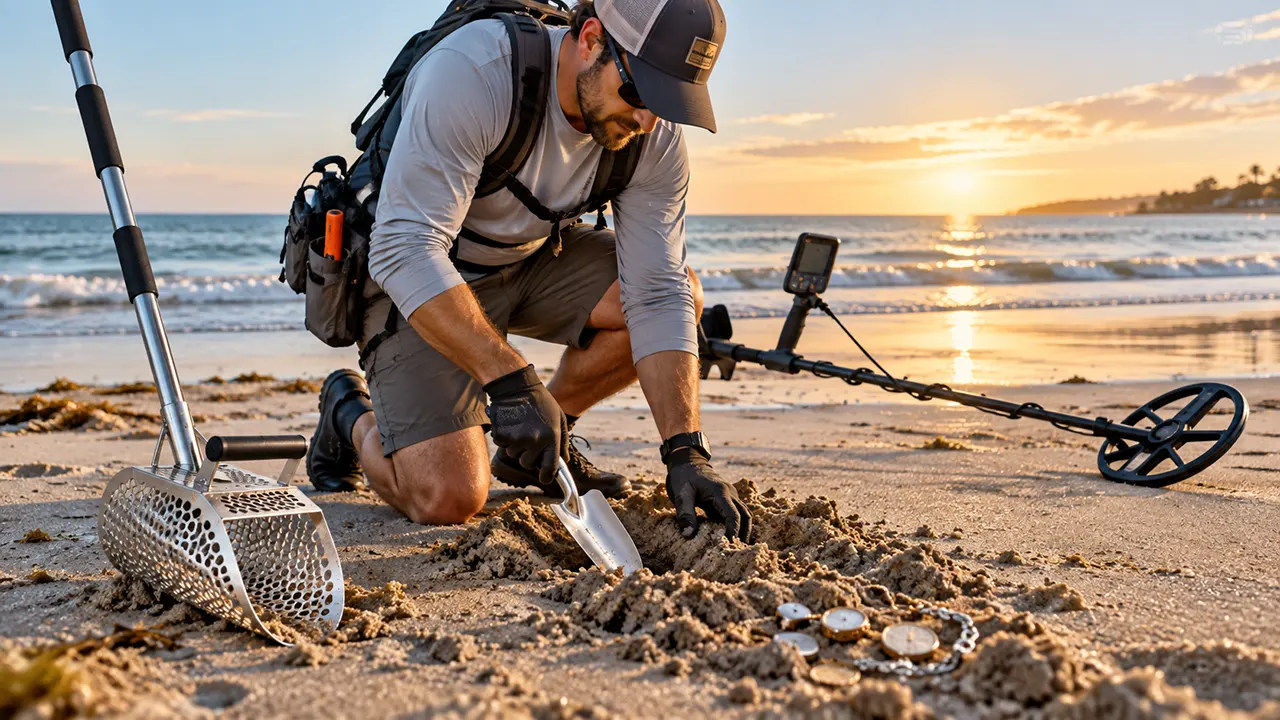
The best metal detecting digging tools depend on where you hunt. Use a hand digger for precise recovery in lawns and turf, a serrated metal detecting shovel for hard or root-filled soil, and a sand scoop for beaches. A complete metal detecting shovel kit can make sense for beginners who want several recovery tools in one purchase.
A good metal detector can find a target, but it cannot recover it for you. That is where the right digging tool matters. The wrong tool can make compact soil frustrating, slow down beach recovery, or make it harder to leave the ground in good condition.
This guide explains the main types of metal detecting digging tools, how to match them to different terrain, what features matter, and which of five supplied products may fit different hunting styles. Product recommendations are based on available product information and published sources, not hands-on testing.
Which Metal Detecting Digging Tool Do You Actually Need?
There is no single digging tool that works perfectly everywhere. Your hunting environment should come first.
| Hunting environment | Useful tool | Main reason |
|---|---|---|
| Lawns and maintained turf | Hand digger or trowel | Precise recovery |
| Hard soil | Heavy-duty digging shovel | More leverage |
| Root-filled ground | Serrated shovel | Helps cut through roots |
| Open fields | Long-handle shovel | Faster digging and less kneeling |
| Dry beach sand | Sand scoop | Fast sand removal |
| Wet beach sand | Stainless steel sand scoop | Efficient sifting and recovery |
| Mixed terrain | Shovel + hand digger | Covers different recovery situations |
| Beginner setup | Metal detecting shovel kit | Multiple tools in one purchase |
The important distinction is simple: a shovel cuts soil, while a sand scoop sifts loose sand. Current metal detecting guides make the same terrain-based distinction, with shovels suited to packed ground and scoops designed for loose or wet sand.
Hand Diggers for Lawns and Shallow Targets
A hand digger is useful when precision matters more than digging speed. It gives you better control around grass, roots and relatively shallow targets than a large shovel.
For maintained turf, a smaller tool also makes it easier to keep the recovery area controlled. The goal is not simply to reach the target. It is to recover it without unnecessarily disturbing the surrounding ground.
Metal Detecting Shovels for Hard Soil and Deeper Recovery
A dedicated metal detecting shovel is more appropriate when the ground is firm, compacted or filled with roots. Serrated edges can help cut through roots and tougher soil, while a longer handle can provide additional leverage.
Home Depot’s digging-tool guide also identifies metal detecting shovels as lightweight digging tools designed for treasure hunting, with saw-like edges that can help with roots and hard soil.
A useful rule is to choose the smallest tool that can comfortably handle the ground you regularly hunt. Bigger is not automatically better.
Sand Scoops for Beaches and Loose Sand
A sand scoop works differently from a conventional shovel. Its perforated basket lets loose sand fall through while retaining the target.
This becomes particularly useful on beaches. Current sand-scoop guides distinguish dry sand from wet sand and emphasize that handle length, basket material and hole size affect how efficiently a scoop works.
For saltwater hunting, corrosion resistance also deserves attention. Rinsing equipment with fresh water after saltwater use is a sensible maintenance habit.
Metal Detecting Shovel Kits for Beginners
A metal detecting shovel kit can be practical if you are starting out and do not yet own recovery equipment. Some kits combine a scoop, shovel, pinpointer, carrying bag or gloves.
The advantage is convenience. The trade-off is that a bundled kit may contain components you eventually replace with specialized tools.
Metal Detecting Digging Tools Compared by Terrain
The simplest way to choose is to start with the ground rather than the product name.
Lawns: A compact hand digger is usually more appropriate because recovery requires control.
Fields: A dedicated digging shovel can save time when targets are deeper or the ground is firm.
Wooded or root-filled areas: A serrated edge becomes more useful because roots can resist a smooth blade.
Dry beaches: A lightweight scoop can remove loose sand quickly.
Wet beaches: A sturdy stainless steel scoop with an appropriate handle is generally better suited to repeated sand recovery.
Mixed hunting: Combining a compact digger with a larger shovel gives you more flexibility than trying to make one tool perform every job.
One important buying lesson is that the strongest tool is not automatically the best tool. Weight, portability, digging control and terrain should all be considered together.
5 Metal Detecting Digging Tools Worth Considering
These five products were supplied for this article. They are presented by use case rather than as a universal ranking because each serves a different recovery job.
GADFISH Sand Scoop for Metal Detecting
Best suited to: Beach, wet-sand and underwater-oriented detecting.
The GADFISH B0CSFRMCRZ uses a stainless-steel scoop with a detachable long handle and 8.5 mm hexagonal openings. Available product information lists its weight at about 1.34 kg and describes an ergonomic grip designed to let the user work while standing.
Third-party Amazon-market tracking has recently listed the product around $35.99, although marketplace prices can change.
Its strongest use case is loose sand rather than compact soil. The perforated basket is designed to let sand drain away during recovery.
If you frequently hunt beaches, the long-handle format can be more useful than carrying a conventional soil-digging shovel.
WodGod Heavy-Duty Sand Scoop Kit
Best suited to: Beginners looking for a broader recovery setup.
The WodGod B0FLJW62V4 is supplied as a multi-piece setup that includes a stainless-steel sand scoop, pinpointer, shovel, carrying bag and gloves. Current product information lists the material as stainless steel and the listed weight at approximately 1.87 kg.
The appeal here is not that every component will outperform a specialized tool. The attraction is convenience.
Someone starting from zero can obtain several recovery accessories in one package rather than purchasing each component separately.
The limitation is equally important: a kit should be judged by the usefulness of the individual components, not simply by how many items are included.
CKG Heavy-Duty Metal Detecting Shovel
CKG Metal Detecting Shovel on Amazon
Best suited to: Harder ground and root-filled areas.
The supplied CKG model is designed around a double-serrated digging edge. That design makes it more relevant to soil recovery than a sand scoop.
A serrated edge is useful when roots or compacted soil make a smooth blade difficult to work with. The broader principle is supported by digging-tool guidance that identifies serrated metal detecting shovels as useful for roots and hard ground.
Current search results did not provide sufficiently reliable pricing for this exact ASIN, so the price should be checked at the time of purchase rather than treated as fixed.
National Geographic Metal Detector Sand Scoop and Shovel Tool Set
Best suited to: Beginners and beach-oriented casual detecting.
This set combines a sand scoop with a compact shovel. Available product information describes the scoop as a beach-sifting tool and the compact shovel as suitable for digging in sand or harder ground.
Third-party Amazon-market tracking recently listed the product at approximately $16.99, with around 6.7K ratings. These figures come from market-tracking data rather than an Amazon announcement, and prices can change.
Its main attraction is versatility at a relatively low entry price. It is not a substitute for a heavy-duty shovel when regularly dealing with very hard ground.
CKG 3-in-1 Detecting Pouch and Sifting Scoop
Best suited to: Compact recovery setups.
The supplied product combines a detecting pouch and sifting scoop in a 3-in-1 configuration. Because reliable current product-specific specifications were not available in the research results, it is better to focus on its stated configuration rather than invent dimensions, material specifications, weight or performance claims.
This type of compact setup can make sense when portability matters more than maximum digging power.
What Makes Professional Metal Detecting Digging Tools Different?
“Professional” does not necessarily mean the largest or most expensive tool. It usually means the tool matches the work and can handle repeated use.
Blade Material and Strength
For soil-digging tools, blade strength matters because the tool may encounter compact soil, roots or small rocks.
For beach scoops, corrosion resistance becomes more important, particularly when hunting around saltwater. Stainless steel is widely used for this reason.
Serrated vs. Straight Edges
A straight edge can work well for controlled soil cutting, while serrations can provide additional bite in root-filled or compact ground.
If you mainly hunt maintained lawns, extreme serration may not be the feature you value most. If you regularly hunt wooded or root-filled ground, it can become much more useful.
Handle Length and Leverage
Long handles allow you to work while standing and can provide leverage when digging. Shorter tools are easier to carry and provide more control in confined spaces.
The right length depends on the terrain and your hunting style rather than a universal ideal.
Weight vs. Durability
A heavy tool may feel reassuring, but you have to carry it throughout the hunt.
That creates a practical trade-off:
More material can increase durability, but unnecessary weight can reduce portability and comfort.
For long hunts, the lightest tool that safely handles your normal ground can be a smarter choice than simply choosing the heaviest model.
Corrosion Resistance for Beach Detecting
Saltwater and salt residue can accelerate corrosion. Beach hunters should rinse their recovery tools with fresh water after saltwater use and allow them to dry properly.
This simple maintenance step can matter more over time than small differences between similar products.
How Deep Do You Need to Dig When Metal Detecting?
The depth you need to dig depends on the detector’s target response, ground conditions and the target itself. Your digging tool does not make a metal detector detect deeper.
That distinction is easy to miss.
A detector detects a target. The digging tool recovers it.
How Deep Are Coins When Metal Detecting?
Coins can occur at different depths depending on the site, soil movement, erosion, human activity and the history of the location.
There is no reliable universal depth at which coins are found.
That is why buying a shovel solely because it is advertised as a “deep digging” tool can be misleading. The more useful question is whether the tool can comfortably recover the targets your detector is already identifying.
Why Detection Depth and Digging Depth Are Different
Suppose your detector produces a strong signal several inches below the surface. You need a tool capable of reaching that target without excessive effort.
But changing from one shovel to another does not increase the detector’s electromagnetic detection range.
Your detector coil, target size, target composition, soil mineralization, settings and other conditions affect detection. The digging tool affects what happens after the target has been located.
When a Long-Handle Shovel Makes Sense
A longer shovel becomes more useful when you regularly hunt open fields or firm ground and want to dig without constantly kneeling.
For maintained turf, however, a smaller hand digger may provide better control.
The best setup is therefore often complementary rather than singular: use a larger shovel for difficult ground and a compact tool when precision matters.
Where Do People Lose the Most Jewelry?
Jewelry can be lost anywhere people regularly remove, handle or wear it, but beaches and recreational areas are particularly relevant to metal detecting because people move, swim, play and change clothes there.
That is one reason sand scoops are such a specialized part of beach detecting equipment.
Loose sand also creates a different recovery problem from soil. Instead of cutting a plug, the detectorist can scoop and sift material.
The important takeaway for equipment selection is simple: the type of place where you hunt often determines the type of digging tool you need.
Where Can You Metal Detect for Old Coins and Gold?
Metal detecting can be used for many types of targets, but the equipment and recovery method should match the environment.
Where to Metal Detect for Old Coins
Old coins may occur in locations with a history of human activity, such as older properties, fields or other permitted areas.
Before detecting, verify that the landowner or relevant authority allows the activity. Historical or archaeological sites can have additional restrictions.
The digging tool should then match the ground. A hand digger can provide control in turf, while a stronger shovel can be more practical in firm soil.
How to Find Lost Gold
Gold can be found in different forms and environments, but a metal detector cannot guarantee that you will locate gold.
Small gold jewelry can produce challenging signals, while natural gold prospecting involves different conditions from ordinary coin hunting.
The most important equipment principle is to match your detector and recovery tools to the type of target and environment rather than assuming one setup works everywhere.
Can You Find Gold in a Creek With a Metal Detector?
A metal detector can be used for certain types of prospecting in suitable environments, but creek hunting introduces additional considerations such as water movement, mineralized ground and local rules.
If you are working around water, use equipment appropriate to the environment and follow local safety requirements. Do not assume that a tool marketed for underwater treasure hunting makes any water activity safe by itself.
How Far Down Can a Metal Detector Detect Gold?
There is no single maximum depth for gold.
Detection depends on factors such as target size, target orientation, detector technology, soil conditions and settings.
A large metal object may be detectable deeper than a tiny gold item. Therefore, claims that a particular detector or digging shovel will find gold at a fixed depth should be treated cautiously.
Is Metal Detecting Legal in the United States?
Metal detecting is not governed by one simple nationwide rule. The answer depends on where you are detecting, who controls the land and whether special archaeological or historical protections apply.
National Park Service rules are especially clear: metal detecting and possession of metal detectors are prohibited in national parks, except for authorized archaeological or research activities. The NPS also states that digging on federal lands without the appropriate archaeological authorization can be illegal.
That does not mean every privately owned property or every beach in the United States follows the same rule.
Why Location and Land Ownership Matter
Before detecting, determine:
- Who owns or manages the land?
- Is metal detecting permitted?
- Are there archaeological or historical restrictions?
- Are digging and removal of objects permitted?
- Are there additional city, county or state rules?
- Do you need permission from the property owner?
When in doubt, check the rules of the specific land manager rather than relying on a general statement about metal detecting legality.
National Parks and Federal Archaeological Resources
National parks require particular caution.
The NPS explicitly tells visitors not to use or even bring metal detectors into national parks and warns against digging or removing archaeological artifacts.
Archaeologists themselves may use metal detecting as a controlled survey method, but those activities operate under professional authorization and research procedures.
That distinction matters: professional archaeological metal detecting is not the same thing as recreational detecting by visitors.
Can You Metal Detect on Florida Beaches?
Florida does not have one simple rule that covers every beach.
Florida State Parks state that metal detecting is allowed only in designated beach areas of coastal state parks and is subject to specific conditions.
Always check the specific park or land manager before bringing a detector and digging tool.
Can You Keep Something You Find?
Not automatically.
Ownership can depend on where the object was found, who owns the land, what type of object it is and whether state or federal archaeological laws apply.
On NPS property, for example, visitors are not allowed to remove archaeological artifacts.
For private land or other jurisdictions, obtain permission and check applicable rules before assuming that a recovered object belongs to you.
How to Choose the Best Digging Tools for Metal Detecting
Start with these five questions.
Choose Based on Your Ground
If you hunt mostly lawns, prioritize control.
If you hunt hard fields or root-filled ground, prioritize digging strength and an appropriate blade.
If you hunt beaches, prioritize sifting efficiency and corrosion resistance.
Choose Based on Your Typical Target
Shallow targets in soft ground do not require the same recovery tool as targets in compact soil.
Think about the recovery conditions rather than assuming deeper targets always require a larger shovel.
Choose Based on How You Hunt
A long-handle shovel makes sense if you spend hours covering open ground.
A compact digger is easier to carry and more precise in tight spaces.
A sand scoop becomes valuable when beach hunting is a major part of your detecting.
Choose Based on Portability
If you walk long distances to a detecting location, every extra pound matters.
A compact kit can be attractive for travel. A larger tool may be justified when difficult ground is your normal environment.
Choose Based on Maintenance
Beach hunters should pay particular attention to salt exposure.
Soil hunters should remove dirt after use and inspect the blade, handle and attachment points regularly.
A tool that is maintained properly can remain useful longer than one that is repeatedly exposed to moisture and left dirty.
How to Get Better at Metal Detecting Recovery
Good recovery is more than digging quickly.
First, identify the target area as accurately as possible before disturbing the ground. Then select a tool appropriate for the soil rather than automatically using the largest shovel available.
On maintained ground, careful recovery and restoration are especially important. A clean recovery area helps protect the site and supports continued permission to detect.
The National Park Service’s archaeological guidance emphasizes avoiding unnecessary ground disturbance, and its archaeological programs use controlled methods when excavation or metal detecting is authorized.
One of the most useful habits for any detectorist is therefore simple: recover the target while disturbing as little surrounding ground as practical.
Can You Make a Living From Metal Detecting?
Metal detecting can generate income in some circumstances, but it should not be treated as guaranteed employment.
Potential income can come from activities such as content creation, permitted detecting services, legally obtained finds or specialized prospecting. Results depend on location, skills, equipment, permissions, costs and applicable laws.
The value of metal detecting is not limited to the resale value of finds. For many people, it is also a hobby and outdoor activity.
If income is your goal, research the rules and economics of the specific activity before spending heavily on equipment.
Frequently Asked Questions About Metal Detecting Digging Tools
What are the best digging tools for metal detecting?
The right tool depends on terrain. A hand digger suits controlled recovery in turf, a serrated shovel works better in firm or root-filled soil, and a sand scoop is designed for loose beach sand. Many detectorists benefit from carrying more than one recovery tool because no single design is ideal for every environment.
What is the best metal detecting shovel?
There is no universal best shovel. A good choice should match your ground, target depth, digging style and portability needs. For firm or root-filled soil, a sturdy serrated design can be useful. For maintained turf, a smaller hand digger may provide better control.
Are heavy-duty metal detecting digging tools worth it?
They can be worthwhile if you regularly encounter hard soil, roots or other demanding ground. However, extra strength often comes with additional weight. If you mostly hunt soft soil or beaches, a heavy-duty digging shovel may provide little practical benefit compared with a lighter tool designed for your terrain.
Do I need a shovel and a hand digger?
You may not need both, but they serve different purposes. A shovel is useful for tougher ground and larger recovery jobs, while a hand digger provides greater control for smaller plugs. A two-tool setup can therefore be more versatile than relying on one tool everywhere.
Are sand scoops better than shovels for beach detecting?
For loose sand, a sand scoop is specifically designed to remove and sift sand quickly. A conventional shovel is better suited to compact soil. Current detecting guides make this same distinction between beach scoops and soil-digging tools.
How deep should you dig when metal detecting?
Dig according to the target signal and your detector’s information rather than a fixed depth rule. Detection depth varies with target size, orientation, soil conditions and detector characteristics. Your digging tool only affects how efficiently you recover the target after detection.
How deep are coins usually found?
There is no universal coin depth. Site history, soil movement, erosion and human activity can all affect how deeply a coin is buried. Instead of choosing a shovel based on a promised depth, choose one that can comfortably handle the type of ground you regularly hunt.
Will pennies go off in a metal detector?
Yes. A metal detector can detect pennies because they contain metal. The exact signal depends on the penny’s composition, condition, orientation, detector settings and the surrounding soil.
What is the largest gold nugget ever found with a metal detector?
Large gold nuggets have been discovered with metal detectors, but the exact answer depends on how “largest” and “found with a metal detector” are defined. Historical records also distinguish naturally occurring nuggets from other gold discoveries, so claims should be checked against a reliable historical or geological source rather than repeated as a simple headline.
Can I keep something I find while metal detecting?
Not necessarily. Ownership and removal rules depend on the location, land ownership and type of object. Federal lands and protected archaeological sites can have strict restrictions. Always verify the rules for the specific location before keeping a significant find.
Choose Your Metal Detecting Digging Tool
The smartest way to buy metal detecting digging tools is to start with your normal hunting ground. Choose a hand digger when precision matters, a serrated shovel when soil and roots demand more digging power, and a sand scoop when loose beach sand is your primary environment.
If you are building a complete setup, a kit can simplify the first purchase. If you already know exactly where and how you hunt, specialized tools may give you better value.
For a broader look at the equipment that supports a complete detecting setup, see the ToolGuider guide to metal detecting accessories.
Before purchasing, check the current product price, availability and specifications because marketplace information can change.
Disclosure: ToolGuider may earn a commission when you purchase through qualifying affiliate links. This does not change the price you pay.
