


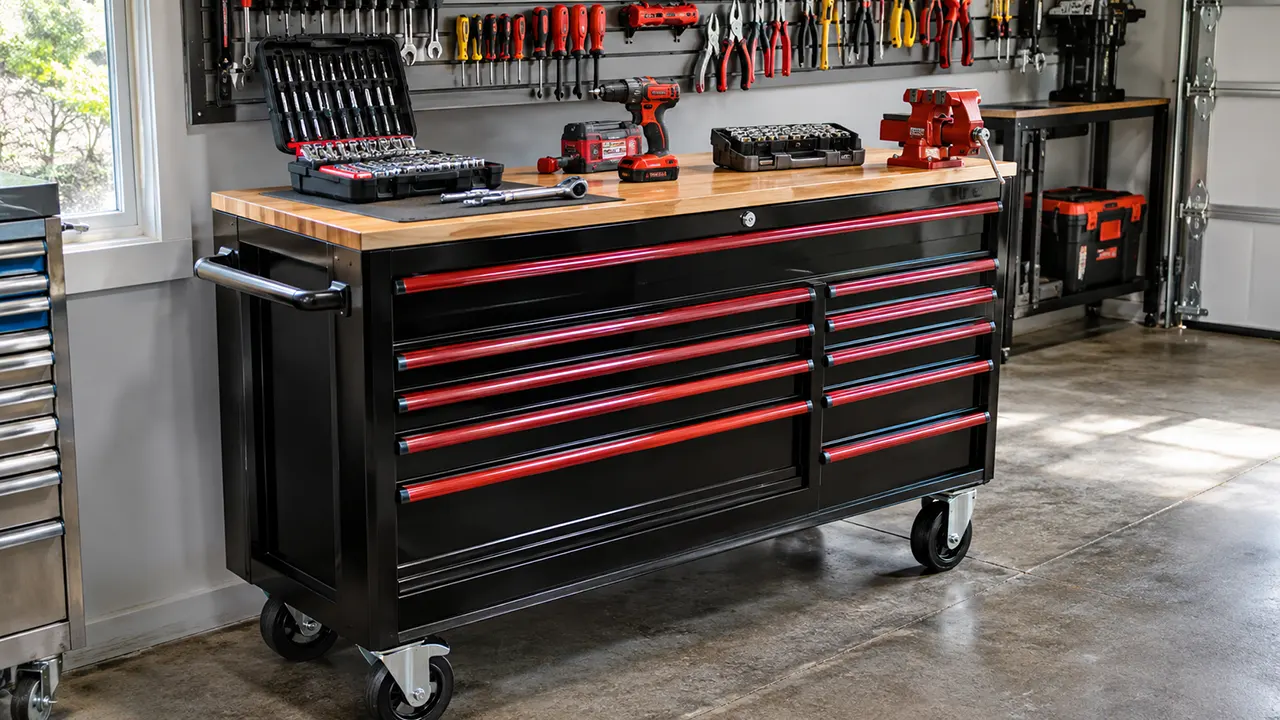
The CRAFTSMAN CMST82763BK is a strong starting point for most home workshops because it combines an upper tool chest with a rolling cabinet. For heavier collections, the CRAFTSMAN S2000 CMST341102RB offers substantially higher drawer capacity. If you need portable, expandable storage, the FLEX STACK PACK FS1105 is worth considering.
Find the Right Tool Chest for Your Home Workshop
A growing tool collection can quickly turn a clean garage into a frustrating workspace. Screwdrivers end up in random boxes, sockets get mixed together, and larger power tools take up valuable bench space. Finding the right tool becomes another job before the actual project even begins.
A good tool chest for a home shop solves this problem by giving every tool a suitable place. But choosing one is not as simple as counting drawers. You also need to consider drawer strength, cabinet construction, available floor space, wheel quality, locking systems and the weight of your tools.
The best tool chest for home shop use is not necessarily the biggest or most expensive model. It is the one that matches your collection, workshop layout and expected storage needs.
This guide compares five approved tool storage candidates and explains how to evaluate their specifications before buying.
Affiliate disclosure: ToolGuider may earn a commission when you purchase through qualifying affiliate links, at no additional cost to you. Product evaluations in this guide are based on manufacturer specifications, published product information and available third-party feedback. We have not conducted hands-on testing of these products. Prices and availability can change.
Best Tool Chests for Home Shop: Our Top Recommendations
These five products serve different workshop needs. Some are traditional steel cabinets, while others offer modular or worktop-based storage.
| Product | Best for | Important specification |
|---|---|---|
| CRAFTSMAN CMST82763BK | Best overall | 300 lb total load rating |
| CRAFTSMAN S2000 CMST341102RB | Best heavy-duty | 100 lb per drawer |
| FLEX STACK PACK FS1105 | Best modular | 70 lb total capacity |
| Seville UltraHD UHD20184B | Best worktop | 300 lb total capacity |
| Goplus 6-Drawer | Best compact budget candidate | Requires availability verification |
1. CRAFTSMAN CMST82763BK – Best Overall Tool Chest for a Home Shop
The CRAFTSMAN CMST82763BK is a practical starting point for homeowners who want an upper chest and lower rolling cabinet in one purchase.
Instead of buying separate storage units, this combination provides a complete two-piece arrangement. The upper chest ships inside the lower cabinet, making the setup convenient for a new home workshop.
Verified specifications
| Feature | Specification |
|---|---|
| Model | CMST82763BK |
| Series | S1000 |
| Drawer count | 5 |
| Individual drawer capacity | 30 lb |
| Total load rating | 300 lb |
| Drawer slides | Full-extension ball-bearing |
| Steel construction | 24-gauge steel |
| Locking | Keyed locking system |
| Casters | 3 x 1 inches |
| Warranty | 3-year limited warranty |
Source: CRAFTSMAN manufacturer product page. Its published storage-volume figure is 1,227 cubic inches.
Why consider it?
- Upper and lower storage in one combination.
- Full-extension drawers for easier access.
- Drawer liners help prevent tools from sliding around.
- Locking system provides basic storage security.
- Relatively narrow 26-inch product format.
Limitations
The 30 lb individual drawer rating is an important limitation. Heavy socket collections, large metal tools and dense automotive equipment may require a stronger cabinet.
The 24-gauge steel construction is also better suited to general home workshop storage than demanding professional workshop use.
Who should buy it?
Choose this model if you mainly store hand tools, measuring equipment, screwdrivers, small power tools and accessories. It is a sensible option for homeowners who want an organized garage without investing in a large professional cabinet.
Who should avoid it?
Avoid it if you regularly store heavy automotive equipment or need high individual drawer load ratings.
Price reference: A retailer listing showed $288 during the research period. Check the current price before purchasing.
2. CRAFTSMAN S2000 CMST341102RB – Best Heavy-Duty Tool Chest
The CRAFTSMAN S2000 CMST341102RB is designed for buyers who need more substantial storage than a compact garage toolbox can provide.
Its ten drawers and higher individual drawer capacity make it particularly interesting for home mechanics, automotive hobbyists and people with large hand-tool collections.
Verified specifications
| Feature | Specification |
|---|---|
| Model | CMST341102RB |
| Series | S2000 |
| Width | 41 inches |
| Depth | 18 inches |
| Height | 37.5 inches |
| Drawer count | 10 |
| Individual drawer capacity | 100 lb |
| Caster system rating | 1,500 lb |
| Construction | Steel I-Frame |
| Drawer slides | Full-extension soft-close ball-bearing |
| Locking | Internal keyed locking system |
The manufacturer confirms the 100 lb drawer capacity and 1,500 lb caster rating. These are separate specifications, and the caster rating must not be mistaken for an independent cabinet payload rating.
Why consider it?
- Ten drawers provide more storage separation.
- Soft-close slides help prevent drawers from slamming.
- Full-extension drawers improve access to stored tools.
- Internal locking protects the stored collection.
- The larger cabinet provides a more substantial workshop storage setup.
Limitations
This cabinet requires considerably more floor space than the compact CRAFTSMAN combination. Its purchase and delivery costs may also be higher.
A 41-inch cabinet is not automatically the right choice for a small garage. Measure the installation area and drawer-opening clearance before ordering.
Who should buy it?
This is a strong candidate for DIY mechanics, automotive enthusiasts and serious home workshop owners who need higher drawer load ratings.
Who should avoid it?
It may be excessive for someone who owns only a small collection of household tools.
Price reference: A September 2026 price comparison listed the Amazon offer at $579. This is a historical price reference, not a confirmed November 2026 offer. Another retailer listing showed a higher price.
3. FLEX STACK PACK FS1105 – Best Modular Tool Storage
The FLEX STACK PACK FS1105 takes a different approach to workshop organization.
Rather than providing a conventional steel rolling cabinet, it offers a modular drawer unit that connects with other compatible STACK PACK components.
This makes it useful for people who move tools between a garage, vehicle and project location.
Verified specifications
| Feature | Specification |
|---|---|
| Model | FS1105 |
| Drawer count | 3 |
| Total weight capacity | 70 lb |
| Exterior dimensions | 22 x 15.1 x 16.3 inches |
| Material | Impact-resistant polypropylene |
| Reinforcement | Aluminum-reinforced corners |
| Drawer organization | Removable dividers |
| Drawer security | Onboard security bar |
| Warranty | 1-year limited warranty |
FLEX confirms the auto-locking drawer mechanism, rust-resistant rails and compatibility with STACK PACK accessories.
Why consider it?
- Modular design supports expandable storage.
- Three drawers keep smaller tools organized.
- Removable dividers help separate hardware and accessories.
- Auto-locking drawers help prevent accidental opening during transportation.
- The security bar provides an additional locking option.
Limitations
The 70 lb total capacity makes this a supplementary storage solution rather than a replacement for a large steel tool cabinet.
Its plastic construction may also be less appealing to buyers who specifically want traditional metal workshop furniture.
Who should buy it?
Choose the FLEX system if you need portable organization, regularly move tools between locations or want to expand your storage gradually.
Who should avoid it?
Avoid treating it as your primary heavy-duty garage cabinet. Its capacity and configuration are better suited to smaller tools and accessories.
Price reference: An October 2026 retailer listing showed $179. Amazon pricing and stock should be checked separately.
4. Seville Classics UltraHD UHD20184B – Best Tool Chest with Worktop
The Seville Classics UltraHD UHD20184B combines tool storage with a useful working surface.
This configuration can be particularly valuable in home workshops where a separate workbench would consume too much floor space.
Verified specifications
| Feature | Specification |
|---|---|
| Model | UHD20184B |
| Drawer count | 6 |
| Width | 28 inches |
| Depth | 25 inches |
| Height | 34.5 inches |
| Worktop | 0.75-inch polyurethane-coated wood |
| Construction | All-steel body |
| Drawer fronts | Stainless steel |
| Wheels | Four 5-inch wheels |
| Locking wheels | Two |
| Total weight capacity | 300 lb |
| Product weight | 117 lb |
The manufacturer also specifies six locking drawers, a powder-coated body and a chrome push-bar.
Why consider it?
- Integrated wooden worktop provides an additional working surface.
- Six drawers offer separate storage areas.
- Locking drawers help protect tools.
- Large wheels support movement around the workshop.
- Stainless steel drawer fronts provide a distinctive appearance.
Limitations
Its 300 lb total capacity is not intended for the same type of heavy-duty storage as a professional cabinet.
It also requires assembly. The manufacturer identifies it as an indoor-use product.
Its 25-inch depth is worth considering in narrow garages. The handle bars increase the overall depth further.
Who should buy it?
Choose this model if you want a combined storage cabinet and small work surface for household repairs, DIY projects and light workshop activities.
Who should avoid it?
It may not suit mechanics who need deep drawers for heavy automotive tools or buyers who already have a dedicated workbench.
Price reference: The manufacturer’s product pages showed prices of $479.99 and $549.99 for the same model at different listings. Confirm the current price and availability before purchasing. Seville
5. Goplus 6-Drawer Rolling Tool Chest – Best Compact Budget Candidate
The Goplus 6-Drawer Rolling Tool Chest is an interesting candidate for homeowners who want a compact combination of upper and lower storage.
Its detachable upper toolbox gives it more flexibility than a basic stationary toolbox.
Research findings
Earlier published product specifications identified:
- Six drawers across the upper and lower sections.
- Four wheels.
- A detachable upper toolbox.
- A compact footprint.
- A keyed locking system.
However, the manufacturer’s current specification research indicates a 200 lb total capacity and a 22 lb individual drawer rating. The product was also reported as sold out on the official store during research.
Why consider it?
- Compact storage arrangement.
- Detachable upper toolbox.
- Separate drawers for smaller tools.
- Potentially useful for light household maintenance.
Limitations
Its lower load ratings make it unsuitable for heavy automotive tool collections. Availability and exact model identification also need confirmation.
Who should buy it?
Consider it only if the exact model becomes available at a competitive price and your storage needs are relatively light.
My recommendation: Do not purchase this model based on an old price or an unverified marketplace listing. Confirm the current seller, specifications, included components and return policy first.
What Makes a Good Tool Chest for a Home Shop?
A good tool chest should organize your collection without becoming difficult to use. Its construction, drawer arrangement, load capacity and mobility all affect its usefulness.
Before comparing individual features, identify the tools you plan to store. A cabinet designed for screwdrivers, pliers and measuring tools has different requirements from one holding large sockets, impact wrenches and automotive equipment.
Storage capacity and drawer configuration
Drawer count is only one part of storage capacity.
A cabinet with ten shallow drawers may be less useful for power tools than one with six deeper drawers.
Consider the following:
- Small drawers for screws, bits, sockets and accessories.
- Medium drawers for hand tools and measuring equipment.
- Deep drawers for drills, impact drivers and larger equipment.
- Open compartments for oversized tools that cannot fit comfortably in drawers.
The useful storage volume matters more than the advertised drawer count.
One practical approach is to separate tools by their physical size before choosing a cabinet. Measure your largest tools first. This helps prevent the common mistake of buying a chest with plenty of drawers but insufficient usable space.
Construction quality and steel thickness
Steel construction is common in traditional tool chests. However, steel thickness is only one part of cabinet quality.
Manufacturers may describe steel thickness using gauge numbers. In the US gauge system, a lower gauge number generally indicates thicker steel.
For example, 18-gauge steel is generally thicker than 24-gauge steel.
But do not choose a cabinet using gauge alone. Frame design, reinforcement, drawer construction, weld quality and total load rating also matter.
Look for clear manufacturer specifications rather than vague claims such as heavy-duty steel.
Drawer slides and load ratings
Drawer slides determine how smoothly a drawer moves and how much weight it can support.
Ball-bearing slides are common in modern tool cabinets. They reduce friction and make heavily loaded drawers easier to open.
Full-extension slides are particularly useful because they allow the drawer to open farther, improving access to tools at the back.
Soft-close mechanisms provide another convenience. They help drawers close gently rather than slamming.
However, these features do not automatically guarantee high load capacity. Always check the manufacturer’s individual drawer rating.
Locking systems and tool security
A locking system is useful when you store expensive tools in a shared garage or workshop.
Common designs include:
- Central keyed locking systems.
- Internal locking bars.
- Individual drawer locks.
- Security bars on modular storage systems.
A locking mechanism can prevent casual access, but it does not make a tool chest theft-proof. The cabinet’s construction, installation and surrounding security also matter.
Best Types of Tool Chests for Different Home Shops
Not every home workshop needs a large rolling cabinet. Understanding the available configurations will help you avoid buying more storage than you actually need.
Portable tool chests
Portable tool chests are useful for smaller collections and occasional maintenance work.
They are suitable for storing hand tools, small accessories and commonly used equipment. Some models have removable compartments or carrying handles.
Their biggest limitation is storage volume. They are not ideal for people with large tool collections.
Stationary tool cabinets
Stationary cabinets are designed to remain in one position.
They are useful when your workshop has a fixed layout and you do not regularly move tools around.
Some cabinets provide larger drawers, shelves or work surfaces. However, you must plan their position carefully because moving a fully loaded stationary cabinet can be difficult.
Rolling tool chests
Rolling tool chests are among the most practical options for home garages.
Their casters allow you to move tools closer to the work area. This is useful when working on vehicles, furniture or equipment in different parts of the garage.
However, a loaded cabinet can become difficult to move. Floor condition, caster design and weight distribution all affect mobility.
Modular tool storage systems
Modular storage systems use compatible boxes, drawers and organizers that connect together.
The FLEX STACK PACK FS1105 is an example.
You can begin with a smaller storage unit and add compatible components as your collection grows.
The main limitation is compatibility. Before investing in a modular ecosystem, check which accessories and additional components are currently available.
Mobile workbench tool chests
A mobile workbench combines tool storage with a work surface.
The Seville UltraHD is an example of this configuration.
This design is useful when your workshop has limited space and you want one unit to perform multiple jobs.
Remember that a worktop’s existence does not automatically mean it is suitable for every type of work. Check the manufacturer’s load limits and intended use.
Tool Chest vs. Rolling Tool Cabinet: Which Should You Choose?
These terms are often used interchangeably, but they can describe different storage configurations.
A tool chest commonly refers to an upper storage unit with drawers. A rolling tool cabinet is generally a larger floor-standing unit with wheels.
A tool chest combo combines both components.
| Feature | Tool chest | Rolling tool cabinet |
|---|---|---|
| Typical placement | Bench or cabinet top | Floor |
| Mobility | Depends on design | Usually on casters |
| Storage | Often smaller | Often larger |
| Work surface | Requires separate support | May include top surface |
| Best use | Smaller tool collections | Larger workshop collections |
For a home shop, a combination can be useful because it provides different storage levels.
However, do not assume that every upper chest can safely sit on every lower cabinet. Use manufacturer-approved combinations and follow the installation instructions.
How Much Tool Storage Capacity Do You Really Need?
The correct storage capacity depends on the size and weight of your tool collection.
A simple way to estimate your requirements is to divide your tools into categories:
- Hand tools.
- Automotive tools.
- Power tools.
- Measuring equipment.
- Fasteners and small accessories.
- Large or unusually shaped equipment.
Next, identify the heaviest individual group you expect to store in one drawer.
Understanding individual drawer load ratings
This is one of the most important specifications in a tool chest.
An individual drawer rating tells you how much weight a particular drawer is designed to support under the manufacturer’s stated conditions.
For example, the CRAFTSMAN S2000 CMST341102RB specifies 100 lb drawer capacity. The smaller CMST82763BK specifies 30 lb per drawer.
That difference matters when storing heavy tools.
Do not assume that ten drawers rated at 100 lb each mean the cabinet can safely support 1,000 lb. The cabinet, frame, casters and overall rating still impose their own limits.
Understanding total cabinet load capacity
The total cabinet load rating describes the overall load the manufacturer allows for the cabinet under its stated conditions.
This is different from the rating of one drawer.
You should never calculate cabinet capacity simply by adding individual drawer ratings.
For example, a cabinet may have multiple drawers with substantial individual ratings but a lower overall cabinet rating.
Both specifications must be respected.
Choosing the right drawer depth
Drawer depth affects what you can store.
Shallow drawers are useful for small hand tools, bits, sockets and accessories. Deep drawers work better for larger power tools and bulky equipment.
Measure your largest tools before selecting a cabinet. Also consider their handles, attachments and accessories.
A tool that technically fits inside a drawer may still be inconvenient to remove if there is little clearance.
Steel Thickness, Drawer Slides and Construction Quality
Construction quality affects how a tool chest performs over time.
A cabinet can look impressive in product photographs but still have limitations in its frame, slides or drawer design.
Understanding tool chest steel gauge
Steel gauge helps buyers compare construction thickness.
Remember that gauge numbers work in the opposite direction from what many buyers expect: lower numbers generally indicate thicker steel.
But gauge alone cannot establish whether a cabinet is durable.
Look at the entire construction:
- Frame reinforcement.
- Drawer panel construction.
- Corner strength.
- Welds and joints.
- Protective coating.
- Manufacturer load ratings.
A well-designed cabinet with a sensible load rating may be a better choice than a larger cabinet with impressive marketing claims.
Ball-bearing vs. other drawer slide systems
Ball-bearing slides use rolling bearings to reduce friction as the drawer moves.
They are common in tool storage cabinets because they can provide smooth operation and support specified loads.
Full-extension slides are useful because they allow access to tools near the back of the drawer.
Soft-close slides add convenience by reducing the impact when a drawer closes.
When comparing two cabinets, check the actual drawer rating rather than assuming that all ball-bearing slides support the same weight.
Full-extension drawers and drawer liners
Full-extension drawers make it easier to see and reach stored equipment.
Drawer liners serve a different purpose. They help reduce tool movement and protect the drawer surface from scratches.
They are especially useful for organizing small tools and accessories.
However, liners cannot compensate for an overloaded drawer or an unsuitable storage configuration.
How to Evaluate Tool Chest Casters and Loaded Mobility
Wheels can make a rolling tool cabinet convenient, but their quality and load ratings deserve attention.
Fixed vs. swivel casters
Fixed casters move in a straight line. Swivel casters can rotate to help change direction.
Many rolling tool cabinets combine these designs to balance directional stability and maneuverability.
For a home workshop, swivel casters can make it easier to move a cabinet around vehicles, workbenches and other equipment.
Locking wheels and brake systems
Locking casters help prevent unwanted movement when the cabinet is parked.
Before opening heavily loaded drawers, engage the wheel brakes as directed by the manufacturer.
This is especially important when the cabinet is positioned on a slightly uneven surface.
Understanding caster load ratings
Caster ratings describe the capacity of the wheel or caster system under specified conditions.
They are not interchangeable with individual drawer ratings or the overall cabinet load rating.
For example, the CRAFTSMAN S2000 has a published 1,500 lb caster system rating. That does not mean buyers should assume the cabinet can carry 1,500 lb of tools.
Always follow the manufacturer’s overall loading instructions.
Moving a loaded tool chest safely
Before moving a rolling cabinet:
- Close and secure all drawers.
- Remove loose tools from the top.
- Check the wheel locks.
- Inspect the floor for obstacles.
- Move the cabinet slowly.
- Avoid slopes and uneven surfaces where possible.
If the cabinet is too heavy to move comfortably, remove some tools before attempting to relocate it.
How to Choose a Tool Chest for Your Workshop Space
A large tool chest can provide excellent storage but become a problem if it blocks access to your work area.
Measure your workshop before buying.
Measuring available floor space
Measure the available width, depth and height.
Do not measure only the cabinet body. Include handles, side attachments and other parts that extend beyond the main frame.
Also account for the space needed to open drawers.
A cabinet that fits against a wall may still become difficult to use if its drawers cannot open fully.
Drawer opening clearance
Consider the position of nearby vehicles, workbenches, shelves and doors.
For example, a 25-inch-deep cabinet may fit into a garage corner, but its open drawers may interfere with a parked vehicle.
Leave enough space to access the drawers without repeatedly moving other equipment.
Workbench height and accessibility
A cabinet with a worktop can help reduce the need for separate furniture.
However, check the actual work surface height and whether it suits your tasks.
The Seville UltraHD offers a wooden top, while the CRAFTSMAN S2000 provides a top surface intended for cabinet use.
Choose a configuration that supports your regular workshop activities.
Combining wall storage and drawer storage
Not every tool needs to go inside a cabinet.
Use wall-mounted storage for frequently used tools where appropriate.
Pegboards, hooks and shelves can help keep commonly used equipment visible and accessible.
A practical arrangement is to keep small, frequently used hand tools near your main work area and heavier or less frequently used tools in lower drawers.
Tool Chest Safety and Proper Loading
Safe tool storage is not only about avoiding damage to equipment. Poor loading and positioning can create hazards in a home workshop.
OSHA‘s warehouse safety guidance recommends placing heavier loads on lower or middle shelves, keeping stored materials stable and respecting rated storage capacities. These are useful safety principles, although workplace warehouse guidance should not be presented as a universal residential regulation.
Distributing heavy tools across drawers
Avoid concentrating all your heaviest tools in one drawer.
Use the manufacturer’s individual drawer limits and overall cabinet rating.
Where practical, place heavier tools in lower drawers. This can help keep the center of gravity lower.
Keeping the cabinet stable
Follow the manufacturer’s installation and positioning instructions.
If the cabinet includes wheel brakes, engage them when it is parked.
Do not assume every rolling tool chest requires wall anchoring. Follow the specific product’s instructions rather than applying a universal rule.
Inspecting wheels, slides and locking systems
Check the cabinet periodically for:
- Loose caster fasteners.
- Damaged wheels.
- Drawer slides that bind.
- Bent drawer panels.
- Faulty locking mechanisms.
- Damaged handles.
- Unusual movement when opening drawers.
Stop using a cabinet if a structural or mechanical fault makes it unsafe.
Checking product recalls
Before purchasing a tool storage product, check the CPSC product recall database.
The Consumer Product Safety Commission publishes product safety warnings and recall notices. A product should not be considered safe simply because it is available through a major retailer.
FAQs About Home Shop Tool Chests
1. What is the best tool chest brand for a home garage?
There is no single best brand for every home garage. CRAFTSMAN offers several configurations for home workshop storage, while FLEX is worth considering for modular organization. Seville Classics offers worktop-based storage. Compare individual models, specifications, warranty coverage and availability rather than choosing solely by brand reputation.
2. How many drawers should a home tool chest have?
The ideal drawer count depends on your tool collection. A small DIY workshop may need only a few drawers, while an automotive workshop may benefit from ten or more. Consider drawer dimensions and weight capacity alongside drawer count. More drawers do not automatically mean more useful storage.
3. Is a 20-inch-deep tool cabinet enough for a home shop?
A 20-inch-deep cabinet can be suitable for many home workshops, but the correct depth depends on your equipment. Measure your largest tools and compare the internal drawer dimensions. Also account for drawer opening clearance and the space occupied by the cabinet handle.
4. Are expensive professional tool chests worth buying for home use?
Professional tool chests can offer higher load capacities, stronger construction and additional storage features. However, these benefits may not justify the cost for someone with a small tool collection. Choose a cabinet based on your actual storage requirements rather than buying professional-grade equipment simply because it looks impressive.
5. Can a rolling tool chest be used as a workbench?
Some rolling tool cabinets include a worktop designed for workshop tasks. Others have a protective top surface that is not necessarily intended for heavy work. Check the manufacturer’s instructions and surface load rating before using a cabinet as a workbench.
6. How much weight can a typical tool chest drawer hold?
Drawer capacity varies considerably by model. The CRAFTSMAN CMST82763BK specifies 30 lb per drawer, while the CRAFTSMAN S2000 CMST341102RB specifies 100 lb per drawer. Always check the exact model’s manufacturer documentation. Never assume all drawers in every cabinet have the same rating.
7. Should I buy a tool chest or a garage storage cabinet?
Buy a tool chest if you primarily need organized drawer storage for hand tools, sockets and accessories. A larger garage storage cabinet may be more useful for bulky equipment, containers and items that do not fit comfortably inside drawers. Some workshops benefit from using both.
Choose a Tool Chest That Fits Your Workshop
The right tool chest should make your work easier, not simply give you more drawers to fill.
For most homeowners building a practical workshop, the CRAFTSMAN CMST82763BK is a sensible starting point. If you regularly store heavier equipment, the CRAFTSMAN S2000 deserves closer attention. FLEX is a useful alternative when modular portability matters more than large cabinet capacity.
Before buying, measure your available space, identify your heaviest tools and compare the individual drawer and overall cabinet ratings.
Your next step: Check the manufacturer’s specifications and current US retailer availability for the model that matches your workshop. Do not sacrifice suitable load capacity or usable space just to get a lower purchase price.
