


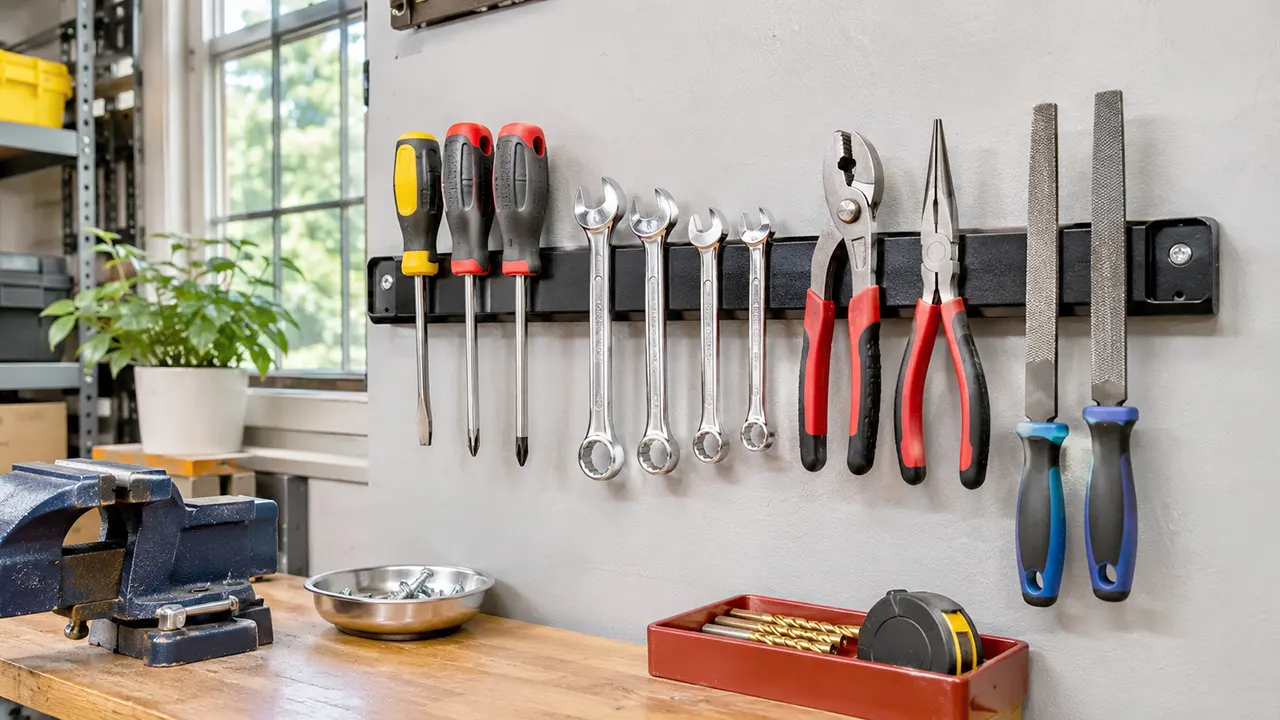
A magnetic tool holder strip can turn an empty workshop wall into useful storage space. It keeps frequently used tools visible and within reach without taking up valuable drawer space. However, not every magnetic tool bar can hold heavy tools safely. The right choice depends on magnetic performance, tool compatibility, mounting hardware and wall construction. This guide explains how to choose a suitable magnetic tool holder and install it securely.
Affiliate disclosure: ToolGuider may earn a commission when you purchase through qualifying links in this article. As an Amazon Associate, we earn from qualifying purchases.
What Is a Magnetic Tool Holder Strip?
A magnetic tool holder strip is a wall-mounted storage bar that uses permanent magnets to hold compatible metal tools. You can attach screwdrivers, pliers, wrenches and other ferrous tools directly to its magnetic surface.
Unlike a traditional tool rack, a magnetic tool holder does not require a separate hook or slot for every tool. You can move tools around without changing the storage arrangement.
Most magnetic tool holders have a steel housing or protective outer surface. They also include mounting holes, brackets or tabs for wall installation.
How Does a Magnetic Tool Bar Work?
A magnetic tool bar creates a magnetic field that attracts suitable ferromagnetic materials. When you place a compatible steel tool against the bar, magnetic attraction keeps it attached.
The strength of that attraction depends on several factors:
- Magnet material and construction.
- Distance between the magnet and the tool.
- Tool material and magnetic properties.
- Contact area between the tool and the holder.
- Tool position and direction of applied force.
For example, a flat steel wrench may make better contact with a magnetic surface than a narrow or rounded tool.
The magnetic holder does not physically lock a tool in place. A sudden impact or sideways force can cause a poorly positioned tool to slide or fall.
Magnetic Tool Strip vs. Magnetic Tool Rack
These terms often describe similar products, but their designs can differ.
A magnetic tool strip usually provides a simple magnetic surface for attaching metal tools. A magnetic tool rack may include additional storage features, such as hooks, brackets, compartments or dedicated holders.
A basic magnetic bar works well for frequently used hand tools. A larger organizer may be more useful when you need to store several types of workshop accessories.
Types of Magnetic Tool Holders for Workshops
Magnetic tool holders come in different lengths, mounting designs and magnetic constructions. Understanding these differences helps you choose a product that fits your workspace.
Standard Magnetic Tool Bars
A standard magnetic tool bar is a simple storage solution for garages, woodworking shops and home workshops.
Most models have a permanent magnet inside a protective housing. Mounting tabs or screw holes allow you to attach the bar to a suitable wall.
These bars work well for:
- Screwdrivers.
- Steel wrenches.
- Pliers.
- Chisels.
- Metal files.
- Small steel accessories.
Choose a standard bar when you want a straightforward storage system without extra components.
Heavy-Duty Magnetic Tool Holders
Heavy-duty magnetic tool holders are designed for applications that require stronger magnetic attraction or more robust construction.
Some industrial models use rare-earth magnetic circuits and stainless steel housings. Industrial Magnetics, for example, offers its TH Series in different lengths, including 12, 18 and 24 inches. Industrial Magnetics, Inc.
However, a heavy-duty label does not automatically establish a safe working load. Always check the manufacturer’s test conditions and application-specific load information.
Modular Magnetic Tool Holder Strips
Modular magnetic strips provide more flexibility when organizing a large workshop wall.
You can install several shorter bars in different locations instead of using one long holder. Some products also have connecting components that allow multiple strips to form a longer storage arrangement.
This design is useful when:
- Your available wall space is limited.
- You want separate tool storage zones.
- You need to expand storage gradually.
- Different workstations require different tool arrangements.
Check whether the connecting system is mechanical or simply places separate bars side by side.
Tool-Specific Magnetic Organizers
Some magnetic organizers are designed around particular tool types.
For example, screwdriver organizers may use dedicated slots, while wrench organizers can provide individual storage positions.
These designs offer better organization when you want every tool to have a fixed location.
A general magnetic bar is more flexible, but a dedicated organizer can make missing tools easier to notice.
How Strong Should a Magnetic Tool Holder Be?
Magnetic strength is one of the most important buying considerations. However, advertised pull force and actual tool-holding capacity are not the same measurement.
A manufacturer may advertise a magnetic bar with 20 pounds of pull force per inch. This describes a specified magnetic test condition, not necessarily the amount of weight the bar can safely carry on a workshop wall.
Pull Force vs. Actual Holding Capacity
Consider the Master Magnetics 18-inch magnetic tool bar. Its published specification advertises 20 pounds of pull per inch. This does not mean that multiplying 20 by 18 gives a safe vertical working load of 360 pounds. Master Magnetics+1
The actual performance depends on the complete installation.
| Measurement | Meaning | Practical importance |
|---|---|---|
| Pull force | Force required to separate a magnet from a test surface | Indicates magnetic attraction under specified conditions |
| Shear resistance | Resistance to movement parallel to a surface | Helps explain sideways or sliding forces |
| Safe working load | Allowable load for a defined application | Helps determine suitable operating limits |
Always look for a manufacturer-supported working load when you intend to store heavier tools.
Ceramic vs. Neodymium Magnets
Ceramic and neodymium magnets are common permanent magnet materials.
| Feature | Ceramic magnets | Neodymium magnets |
|---|---|---|
| Common name | Ferrite magnets | Rare-earth magnets |
| Magnetic strength | Generally lower for comparable size | Generally higher for comparable size |
| Material cost | Usually lower | Usually higher |
| Typical use | General magnetic holders | Compact, high-strength magnetic applications |
| Corrosion considerations | Generally good corrosion resistance | Usually require suitable protection |
The magnet material alone does not determine the performance of a complete tool holder. Housing design, magnetic circuit construction and surface contact also matter.
Why Tool Weight and Contact Area Matter
A magnetic holder may attract a steel tool strongly when the tool sits flat against its surface. The same tool may be less secure when it touches the magnet through a small or uneven area.
Three factors deserve attention:
- Contact area: A larger, flatter contact area can improve magnetic coupling.
- Tool shape: Rounded shafts, narrow edges and irregular surfaces may reduce effective contact.
- Direction of force: A tool hanging vertically can create different forces from one resting flat against the magnetic surface.
Do not use a magnetic pull-force specification as a substitute for a verified working-load rating.
What Tools Can You Store on Magnetic Tool Strips?
Magnetic tool holders work best with tools containing suitable ferromagnetic materials.
Wrenches, Pliers and Screwdrivers
Many common hand tools have steel components that respond to magnetic attraction.
You can organize:
- Combination wrenches.
- Adjustable wrenches.
- Steel screwdrivers.
- Pliers.
- Metal files.
- Chisels.
- Small steel measuring accessories.
Arrange frequently used tools at a comfortable working height. Leave enough room between them to remove each tool without disturbing neighboring items.
Sockets, Bits and Small Metal Accessories
Small metal accessories can also benefit from magnetic storage.
However, tiny parts may be difficult to organize on a long magnetic bar. A dedicated socket rail, parts tray or magnetic container may provide better control.
Avoid placing small components where vibration or accidental contact can dislodge them.
Stainless Steel and Non-Magnetic Tool Limitations
Not all metal tools respond equally to magnets.
Some stainless steel grades are strongly magnetic, while others are weakly magnetic or effectively non-magnetic. Their magnetic properties depend on alloy composition and manufacturing processes.
Aluminum, brass, copper, plastic and wood do not behave like ordinary ferromagnetic steel.
Before buying a magnetic holder for a particular tool collection, test a representative tool with a small magnet.
Tools Better Kept in Drawers or Dedicated Racks
A magnetic strip is not a replacement for every type of workshop storage.
Keep the following tools in suitable storage systems when their shape, weight or design makes magnetic mounting unsuitable:
- Heavy hammers.
- Large power tools.
- Bulky woodworking planes.
- Tools with delicate cutting edges.
- Non-magnetic tools.
- Tools that require individual protective holders.
For larger collections, combine magnetic strips with conventional storage.
How to Choose the Right Magnetic Tool Holder Strip
The best magnetic tool holder depends on your tools, available wall space and mounting surface. Do not choose a product based on advertised strength alone.
Select the Correct Length
Magnetic tool bars commonly come in different lengths, including 12, 18 and 24 inches.
| Length | Suitable application |
|---|---|
| 12 inches | Small tool collections and compact workstations |
| 18 inches | General home workshop organization |
| 24 inches | Longer tool collections and larger storage areas |
Remember that the usable storage space is smaller than the full bar length because tools need room for placement and removal.
Check Magnetic Construction and Holding Specifications
Look for the following information:
- Magnet type.
- Manufacturer-stated pull force.
- Published working-load information, if available.
- Housing material.
- Mounting design.
- Test conditions for advertised capacity.
If the manufacturer only provides pull force, do not assume that the product has a verified safe working load.
Evaluate Mounting Brackets and Hardware
The mounting system is just as important as the magnetic surface.
Check:
- Number of mounting points.
- Distance between mounting holes.
- Hole diameter.
- Bracket construction.
- Supplied screws.
- Compatibility with your wall material.
A strong magnet attached to weak drywall anchors can still fall off the wall.
Consider Surface Protection and Corrosion Resistance
Workshop environments can expose storage equipment to moisture, dust and oil.
Look for:
- Powder-coated steel.
- Corrosion-resistant housing.
- Smooth protective surfaces.
- Securely fitted end caps, where applicable.
- Easy-to-clean construction.
A protective coating can reduce surface corrosion, but it does not make every magnetic holder suitable for outdoor installation.
Use This Magnetic Tool Holder Selection Matrix
Use this matrix before purchasing.
| Evaluation factor | What to check |
|---|---|
| Holding capacity | Manufacturer-supported load information |
| Magnet type | Ceramic or rare-earth construction |
| Length | Available wall space and tool collection |
| Mounting | Brackets, holes and supplied hardware |
| Compatibility | Tool material, weight and shape |
| Durability | Housing and corrosion protection |
| Accessibility | Clearance for removing tools |
| Expansion | Ability to add more strips |
My recommendation: Start with the tools you actually use. Measure the wall area and check the mounting points before choosing a magnetic bar. This prevents buying a longer holder that cannot be mounted securely in the available space.
Best Magnetic Tool Holder Strips to Consider
The following products offer different approaches to workshop tool organization. These recommendations are based on manufacturer information, Amazon listings and published product details, not ToolGuider hands-on testing.
1. Master Magnetics 18-Inch Magnetic Tool Bar
The Master Magnetics 18-Inch Magnetic Tool Bar is a straightforward option for general workshop storage.
Verified specifications:
- Length: 18 inches.
- Advertised pull force: 20 pounds per inch.
- Two welded steel mounting tabs.
- Mounting holes: 0.25 inches in diameter.
- Mounting-hole spacing: 16 inches.
- Two mounting screws included.
- Black powder-coated finish.
The 16-inch mounting-hole spacing is particularly useful because it corresponds to common US wall stud spacing. However, verify the actual stud positions and mounting requirements before installation. Amazon+1
Best for: Home workshop owners who want a simple, established-brand magnetic bar.
Limitation: Amazon displayed no featured offer when checked, although its listing showed a 4.8-star rating from 2,656 ratings and 50+ purchases in the previous week.
2. ELEAD 6-Piece 12-Inch Magnetic Tool Holder
The ELEAD 6-Piece Magnetic Tool Holder offers a modular approach to organizing tools.
Verified listing details:
- Six magnetic tool holders.
- 12-inch product designation.
- Alloy steel construction.
- Mounting screws included.
- Manufacturer listing describes a 10-pound holding capacity.
- Suitable for workshop and garage organization.
The multi-piece design gives buyers more flexibility when organizing separate workstations or tool groups. Amazon+1
Best for: Buyers who prefer multiple smaller storage locations instead of one long magnetic bar.
Limitation: Amazon displayed no featured offer when checked. Its listing showed 4.3 stars from 389 ratings.
3. SEDY 7-Piece Magnetic Tool Holder Storage Organizer
The SEDY 7-Piece Magnetic Tool Holder is another modular storage option.
Verified listing details:
- Seven-piece organizer.
- Alloy steel construction.
- Magnetic tool storage strips.
- Mounting screws included.
- Additional compatibility with workshop and slatwall-style organization is described in the product listing.
The retailer’s product information also describes vertical holding capacity up to 11 kg. Treat this as a manufacturer-listed product claim, not an independently verified safe working load for every installation. Amazon+1
Best for: Buyers who want a multi-piece tool organization system.
Limitation: Amazon displayed no featured offer when checked. Its listing showed 4.2 stars from 670 ratings and 500+ purchases in the previous month.
Other Products Worth Considering
Two additional candidates from the original shortlist deserve consideration:
- POWERTEC 71965 Magnetic Tool Holder 4-Pack: Four 12-inch strips with Y30BH magnets, a carbon steel body and manufacturer-advertised 10-11-pound capacity per strip. Its official listing displayed $25.99 before tax when researched, but stock information was inconsistent. View POWERTEC.
- Rockler 18-Inch Magnetic Tool Holder: An 18-inch rail with mounting holes spaced 16 inches apart. Its one-inch projection from the wall provides space to grip tools. Rockler listed it at $14.99 when researched. View Rockler.
These two are included as non-Amazon alternatives. No verified Amazon affiliate URL was established for either product.
Quick Product Comparison
| Product | Best use | Main distinction |
|---|---|---|
| Master Magnetics | General workshop | Traditional magnetic bar |
| ELEAD | Modular storage | Six-piece system |
| SEDY | Multi-piece storage | Seven-piece organizer |
| POWERTEC | Expandable storage | Interlocking strips |
| Rockler | Easy tool access | One-inch wall projection |
Check the live listings for current prices, seller details and availability before publishing or purchasing. Prices and offers can change.
How to Install a Wall-Mounted Magnetic Tool Holder
Correct installation matters. Even a strong magnetic holder can become dangerous if its mounting hardware fails.
Before starting, identify the wall material and choose fasteners designed for that surface.
Tools and Materials Required
You may need:
- Magnetic tool holder.
- Drill and suitable drill bits.
- Stud finder.
- Measuring tape.
- Pencil.
- Level.
- Screwdriver or drill driver.
- Suitable mounting screws.
- Wall anchors, if required.
- Safety glasses.
Check the product instructions first. Some manufacturers supply mounting screws, but those screws may not suit every wall type.
Step 1: Find and Mark the Mounting Position
Choose a position that allows you to reach the tools comfortably.
Avoid placing the holder directly above areas where people sit or work. Also consider nearby electrical outlets, wiring, pipes and other hidden services.
Use a stud finder to locate suitable wall studs. Mark the intended mounting positions with a pencil.
Step 2: Mount the Magnetic Tool Holder Into Wood Studs
Mounting directly into suitable wood studs is generally preferable for a regularly loaded workshop tool holder.
Follow these steps:
- Position the holder against the wall.
- Align its mounting holes with the stud locations.
- Check that the holder is level.
- Mark the screw positions.
- Drill appropriate pilot holes if required by the fastener instructions.
- Install the mounting screws.
- Tighten them securely without damaging the mounting tabs.
The Master Magnetics 18-inch model has mounting tabs spaced 16 inches apart, making it a convenient candidate for mounting across two appropriately positioned studs. Amazon+1
Do not force screws into an incorrect position simply to match the holder’s mounting holes.
Step 3: Install With Drywall Anchors
Sometimes the available mounting position does not line up with wall studs.
In that situation, use suitable drywall anchors designed for the actual application.
Common options include:
- Self-drilling drywall anchors.
- Expansion anchors.
- Toggle bolts.
Check the anchor manufacturer’s instructions for material thickness, installation method and load limitations.
Do not assume that the advertised capacity of an anchor equals the safe working load of the complete magnetic tool holder installation.
For heavier tools or uncertain wall conditions, choose another mounting location or use a suitable structural backing.
Step 4: Mount on Masonry or Concrete
Concrete and masonry require different fasteners from drywall.
Use appropriate masonry screws or anchors designed for the wall material. Follow the fastener manufacturer’s drilling depth and installation instructions.
Avoid using ordinary wood screws directly in concrete.
Step 5: Check Alignment and Test the Installation
After installation:
- Check that the bar sits securely against the mounting surface.
- Inspect all screws and brackets.
- Test the holder with a light, suitable tool.
- Add other tools gradually.
- Watch for sliding, movement or unusual noise.
- Stop using the holder if its mounting or tool retention appears unreliable.
Do not use a sudden pull or heavy tool as an improvised load test.
Magnetic Tool Holders vs. Pegboards: Which Is Better?
Both systems can improve workshop organization, but they solve slightly different storage problems.
| Feature | Magnetic tool holder | Pegboard |
|---|---|---|
| Installation | Usually simple | Requires board and mounting support |
| Tool access | Direct magnetic attachment | Hooks and dedicated accessories |
| Flexibility | Tools can move along the magnetic surface | Hooks can be repositioned |
| Tool compatibility | Requires suitable magnetic material | Supports many tool materials |
| Storage layout | Simple and compact | Highly customizable |
| Best use | Frequently used metal hand tools | Mixed tool collections |
When a Magnetic Tool Holder Is Better
Choose a magnetic holder when you want to store frequently used steel tools within easy reach.
It is particularly useful for screwdrivers, pliers, wrenches and similar hand tools.
When a Pegboard Is Better
Choose a pegboard when you need more flexibility for different tool shapes and materials.
It can support plastic-handled tools, measuring accessories and other items that do not attach to magnets.
When to Combine Both Systems
A combination often provides the most practical workshop layout.
Use magnetic strips for frequently used metal tools. Use pegboards for larger items, non-magnetic tools and accessories that need dedicated hooks.
For additional storage capacity, consider a tool chest for a home shop. It provides enclosed storage for tools that should not remain on an exposed wall.
Magnetic Tool Holder Safety and Maintenance
A magnetic tool holder should keep tools accessible without creating a falling-object hazard.
Prevent Tools From Falling
Arrange tools so their weight remains supported by sufficient magnetic contact.
Avoid placing heavy tools in positions where they can easily slide or rotate away from the magnetic surface.
Keep sharp tools away from frequently used walkways and working positions.
Keep Sharp Tools Positioned Safely
Chisels, knives and other sharp tools require extra care.
Position cutting edges away from your hands and body. Use dedicated protective covers when appropriate.
Do not store sharp tools in locations where someone could accidentally brush against them.
Clean Magnetic Surfaces
Dust, metal particles and workshop debris can collect around magnetic surfaces.
Clean the holder periodically using a suitable cloth. Follow the manufacturer’s cleaning recommendations.
Remove accumulated metal fragments carefully. Avoid damaging the protective coating.
Inspect Mounting Hardware and Corrosion
Check the installation periodically.
Look for:
- Loose screws.
- Damaged mounting tabs.
- Cracked housing.
- Rust or corrosion.
- Movement around mounting points.
- Tools sliding from their positions.
Replace damaged hardware and stop using an unstable holder until the installation is corrected.
Frequently Asked Questions
1. Do magnetic tool holders work with stainless steel?
Some stainless steel tools respond to magnets, while others do not. Austenitic stainless steels are generally weakly magnetic or non-magnetic, while ferritic and martensitic stainless steels are typically magnetic. Test the actual tool before relying on a magnetic holder.
2. Can you mount a magnetic tool bar on drywall?
Yes, provided the holder and mounting system are suitable for the application. Use appropriate drywall anchors and follow their load limitations. For heavier workshop tools, mounting into structural studs is generally preferable.
3. Can magnetic tool strips hold heavy wrenches?
They can hold suitable steel wrenches, but performance depends on the wrench’s weight, shape, contact area and the magnetic holder’s specifications. Do not rely on advertised pull force alone to determine whether a heavy wrench can be stored safely.
4. Can you install multiple magnetic tool bars side by side?
Yes. Multiple bars can create a larger storage area. Leave enough space between them for tool access and ensure each bar has appropriate mounting support. Use connecting components only when the manufacturer specifies that the bars are designed to connect.
5. Do magnetic tool holders lose their strength over time?
Permanent magnets generally retain their magnetic properties under suitable operating conditions. However, excessive heat, physical damage and unsuitable operating conditions can affect performance. Follow the manufacturer’s storage and temperature recommendations.
6. Can magnetic tool holders scratch tools?
They can. Metal particles, dirt and rough contact surfaces may scratch tools when you attach or remove them. Keep the magnetic surface clean and avoid dragging delicate tools across it.
7. Are magnetic tool holders suitable for outdoor sheds?
Some models may be suitable, but check the manufacturer’s environmental and corrosion-resistance specifications first. Moisture and temperature changes can affect the housing, mounting hardware and tools stored on the bar.
Choose a Magnetic Tool Holder That Fits Your Workshop
The best magnetic tool holder is not necessarily the one with the highest advertised pull force. It is the one that suits your actual tools, available wall space and mounting conditions.
For a simple workshop setup, an established magnetic bar such as Master Magnetics is worth considering. Modular options from ELEAD and SEDY offer another approach when you need several smaller storage locations.
Before buying, verify the current product specifications and mounting requirements. Then install the holder using suitable structural support and keep heavier tools within the manufacturer’s stated application limits.
A well-planned magnetic tool storage system can make a small workshop easier to use without sacrificing valuable bench or drawer space.
Ready to organize your workshop wall? Compare the magnetic tool holder options above, check their current Amazon offers and choose a system that matches your tools and installation requirements.
