


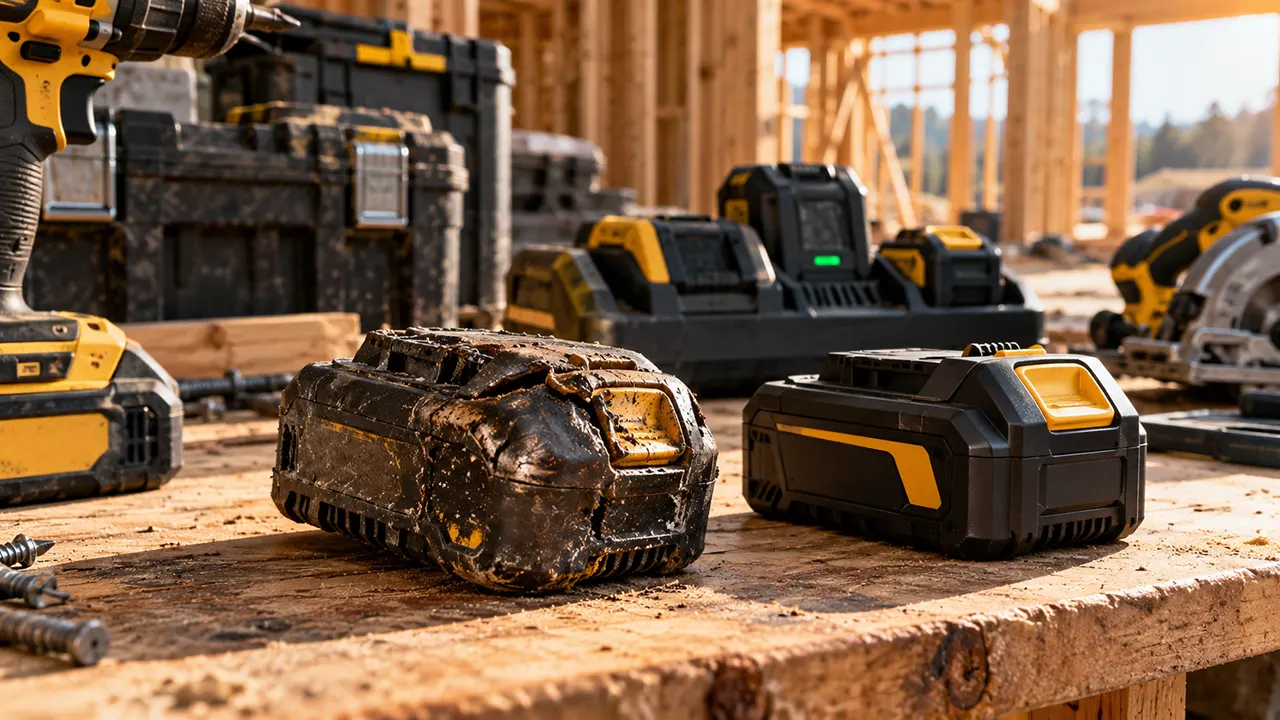
A power tool battery fire can start when physical damage, excessive heat, charging problems, an internal defect, or a short circuit creates abnormal heating inside a lithium-ion cell. If the cell cannot shed that heat, thermal runaway can develop. The resulting chain reaction can produce gas, smoke, extreme heat, venting, and fire.
A cordless drill or impact driver can look completely normal while its battery contains damage you cannot see. That is why understanding the failure process matters more than memorizing another generic battery-safety checklist.
For power tool users, the key chain is simple:
Damage or abnormal condition -> internal fault -> heat -> thermal runaway -> fire
The goal is to recognize where that chain can begin and know when a battery should no longer be used.
What Thermal Runaway Actually Means Inside a Lithium-Ion Battery
Thermal runaway is an uncontrolled self-heating state inside a lithium-ion cell. Under normal conditions, a battery produces some heat during charging and discharging, but that heat can dissipate. During thermal runaway, heat is generated faster than it can escape, causing the cell temperature to rise rapidly. UL Research Institutes describes thermal runaway as capable of producing extreme temperatures, gas release, venting, smoke and fire.
The battery cell has to stay electrically separated
A lithium-ion cell contains components including an anode, cathode, electrolyte and separator. The separator keeps the electrodes electrically apart while allowing lithium ions to move through the cell during normal operation.
If a defect or physical event compromises that separation, an internal short circuit can occur. UL Research Institutes identifies internal short circuits as one possible pathway to thermal runaway.
An internal short circuit can turn a small fault into rapid heating
An internal short can create a localized area of abnormal heat. If that heat damages the cell further, additional reactions can occur and release still more heat.
This is why a battery fire is not simply a case of the outside of a battery becoming hot. The dangerous process can begin inside the cell.
OSHA explains that heat released during cell failure can damage nearby cells, producing a chain reaction known as thermal runaway.
Why thermal runaway becomes self-accelerating
The important concept is feedback.
Cell fault -> heat -> additional cell damage -> more heat -> runaway
Once this process becomes uncontrolled, the battery can release gases and intense heat. Depending on the battery design and chemistry, the failure can involve venting, smoke, fire or other hazardous effects.
That is also why a battery that was only warm a short time earlier can become a serious fire hazard if its condition is deteriorating.
The 8 Conditions That Can Start a Power Tool Battery Fire
A lithium-ion battery does not need to be visibly broken before a dangerous failure becomes possible. OSHA identifies physical impact, temperature exposure and improper charging as potential sources of battery damage. UL Research Institutes also identifies internal faults, overcharge, external short circuits and extreme temperatures as possible thermal-runaway triggers.
Physical impact, crushing or puncture
Dropping, crushing or puncturing a battery can damage internal components even when the outer case shows little damage. OSHA specifically identifies dropping, crushing and puncturing as forms of physical impact that can damage lithium batteries.
A battery that has suffered a hard impact should therefore not be treated as automatically safe just because it still powers the tool.
Overheating and extreme temperatures
Excessive heat can accelerate battery failure. OSHA warns that high temperatures can damage lithium batteries, while charging below freezing can also create a failure risk for lithium-ion batteries.
A power tool battery left in a very hot vehicle, placed beside a heat source, or exposed to other extreme conditions may face risks that are not obvious during a quick visual inspection.
Improper or incompatible charging
Charging equipment matters because the battery and charger must operate within the conditions specified by the manufacturer.
OSHA advises following manufacturer charging instructions and using the manufacturer’s charger or an authorized reseller. Improper charging can damage rechargeable lithium-ion batteries.
External short circuits
A short circuit outside the cell can create a rapid electrical discharge and abnormal heating. UL Research Institutes identifies external short circuits as one possible thermal-runaway trigger.
This is one reason battery terminals should be protected from unintended contact with conductive objects during storage and transport.
Internal cell defects
A battery cell can have an internal defect that creates a dangerous pathway without obvious external damage.
UL Research Institutes explains that defects affecting the separator can create an internal short circuit, which can lead to thermal runaway.
Manufacturing defects
Battery safety depends on cell quality, design, controls and manufacturing.
A manufacturing problem does not mean every battery from a particular brand is dangerous. It means that defects can create failure conditions, which is one reason recalls and manufacturer safety notices matter.
Damaged or degraded cells
Repeated abuse, mechanical damage, extreme conditions or other faults can compromise a battery over time.
The important rule is not to keep using a questionable battery simply because it still works. A battery can continue powering a tool while its safety condition has changed.
Counterfeit or poorly designed batteries and chargers
Battery packs and chargers are engineered as systems. A product that does not meet the tool manufacturer’s specifications can create additional risk.
For that reason, use batteries and chargers approved by the tool manufacturer or explicitly identified as compatible by the manufacturer rather than relying only on physical fit.
Why a Dropped Power Tool Battery Can Be More Dangerous Than It Looks
A dropped power tool battery may look fine and still deserve attention.
The reason is simple: the outside of the battery does not reveal everything that happened inside the cells.
Mechanical impact can damage internal components without producing a large crack, hole or other obvious external defect. OSHA specifically identifies dropping and crushing as forms of physical damage to lithium batteries.
External damage does not reveal all internal damage
A battery case can remain intact while internal components have experienced mechanical stress.
That does not mean every dropped battery will fail. It means visual inspection alone cannot guarantee that an impact caused no internal damage.
A hard drop, crushing event or other significant impact should therefore be treated according to the tool and battery manufacturer’s instructions.
Should you charge a battery after a hard drop?
Do not automatically put a heavily dropped or visibly damaged battery on a charger just to see whether it still works.
Instead, stop and assess the battery using the manufacturer’s safety instructions. If there is visible damage, swelling, unusual heat, leaking, hissing, smoke or another abnormal condition, OSHA guidance says the battery should be removed from service.
When a dropped battery should be removed from service
Remove a battery from normal use when it has obvious physical damage or shows abnormal behavior.
Do not rely on a successful tool start as proof that the battery is safe. The ability to deliver power and the absence of a dangerous internal fault are not the same thing.
Battery Damage -> Warning Sign -> Required Action
The most useful battery-safety skill is recognizing when a normal battery has become abnormal.
| Warning sign | What it may indicate | Recommended action |
|---|---|---|
| Cracked casing | Possible mechanical damage | Stop using it and follow manufacturer guidance |
| Swelling or bulging | Possible cell failure | Remove from normal service |
| Unusual heat | Abnormal heating or developing fault | Stop use and follow safety procedures |
| Hissing | Possible gas release or cell failure | Keep people away and follow emergency procedures |
| Smoke | Active battery failure may be occurring | Move people away and activate the appropriate emergency response |
| Heavy drop or impact | Possible hidden internal damage | Do not assume the battery is safe |
| Leakage | Battery damage or failure | Avoid contact and follow manufacturer/disposal guidance |
OSHA specifically lists bulging, cracking, hissing, leaking, rising temperature and smoking among signs of damaged or failing lithium-powered devices and batteries.
The key distinction is that one warning sign does not tell you exactly what failed inside the battery. It tells you that continued normal use may no longer be appropriate.
Can a Power Tool Battery Catch Fire While It Is Not Charging?
Yes. Charging is one possible failure pathway, but it is not the only one.
A lithium-ion battery contains stored energy even when it is disconnected from a charger and removed from a tool. Mechanical damage, internal faults, temperature exposure and other abnormal conditions can create a failure pathway without active charging. OSHA identifies mechanical damage, excessive temperatures, defects and charging problems among conditions that can initiate thermal runaway.
This is particularly important after a battery has been dropped, crushed, exposed to fire or subjected to another severe event.
NIOSH/CDC guidance states that lithium-ion batteries can experience thermal runaway minutes, hours or days after being damaged by mechanical stress or exposed to fire.
That does not mean a damaged battery will inevitably ignite later. It means the risk can persist beyond the moment of the original incident.
How Heat Turns a Battery Problem Into Thermal Runaway
Heat is the critical bridge between an abnormal battery condition and thermal runaway.
Normal battery heat vs dangerous overheating
Lithium-ion batteries naturally produce some heat during charging and discharging. The problem begins when heat generation becomes excessive or the battery cannot dissipate heat effectively.
UL Research Institutes describes thermal runaway as a condition where heat is generated faster than it can dissipate, causing an uncontrolled rise in temperature.
So “the battery is warm” and “the battery is undergoing thermal runaway” are not interchangeable statements.
The important warning is abnormal or rapidly increasing heat, especially when it occurs with other signs such as swelling, hissing, smoke or unusual odor.
When heat generation exceeds heat dissipation
A battery normally has a balance between heat production and heat removal.
If a fault causes heat production to accelerate, that balance can fail.
The result can become self-reinforcing:
More heat -> more internal damage -> more heat
At that point, the battery can move from a manageable abnormal condition toward thermal runaway.
How one failing cell can affect neighboring cells
Battery packs contain multiple cells or cell groups. Heat from a failing cell can affect nearby cells.
OSHA describes this as a chain reaction in which heat released during cell failure damages nearby cells and releases more heat.
That is one reason a battery-pack fire can escalate quickly rather than behaving like a single isolated electrical fault.
Why battery fires can escalate quickly
Thermal runaway can involve gas generation, venting, extreme heat and combustion. UL Research Institutes identifies violent cell venting, smoke and fire among the possible outcomes.
The practical lesson is simple: once a battery is showing signs of active failure, treat it as a serious safety event rather than attempting to diagnose the internal chemistry yourself.
Power Tool Battery Fire Prevention on a Jobsite
Prevention starts before the battery becomes abnormal.
Charge with the manufacturer’s approved equipment
Use the charger and charging method specified by the tool or battery manufacturer.
Do not assume that a charger is safe simply because its connector fits. Compatibility involves the electrical and control characteristics of the battery and charger.
OSHA recommends following manufacturer instructions for charging and using the manufacturer’s charger or an authorized reseller.
Keep damaged batteries out of service
Do not keep a battery in the active tool rotation after obvious damage or abnormal behavior.
A damaged battery should be handled according to manufacturer and applicable safety guidance rather than placed back in a tool bag for later use.
Control heat during transport and storage
Keep lithium-ion batteries in the conditions specified by the manufacturer and avoid unnecessary exposure to extreme temperatures.
OSHA recommends storing lithium-ion batteries and devices in dry, cool locations.
A work truck parked in direct summer sun deserves particular attention because the battery may experience much higher temperatures than the surrounding outdoor air.
Keep charging areas away from combustible materials
A charging station should not become an accidental ignition point beside cardboard, sawdust, solvents, gasoline or other combustible materials.
OSHA’s current battery-safety guidance specifically advises workers not to charge lithium-ion batteries near flammable items.
Inspect batteries before use
A quick inspection can identify visible warning signs before a battery is placed under load.
Look for:
- swelling or bulging
- cracks
- leaking
- unusual heat
- signs of impact
- smoke
- hissing
- other abnormal behavior
OSHA recommends inspecting lithium-powered devices and batteries for signs of damage before use.
Follow manufacturer storage and charging instructions
There is no universal storage rule that overrides the battery manufacturer’s instructions.
The correct charging temperature, storage state, transport method and handling procedure can vary by product.
When the manufacturer’s instructions conflict with generic internet advice, use the manufacturer’s instructions and applicable safety guidance.
What To Do When a Power Tool Battery Starts Smoking, Hissing or Burning
Once a battery is actively smoking, venting, sparking or burning, the situation has moved beyond routine battery maintenance.
Recognize when the situation has become an emergency
Smoke, fire, rapid heating, hissing or other signs of active failure should be treated seriously.
Do not attempt to determine the exact internal failure before taking appropriate safety action.
Keep people away from the battery
Your first priority is people, not the battery.
Move away from the hazard and follow the emergency procedures established for the workplace, jobsite or facility.
If there is an active fire or immediate danger to people or property, contact emergency services.
Follow the manufacturer’s emergency instructions
Battery fire response can depend on the product, battery design, location and surrounding hazards.
OSHA advises that workplace emergency action plans include lithium-related incident procedures based on manufacturer instructions and applicable guidance.
Do not improvise a specialized battery-fire procedure from a generic social-media post.
When to evacuate and call emergency services
If a battery is actively burning, producing significant smoke, rapidly heating, repeatedly venting or threatening nearby people or structures, treat the event as an emergency.
Evacuate people from the affected area and call emergency services when appropriate.
Never put yourself at risk to retrieve a battery, tool or charger.
Why a battery that appears extinguished can still be dangerous
A battery can remain hazardous after the visible flames disappear.
NIOSH/CDC notes that thermal runaway can occur minutes, hours or days after lithium-ion batteries have been damaged by mechanical stress or exposed to fire.
That is why post-fire handling should be left to trained responders or qualified personnel following appropriate procedures.
A 60-Second Power Tool Battery Safety Check
Before putting a cordless-tool battery into service, ask:
- Is the casing intact?
- Is the battery swollen or bulging?
- Does it feel unusually hot?
- Is there smoke, hissing or leaking?
- Was it recently dropped, crushed or severely impacted?
- Am I using the manufacturer-approved charging equipment?
- Has the battery been exposed to extreme heat, cold, water or fire?
- Is there a current recall or manufacturer safety notice for this battery or tool?
If something looks or behaves abnormally, do not treat the battery as normal simply because the tool still operates.
The 2026 Kobalt Battery Recall Shows Why Charging Design Matters
A recent U.S. recall illustrates how battery-fire risk can involve the charging system rather than only physical battery damage.
On July 9, 2026, the U.S. Consumer Product Safety Commission announced a recall of about 554,780 Kobalt 24V and 48V yard power tools with USB-C batteries. CPSC said charging the lithium-ion batteries through the USB-C port while the batteries were inserted in the yard tools could cause a short circuit and create a fire hazard.
The recalled products included Kobalt trimmers, blowers, mowers, chainsaws and pruning saws using specified USB-C batteries. CPSC reported 34 incidents involving smoke, sparks or fire, with no reported injuries or property damage at the time of the recall.
The important lesson is not that all Kobalt batteries or all USB-C charging systems are unsafe. The lesson is that battery safety depends on the complete battery, charger, tool and control system working as designed.
For recalled products, the correct response is to follow the official recall instructions rather than continuing to use the product and hoping the problem does not occur.
What the Battery Fire Risk Really Comes Down To
The dangerous event is not simply “a lithium-ion battery getting hot.”
The real concern is uncontrolled internal heating that can progress into thermal runaway.
For a power tool user, the most useful mental model is:
Trigger -> internal fault -> abnormal heat -> thermal runaway -> smoke/fire
A trigger can be obvious, such as a crushed battery or severe overheating. It can also involve a fault that is not visible from the outside.
That is why the safest approach is not to diagnose a questionable battery by continuing to use or charge it. Recognize abnormal signs, remove damaged batteries from normal service, follow the manufacturer’s instructions and use the appropriate emergency response when a battery is actively failing.
Frequently Asked Questions About Power Tool Battery Fires
Why do power tool batteries catch fire?
Power tool batteries can catch fire when a lithium-ion cell develops an internal or external fault that creates excessive heat. Possible triggers include mechanical damage, excessive temperatures, improper charging, short circuits and manufacturing or cell defects. If heat generation becomes uncontrolled, thermal runaway can produce gas, smoke, extreme heat and fire.
Can a dropped lithium-ion battery catch fire later?
A dropped battery can potentially develop hidden internal damage. That does not mean every dropped battery will catch fire, but severe mechanical damage can create conditions that lead to thermal runaway. NIOSH/CDC notes that thermal runaway can occur minutes, hours or days after a lithium-ion battery is damaged by mechanical stress or exposed to fire.
Can a lithium-ion battery catch fire when it is not charging?
Yes. Charging is only one possible trigger. Mechanical damage, internal defects, short circuits and temperature exposure can also create dangerous conditions. A battery still contains stored energy when it is disconnected from a charger, so an abnormal or damaged battery should not automatically be considered safe simply because it is not charging.
What are the warning signs of thermal runaway?
Warning signs can include rapidly increasing temperature, swelling or bulging, hissing, leaking, smoke and other abnormal behavior. These signs do not prove exactly what is happening inside the cell, but they indicate that the battery may be damaged or failing. OSHA recommends removing batteries showing such signs from service.
Can the wrong charger cause a lithium-ion battery fire?
An incompatible or improperly designed charging system can contribute to dangerous battery conditions. UL Research Institutes identifies overcharge caused by incompatibility between a cell and charger, or by poorly designed battery-management systems, as a possible thermal-runaway pathway. Follow the battery and tool manufacturer’s charging requirements.
Should you use a swollen power tool battery?
A swollen or bulging battery should not be treated as normal equipment. Swelling can indicate a battery failure condition, and OSHA lists bulging among signs of damaged or failing lithium-powered devices. Remove the battery from normal service and follow the manufacturer’s handling and disposal instructions.
Can a lithium-ion battery fire reignite?
A battery that has experienced thermal runaway or severe damage can remain hazardous after visible flames disappear. NIOSH/CDC notes that thermal runaway can occur after a delay following mechanical damage or fire exposure. Post-fire handling should therefore follow appropriate emergency and manufacturer procedures rather than assuming the battery is safe because the flames are gone.
The Bottom Line for Power Tool Users
A power tool battery fire usually becomes dangerous through a chain of events, not a single moment: an abnormal condition creates a fault, the fault generates heat, and uncontrolled heating can develop into thermal runaway.
The smartest prevention strategy is therefore simple: inspect batteries, respect physical damage, control heat, use the correct charging equipment and take abnormal warning signs seriously.
If a battery is swollen, cracked, leaking, hissing, smoking, unusually hot or severely damaged, do not gamble on getting one more job out of it. Follow the manufacturer’s safety instructions and appropriate emergency procedures instead.
