


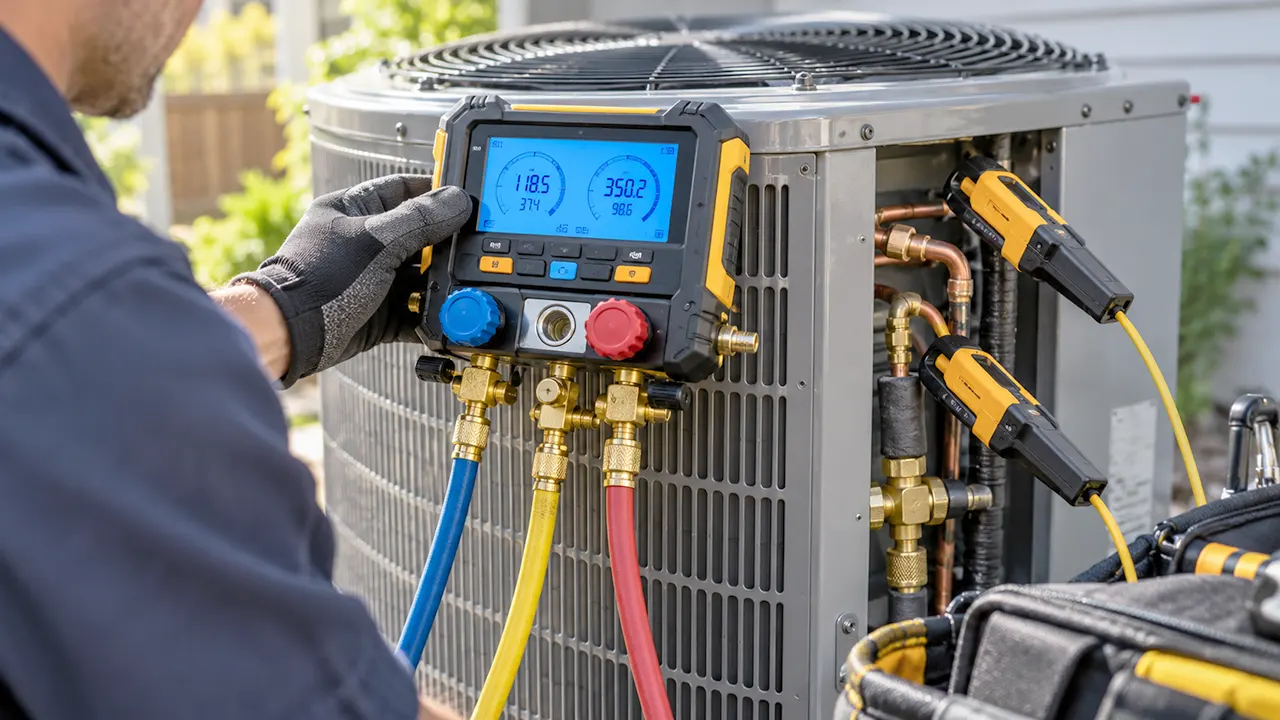
Digital HVAC manifold gauges help technicians measure refrigerant pressure, calculate saturation temperatures, and evaluate superheat and subcooling when the correct temperature probes are connected. The right set depends on pressure limits, refrigerant compatibility, measurement accuracy, probe support, and service workflow. For professional heat pump work, these specifications matter more than the number of features listed on the box.
This guide compares three professional options using manufacturer documentation and published retailer information. It is based on specification research, not hands-on product testing.
Affiliate disclosure: ToolGuider may earn a commission if you purchase through qualifying affiliate links, at no additional cost to you. Product specifications and purchasing considerations are evaluated independently of potential commissions.
Why Digital HVAC Manifold Gauges Matter for Modern Heat Pump Service
Digital HVAC manifold gauges display pressure readings electronically and use refrigerant-specific pressure-temperature data to calculate saturation temperatures. When paired with suitable temperature probes, they can also calculate superheat and subcooling. These measurements help technicians evaluate system operation, but they must be interpreted alongside operating conditions and other diagnostic evidence.
A technician servicing a heat pump may need to check operating pressures, compare pipe temperatures, assess refrigerant conditions, or document measurements before and after service. A digital manifold can bring several readings together on one display, reducing manual chart lookups and calculation errors.
What digital manifold gauges measure
Depending on the model and connected accessories, a digital manifold may provide:
- High-side and low-side refrigerant pressure.
- Evaporating and condensing saturation temperatures.
- Suction-line and liquid-line temperatures.
- Calculated superheat and subcooling.
- System vacuum measurements when supported by a suitable vacuum sensor.
- Logged readings for service documentation.
Not every model includes every function. Some require wireless probes, separate vacuum instruments, or compatible manufacturer apps.
When digital gauges provide a practical advantage
Digital gauges are particularly useful when technicians regularly service different refrigerants, need repeatable measurements, or document system performance. A connected measurement ecosystem can also help when a technician wants to view several readings without repeatedly returning to the manifold.
However, a digital display does not automatically make every diagnosis correct. Incorrect probe placement, unsuitable refrigerant settings, unstable operating conditions, and inaccurate measurements can still lead to the wrong conclusion.
Digital vs Analog Manifold Gauges
Digital manifold gauges are generally more convenient for calculations, refrigerant selection, and electronic documentation. Analog gauges remain useful for technicians who prefer a simple instrument that does not depend on batteries or electronic menus.
The better choice depends on the work performed rather than the technology alone.
| Comparison | Digital manifold | Analog manifold |
|---|---|---|
| Pressure readings | Electronic display with model-specific resolution and accuracy | Needle position against a calibrated scale |
| Saturation temperature | Usually calculated from selected refrigerant data | Commonly read from a refrigerant-specific pressure-temperature scale or chart |
| Superheat and subcooling | Can calculate automatically when compatible temperature measurements are available | Usually requires separate temperature measurements and manual calculation |
| Data logging | Available on selected models | Generally requires separate equipment |
| Power requirements | Batteries or another specified power source | Typically no battery required for pressure indication |
| Purchase cost | Varies by model and accessories | Often less expensive for basic configurations |
| Service documentation | May support apps and stored records | Usually requires manual recordkeeping |
What digital gauges do better
The main advantage is measurement integration. A compatible digital set can combine pressure, pipe temperature, and refrigerant data to calculate useful values on the same display.
This is especially helpful for technicians who service multiple refrigerants or need consistent documentation across many calls.
Where analog gauges still make sense
A basic analog manifold can be a reasonable choice for technicians who already own suitable temperature instruments and prefer straightforward pressure indication. It may also suit occasional use where logging and wireless connectivity provide little practical benefit.
Neither type eliminates the need for correct measurement procedures or refrigerant-specific pressure limits.
Features That Matter When Buying Digital HVAC Manifold Gauges
The most useful digital manifold is not necessarily the one with the largest display or the most wireless accessories. Start with the measurements you need, then check whether the complete instrument and accessory set can perform them safely and accurately.
Pressure range, accuracy, and resolution
Check the maximum working pressure, supported measurement range, stated accuracy, and display resolution. These are different specifications.
For example, the Testo 550s lists a pressure range of approximately -15 to 870 psi and pressure accuracy of ±0.5% of full scale. Fieldpiece publishes a maximum manifold pressure of 870 psig for the SM482V, while its operating manual specifies different accuracy limits across pressure ranges. These figures should not be treated as identical accuracy claims.
Accuracy describes how close a measurement should be to the actual value under the manufacturer’s stated conditions. Resolution describes the smallest displayed increment. A display that changes in small increments is not necessarily more accurate.
Before purchasing, check:
- Whether accuracy is stated as a percentage of full scale, a percentage of reading, or a combination.
- Whether the manufacturer’s accuracy specification changes across the pressure range.
- Whether the maximum working pressure is suitable for the intended refrigerant and operating conditions.
- Whether the complete hose, fitting, adapter, and accessory setup has appropriate pressure ratings.
Do not select a manifold based on maximum pressure alone. Measurement accuracy in the range used for the actual job matters too.
Temperature probes and superheat/subcooling calculations
Pressure alone cannot establish every operating condition. Temperature measurements are needed for meaningful superheat and subcooling calculations.
Superheat compares the measured vapor temperature with its saturation temperature at the relevant pressure. Subcooling compares the saturation temperature with the measured liquid temperature. A digital manifold can perform these calculations automatically when the correct pressure and temperature inputs are available.
Check whether the package includes temperature clamps, wired or wireless probes, or only the manifold. Also confirm the probe’s temperature range, stated accuracy, connection type, and compatibility with the instrument.
A low-priced manifold-only listing may cost less initially but require additional purchases before it can perform the measurements you need.
Refrigerant compatibility and A2L suitability
Refrigerant compatibility deserves special attention when buying equipment for modern heat pumps. Refrigerants have different pressure-temperature relationships, and a gauge must support the refrigerant being measured.
Check the manufacturer’s current compatibility list for the exact model. Do not assume that a long refrigerant list guarantees suitability for every application.
For R-32 and R-454B systems, verify that the complete equipment setup is approved or specified for the intended refrigerant, including the manifold, hoses, seals, fittings, and connected accessories. A2L suitability is a separate consideration from pressure range.
Fieldpiece lists R-32 and R-454B among the supported refrigerants in its SM482V operating documentation, while Testo publishes a broad supported-refrigerant library for the 550s family. Confirm the latest documentation and any applicable firmware requirements before purchasing.
Valve configuration, vacuum measurement, and connections
Two-valve and four-valve manifolds serve different workflows. A two-valve manifold can be sufficient for many routine pressure-measurement tasks. A four-valve design may offer additional connection flexibility, depending on its port arrangement and the service procedure.
A built-in vacuum sensor can simplify some evacuation workflows, but its presence does not replace good evacuation practices. Some models instead use a separate wireless vacuum probe.
Also examine port sizes and locations. The Fieldpiece SM482V, for example, has a dedicated 3/8-inch vacuum port in addition to its refrigerant ports. This can be useful for compatible evacuation setups.
Data logging, Bluetooth, and app connectivity
Connected tools can make service documentation easier. Depending on the system, a technician may be able to view readings remotely, save jobs, track measurements over time, or export data.
Before paying extra for connectivity, consider whether the app supports your existing probes and workflow. Check smartphone compatibility, data export options, storage limits, and whether any functions depend on additional accessories.
Durability, battery life, and calibration
A manifold used daily on service calls needs a housing and protection rating suited to its working environment. Compare ingress protection ratings, display readability, battery life, physical controls, and warranty terms.
Calibration requirements also matter. Follow the manufacturer’s instructions for checking, maintaining, and calibrating the instrument. If readings become inconsistent or the instrument is damaged, do not assume that a reset or fresh battery restores measurement accuracy.
Digital HVAC Manifold Gauge Comparison: 3 Professional Options
The Fieldpiece SM482V, Testo 550s, and Yellow Jacket TITANMAX serve different service workflows. Fieldpiece combines manifold and vacuum measurement, Testo offers a compact two-way design with app connectivity, and Yellow Jacket provides a four-valve touchscreen manifold with an external vacuum sensor.
The following comparison uses published manufacturer specifications and US retailer listings. It is not a hands-on performance ranking.
| Feature | Fieldpiece SM482V | Testo 550s | Yellow Jacket TITANMAX |
|---|---|---|---|
| Valve configuration | Four-port | Two-way | Four-way |
| Maximum stated pressure | 870 psig | 870 psi measurement range | 740 psia working pressure |
| Vacuum measurement | Integrated, 50-9,999 microns | Separate compatible probe or kit | External sensor, 5-100,000 microns |
| Temperature measurements | Compatible Type K probes | Compatible temperature probes | Compatible temperature clamps |
| Connectivity | Job Link wireless ecosystem | Bluetooth and Testo Smart App | Bluetooth 5.2, YJACK VIEW and measureQuick |
| Data logging | Up to 168 hours | App-based documentation | Internal logging and export |
| Protection rating | IP55 | IP54 | IP52 |
| Published price | $822.80 for the manifold listing | $424.15-$803.25 across selected kits | Current price not verified |
| Best fit | Integrated vacuum measurement and logging | Compact everyday service and app documentation | Four-valve operation and touchscreen controls |
Sources: manufacturer documentation and retailer listings. Prices are observed listings, not guaranteed checkout prices, and configurations are not equivalent. resources.
1. Fieldpiece SM482V SMAN: Best fit for an integrated measurement workflow
The Fieldpiece SM482V SMAN combines refrigerant pressure measurements, temperature inputs, calculations, data logging, and vacuum measurement in one instrument.
Its manufacturer documentation specifies a maximum manifold pressure of 870 psig, an integrated vacuum measurement range of 50 to 9,999 microns, IP55 protection, and a five-inch display. It supports more than 70 refrigerants according to the manufacturer, with new refrigerants added through firmware updates.
Published price: SupplyHouse listed the SM482V at $822.80, with a listed MSRP of $968.00, when checked for this guide. Hoses and other accessories may require separate purchases depending on the package.
Strengths
- Integrated vacuum measurement.
- Four-port arrangement for suitable service and evacuation workflows.
- Wireless connectivity and extended data logging.
- IP55 dust and water resistance.
Limitations
- Its size, weight, and features may exceed the needs of technicians performing only occasional pressure checks.
- Included accessories vary by retailer and package.
Choose it if: You want a central instrument for pressure measurements, temperature calculations, vacuum monitoring, and job documentation.
Official details: Fieldpiece SM482V specifications.
2. Testo 550s: Best fit for compact everyday service
The Testo 550s uses a two-way valve block and connects to compatible Bluetooth probes. It is designed for refrigeration, air conditioning, and heat pump measurements.
Testo publishes a pressure measurement range of -15 to 870 psi, pressure accuracy of ±0.5% of full scale, and temperature accuracy of ±0.9°F or ±0.5°C. Its Smart App supports digital documentation and access to updated refrigerant data.
Published US retailer prices: The Testo-Direct listings showed the following prices for different kits:
| Kit configuration | Listed price |
|---|---|
| Manifold with temperature probes | $424.15 |
| Smart kit with wireless temperature probes | $575.45 |
| Smart kit with temperature and vacuum probes | $680.00 |
| Smart kit with temperature and vacuum probes plus hoses | $803.25 |
These were observed sale prices, and availability varied by configuration. Confirm the current price and included accessories before purchasing. testo-direct.com+1
Strengths
- Compact two-way configuration.
- Bluetooth probe integration.
- App-based service documentation.
- Multiple kit configurations for different budgets and workflows.
Limitations
- The base manifold is not equivalent to a complete kit with wireless temperature probes, vacuum measurement, and hoses.
- Technicians who need four-valve operation may prefer another design.
Choose it if: You prioritize everyday HVAC and heat pump service, compact equipment, and app-based records over an integrated four-valve manifold.
Official details: Testo 550s specifications.
3. Yellow Jacket TITANMAX: Best fit for touchscreen and four-valve operation
The Yellow Jacket TITANMAX features a five-inch color touchscreen, a four-way valve block, internal data logging, and compatibility with the YJACK VIEW and measureQuick apps.
Its 2026 manufacturer specification sheet lists a maximum working pressure of 740 psia, an external vacuum sensor, IP52 protection, and a rechargeable battery rated for approximately 4.5 hours of continuous use with the full backlight enabled. The specified battery life without the backlight is 80 hours.
Current US price: A reliable current retailer price for the TITANMAX was not verified during this research. Check the exact model and included kit components before comparing it with the other options.
Strengths
- Large touchscreen and graphical measurements.
- Four-valve configuration.
- Internal data logging and app integration.
- External vacuum sensor with target notifications.
Limitations
- Vacuum measurement depends on the separate sensor.
- The published maximum working pressure is lower than the maximum pressure ratings listed for the other two models.
- Battery life changes substantially with backlight use.
Choose it if: You prefer a touchscreen interface, four-valve operation, and integrated digital reporting, and its pressure specification suits your intended applications.
Official details: Yellow Jacket TITANMAX specifications.
Which Digital Manifold Gauge Is Best for Your HVAC Workflow?
The most useful way to choose is to start with the work you perform most often, then identify the minimum instrument configuration that covers those tasks.
| Your service requirement | What to prioritize |
|---|---|
| Routine residential heat pump diagnostics | Suitable pressure range, temperature probes, refrigerant compatibility |
| Frequent evacuation work | Vacuum measurement range, sensor placement, dedicated vacuum connection |
| Detailed service records | Data logging, app support, export options |
| Multiple refrigerants | Current refrigerant library and firmware support |
| Advanced multi-connection work | Four-valve manifold and suitable port configuration |
| Basic pressure checks | Reliable pressure measurement without unnecessary accessories |
Residential heat pump service
For routine heat pump service, prioritize accurate pressure measurements, compatible temperature probes, and access to the correct refrigerant profile. Wireless connectivity is useful when it improves your workflow, but it is not essential for every technician.
Installation, commissioning, and evacuation
If your work regularly involves evacuation, pay particular attention to vacuum measurement. A dedicated vacuum sensor or built-in vacuum gauge can help you monitor the process, but the sensor’s location and the manufacturer’s specified measurement procedure matter.
A pressure gauge’s negative-pressure reading should not automatically be treated as a substitute for a suitable micron measurement during deep evacuation.
Commercial refrigeration and advanced diagnostics
Technicians handling more complex systems may benefit from four-valve arrangements, longer data logs, graphical pressure testing, and broader accessory compatibility. Verify that the instrument’s working-pressure rating and refrigerant compatibility cover the equipment being serviced.
Technicians who prefer wireless probes
Wireless probes can reduce cable clutter and allow remote viewing of compatible measurements. However, check the full accessory cost and app ecosystem before choosing a manifold based on connectivity alone.
How to Evaluate Gauge Accuracy and Measurement Results
A digital manifold can display a precise-looking number without guaranteeing that the number is sufficiently accurate for the job. Understanding the manufacturer’s accuracy specification is essential.
Full-scale accuracy versus reading accuracy
Consider a gauge with a 1,000 psi full scale and a stated accuracy of ±0.5% of full scale. That specification corresponds to ±5 psi, regardless of whether the displayed reading is 100 psi or 800 psi, subject to the manufacturer’s stated conditions.
By contrast, ±0.5% of reading at 100 psi corresponds to ±0.5 psi. These specifications describe different measurement performance, even though both use the number 0.5%.
Always read the complete accuracy statement, including operating temperature and any calibration conditions. Do not compare products using the percentage alone.
Why gauge readings do not identify every system fault
Pressure, temperature, and calculated superheat or subcooling are evidence used in diagnosis, not standalone fault codes. The same reading may have different implications depending on equipment design, operating mode, airflow, load, ambient conditions, and manufacturer specifications.
A technician should interpret readings in context and use the appropriate additional checks before deciding whether a system has a refrigerant, airflow, control, or mechanical problem.
Measurement checks and calibration guidance
Follow the instrument manufacturer’s maintenance and calibration instructions. Check probes, connections, and batteries, and investigate unexpected or inconsistent readings before relying on them.
Do not assume that a higher display resolution proves better accuracy. When comparing two instruments, prioritize the documented accuracy over the number of decimal places displayed.
Buying Mistakes to Avoid
A few purchasing mistakes can turn a feature-rich instrument into an expensive mismatch for your work.
- Choosing by refrigerant count alone: Confirm support for the exact refrigerant and the complete setup’s pressure and safety requirements.
- Comparing incomplete kits with complete kits: Include the cost of necessary hoses, temperature probes, vacuum sensors, adapters, and cases.
- Ignoring accessory compatibility: A wireless probe may require a particular instrument, app, or connection ecosystem.
- Overlooking pressure ratings: Check maximum working pressure and the ratings of connected accessories.
- Paying for unused features: Data logging, advanced connectivity, and multiple ports are valuable only when they support your actual workflow.
- Assuming a new display means better measurement accuracy: Compare the manufacturer’s documented accuracy, not just resolution or interface design.
EPA Section 608 and Refrigerant Service Safety
In the United States, EPA Section 608 certification requirements apply to technicians who perform covered work on equipment that could release refrigerants into the atmosphere. The EPA specifically identifies attaching and detaching hoses and gauges to measure appliance pressure as a covered activity. US EPA+1
Before connecting a manifold to a refrigerant circuit, confirm the applicable certification requirements, use equipment suitable for the refrigerant and system pressure, and follow the equipment manufacturer’s service procedures. Refrigerant handling is not a casual DIY task.
A2L refrigerants also require suitable tools and safe handling practices. Confirm the manufacturer’s compatibility documentation for the manifold, hoses, fittings, and accessories instead of relying on a general claim that a product supports modern refrigerants.
For the applicable rules, consult the EPA’s Section 608 Technician Certification Requirements.
Frequently Asked Questions
1. Are digital HVAC manifold gauges worth buying?
Digital gauges are useful when you need automatic calculations, multiple refrigerant profiles, electronic records, or integration with wireless probes. For technicians who mainly need basic pressure measurements, an analog manifold may remain suitable. The value depends on the time saved and the measurements required, not simply on whether the instrument is digital.
2. Do digital manifold gauges require calibration?
Follow the manufacturer’s instructions for accuracy checks and calibration. Requirements vary by model, and some instruments support field calibration for specified measurements. Do not assume that every digital manifold needs the same calibration interval or that resetting the instrument replaces calibration.
3. Can one digital manifold support multiple refrigerants?
Many professional digital manifolds include profiles for multiple refrigerants, but support varies by model and firmware. Select the correct refrigerant profile and verify that the instrument, hoses, seals, and fittings are suitable for the refrigerant being serviced. Never infer compatibility solely from a product’s maximum pressure rating.
4. Is a built-in micron gauge necessary?
A built-in micron gauge is convenient for technicians who frequently perform evacuation work. It is not essential for every pressure-measurement task, and some manifolds support separate vacuum sensors instead. Choose the arrangement that fits your workflow and follow the manufacturer’s instructions for sensor placement and evacuation measurement.
5. Can digital gauges diagnose a heat pump without other tests?
No. Digital manifold gauges provide pressure and, when configured appropriately, temperature measurements and calculated values. They do not independently establish the cause of every performance problem. Accurate diagnosis may require additional checks of airflow, electrical components, controls, operating conditions, and equipment-specific requirements.
Choose a Gauge That Fits Your Service Work
For a professional who wants integrated vacuum measurement and extensive data logging, the Fieldpiece SM482V is a strong specification-based candidate. The Testo 550s is worth considering for compact everyday service and app-based documentation. The Yellow Jacket TITANMAX is a candidate for technicians who prefer a touchscreen and four-valve configuration.
Before buying, compare the exact kit contents, current price, refrigerant compatibility, pressure accuracy, and accessories you actually need. Check the manufacturer’s documentation and the retailer’s current listing rather than choosing by feature count alone.
For ToolGuider readers, the next step is to compare the approved purchase options against your typical service calls. Affiliate links should be added only after the exact product URLs have been verified.
