


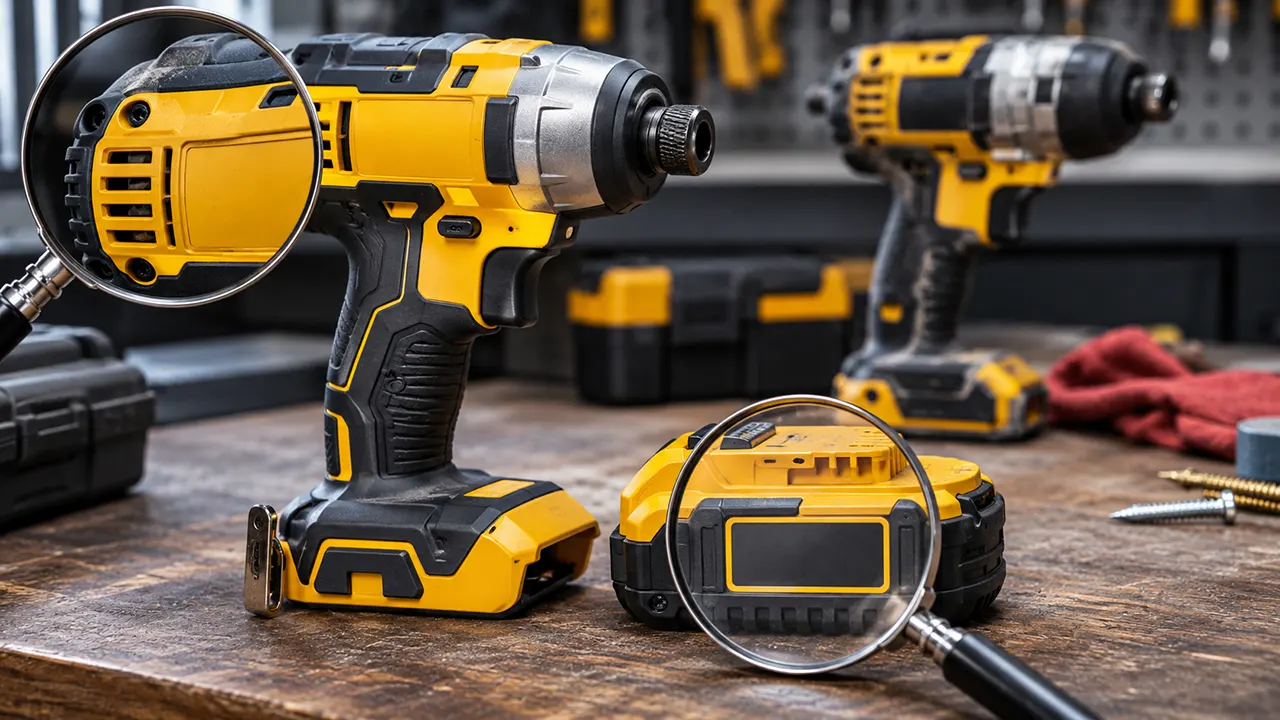
To spot fake DEWALT tools, check the model number, serial number, rating label, battery markings, and overall construction. Compare these details with official DEWALT documentation. Inspect the seller’s reputation and verify its authorization through DEWALT’s retailer locator. No single visual feature, including a QR code or screw type, can prove a tool is genuine.
Why Fake DEWALT Tools Are Harder to Identify
Buying a DEWALT drill or impact driver should be straightforward. However, counterfeit power tools can make that decision difficult. Some fake products copy the yellow-and-black design, brand logo, model numbers, packaging, and even product labels.
The problem goes beyond appearance. A counterfeit tool may look similar to a genuine model but use different internal components, lower-quality materials, or an inferior battery pack.
For homeowners, DIY enthusiasts, and professional contractors, this creates several risks. A suspicious product may deliver poor performance, have an unreliable battery, or lack the manufacturer support expected from a genuine DEWALT purchase.
How Counterfeit Tools Copy Genuine DEWALT Products
Counterfeit manufacturers often reproduce recognizable product features to make their tools look authentic. They may copy:
- DEWALT logos and yellow-and-black color schemes.
- Model numbers and product labels.
- Battery shapes and capacity markings.
- Packaging, instruction manuals, and accessories.
- Product photographs used by legitimate retailers.
Some counterfeit products even use real DEWALT model numbers. Therefore, finding a valid model number on a tool does not automatically establish its authenticity.
It is also important to distinguish counterfeit products from third-party compatible tools. A compatible battery or accessory sold under another brand is not automatically counterfeit. The problem occurs when a product falsely represents itself as an original DEWALT item.
For a broader explanation of counterfeit products, warning signs, and purchasing risks, see our guide to counterfeit power tools.
What the September 2026 Independent Tool Tests Reveal
Counterfeit tools are not always easy to identify by appearance. Independent performance testing provides another reason to examine them carefully.
In September 2026, Project Farm published an investigation titled Are Counterfeit Impact Tools Worth Buying? The comparison included genuine and counterfeit DEWALT, Milwaukee, and Makita impact drivers and impact wrenches.
The tests examined several performance factors:
- No-load rotational speed (RPM).
- Bit movement.
- Time required to drive five-inch screws.
- Installation and removal of lag bolts.
- Maximum torque under the specified test conditions.
Project Farm stated that it independently purchased the tested tools and sourced counterfeit examples from AliExpress.
The investigation is useful because it demonstrates that products with similar external appearances can perform differently. However, it is an independent comparison, not a certified laboratory authentication test. Its results should not be treated as proof that every counterfeit DEWALT tool performs in the same way.
Watch the September 2026 counterfeit impact tool comparison to understand the testing approach.
Why Appearance Alone Cannot Confirm Authenticity
A genuine DEWALT product can have minor differences because of its model, production period, manufacturing location, or regional configuration.
For example, screw designs, labels, and other physical details may vary between battery generations.
A suspicious appearance deserves further investigation, but it does not automatically prove counterfeiting. The strongest approach combines physical inspection, product identification, and seller verification.
How to Spot a Fake DEWALT Tool

Start with the tool itself. Inspect its body, logo, controls, labels, and packaging. Compare the product with official photographs of the exact model rather than relying on general DEWALT product images.
Compare the Housing and Overall Construction
Genuine DEWALT tools are designed for demanding work environments. Their construction should be consistent with the specific product model.
Check these areas:
- Housing: Look for uneven seams, poor assembly, loose sections, or unusual gaps.
- Grip: Examine the rubberized grip and molded surface. Poor finishing may indicate a problem.
- Controls: Check whether the trigger, forward and reverse switch, and speed selector operate consistently.
- Battery connection: Inspect the mounting rails and external contacts for obvious damage or poor construction.
- Fasteners: Look for missing, damaged, or unusually fitted screws.
Do not assume that every small manufacturing difference means the product is fake. Wear, previous repairs, and production revisions can affect the appearance of a genuine tool.
Inspect the DEWALT Logo, Controls, and Product Details
Look closely at the DEWALT logo and printed markings.
Potential warning signs include:
- Misspelled brand names or product descriptions.
- Poorly aligned labels.
- Blurry or inconsistent printing.
- Incorrect voltage or model information.
- Loose or poorly fitted components.
Compare the markings with photographs and product specifications from the official DEWALT website.
Pay particular attention to the exact model. A DEWALT impact driver and a hammer drill may have different housings, controls, and identification labels.
Check the Tool Against Official Product Photographs
Visit DEWALT’s official website and search for the exact model number.
Compare:
- Overall product shape.
- Housing and grip design.
- Control positions.
- Battery mounting system.
- Rating label and model information.
A copied photograph or matching external design is not proof of authenticity. However, a clear mismatch between the actual tool and the official model information is a reason to investigate further.
Look for Inconsistent Packaging and Accessories
Packaging can provide additional clues.
Check whether the product name, model number, included batteries, charger, and accessories match the retailer’s description and official product information.
DEWALT model numbers can have different kit variations. For example, a bare tool and a kit containing batteries may share the same main tool model identifier but have different suffixes.
A missing accessory does not necessarily indicate counterfeiting. Some DEWALT products are sold as bare tools without batteries or chargers.
Check the DEWALT Model Number, Serial Number, and Rating Label
The product rating label is one of the most useful starting points when identifying a suspicious DEWALT tool.
DEWALT provides official instructions for locating product model and serial numbers. Its documentation explains that the model number appears on the product rating label, while the serial number may be located on the rating label or inside the battery compartment.
Read the official DEWALT model and serial number guide before checking an unfamiliar product.
Where to Find the DEWALT Model Number
Look for the rating label on the tool housing.
Depending on the model, it may be located on the side, rear, or another accessible area of the tool.
DEWALT model numbers commonly begin with the letter D. Examples include:
- DCF series: Impact drivers and related cordless tools.
- DCD series: Drills and hammer drills.
- DCB series: Batteries.
These examples help identify product families, but they do not establish authenticity.
Write down the complete model number and compare it with the official product information.
Where to Find the Serial Number on Cordless Tools
The serial number location varies by product.
Check:
- The product rating label.
- The protected area inside the battery compartment.
- The manufacturer’s product identification documentation.
Some cordless tools have identification markings in less exposed locations to protect them from everyday wear.
Do not assume that every DEWALT tool uses the same serial number location or format.
How to Check the Product Information
Once you locate the model and serial numbers, follow these steps:
- Record the complete model number.
- Record the serial number and any visible date code.
- Compare the model with DEWALT’s official product documentation.
- Check whether the packaging and receipt describe the same product.
- Contact DEWALT support if the information appears inconsistent.
You can also use the DEWALT product registration instructions to understand the information required for registration.
Why a Genuine Model Number Does Not Prove Authenticity
Counterfeit manufacturers can copy model numbers from genuine products.
A copied number may even correspond to a real DEWALT tool. Therefore, model number matching is only one part of the authentication process.
If the product information looks correct but the housing, battery, or seller appears suspicious, ask DEWALT to review the product details.
How to Identify Fake DEWALT Batteries
A counterfeit battery deserves particular attention because it contains lithium-ion cells and electrical components.
DEWALT batteries are available in different capacities, platforms, and designs. Their physical appearance and identification markings can vary.
Do not rely on one screw, label, QR code, or contact color to decide whether a battery is genuine.
Check the Battery Model Number and Date Code
Start with the battery model number.
Most DEWALT batteries have an alphanumeric model number printed on a warning label attached to the plastic housing. Many familiar cordless battery models use the DCB prefix.
Next, locate the date code.
According to DEWALT’s US support guidance, the battery date code is usually printed directly on the plastic housing near the charging cells. The current guidance identifies the first six digits as the relevant date-code information.
This is different from some DEWALT tool date codes, which can use a longer format.
Use the manufacturer’s battery and charger date-code guide to identify the correct markings.
A date code alone does not authenticate a battery. It should be considered alongside the model, physical construction, seller, and manufacturer confirmation.
Inspect Battery Labels and Housing
Examine the battery carefully without opening it.
Check the following:
- Brand name and logo.
- Model number.
- Voltage and capacity markings.
- Warning labels.
- Housing quality.
- Visible cracks or poor assembly.
- Consistency between the battery and its packaging.
Spelling mistakes, inconsistent specifications, and obviously poor printing are warning signs.
However, a genuine battery may have different label layouts or housing details depending on its generation.
Compare Battery Contacts and Terminals
Look at the external electrical contacts where the battery connects to the tool or charger.
Check for:
- Damaged or loose terminals.
- Poorly fitted contact components.
- Visible corrosion.
- Unusual physical construction.
- Damage around the mounting rails.
Do not treat contact color or metal appearance as a universal authentication test. Different battery generations and designs may have different components.
Never insert a suspicious or visibly damaged battery into an expensive tool simply to see whether it works.
Check Battery Capacity and Product Markings
Battery capacity is another area worth checking.
For example, if a seller advertises a DEWALT 20V MAX battery with a particular amp-hour rating, verify that the model number and capacity correspond to an actual DEWALT product.
A large capacity claim on a very small or unusually lightweight battery deserves investigation.
However, weight and size alone cannot establish authenticity. Compare the battery with the exact model’s official specifications.
Why Older Counterfeit Battery Guides Can Be Misleading
Some older counterfeit battery guides identify screw shape, screw color, QR codes, and other physical details as authentication clues.
These guides can provide useful background, but they should not be treated as universal rules for every current battery.
DEWALT’s UK support documentation contains counterfeit battery identification guidance. However, regional guidance and older battery designs may not apply to every US product.
A genuine battery may also have different physical features because of design revisions.
The safest approach is to use the current manufacturer documentation for the relevant battery model and ask DEWALT support to review suspicious markings.
Inspect the Battery Connection and Charger
The battery and charger should also be checked as part of the complete cordless system.
A counterfeit or incompatible component may create performance and reliability problems even when the tool itself appears genuine.
Check the Battery Rails and Electrical Contacts
Inspect the mounting rails and external contacts on both the battery and tool.
The battery should fit the compatible tool without unusual force or excessive movement.
Look for damaged plastic, loose terminals, cracks, or signs of overheating.
Do not force a battery into a tool because it appears to have the correct voltage or shape. Check the manufacturer’s compatibility information first.
Compare the Charger Model and Identification Label
DEWALT chargers have their own model numbers and date codes.
According to DEWALT’s US guidance:
- The charger model number is usually printed on a label on the side.
- The charger date code can be found at the bottom, engraved into the housing.
Compare these details with the official charger information.
You can also check the battery and charger compatibility using the product manuals.
Look for Compatibility and Construction Problems
A suspicious charger may have inconsistent labels, poor housing construction, damaged electrical connections, or specifications that do not match the advertised product.
Stop using a charger if it shows signs of overheating, damaged wiring, burning smells, or other electrical problems.
Do not open the charger or battery pack to inspect internal components unless you are qualified and following appropriate manufacturer service procedures.
How to Verify DEWALT Sellers and Authorized Retailers
Seller verification is one of the most reliable ways to reduce the risk of purchasing counterfeit DEWALT products.
A genuine-looking tool from an unknown website is not necessarily a genuine product.
DEWALT has specifically warned consumers about fraudulent websites and social media advertisements that impersonate the brand or legitimate sales platforms.
Use the Official DEWALT Authorized Retailer Locator
Before buying a DEWALT tool, visit the official DEWALT Authorized Retailer Locator.
Use it to check whether the seller appears on the manufacturer’s authorized retailer list.
This is particularly important when purchasing expensive cordless tool kits, batteries, or professional equipment.
If you cannot find a retailer, contact DEWALT to confirm its status before placing an order.
Identify Fake DEWALT Websites and Social Media Ads
Counterfeit sellers may create websites that look similar to official DEWALT pages.
Some advertise unrealistic discounts through social media platforms.
DEWALT has specifically warned about scam websites advertising extremely cheap tool combinations, including a drill and impact driver kit for $2.
Before buying, check:
- The actual website domain.
- Business contact information.
- Return and refund policies.
- Payment methods.
- Seller identity.
- Whether the retailer is authorized.
Do not assume that a website is legitimate because it displays the DEWALT logo or uses professional product photographs.
Read DEWALT’s official fraudulent website warning for additional guidance.
Recognize Suspicious Prices and Marketplace Listings
A price significantly below the normal retail price should encourage further investigation.
However, a low price alone does not prove counterfeiting. Genuine tools may be discounted during clearance events, seasonal promotions, or retailer sales.
Check the seller rather than judging the offer only by its price.
For marketplace purchases, also distinguish between the marketplace platform and the actual seller. A familiar marketplace name does not automatically establish that every third-party seller is authorized.
Understand Warranty Limitations When Buying from Unauthorized Sellers
Purchasing from an unauthorized seller can affect your warranty protection.
DEWALT’s US warranty information states that its applicable warranty coverage generally requires purchase from DEWALT or an authorized seller, unless otherwise prohibited by law. DEWALT also reserves the right to reject certain warranty claims involving unauthorized sellers.
Proof of purchase showing when and where the product was purchased may be required.
Before purchasing an expensive tool, review the official DEWALT US warranty information.
This is another reason to verify the retailer before paying.
What to Do If Your DEWALT Tool or Battery Looks Fake
Finding suspicious markings does not always mean you have purchased a counterfeit product. Manufacturing variations, previous repairs, and older designs can create differences.
However, you should investigate before continuing to use a suspicious product.
Stop Using a Suspicious or Damaged Battery
Stop using a battery if it shows swelling, leakage, unusual heating, physical damage, or other signs of failure.
Do not charge, open, puncture, or attempt to repair a damaged lithium-ion battery.
Keep it away from combustible materials and follow the manufacturer’s guidance for safe handling and disposal.
If you suspect a battery is counterfeit but it shows no visible damage, avoid relying on it until DEWALT has reviewed the product information.
Collect Product and Purchase Information
Prepare the following information before contacting the manufacturer:
- Tool or battery model number.
- Serial number, if available.
- Date code.
- Clear photographs of the product and labels.
- Packaging photographs.
- Purchase receipt.
- Seller name and website address.
Keep the original packaging and transaction records if possible.
These details can help DEWALT investigate the product’s identity and purchase history.
Contact DEWALT Customer Support
Contact DEWALT through its official Product Support page.
Explain why you suspect the product may be counterfeit. Provide the model number, serial number, date code, seller information, and photographs.
Ask whether the product markings and identification information are consistent with the relevant model.
Do not assume that successful product registration alone proves authenticity. Registration and manufacturer authentication are different processes.
Report Fraudulent Sellers and Websites
If you identify a website impersonating DEWALT, report it through the manufacturer’s official fraudulent website reporting process.
If you have already shared your credit card or banking information with a suspected scammer, contact your financial institution promptly.
DEWALT also provides a support request process for submitting information about suspected fraudulent websites.
Contact Your Payment Provider If You Were Scammed
If you paid for a counterfeit tool or received a product that differs materially from the advertised item, contact the seller and request a resolution.
If the seller does not respond or appears fraudulent, contact your credit card company or payment provider.
Keep copies of the listing, receipt, messages, and product photographs. These records may help support a payment dispute.
FAQs: How to Spot Fake DeWalt Tools
1. Can Fake DEWALT Tools Have Genuine Model Numbers?
Yes. Counterfeit manufacturers can copy model numbers from genuine DEWALT products. Therefore, finding a valid model number does not prove authenticity. Compare the complete product information with official documentation, inspect the physical construction, and verify the seller. Contact DEWALT if the product details remain suspicious.
2. Can You Verify a DEWALT Tool Using Its Serial Number?
A serial number is useful for product identification, but it is not conclusive proof of authenticity. Counterfeit manufacturers may copy genuine product information. DEWALT support can help review the model, serial number, date code, and other identifying details. Provide the purchase receipt and product photographs when requesting assistance.
3. Are All Third-Party DEWALT-Compatible Batteries Counterfeit?
No. Some manufacturers produce compatible batteries designed for use with DEWALT tools. These products are not automatically counterfeit if they are clearly sold under their own brand. A counterfeit product misrepresents its brand identity or origin. Always check compatibility, manufacturer information, safety documentation, and applicable warranty limitations before buying.
4. Can a Genuine DEWALT Battery Have Different Screws or Contacts?
Yes. Physical details can vary between battery designs and production revisions. Screw color, head shape, and contact appearance should not be used as universal authenticity tests. Compare the exact battery model with current manufacturer documentation. If the markings or construction seem suspicious, contact DEWALT before using it.
5. Does Buying from Amazon Guarantee a Genuine DEWALT Tool?
No. A product listed on a major marketplace is not automatically guaranteed to come from an authorized DEWALT retailer. Check the actual seller, product description, purchase documentation, and retailer authorization. If you are unsure about a particular seller, use DEWALT’s official retailer locator or contact customer support before buying.
6. Can DEWALT Refuse Warranty Service for Unauthorized Purchases?
DEWALT’s US warranty terms state that applicable warranty coverage generally requires purchasing from DEWALT or an authorized seller, unless otherwise prohibited by law. The manufacturer reserves the right to reject certain claims involving unauthorized sellers. Keep your receipt and verify the retailer before purchasing. Your rights may also depend on applicable state law.
Make Your Next DEWALT Purchase With Confidence
A convincing logo, matching model number, or familiar battery design cannot establish that a DEWALT tool is genuine.
The best protection is to combine product identification with physical inspection and seller verification. When something does not match, ask the manufacturer rather than relying on a single visual clue.
Before buying your next drill, impact driver, or battery, check the seller through DEWALT’s authorized retailer locator. It is a simple step that can help protect your money, equipment, and warranty options.
