


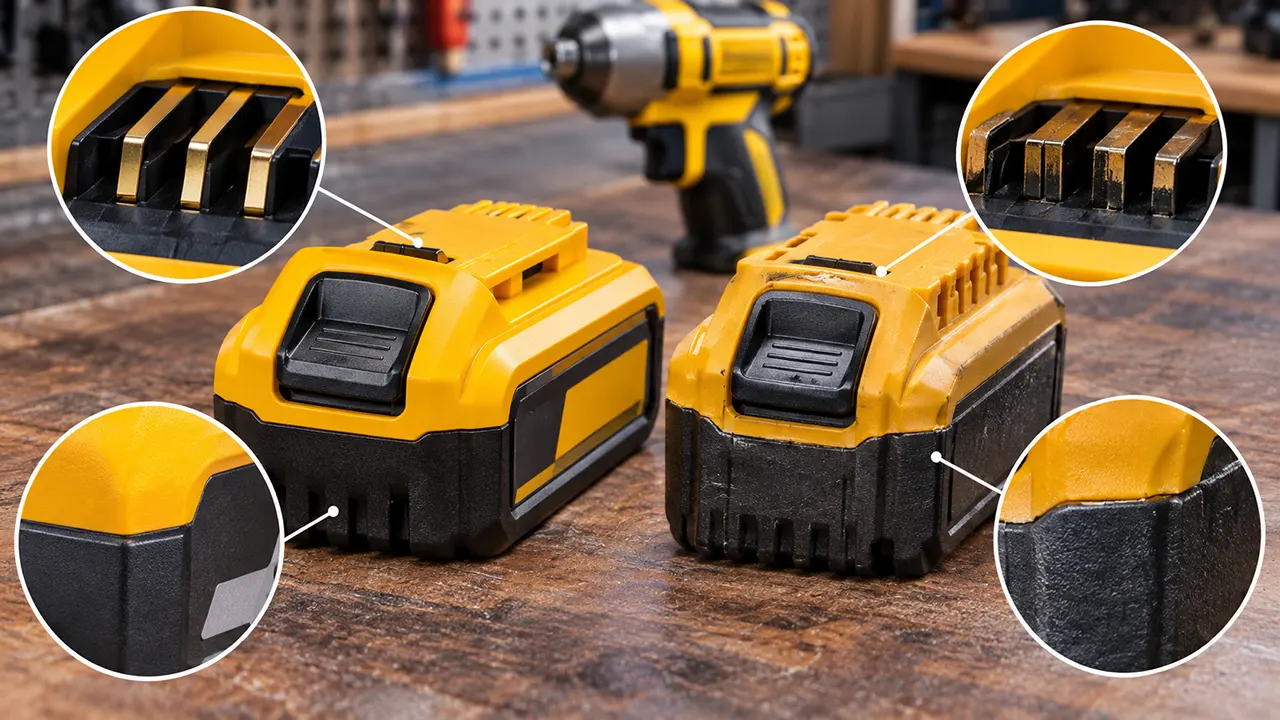
Counterfeit power tool batteries can create fire, overheating and electrical hazards when their internal cells, protective electronics or construction fail to meet appropriate safety requirements. However, not every counterfeit battery will catch fire, and legitimate aftermarket batteries are not automatically unsafe. Buy from trusted sources, verify compatibility and stop using batteries that show signs of damage.
A cordless drill may look genuine, but its battery deserves just as much attention as the tool itself.
Imagine buying a replacement battery for your DeWalt, Milwaukee or Makita drill. The packaging looks convincing, the logo appears genuine and the price is attractive. Yet, the battery may contain different cells, inadequate protective electronics or poorly assembled internal connections.
You might not notice these problems during the first few uses.
That is what makes counterfeit power tool batteries particularly concerning. Their external appearance does not reveal the quality of their internal construction.
The risks extend beyond poor performance. A defective lithium-ion battery can overheat, release hazardous gases or experience thermal runaway, potentially causing a fire.
This guide explains how to recognize suspicious batteries, distinguish counterfeit products from legitimate aftermarket alternatives, understand lithium-ion fire risks and choose safer replacements. It also includes practical inspection and emergency-response guidance for US power tool owners.
Why Counterfeit Power Tool Batteries Can Be Dangerous
Counterfeit power tool batteries can create safety hazards because their internal cells, electrical connections and protective electronics may not meet the original manufacturer’s requirements. Poor construction or incompatible charging equipment can increase the risk of overheating, short circuits and battery failure.
To understand these risks, it helps to know how cordless tool batteries work.
How lithium-ion power tool batteries work
Most modern cordless power tools use rechargeable lithium-ion battery packs. These packs contain multiple individual cells connected in specific arrangements to provide the required voltage and capacity.
A battery pack also contains several supporting components:
- Battery cells: Store and release electrical energy.
- Battery Management System (BMS): Monitors important operating conditions and provides protective functions.
- Temperature sensors: Monitor battery temperature.
- Electrical connections: Transfer power between the battery, tool and charger.
- Protective housing: Helps protect internal components from physical damage.
All these components must work together. A battery is not simply a collection of cells inside a plastic case.
Why poor internal construction creates safety risks
Genuine manufacturers design their batteries around specific tools and charging systems. They consider cell quality, electrical connections, temperature monitoring and protective electronics.
A counterfeit manufacturer may copy the external appearance without reproducing the original engineering.
Potential problems include:
- Low-quality or unsuitable battery cells.
- Poor internal electrical connections.
- Inadequate temperature monitoring.
- Missing or ineffective protective electronics.
- Poor insulation between electrical components.
- Weak housing that offers insufficient physical protection.
These problems do not mean every counterfeit battery will fail. However, they can increase the possibility of unsafe operating conditions.
The Power Tool Institute’s counterfeit battery guidance explains why manufacturers recommend original equipment manufacturer (OEM) batteries designed for their specific power tool systems.
How battery protection systems help prevent failures
A Battery Management System helps monitor battery operation and control important electrical conditions.
Depending on the design, its protective functions may include:
- Overcharge protection.
- Over-discharge protection.
- Overcurrent protection.
- Short-circuit protection.
- Temperature monitoring.
- Cell balancing.
These protections help reduce the risk of certain battery failures. However, they cannot make a defective or physically damaged battery completely safe.
A counterfeit battery may contain electronics that look convincing but do not provide equivalent protection.
The important distinction: A battery’s external appearance cannot establish the quality of its internal protection system.
What happens during thermal runaway?
Thermal runaway is a dangerous chain reaction that can occur inside a lithium-ion battery.
It may begin when a cell experiences an internal short circuit, excessive heat, mechanical damage or another failure. The resulting heat can damage neighboring cells and cause additional reactions.
This process can lead to:
- Rapid temperature increases.
- Gas and vapor release.
- Smoke.
- Fire.
- Additional cell failures.
According to OSHA’s lithium-ion battery hazard guidance, manufacturing defects, mechanical damage, extreme temperatures and improper charging can initiate thermal runaway. Battery fires may also release hazardous gases and chemicals. Occupational Safety and Health Administration
How to Recognize a Suspicious Cordless Tool Battery
You can identify several warning signs of a potentially counterfeit power tool battery by checking its packaging, manufacturer information, model number, seller and price. However, visual inspection cannot guarantee authenticity because counterfeit products can closely imitate genuine batteries.
Before buying a replacement, compare it with information published by the original manufacturer.
Check the packaging and manufacturer information
Start with the packaging.
Genuine products normally have consistent product identification, manufacturer information and model details. Counterfeit products may contain spelling mistakes, unusual printing, incorrect logos or incomplete information.
Look for:
- Misspelled brand names.
- Poor-quality printing.
- Inconsistent logos.
- Missing manufacturer information.
- Unusual packaging.
- Incorrect product descriptions.
- Missing model or part numbers.
These signs do not independently prove that a battery is counterfeit. Packaging can vary by region, product generation and seller.
However, several inconsistencies together deserve attention.
Verify model numbers and battery specifications
Check the battery model number against the manufacturer’s official website or product documentation.
Pay attention to:
- Voltage.
- Amp-hour (Ah) capacity.
- Model number.
- Product generation.
- Battery platform.
- Compatible tools.
- Compatible chargers.
Be particularly careful with batteries advertising unusually high capacities in familiar-looking housings.
A replacement battery claiming significantly higher capacity than the manufacturer’s original product deserves closer examination. Do not assume the advertised capacity is accurate.
Look for suspiciously low prices
Price is another useful warning sign.
Counterfeit sellers may offer batteries at prices far below those of genuine replacements.
For example, an online listing may advertise a premium-brand battery at a fraction of the normal retail price.
However, a low price alone does not establish counterfeiting. Clearance sales, promotions and refurbished products can also be inexpensive.
Consider the seller’s reputation, product origin, return policy and manufacturer verification before purchasing.
Check the seller’s authorization
The safest approach is to purchase directly from the manufacturer or an authorized distributor.
If you are shopping through an online marketplace, check who actually sells and fulfills the product. A recognizable marketplace name does not automatically establish that an individual seller is authorized.
For example, a listing may display a genuine DeWalt or Milwaukee product photograph while shipping an unauthorized replacement.
Why appearance alone cannot prove authenticity
Some counterfeit batteries closely reproduce genuine labels, housing designs and packaging.
A battery may even display a familiar certification symbol without having a valid certification.
The UL Research Institutes explains that counterfeit products can carry false certification marks. Therefore, seeing a UL logo is not enough to establish that a particular battery has been independently tested and certified.
If you are uncertain, contact the manufacturer and provide the battery’s model number, serial number, seller information and photographs.
For more examples of suspicious product markings and external identification problems, see our guide on how to identify counterfeit power tools.
Counterfeit vs. Aftermarket vs. Genuine Power Tool Batteries
Counterfeit, aftermarket and genuine power tool batteries are not the same products. A genuine battery comes from the original manufacturer, an aftermarket battery is an independently produced replacement, and a counterfeit battery falsely imitates an existing brand or product.
Understanding these differences helps you avoid misleading product listings.
| Battery type | Description | Main consideration |
|---|---|---|
| Genuine OEM | Manufactured or supplied by the original tool manufacturer | Designed for the manufacturer’s battery system |
| Aftermarket / third-party | Produced by another company as a replacement | Compatibility and safety require verification |
| Counterfeit | Falsely presented as a genuine branded product | Authenticity and internal quality are questionable |
| Knockoff | Unauthorized imitation of an OEM product | May copy the design without reproducing original engineering |
What makes a battery counterfeit?
A counterfeit battery is designed or marketed to deceive buyers into believing it is a genuine branded product.
For example, a seller might advertise a battery as an authentic Milwaukee M18 replacement even though the product was not manufactured or authorized by Milwaukee.
The battery may use copied logos, packaging, product names or model information.
The biggest concern is that buyers may trust the product based on a brand name that does not actually belong to its manufacturer.
What makes an aftermarket battery different?
An aftermarket battery is manufactured by a third-party company and sold as an alternative to an OEM replacement.
It may advertise compatibility with a DeWalt, Makita or Milwaukee tool platform without claiming to be manufactured by that brand.
However, being openly marketed as aftermarket does not automatically make a battery safe.
Some third-party batteries may meet relevant safety standards, while others may lack adequate testing or protection. A general battery certification also does not automatically establish that the complete tool, battery and charger combination has been evaluated as a system.
Why tool, battery and charger compatibility matters
Power tool batteries and chargers are engineered to operate within specific electrical and temperature limits.
The tool, battery and charger may communicate through proprietary electronics to monitor important operating conditions.
Using an incompatible replacement can affect charging behavior, power delivery and protective functions.
The Power Tool Institute explains that manufacturers develop their own battery management and control systems. Follow the tool’s manual when considering replacement batteries.
Are third-party replacement batteries always unsafe?
No. A legitimate third-party product is not automatically counterfeit or defective.
However, buyers should not assume that an aftermarket battery is equivalent to an OEM battery simply because it fits the tool.
Before considering one, verify:
- The actual manufacturer and product identity.
- The exact tool and charger compatibility.
- Applicable independent safety certification.
- The seller’s reputation and warranty.
- The manufacturer’s instructions and restrictions.
For a safety-critical purchase, a genuine OEM replacement from an authorized seller is the more straightforward choice.
Lithium-Ion Battery Fire and Thermal Runaway Risks

Lithium-ion batteries store substantial energy in a compact package. Under normal operating conditions, they are designed to provide reliable power. However, certain electrical, mechanical and environmental conditions can cause serious failures.
How an internal short circuit can trigger thermal runaway
An internal short circuit occurs when electrical current flows through an unintended path inside a battery cell.
It can result from manufacturing defects, physical damage or deterioration.
An internal short circuit may generate heat inside the cell. If the temperature continues to rise, the cell can enter thermal runaway.
Heat from the failing cell may then affect neighboring cells in the same battery pack.
This explains why a battery failure can escalate quickly rather than remaining limited to one cell.
How manufacturing defects and poor protection increase risk
Manufacturing quality matters because battery safety depends on several interacting components.
Potential weaknesses include:
- Poor cell quality.
- Inadequate electrical insulation.
- Defective internal connections.
- Inconsistent cell construction.
- Inadequate protective electronics.
- Incorrect charging control.
A poorly designed battery may also lack the protective features needed to operate safely with a particular tool or charger.
However, it is important not to confuse a possible failure mechanism with proof that a specific battery will fail.
A counterfeit battery can operate for some time without visible problems and still have unknown internal safety characteristics.
Why battery fires can produce hazardous smoke and gases
Lithium-ion battery failures can produce more than flames.
A failing battery may release hot gases, vapor, smoke and potentially hazardous chemicals.
OSHA identifies substances such as hydrogen fluoride, hydrogen chloride and carbon monoxide among the possible hazards associated with lithium-ion battery thermal runaway. Occupational Safety and Health Administration
For this reason, people should not approach a smoking or venting battery to inspect it.
Move away from the area and avoid inhaling smoke.
What independent battery testing can and cannot establish
Independent testing can help consumers understand differences between genuine, counterfeit and aftermarket products.
For example, Project Farm’s 2026 battery investigation brought attention to differences in genuine, counterfeit and knockoff DeWalt, Milwaukee and Makita batteries.
Such comparisons can help readers understand why internal design matters.
However, a test of selected battery samples cannot establish the failure rate of every product sold under a particular brand or category.
A battery performing well in one test does not automatically prove long-term safety. Similarly, one defective sample does not prove that every battery from the same third-party manufacturer is defective.
Readers should treat independent testing as useful supporting evidence, not a substitute for manufacturer safety documentation and recognized certification.
Warning Signs of a Damaged Power Tool Battery
A damaged lithium-ion battery may show visible or behavioral warning signs before a serious failure occurs. Stop using a battery that is swollen, cracked, leaking, unusually hot or producing smoke. Never charge a battery that shows signs of physical damage.
Use the following checklist to recognize potential problems.
Swelling, cracks and physical deformation
Check the battery housing for:
- Bulging or swelling.
- Cracked plastic.
- Deep scratches or cuts.
- Puncture marks.
- Deformation.
- Loose or separated casing.
A battery pack should retain its intended shape.
If the housing becomes swollen or distorted, stop using it. Do not attempt to compress, open or repair the battery.
Excessive heat and unusual odors
A battery may become warm during normal operation or charging. However, unusual or rapidly increasing heat deserves attention.
Warning signs include:
- Unexpectedly high temperature.
- Heat that continues increasing after use.
- Burning or chemical odors.
- Discoloration near the battery contacts.
- Melted plastic.
Do not touch or handle a battery that appears to be overheating. Move away if it shows signs of failure.
Leaking, hissing, smoke and unusual sounds
These are particularly serious warning signs.
A damaged battery may produce:
- Liquid leakage.
- Hissing sounds.
- Popping or crackling.
- Smoke.
- Vapor or gas release.
If a battery begins smoking, venting or making unusual noises, move away immediately.
Do not try to remove it from the charger or carry it outdoors. Call 911 if there is smoke, fire or an immediate threat.
Damaged terminals and electrical contacts
Inspect the battery contacts for:
- Bent metal terminals.
- Burn marks.
- Corrosion.
- Melted plastic around contacts.
- Loose connections.
- Visible electrical damage.
Damaged contacts may interfere with the electrical connection between the battery and tool.
Never try to repair damaged terminals using improvised metal pieces, wires or other conductive materials.
Power tool battery safety inspection checklist
Use this checklist before charging or using a battery.
| Inspection point | Warning sign | Recommended action |
|---|---|---|
| Housing | Swelling or deformation | Stop using |
| Casing | Cracks or punctures | Stop using |
| Temperature | Unusual heating | Stop charging and using |
| Odor | Burning or chemical smell | Stop using and move away if necessary |
| Leakage | Visible liquid | Avoid handling and seek guidance |
| Sounds | Hissing or popping | Move away immediately |
| Contacts | Burned or damaged terminals | Stop using |
| Manufacturer details | Missing or questionable information | Verify authenticity |
| Charger | Unknown or incompatible equipment | Do not connect |
Remember: This is a warning-sign inspection, not a certification test. A battery can look normal and still contain internal defects.
Safe Charging and Storage Practices for Lithium-Ion Batteries
Safe charging and storage help reduce the risk of battery damage. Use the charger specified or approved by the tool manufacturer, follow the operating manual and keep batteries away from excessive heat, moisture and physical damage.
Use compatible manufacturer-recommended chargers
A charger is not simply a device that supplies electricity.
It must work within the battery’s charging requirements.
Always check:
- Battery model compatibility.
- Charger model compatibility.
- Voltage and charging specifications.
- Manufacturer charging instructions.
- Any charging restrictions.
Avoid universal chargers or inexpensive alternatives that claim broad compatibility without reliable technical documentation.
Charge on a stable, appropriate surface
Choose a dry, stable location for charging.
Keep the battery and charger away from:
- Flammable liquids.
- Paper and cardboard.
- Fabric and upholstery.
- Excessive heat.
- Direct sunlight.
- Water and moisture.
Follow the manufacturer’s recommendations for ventilation and charging conditions.
Do not charge a damaged or recalled battery unless the official recall instructions specifically provide a safe procedure.
Avoid excessive heat, cold and moisture
Extreme temperatures can affect lithium-ion battery performance and safety.
Do not leave batteries inside hot vehicles or expose them to direct sunlight for extended periods.
Avoid charging batteries that are outside the temperature limits specified in their manuals.
If a battery becomes wet, physically damaged or unusually hot, stop using it and contact the manufacturer for instructions.
Store batteries correctly
When storing cordless tool batteries:
- Use a cool, dry location within the manufacturer’s recommended temperature range.
- Keep batteries away from direct heat sources.
- Protect them from physical impact.
- Prevent metal objects from contacting the terminals.
- Follow the recommended storage charge level.
- Avoid storing batteries in areas where they may be crushed or punctured.
Do not stack heavy equipment on top of battery packs.
What to Do With a Suspected Counterfeit or Damaged Battery
The correct response depends on whether the battery is simply suspicious or already showing signs of failure. A suspicious but apparently intact battery should not be used until verified. A damaged, overheating or actively venting battery requires a more cautious response.
What to do when authenticity is uncertain
If you suspect that a battery is counterfeit but cannot identify physical damage:
- Stop using the battery until its identity can be verified.
- Do not charge it simply to see whether it works.
- Photograph the product, packaging and labels without handling an unsafe battery.
- Check its model number and seller information.
- Contact the original manufacturer.
- Request verification and guidance about returning or disposing of the product.
If you purchased it online, report the suspicious listing to the marketplace.
Do not resell or give away a battery that you believe may be unsafe.
What to do when a battery shows signs of failure
If you notice swelling, cracks, leakage or unusual heat:
- Stop using and charging the battery.
- Keep other people away from it.
- Do not open, puncture or dismantle it.
- Do not attempt to repair it.
- Do not place it near combustible materials.
- Contact the manufacturer for safe handling instructions.
If the battery is actively overheating, hissing, smoking or venting, do not attempt to move it. Evacuate the area and call 911.
How to respond to smoke, fire or venting
A lithium-ion battery fire can develop quickly.
If you notice smoke, flames or gas venting:
- Move away from the battery immediately.
- Warn other people in the area.
- Evacuate the building or affected space.
- Close doors behind you if safe to do so.
- Call 911 from a safe location.
- Do not return until emergency responders say it is safe.
Do not attempt to pick up or carry a failing battery.
Battery fires can produce hazardous smoke and gases. Avoid attempting to handle the battery or extinguish a serious battery fire yourself.
How to report counterfeit products
If you discover a suspected counterfeit battery, report it to the appropriate parties.
You can:
- Contact the original power tool manufacturer.
- Report the product to the online marketplace.
- Contact the seller and request a return where safe and permitted.
- Report suspected counterfeit merchandise through the appropriate US government channels.
For suspected online shopping fraud, the Federal Trade Commission’s Report Fraud resource provides a reporting channel.
Keep receipts, seller details, photographs and product information where available.
How to dispose of lithium-ion batteries safely
Never put lithium-ion power tool batteries in household garbage or ordinary curbside recycling bins.
The US Environmental Protection Agency recommends using appropriate battery recycling facilities, participating retailer collection programs or household hazardous waste collection services.
For an intact, undamaged battery:
- Follow the battery manufacturer’s disposal instructions.
- Protect the terminals with non-conductive tape when recommended.
- Place the battery in a separate plastic bag when recommended.
- Use an appropriate battery collection facility.
For a damaged or defective battery, do not assume ordinary retail collection boxes will accept it. Contact the manufacturer or local household hazardous waste program first and ask about its special handling procedure.
The EPA explains that damaged, defective and recalled lithium-ion batteries may require different handling arrangements. US EPA
How to Choose a Genuine Replacement Power Tool Battery
The safest way to replace a suspicious or damaged power tool battery is to purchase an authentic OEM battery from the manufacturer or an authorized distributor. Verify the model, voltage, compatibility and applicable safety information before buying.
Buy from authorized dealers and distributors
Start with the manufacturer’s official website.
Major power tool manufacturers provide product information and purchasing options for their battery platforms.
For example:
- DeWalt: Official website.
- Milwaukee Tool: Official website.
- Makita: Official website.
Use their authorized dealer directories or official purchasing channels when available.
Verify the exact battery model and tool compatibility
Do not select a replacement based only on voltage or physical appearance.
Check the following information against the tool’s manual.
| Compatibility factor | What to verify |
|---|---|
| Battery platform | Correct manufacturer platform |
| Voltage | Supported voltage |
| Model number | Approved battery model |
| Charger | Compatible charging equipment |
| Tool model | Manufacturer-approved compatibility |
| Battery capacity | Suitable capacity and dimensions |
Two batteries may have the same voltage but use different connections or electronic controls.
Check applicable independent safety certification
Independent certification can provide additional confidence in a battery’s safety evaluation.
Look for certification information from recognized testing organizations such as UL or CSA.
In the United States, OSHA maintains a list of Nationally Recognized Testing Laboratories (NRTLs). Consult its NRTL program information to understand recognized testing organizations.
However, remember three important points:
- A certification logo alone does not prove authenticity.
- A counterfeit product may display a copied certification mark.
- A general battery safety certification does not necessarily establish that the complete tool, battery and charger system has been evaluated together.
Where possible, verify the actual product listing with the certification organization.
Check CPSC recalls before buying
Even genuine batteries and power tools can have manufacturing or design problems.
A useful example is the July 9, 2026 recall involving approximately 554,780 Kobalt 24V and 48V yard power tools with USB-C batteries.
The CPSC reported a fire hazard involving charging affected batteries through their USB-C ports while they remained installed in the yard tools. This was a genuine-product safety recall, not a counterfeit battery recall.
The example demonstrates why buyers should check current safety notices instead of assuming that a familiar brand guarantees every product is free from defects. U.S. Consumer Product Safety Commission
Before purchasing or using a battery, check the CPSC Recalls and Product Safety Warnings database.
When to replace a battery instead of attempting repair
Replace a battery rather than attempting a DIY repair when:
- The casing is swollen or cracked.
- The battery has suffered significant impact damage.
- Internal components are exposed.
- The battery leaks or overheats.
- The battery has been recalled.
- The manufacturer identifies it as unsafe.
- Its authenticity and safety cannot be established.
Do not open a sealed battery pack to replace individual cells unless the manufacturer explicitly provides an approved service procedure for qualified personnel.
A battery pack contains stored electrical energy even when disconnected from the tool.
FAQs: Counterfeit Power Tool Battery Safety
1. Are counterfeit power tool batteries dangerous?
Counterfeit power tool batteries can be dangerous because their internal cells, protective electronics and construction may not meet the original manufacturer’s requirements. This can increase the risk of overheating, electrical failure and fire. However, not every counterfeit battery will catch fire. The safest option is to purchase genuine replacements from authorized sellers.
2. Can a fake power tool battery cause a fire?
Yes. A defective counterfeit lithium-ion battery can potentially cause a fire if internal components fail, an electrical short circuit develops or charging conditions become unsafe. Thermal runaway can cause rapid heating, gas release and fire. However, the actual risk depends on the battery’s construction, condition and operating circumstances.
3. How can I identify a fake DeWalt battery?
Check the model number, packaging, manufacturer information, logo, specifications and seller. Compare the product with information on DeWalt’s official website. Unusually low prices and inconsistent labeling deserve attention. However, some counterfeits closely resemble genuine products, so contact DeWalt for verification if you are uncertain. You can also read our guide on how to spot fake DeWalt tools.
4. Are aftermarket Milwaukee M18 batteries safe?
Not automatically. Aftermarket Milwaukee M18-compatible batteries are manufactured by independent companies, so their construction, testing and compatibility can vary. A third-party replacement should not be assumed to provide the same protection as an OEM battery. Verify the manufacturer, applicable certification, tool compatibility and charger requirements before considering one.
5. Can a counterfeit battery damage a genuine power tool?
Yes, a poorly designed or incompatible replacement battery may cause electrical or charging problems that affect a genuine power tool. The risk depends on the battery’s electrical characteristics, protective electronics and compatibility with the tool. Using a manufacturer-approved battery helps avoid uncertainty about system compatibility.
6. Does a UL mark guarantee that a power tool battery is genuine?
No. A UL mark indicates a claimed relationship with a safety certification, but counterfeit products may display copied or unauthorized marks. Verify the actual product listing and certification information rather than relying on the printed logo alone. Also, general battery certification does not necessarily establish complete tool-and-charger system compatibility.
7. Should I charge a swollen lithium-ion battery?
No. Never charge or use a swollen lithium-ion battery. Swelling can indicate an internal problem that may create a fire or other safety hazard. Do not puncture, compress or dismantle it. Keep people away, avoid handling it if it shows other failure signs and contact the manufacturer or an appropriate hazardous waste service for instructions.
8. Where can I dispose of a damaged power tool battery?
Contact the battery manufacturer or your local household hazardous waste collection program before transporting a damaged lithium-ion battery. Do not place it in household garbage, curbside recycling or an ordinary battery collection box without confirming acceptance. Damaged batteries may require special handling and collection arrangements.
Choose Battery Safety Over a Bargain
A cheap replacement battery may look attractive, especially when you own several cordless tools. But price and appearance cannot tell you whether the internal cells, protective electronics and charging system are safe.
Choose a genuine battery from a trusted source whenever possible. Verify compatibility, follow the manufacturer’s charging instructions and stop using any battery that shows signs of damage.
If you already own a suspicious replacement, do not assume it is safe simply because it still powers your drill.
Your next step: Check the battery model, verify its source and inspect its condition before charging it again. A small saving is not worth taking an unnecessary safety risk.
