


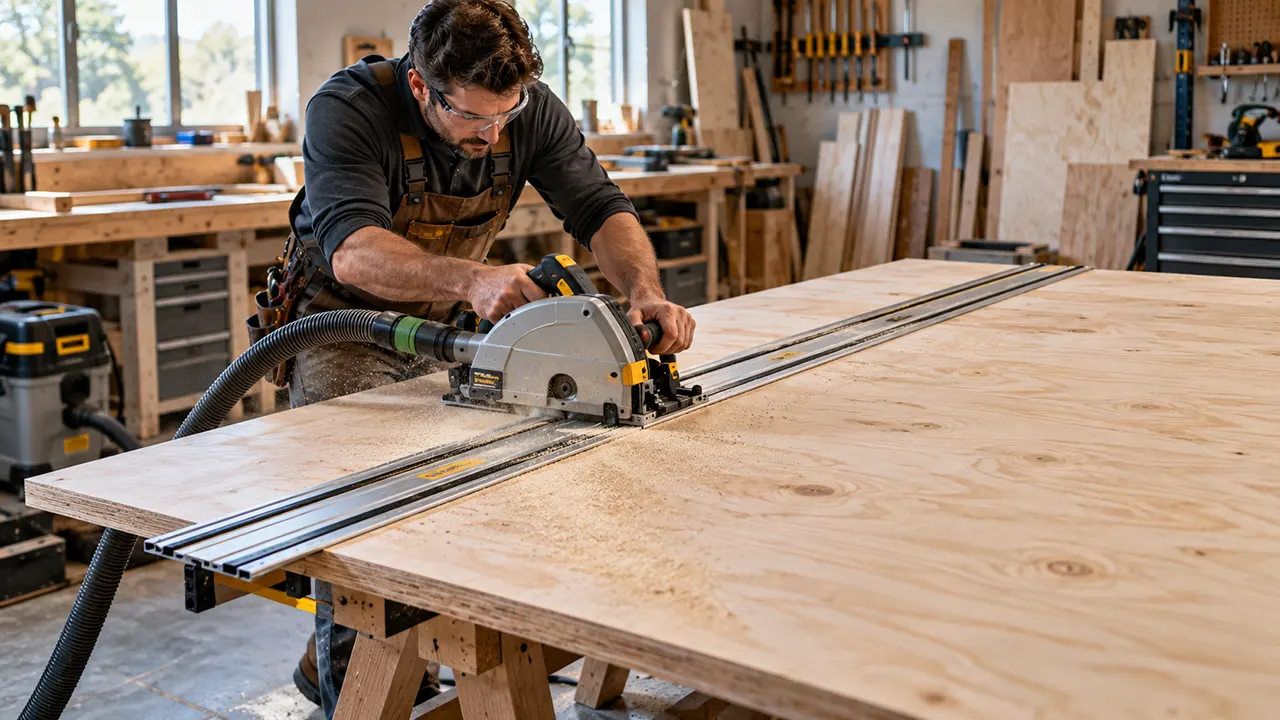
A track saw is not simply a circular saw with a rail. The rail, plunge mechanism, depth control and splinter protection turn it into a different way of processing sheet goods. That distinction matters more in 2026 as new cordless models, including DeWalt’s 20V MAX XR 6-1/2-inch Plunge Track Saw, push the category further into mainstream professional tool territory.
The interesting question is not whether a track saw can replace every other saw. It cannot. The better question is why woodworkers, cabinetmakers and contractors increasingly reach for one when a large sheet of plywood needs to become smaller, cleaner and more manageable.
Quick Answer: What Is a Track Saw?
A track saw is a plunge-style circular saw that runs along a guide rail to make straight, accurate cuts. It is especially useful for breaking down plywood, MDF, melamine and other large sheet goods because the rail controls the saw’s path while the plunge mechanism allows cuts to start inside the panel. Unlike a table saw, the material can stay stationary while the saw moves across it.
Why Track Saws Are Getting More Attention in 2026
The track saw category is receiving a fresh burst of attention in 2026 for a simple reason: manufacturers are making the format more capable without giving up its main advantage, portability.
DeWalt announced its new 20V MAX XR 6-1/2-inch Plunge Track Saw in August 2026 as part of a broader cordless carpentry lineup. The company says the saw is designed for professional carpenters and contractors and claims repeatable straight cuts within 1/32 inch. The kit includes an 8Ah battery, charger, connecting hardware and two 30-inch tracks for a total 60-inch system length.
That launch matters because cordless track saws are no longer unusual alternatives to corded models. Current 2026 testing and buying coverage includes cordless systems from Bosch, DeWalt, Festool, Makita, Milwaukee, Metabo HPT, Ridgid and Ryobi. A 2026 head-to-head test from Concord Carpenter evaluated 12 cordless track saws across accuracy, cut quality, power, ergonomics, dust collection and track performance.
But the bigger story is not cordless power.
It is workflow.
A table saw asks you to bring the material to the machine. A track saw lets you bring the machine to the material. For a 4×8 sheet, that difference can change the entire cutting process.
What a Track Saw Actually Changes
A track saw is a plunge-style circular saw designed to run along a dedicated guide rail. The rail establishes the saw’s path while the plunge mechanism allows the blade to enter the material at a controlled location and depth.
That sounds like a small modification to a circular saw. It is not.
With a conventional circular saw, the operator must maintain the relationship between the saw and a straightedge or guide. With a track saw, the saw is physically constrained by the rail.
The rail therefore becomes part of the cutting system.
A typical system combines four important elements:
- The saw provides the motor, blade and plunge mechanism.
- The guide rail establishes the cutting path.
- The splinter guard supports the material near the blade.
- The depth mechanism controls how far the blade enters the workpiece.
This is why a track saw can feel dramatically more controlled than a conventional circular saw when making a long cut through plywood.
The advantage is not simply that the blade is sharp or the motor is powerful. The advantage is that the system controls where the blade travels.
Why Track Saws Make Sense for Sheet Goods
Large sheets create a problem that is easy to underestimate.
A 4×8 panel is large, flexible and awkward to control. Moving it across a table saw requires adequate support around the machine and enough space to keep the panel aligned. When working alone, the problem becomes even more obvious.
A track saw reverses the workflow.
You can support the sheet on a suitable cutting surface, position the rail where the cut belongs and move the saw across the stationary panel.
That makes the tool particularly useful for:
- Plywood
- MDF
- Melamine
- Cabinet panels
- Doors
- Countertop material
- Large furniture panels
- Long sheet-goods cuts
Current 2026 coverage continues to identify sheet-goods breakdown as the track saw’s strongest use case. A September 2026 plywood guide, for example, focuses specifically on guide rails, splinter guards, plywood tear-out and the relationship between track saws and table saws.
The important distinction is that the track saw does not make a large sheet smaller by brute force. It makes the sheet easier to control while cutting it.
Track Saw vs Table Saw: Which One Actually Wins?
Neither tool wins every job.
A track saw is particularly strong when the workpiece is large and the cut is long. A table saw becomes more attractive when the material is manageable and you need repeated, highly consistent cuts against a fixed fence.
| Task | Better starting point |
|---|---|
| Breaking down a full plywood sheet | Track saw |
| Long cuts on large panels | Track saw |
| Working alone with sheet goods | Track saw |
| Mid-panel plunge cut | Track saw |
| Repeated identical-width rips | Table saw |
| Narrow stock ripping | Table saw |
| Dadoes and rabbets | Table saw |
| High-volume dimensioning | Table saw |
| Small-shop sheet breakdown | Track saw |
| General stationary shop production | Table saw |
The key difference is material movement.
A table saw keeps the blade fixed while the material moves through it. A track saw keeps the material stationary while the saw moves along the cut.
That makes a track saw particularly compelling before final sizing. You can break a large panel into manageable pieces with the track saw, then use a table saw for repetitive dimensioning or joinery.
That is why the strongest argument is not “track saws replace table saws.”
It is that the two tools solve different parts of the same workflow.
Track Saw vs Circular Saw: Is the Difference Real?
A circular saw can already make straight cuts.
Add a straightedge or guide, measure carefully, clamp it down and the results can be very good. For rough construction, framing and occasional sheet breakdown, that may be all you need.
So what are you paying for with a dedicated track saw?
The answer is control.
The saw base is designed to engage the rail. The plunge mechanism provides controlled entry into the material. The rail’s splinter strip can also sit directly at the cut line, helping reduce tear-out on suitable materials.
The Spruce describes the basic distinction clearly: a track saw is a circular saw designed to ride along a guide rail, making long straight cuts easier, particularly when working with large sheets.
A circular saw remains the more flexible general-purpose tool for many rough cuts. It is usually simpler to grab for framing lumber, construction cuts and jobs where ultimate edge quality is not the main concern.
A track saw becomes more attractive when the cut itself is part of the finished result.
What Actually Determines Track Saw Accuracy?
“Accurate” is one of the most overused words in track saw marketing.
A track saw cannot magically make every cut perfect.
The final result depends on the entire system.
Rail Position
The rail determines where the saw travels, so positioning it correctly is the first accuracy requirement.
If the rail is placed incorrectly, the saw can make an extremely straight cut in exactly the wrong place.
That is why measuring and marking still matter.
Rail-to-Saw Fit
The saw must remain properly constrained by the rail.
Excessive play between the saw and guide can affect the cut, especially over a long distance. Current cordless track-saw testing evaluates guide-rail slop as a separate performance category, which shows how important this interface has become.
Blade Quality
A perfectly positioned rail cannot compensate for a poor or inappropriate blade.
For plywood and veneered materials, tooth geometry matters because the blade has to remove material without unnecessarily damaging the visible surface.
Workpiece Support
A sheet that moves, flexes or closes around the blade can undermine an otherwise precise setup.
The workpiece needs adequate support without placing the support directly where the blade will travel.
Operator Technique
The saw still has to be moved correctly.
Feed too aggressively and the motor can struggle. Force the tool sideways against the rail and you can affect the cut. Rush a plunge and the entry can become less controlled.
This is why a manufacturer’s accuracy specification should be understood as a capability claim, not a guarantee that every cut made by every user will land within the same tolerance.
For example, DeWalt states that its new 20V MAX XR 6-1/2-inch Plunge Track Saw can make repeatable straight cuts within 1/32 inch under its specified test conditions. That is a useful specification, but it should not be interpreted as a universal measurement of every cut in every material.
The Guide Rail May Matter More Than You Think
When buying a track saw, it is easy to focus on the motor, battery voltage or blade diameter.
The rail deserves equal attention.
The rail determines how the saw travels, how long a cut you can make in one pass and how easily you can position the system. The splinter strip also works at the edge of the rail to help define the cutting line and reduce tear-out.
Rail length is therefore a practical buying decision.
A short rail can be convenient for doors, shelves and smaller panels. Longer rails become more useful for full-sheet cuts. Some systems allow multiple rails to be joined when a single rail is not long enough.
DeWalt’s new 20V MAX XR kit illustrates this system approach. Its package includes two 30-inch tracks and a connector for a total 60-inch track length. DeWalt also offers separate track lengths within its broader track-saw system.
This leads to an important buying rule:
Do not evaluate a track saw without evaluating the rail ecosystem that comes with it.
A slightly cheaper saw can become less attractive if the rails, connectors and accessories do not fit the way you need to work.
Why the Splinter Guard Matters
The rubber strip along a guide rail serves a useful purpose beyond helping identify the cut line.
It sits close to the blade path and supports material fibers near the cut. That can help reduce splintering and tear-out, especially when cutting sheet materials where the visible face matters.
This is one reason a track saw can produce a cleaner result than a freehand circular saw even when both use similar blade sizes.
The result still depends on the blade, material, feed rate and setup. The rail does not make tear-out physically impossible.
But it moves the cutting system closer to the finished edge you want.
That matters in cabinet work, furniture panels and other projects where the cut edge may eventually be glued or exposed.
Dust Collection and Kickback Are Part of the System
A track saw’s value is not limited to straight cuts.
Dust control matters because long sheet cuts can generate a large amount of fine dust. Many track saws provide dust ports designed to connect to an extractor.
DeWalt says its new 20V MAX XR model can capture up to 94% of dust under its specified conditions and can trigger a compatible vacuum through its Wireless Tool Control system.
Kickback protection is another area receiving more attention.
DeWalt’s new saw includes its KICKBACK BRAKE system, which is designed to shut the saw down when a pinch, stall or bind is detected.
However, no electronic protection system changes the basic rules of cutting.
The material still needs proper support. The blade needs to remain appropriate for the job. The operator needs to control the plunge and feed. The rail must be positioned securely.
A track saw is a controlled cutting system, not a risk-free cutting system.
Corded vs Cordless Track Saws in 2026
Cordless track saws have become one of the biggest developments in the category.
The reason is easy to understand.
A track saw can already be awkward to move because the rail may be several feet long. Adding a power cord creates another object that can catch on the material, support surface or operator.
Cordless operation removes that constraint.
Current 2026 testing includes a wide range of cordless platforms, from 18V and 20V systems to higher-voltage dual-battery designs. The category now includes cordless models from major professional tool ecosystems rather than treating cordless as a compromise option.
But corded models still make sense.
Choose corded when:
- You work primarily in a fixed shop.
- Long cutting sessions are common.
- You already have convenient power and extraction.
- Battery compatibility is not important.
Choose cordless when:
- You work on jobsites.
- You already own compatible batteries.
- You move between rooms or buildings.
- You want maximum freedom around large panels.
The best cordless option is therefore not automatically the one with the highest voltage.
The battery ecosystem you already own can be a more important factor.
What to Look for in a Track Saw
Instead of judging a track saw by one headline specification, evaluate the complete system.
Rail compatibility
Check the rail supplied with the saw and whether additional lengths or connectors are readily available.
Plunge control
The plunge action should feel predictable and provide useful depth control.
Cutting depth
Most 6-1/2-inch track saws are designed around the thicknesses commonly encountered in sheet goods, but exact depth varies by model and cutting angle.
Rail adjustment
A good saw should maintain a controlled relationship with the rail without excessive side play.
Dust extraction
If you regularly cut MDF, plywood or other dusty materials indoors, extraction deserves serious weight in the buying decision.
Battery platform
For cordless tools, compatibility with batteries you already own can change the economics dramatically.
Blade availability
A track saw is only as useful as the blades available for your materials and the cuts you need to make.
Rail ecosystem
This is the criterion many first-time buyers overlook. A track saw is not just a power tool. It is a saw-and-guide system.
Track Saw Systems Worth Watching in 2026
The current market gives buyers several established ecosystems rather than one obvious winner.
DeWalt 20V MAX XR 6-1/2-inch Plunge Track Saw
This is the most relevant model for the current 2026 freshness angle because it is a new addition to DeWalt’s 20V MAX XR cordless carpentry lineup.
The official specifications include a brushless motor, variable speed, 1/32-inch repeatable-cut claim, KICKBACK BRAKE, dust extraction and a kit with two 30-inch tracks.
Bosch Professional Track Saw
Bosch has strong representation in current track-saw testing. Bob Vila’s February 2026 testing selected the Bosch GKT13-225L as its top overall track saw after testing nine models.
Makita Track Saw Systems
Makita remains a significant option for buyers who want either a corded or cordless system. Its track saws also appear frequently in current 2026 comparisons and cordless testing.
Festool Track Saw Systems
Festool remains important for buyers who prioritize a mature premium rail ecosystem, dust extraction and refined cutting performance. It is frequently positioned at the premium end of current 2026 track-saw comparisons.
Milwaukee M18 Fuel Track Saw
Milwaukee is particularly relevant for users already invested in the M18 battery ecosystem. Its cordless track saw is included in current professional testing and 2026 buying coverage.
The right choice among these systems depends less on brand popularity than on the work you actually do, the battery platform you already own and the rail ecosystem you are willing to build around.
Is a Track Saw Worth It in 2026?
A track saw is worth considering if large panels are a regular part of your work.
It makes especially strong sense when you:
- Break down plywood frequently.
- Work alone.
- Have limited workshop space.
- Need long straight cuts.
- Want controlled plunge cuts.
- Move between jobsites.
- Want a portable alternative for sheet-goods breakdown.
It is less compelling if most of your work involves:
- Repetitive narrow rips.
- Dadoes and rabbets.
- High-volume dimensioning.
- Rough framing cuts.
- Small pieces that are already easy to control.
In those situations, a table saw or conventional circular saw may be the more efficient tool.
The decision becomes clearer when you stop asking which saw is “better” and ask which tool makes the difficult part of your work easier.
Can a Track Saw Replace a Table Saw?
For sheet-goods breakdown, often yes.
For an entire woodworking workflow, no.
A track saw can handle long panel cuts, bevel cuts and plunge cuts with excellent control. A table saw remains extremely useful for repeated rips, narrow stock, joinery operations and production-style workflows.
That makes the two tools complementary.
A practical workflow for a small woodworking shop can look like this:
- Place the full sheet on a stable cutting surface.
- Mark the required cut.
- Position the track.
- Break the sheet into manageable panels with the track saw.
- Move smaller pieces to the table saw when repeated sizing or joinery is required.
The track saw therefore does not have to defeat the table saw to be valuable.
It only has to solve the jobs the table saw makes awkward.
The Bottom Line: Track Saw or Table Saw?
The 2026 track saw story is not really about one new DeWalt model or one award.
It is about a tool category becoming increasingly capable while preserving a very useful idea: the saw travels to the material instead of forcing the material to travel through the saw.
That is why track saws are particularly powerful for plywood, MDF, melamine, cabinet panels and other large sheet goods.
A table saw still has the advantage when you need repetitive dimensioning and traditional joinery. A circular saw remains the simpler choice for many rough construction cuts.
But if your hardest cutting problem is a large sheet that needs to become a straight, clean, accurately positioned panel, the track saw has a compelling answer.
And in 2026, with new cordless models expanding the category, that answer is getting harder to ignore.
