


You Inherited Gold Stamps. Now You Need the Truth.
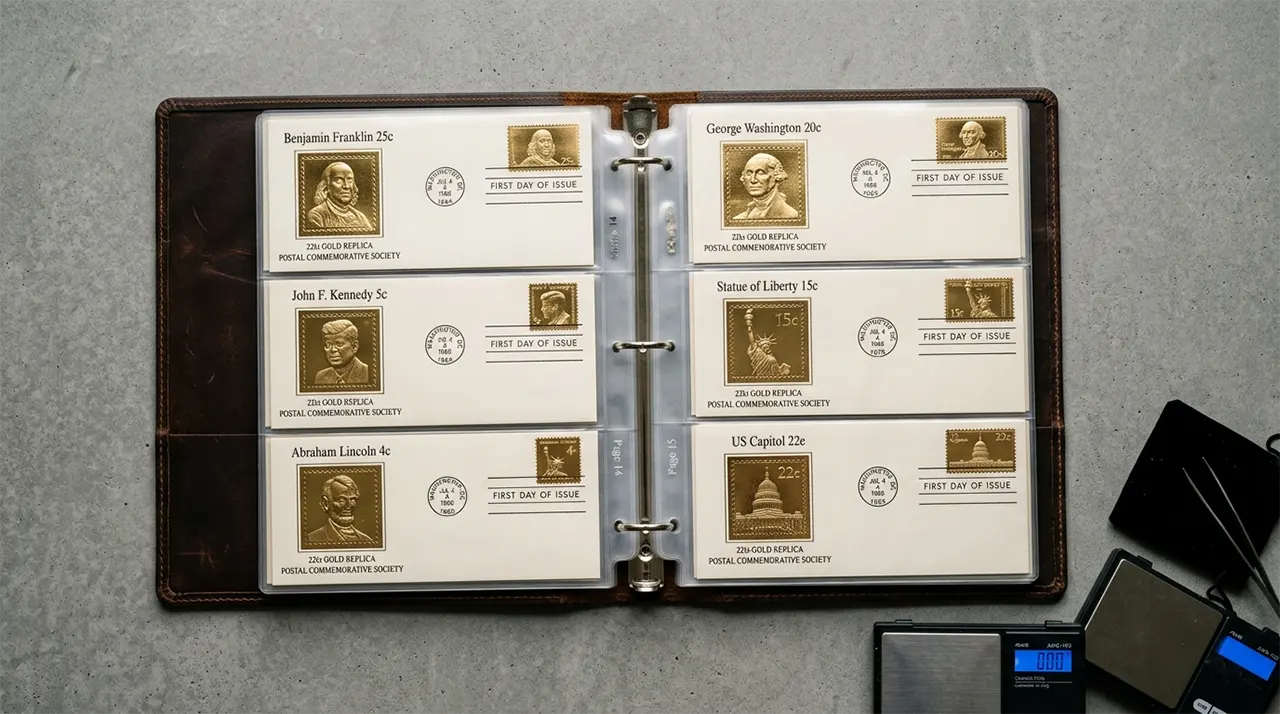
Someone passes you a leather binder filled with gleaming 22kt gold replica stamps, and your mind does the math. Gold is over $2,300 an ounce. There are 75 stamps in this book. That has to be worth something significant, right? The answer is uncomfortable but important. This guide separates replica stamp value from jewelry gold hallmark value, provides real sold-price data from eBay, and does the gold content math that sellers do not want you to see.
Gold Stamp Values: The Unfiltered Truth
Gold stamp values fall into two completely unrelated categories with vastly different worth. Gold replica stamps from the Postal Commemorative Society sell for $0.25 to $2 each as collectible novelties. Jewelry gold hallmarks such as 14K, 18K, or 22K indicate solid gold purity and carry significant precious metal value based on weight.
The confusion is understandable. Both topics involve the word “gold” and the word “stamp,” but they share nothing else. A gold replica stamp is a thin metal reproduction of a postage stamp, plated in a microscopic layer of gold, sold inside a commemorative envelope. A jewelry gold hallmark is a tiny number stamped inside a ring or necklace clasp that certifies the item is made from solid gold alloy.
Most people arriving at this page inherited a binder of gold replica stamps and want a dollar figure. This guide covers replica stamps first, then clearly separates the jewelry hallmark topic later so you never confuse the two.
The phrase “22kt gold” on a replica stamp package was never a statement of precious metal value. It was a marketing phrase engineered to make a $3 commemorative envelope feel like an inheritance-worthy asset. The gold content was always incidental to the product.
💡 Key Takeaway: If you hold a binder of gold replica stamps with First Day Covers, you are holding a novelty collectible worth $0.25 to $2 per stamp, not a precious metal investment.
What Are Gold Replica Stamps, Really?
Gold replica stamps are privately produced commemorative covers featuring oversized stamp reproductions plated in a microscopic layer of 22kt or 24kt gold. The Postal Commemorative Society marketed these through mail subscriptions from the 1980s through the 2010s, operating as a private company, not the United States Postal Service.
The Postal Commemorative Society Business Model
The Postal Commemorative Society, often abbreviated as PCS, built a direct-mail empire by shipping monthly gold replica stamp envelopes to subscribers across the United States. Each shipment arrived with a First Day Cover featuring a real USPS postage stamp alongside an oversized gold-plated replica of that same stamp design.
Subscribers paid monthly fees ranging from $5 to $15 per shipment during the 1980s and 1990s. Over a decade, a dedicated subscriber could accumulate hundreds of these covers, often stored in branded leather binders that PCS sold separately. The binders themselves became part of the perceived value, giving the collection a physical weight and presentation that felt substantial.
PCS was never a government entity. The company leveraged the credibility of the USPS cancellation mark and the real postage stamp on each envelope to create an association with official postal merchandise. This marketing strategy worked. Millions of replica covers entered American homes between 1980 and 2015, which directly explains why the secondary market is flooded with them today. You can explore postal commemorative cover history to understand how First Day Covers work independently of gold replicas.
What You Actually Receive in Each Envelope
A standard PCS gold replica envelope contains three components. The envelope itself is a standard First Day Cover with a postmark cancellation dated to the stamp’s issue date. Inside, a real USPS postage stamp is affixed to the left side. On the right side, an oversized replica of that stamp is reproduced and plated with a thin layer of gold leaf or gold electroplate.
Some editions included a fourth element: a small history card describing the stamp’s origin and significance. The “Golden Replicas of United States Stamps” series, the most common variant, packaged 75 covers per binder organized by year or theme. Other themed series included Presidential stamps, Olympic stamps, state greeting stamps, and “Stamps of the Century” collections.
Let’s be honest about what these are. They are attractive novelty items with a thin gold coating. They are not bullion. They are not rare philatelic material. They are mass-produced commemorative souvenirs that looked impressive in a binder on a shelf.
The United States Postal Service never produced or sold gold replica stamps. The USPS only cancelled the envelopes and provided the real postage stamp. Every gold replica was manufactured and distributed by a private company that capitalized on the postal brand.
The Gold Content Myth: Real Numbers
A single 22kt gold replica stamp contains approximately 0.00021 grams of gold, giving it a raw melt value of roughly $0.015. You would need over 147,000 stamps to accumulate one troy ounce of pure gold, making chemical extraction completely financially pointless at any scale.
The Actual Gold Weight Per Stamp
Independent testing of PCS gold replica stamps has measured the gold layer at approximately 0.000211 grams per stamp. At 22kt purity, that translates to roughly 0.000194 grams of pure gold per replica. With gold priced around $60 per gram, the actual gold value in a single stamp sits at $0.0116, or about one penny.
The gold application process used by PCS was gold leaf electroplating, a technique that deposits a layer measured in microns. Gold leaf this thin is designed for visual effect, not material accumulation. Think of it like gold leaf applied to picture frames or domed building accents. The gold is real, but the quantity is invisible to the naked eye.
Why Melting These Stamps Is Financial Suicide
Even if you somehow acquired 150,000 gold replica stamps at no cost, the economics of extraction collapse immediately. Gold recovery from electroplated surfaces requires chemical dissolution using aqua regia or cyanide leaching, processes that demand laboratory-grade equipment, hazardous material permits, and significant labor. The chemical cost alone per batch would exceed the gold value recovered.
YouTube creators have demonstrated the process. Modern Goldsmith, a precious metal working channel, extracted a visible gold fleck from a batch of gold replica stamps but concluded the effort and chemical expense rendered the endeavor worthless. The gold recovered was visually measurable but financially negligible.
Do not attempt to melt or chemically process gold replica stamps at home. The chemicals required are extremely hazardous, the gold yield is negligible, and you will destroy any collectible resale value the stamps retain. Check current gold spot prices to understand what real gold quantities look like in dollar terms.
A forum contributor spent an entire day running the mathematical calculations on PCS stamp gold content. The conclusion: you would need over 10,000 stamps just to have a conversation about melting. The actual number is 14 times higher. The math is the most generous thing about these stamps.
Gold replica stamps derive their visual appeal from the reflective quality of electroplated gold leaf, not from material substance. The stamp surface catches light beautifully in a binder, creating the impression of precious metal wealth that the actual numbers completely contradict.
The replica stamp sits inside a First Day Cover envelope alongside a real USPS postage stamp, which is worth exactly its face value as postage and nothing more as a collectible in this context.

Real Gold Stamp Values: What They Actually Sell For
Gold replica stamps from the Postal Commemorative Society sell for $0.25 to $2.00 per individual stamp on the secondary market, with complete 75-stamp albums fetching $30 to $90 depending on theme and condition. These figures reflect eBay sold-price data, not seller asking prices, which typically sit three to five times higher and rarely sell.
Single Stamp Values
Individual PCS gold replica stamps sold without envelopes or binders consistently move at $0.25 to $1.00 each on eBay. These are typically broken out of larger collections by sellers trying to move inventory that will not sell as a complete set. Demand for singles is almost nonexistent unless the design carries specific nostalgic appeal.
Inverted Jenny replicas, despite copying one of the most famous and valuable stamps in philatelic history, sell for $1.00 to $3.00 each. The original 1918 Inverted Jenny error stamp sold for $2 million at auction. The gold replica is worth pocket change. This contrast perfectly illustrates the gulf between real philatelic value and replica novelty value.
Complete 75-Stamp Album Values
The “Golden Replicas of United States Stamps” binder containing 75 First Day Covers is the most common format found in estates. Sold prices on eBay for complete 75-stamp albums range from $30 to $90, averaging roughly $0.50 to $1.20 per stamp. Albums from the 1980s and 1990s dominate this range.
Condition plays a secondary role here. Envelopes without mailing addresses sell faster and command slight premiums. Binders with torn covers, water damage, or missing stamps drop to the $20 to $40 range. The binder itself holds no independent value. PCS produced these binders in massive quantities, and replacement binders are common.
Large Lot Values: 150+ Stamps
Bulk lots of 150 or more gold replica stamps sell between $45 and $175 on eBay. The per-stamp price drops significantly in bulk, averaging $0.30 to $0.80. Sellers offering these lots are typically liquidating inherited collections of multiple binders and have accepted that individual listing is not worth the time investment.
A notable eBay listing for a 150+ stamp collection carried an asking price of $479.99 with free shipping. That listing sat unsold for weeks. The actual transaction price for comparable lots consistently landed between $80 and $150. Always filter eBay search results by “Sold Items” to see real transaction prices rather than optimistic seller expectations.
Themed Set Values
Themed PCS collections carry a small premium over generic albums. Presidential sets, “Flags of Our Nation” series, and Olympic collections sell for $50 to $150 depending on completeness and presentation. The “Stamps of the Century” 75-stamp albums consistently sell in the $45 to $90 range.
The most frequently cited “premium” item is the Thomas Edison First Day Cover that includes both the gold replica and the original three-cent stamp. JustAnswer appraisers valued this single cover at $140, but this figure appears inflated when compared against actual eBay sold data. Comparable Edison covers with original stamps have sold for $8 to $20 in completed listings. The $140 valuation likely represents a best-case retail scenario, not a realistic market transaction.
💡 Key Takeaway: Asking prices on eBay average 3x to 5x higher than actual sold prices for gold replica stamps. Never estimate your collection’s value using active listings. Use the “Sold” filter and look at transactions from the past 90 days.
The secondary market for Postal Commemorative Society replica stamps has been in slow decline for over a decade. As the original subscriber generation ages and passes down collections, supply continues to increase while demand remains flat to declining. Basic economics dictates further price softening over time.
Niche themes like state greeting stamps or specific historical figures may hold marginal collector interest, but “investment” is not a word that belongs anywhere near these products.

Gold Hallmarks on Jewelry: A Completely Different Topic
Jewelry gold hallmarks are stamped numbers or letters on rings, necklaces, and bracelets that indicate the precious metal purity of that specific piece. Unlike gold replica stamps, jewelry hallmarks represent solid gold alloy that carries real melt value proportional to the item’s weight and karat rating.
Many people searching for gold stamp values are actually looking at a number stamped inside a piece of jewelry. If you are looking for information about a number like 14K, 585, or 750 stamped on a ring or chain, you are in the right place.
Understanding Karat Numbers
Karat numbers indicate what fraction of a jewelry piece is pure gold out of a maximum of 24 parts. 14K gold contains 14 parts gold and 10 parts other metals, making it 58.3% pure. 18K gold is 75% pure. 22K gold is 91.7% pure. 24K gold is 99.9% pure and too soft for most practical jewelry applications.
Federal law requires gold jewelry sold in the United States to carry a purity stamp. Finding a stamp is a positive indicator that the piece contains real gold. The stamp location varies by item type. Ring stamps appear on the inside of the band. Necklace and bracelet stamps appear on or near the clasp. Earring stamps are often found on the post or the back of the piece.
Purity Conversion: Karat Numbers to Percentages
✅ 10K (stamped 417) — 41.7% pure gold — Most durable, least valuable per gram
✅ 14K (stamped 583 or 585) — 58.3% pure gold — Most common in US jewelry
✅ 18K (stamped 750) — 75% pure gold — Premium jewelry, rich yellow tone
✅ 22K (stamped 916) — 91.7% pure gold — Traditional Indian jewelry, very soft
✅ 24K (stamped 990 or 999) — 99.9% pure gold — Investment gold, not for daily wear
The three-digit number system represents purity as a value out of 1,000. A stamp reading “750” means 750 parts per thousand are gold, which equals 75% or 18 karats. Both systems appear on jewelry and mean the same thing. A piece stamped “14K” is identical in purity to one stamped “585.”
Warning Stamps That Mean Plated, Not Solid
Letter suffixes on jewelry stamps change everything about the value equation. A karat number followed by letters like GP, GE, HGE, GF, or RGP indicates the piece is gold-plated or gold-filled, not solid gold. These items contain a thin gold layer bonded to a base metal core and hold minimal precious metal value.
🚫 GP (Gold Plated) — Microscopic electroplated gold layer over base metal
🚫 GE (Gold Electroplate) — Same as GP, different terminology
🚫 HGE (Heavy Gold Electroplate) — Slightly thicker plating, still negligible gold content
🚫 GF (Gold Filled) — Bonded gold layer, more than plating but far less than solid
🚫 RGP (Rolled Gold Plate) — Mechanically bonded gold sheet, minimal value
A ring stamped “18K HGE” contains 18 karat gold as a plating layer only. The ring itself is mostly base metal. It is not worth 75% of the spot gold price. It is worth its weight in scrap base metal plus a negligible gold content credit. If you are unsure about a jewelry hallmark, consult a professional appraiser or use a gold testing kit to verify purity before selling.
The gold plating on a “22kt gold replica stamp” and the “22K HGE” stamp inside a $19 ring are functionally identical products. Both apply a microscopic layer of real gold over a cheaper base. Neither one justifies calculating value based on the spot price of gold.
How to Spot Fake 22-Carat Gold Stamps
Fake gold replica stamps exist in two forms: non-gold reproductions sold as genuine PCS items, and PCS items that have been artificially enhanced or altered to appear more valuable than they are. Identifying fakes requires examining the stamp surface, the envelope authenticity, and the gold content itself.
Genuine PCS gold replica stamps have a distinctly matte gold finish with subtle texture variation from the electroplating process. Counterfeit versions often display an unnaturally bright, uniform gold sheen that resembles gold paint rather than electroplated gold leaf. If the gold surface looks too perfect or has visible brush strokes, treat it with suspicion.
The envelope provides additional authentication clues. Genuine PCS covers feature a real USPS cancellation postmark with a legible date and location. Fake envelopes may have printed cancellations that lack the ink irregularity of a real postmark. The real postage stamp on the left side of the envelope should show proper perforation edges and correct face value for the issue date.
For definitive verification, gold content testing removes all doubt. A gold testing kit with testing solutions and a testing stone can confirm whether the gold layer on your replica stamp is genuine 22kt gold or a base metal with gold-colored coating. For a complete walkthrough of authentication methods, read our detailed guide on how to identify fake 22-carat gold stamps. If you prefer electronic verification, a digital gold testing pen provides instant surface composition readings without damaging the stamp.
Let’s be honest though. Testing a PCS gold replica stamp for gold authenticity is like testing a $1 bill for counterfeiting. Even if the gold is genuine, the value remains negligible. Testing only makes sense if you suspect someone sold you a fake PCS item at a premium price, which is itself a rare scenario given how inexpensive these items are on the open market.
What to Do With Your Gold Stamp Collection
You have three realistic options for a gold replica stamp collection: sell it on eBay for market value, gift it to family members who appreciate the aesthetics, or keep it as a decorative shelf item. Taking these to a coin shop, pawn shop, or precious metals dealer will result in an offer of $0 to $5 for an entire binder, because dealers recognize the negligible gold content and lack of collector demand.
Option 1: Sell on eBay With Accurate Expectations
Selling a complete 75-stamp album on eBay is the most reliable path to extracting value. Photograph every page clearly, note whether envelopes have addresses, and list the specific theme or year range. Set your Buy It Now price at the low end of the sold-price range, around $40 to $60 for a standard album, to move the item within a reasonable timeframe.
Avoid the trap of pricing your listing at $150 to $300 because you see other sellers asking those prices. Those listings sit unsold for months. The market speaks through completed transactions, not active wishful listings. Factor shipping costs into your pricing. A binder of 75 First Day Covers weighs several pounds and requires a box, not an envelope.
Option 2: Break Up and Gift by Theme
Multiple forum discussions from inheritors concluded that gifting individual stamps or small themed sets to nieces, nephews, and grandchildren generated more satisfaction than selling. A child who receives a small packet of space-themed or Disney-related gold replica stamps experiences genuine excitement, even if the market value is negligible.
This approach converts a low-value commodity into a meaningful family moment. Several people in stamp collecting forums reported breaking apart inherited PCS collections by category and distributing themed groups as birthday and holiday gifts. The recipients valued the visual appeal and the family connection far more than any dollar figure a stranger would offer on eBay.
Option 3: Display as Decorative Objects
Gold replica stamp binders are genuinely attractive objects on a bookshelf or coffee table. The gold surfaces catch light beautifully, and the leather binders have a classic library aesthetic. If you have shelf space and no urgent need for $40 to $90, displaying the collection costs nothing and provides visual enjoyment.
The collection becomes a conversation piece rather than a failed investment. Visitors will pick up the binder, flip through the pages, and ask about it. That interaction has value that does not appear on a spreadsheet. Not everything inherited needs to be monetized, converted, or liquidated. Some things are allowed to just exist on a shelf and look golden.
If you decide to sell, a basic digital scale helps you accurately calculate shipping costs for eBay listings. A precision digital pocket scale handles this task and doubles as a useful tool for any future shipping or mailing needs.
The Bottom Line on Gold Stamp Values
Gold replica stamp values are determined by novelty appeal, not precious metal content. A complete Postal Commemorative Society binder of 75 stamps is worth $30 to $90 on today’s market. Individual stamps trade for $0.25 to $2.00. The gold in every single stamp combined is worth roughly $0.015. These numbers do not improve with age, theme, or presentation.
Jewelry gold hallmarks represent an entirely different asset class. A ring stamped 14K or 750 contains solid gold alloy worth a calculable percentage of the current spot gold price based on the ring’s weight. That value is real, liquid, and significant. A gold replica stamp contains gold leaf worth one penny. The distance between these two realities is measured in orders of magnitude, not percentages.
Your next step depends on what you are holding. If it is a PCS binder, check eBay sold listings for your specific theme, price realistically, and move forward without emotional attachment to the “22kt gold” marketing language. If it is a piece of jewelry with a karat stamp, weigh the item, look up the current spot price, and calculate your metal value. Know which “gold stamp” you are looking at before you make any decisions about selling, keeping, or gifting.
