


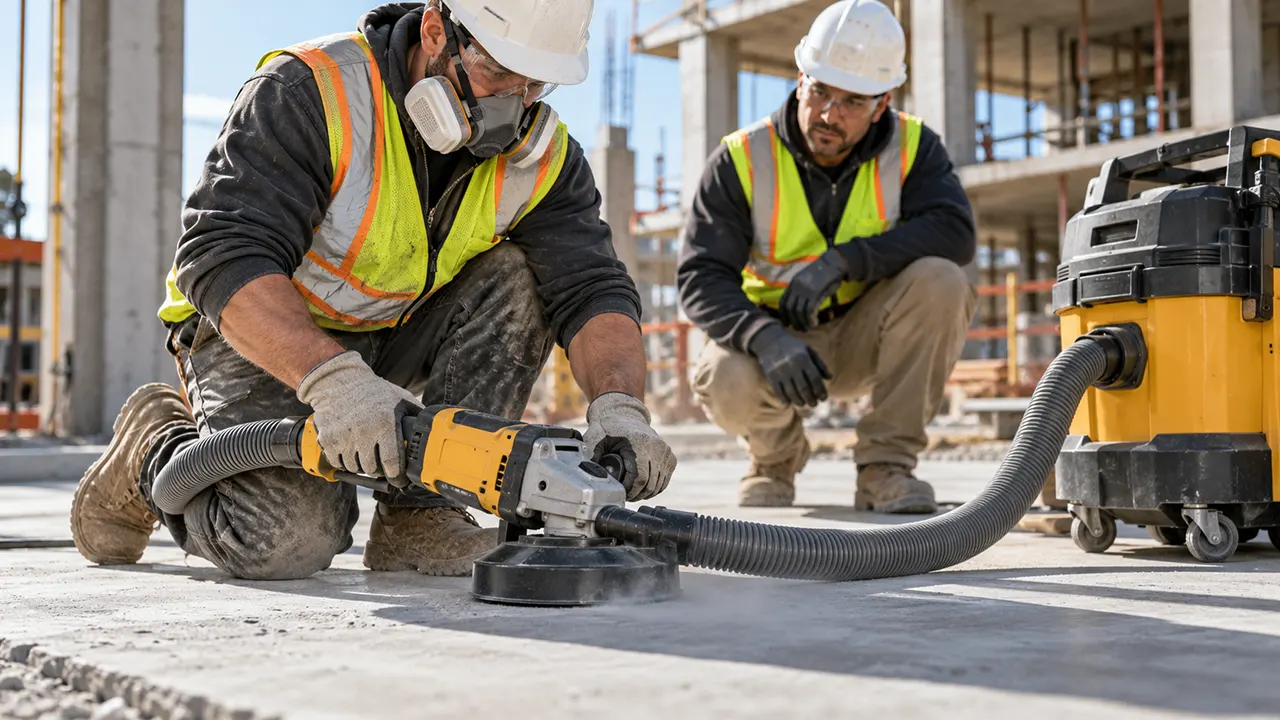
OSHA Silica Table 1 is a task-specific guide to controlling workers’ exposure to respirable crystalline silica during construction. It lists required engineering controls, work practices, and respiratory protection for covered tasks. Contractors who follow Table 1 must fully and properly implement the requirements for the specific task rather than relying on a generic dust extractor or vacuum alone.
When a contractor cuts concrete, drills masonry, grinds mortar, or removes material with a powered chipping tool, the correct dust-control setup depends on the task. Some operations require water delivery, while others use a shroud connected to a dust collection system. The standard also specifies when respiratory protection is required.
This guide explains how to interpret the table, select compatible equipment, maintain dust controls, and avoid common compliance mistakes. It is an educational reference, not a substitute for reviewing the applicable OSHA requirements for your jobsite.
What Table 1 covers and when it applies
OSHA’s construction silica standard, 29 CFR 1926.1153, addresses occupational exposure to respirable crystalline silica. The standard generally applies unless employee exposure will remain below the action level of 25 micrograms per cubic meter of air as an eight-hour time-weighted average under any foreseeable conditions.
Table 1 covers common construction operations, including masonry sawing, handheld power sawing, drilling, jackhammering, mortar removal, and floor grinding. Its requirements vary by task, work environment, and sometimes the duration of work during a shift.
Two exposure values help explain the broader standard:
- Action level: 25 micrograms per cubic meter, averaged over eight hours.
- Permissible exposure limit (PEL): 50 micrograms per cubic meter, averaged over eight hours.
These figures describe airborne exposure concentrations. They are not minimum vacuum ratings, filter-efficiency targets, or guarantees that a particular tool setup controls dust adequately.
Table 1 versus alternative exposure-control methods
Construction employers can use either of two compliance approaches under the standard.
Specified exposure-control methods: Employers fully and properly implement the engineering controls, work practices, and respiratory protection listed for the relevant Table 1 task. When they do so, they do not need to assess employee exposure or separately demonstrate compliance with the PEL for that task under the alternative method.
Alternative exposure-control methods: For tasks not listed in Table 1, or when an employer does not fully and properly implement its specified controls, the employer must follow paragraph (d). This approach includes assessing and limiting exposure as required by the standard, using feasible engineering and work-practice controls, and providing respiratory protection when required.
The practical distinction matters when choosing equipment. A dust extractor advertised for concrete grinding does not automatically make a noncompliant setup compliant. If the employer chooses Table 1, the complete system and work practices must meet the applicable requirements.
OSHA Table 1 tool requirements by task
The following table summarizes selected construction tasks. It is a practical reference, not a replacement for the exact regulatory language. Consult the official OSHA Table 1 before work begins.
| Tool or task | Required control approach | Important detail |
|---|---|---|
| Stationary masonry saws | Integrated water delivery | Water must continuously feed the blade. |
| Handheld power saws | Integrated water delivery | Respiratory protection depends on indoor or outdoor use and task duration. |
| Handheld fiber-cement saws with blades 8 inches or smaller | Commercial dust collection for outdoor tasks | Collector airflow must meet the tool manufacturer’s recommendation or exceed it, with at least 99% filter efficiency. |
| Walk-behind saws | Integrated water delivery | Indoor and enclosed-area use has additional respirator requirements. |
| Rig-mounted core saws or drills | Integrated water delivery | Water must reach the cutting surface. |
| Handheld and stand-mounted drills | Shroud or cowling connected to dust collection | Manufacturer-recommended airflow or greater, at least 99% filter efficiency, a filter-cleaning mechanism, and HEPA-filtered hole cleaning. |
| Jackhammers and handheld powered chipping tools | Water delivery or an eligible shroud and dust collection system | Respiratory protection depends on the selected method, location, and duration. |
| Handheld grinders for mortar removal | Shroud and dust collection | At least 25 CFM per inch of wheel diameter, at least 99% filter efficiency, and a cyclonic pre-separator or filter-cleaning mechanism. |
| Other handheld grinder uses | Applicable water method or shroud and dust collection method | The specified dry collection method has task-specific airflow, filtration, and respiratory protection requirements. |
| Walk-behind milling machines and floor grinders | Integrated water delivery or manufacturer-recommended dust collection | Dust collection requires manufacturer-recommended airflow or greater, at least 99% filter efficiency, and a filter-cleaning mechanism. |
These task controls and qualifications are drawn from OSHA’s current published standard. Some Table 1 rows include additional conditions, such as indoor versus outdoor use or respiratory protection after four hours of combined Table 1 work in a shift. Always check the full row before deciding which controls apply.
Handheld and stand-mounted drills
For covered handheld and stand-mounted drilling tasks, including impact and rotary hammer drills, Table 1 requires a commercially available shroud or cowling connected to a dust collection system. The collector must provide at least the airflow recommended by the tool manufacturer, use a filter with at least 99% efficiency, and have a filter-cleaning mechanism.
The standard also requires a HEPA-filtered vacuum when cleaning drilled holes. That requirement is specific and important: a contractor should not assume that blowing out holes with compressed air or using an ordinary shop vacuum is an equivalent method.
Before drilling, verify that the shroud fits the drill and bit, the hose connection is secure, and the collector meets the manufacturer’s airflow recommendation. If the system is modified or its performance is uncertain, confirm that the complete setup still meets the applicable requirements.
Handheld grinders and mortar removal
Mortar removal, often called tuckpointing, has a specific airflow formula under Table 1. The dust collector must provide at least 25 cubic feet per minute (CFM) for each inch of grinding-wheel diameter, use a filter with at least 99% efficiency, and have either a cyclonic pre-separator or a filter-cleaning mechanism.
For example, a 5-inch wheel requires at least 125 CFM under this formula, while a 7-inch wheel requires at least 175 CFM. These are calculated minimums, not proof that a particular extractor and shroud combination will work correctly in practice.
For handheld grinders used for purposes other than mortar removal, Table 1 allows specified water delivery or a shroud-and-collection method under its stated conditions. Respirator requirements differ according to the task and whether work takes place indoors or in an enclosed area.
Saws, core drills, and other cutting equipment
Many saw and core-drilling tasks use water supplied continuously to the blade or cutting surface. Certain outdoor fiber-cement cutting tasks instead use a commercial dust collection system with the required airflow and filter efficiency.
Do not assume that a dry vacuum setup can replace water delivery wherever water is specified. Select the control method that appears in the relevant Table 1 row, and follow the tool manufacturer’s operating and maintenance instructions.
Jackhammers and handheld chipping tools
Table 1 provides a water-delivery option and a shroud-and-dust-collection option for covered jackhammer and handheld powered chipping tasks. The collection option has specified airflow, filtration, and filter-cleaning requirements.
Respiratory protection varies by work location and duration. The relevant row must be read in full before selecting the control method and determining whether a respirator is required.
Dust collector airflow, filters, and shrouds
A dust collection system works as a complete assembly. The tool generates dust, the shroud captures it near the source, the hose transports it, and the extractor pulls the contaminated air through its filtration system. A weak connection or poorly matched component can undermine the entire setup.
How to interpret manufacturer-recommended airflow
For several Table 1 tasks, OSHA requires the dust collector to provide the airflow recommended by the tool manufacturer or greater. This applies to covered drilling tasks, specified fiber-cement cutting, and certain chipping operations. Other tasks, including the grinder applications discussed above, have a specific minimum airflow formula.
CFM means cubic feet per minute. It describes airflow, but it does not tell you everything about dust collection performance. Suction pressure, hose diameter and length, bends, filter loading, shroud design, and the material being removed can affect how well a system captures and transports dust.
Before buying an extractor, check the documentation for the exact tool and dust collection attachment. Do not compare CFM numbers alone or assume that a unit with a higher advertised maximum automatically meets every requirement.
When the 99% filter-efficiency requirement applies
Some Table 1 tasks require a dust collector with a filter rated at 99% efficiency or greater. The requirement applies to the specified collection system, not merely to a general marketing description of the vacuum.
HEPA filtration is a distinct classification. A filter rated to capture 99.97% of particles at 0.3 microns, for example, has a higher stated efficiency than a 99% filter at the same particle size. However, the exact rating, applicable test method, filter installation, and complete equipment configuration still matter.
For drilling, the employer must also use a HEPA-filtered vacuum when cleaning holes. That specific requirement should not be confused with the filtration requirements for every other Table 1 task.
Why shroud, hose, and extractor compatibility matters
A shroud should fit the tool and capture dust as close to the point of generation as practical. The hose must connect securely and allow the system to deliver the airflow needed for the application.
NIOSH’s concrete-grinding engineering guidance describes a local exhaust ventilation system using a grinder, shroud, flexible hose, and portable vacuum. Its research found that the tested grinder-and-shroud combinations reduced dust exposure by at least 90%. That finding applies to the studied combinations and conditions, not every product on the market.
Use these checks when assembling a system:
- Confirm that the shroud is designed for the tool, wheel, bit, or cutting attachment.
- Check hose connections and inspect for cracks, leaks, or blockages.
- Follow the manufacturer’s hose and airflow recommendations.
- Confirm the correct filter and collection bag are installed.
- Use the filter-cleaning mechanism as directed and replace damaged or loaded components when required.
- Check whether the complete setup matches the applicable Table 1 requirements.
Filter cleaning and dust collection maintenance
Fine silica dust can accumulate on filters and reduce airflow. Automatic filter cleaning can help maintain performance, but it does not eliminate the need for inspection, correct filter installation, and proper waste handling.
Follow the extractor manufacturer’s instructions for cleaning and replacing filters, changing bags, and emptying the container. Avoid practices that release collected dust into the breathing zone. If a system loses suction or dust escapes, stop and correct the problem before continuing under a compliance method that depends on that system.
OSHA’s construction FAQs explain that employers can generally rely on manufacturer statements about the airflow a system provides; independent airflow testing is not ordinarily required solely to verify the manufacturer’s recommended airflow. This does not remove the obligation to maintain the equipment and implement the specified controls properly.
When HEPA hole cleaning and respiratory protection are required
Cleaning drilled holes with a HEPA-filtered vacuum
When using Table 1 for covered handheld and stand-mounted drilling tasks, employers must use a HEPA-filtered vacuum to clean holes. The rule is specific to the hole-cleaning step and is separate from the requirements for the drill’s dust collection system.
Choose a vacuum and hole-cleaning attachment suitable for the drilling application. Follow the tool and attachment instructions, and ensure the setup can remove dust from the hole without unnecessarily dispersing it into the work area.
A drill connected to a dust extractor is not the whole system if the next step involves cleaning the drilled hole. Plan for both operations before starting the job.
Respiratory protection by task and duration
Table 1 specifies respiratory protection for some tasks but not others. The requirements may depend on whether the work takes place outdoors, indoors, or in an enclosed area, and on the total duration of Table 1 tasks during the shift.
For example, the table specifies respiratory protection for certain handheld power-saw operations and for particular chipping and grinding applications. Other listed tasks may specify no additional respirator requirement when all stated controls are properly implemented.
Where OSHA requires a respirator, the employer must comply with the applicable respiratory protection requirements, including the respiratory protection program provisions in 29 CFR 1910.134. Do not infer that a respirator is unnecessary for every task merely because the extractor has a HEPA filter.
Wet methods versus vacuum dust extraction
Water delivery and local exhaust ventilation are both used to control silica dust, but they are not interchangeable in every application.
When Table 1 specifies water delivery
For tasks such as covered masonry sawing and rig-mounted core drilling, Table 1 specifies integrated water delivery to the blade or cutting surface. The employer must operate and maintain the tool according to the manufacturer’s instructions and apply water at a flow rate sufficient to minimize visible dust release.
Wet methods can be useful when the equipment supports them and the jobsite can manage water, slurry, drainage, and electrical safety. Contractors should also plan for the safe collection and disposal of wet material.
When Table 1 permits dust collection instead
For certain drilling, grinding, and chipping tasks, Table 1 specifies shrouds and dust collection as an available control method. In these cases, contractors must meet the relevant airflow, filtration, filter-cleaning, and respiratory protection provisions.
The best choice is the control method that satisfies the applicable row and fits the jobsite. Do not substitute a dry extractor for required water delivery, or assume that adding water removes the need for other controls specified by the standard.
How to choose a dust extractor for your tools
The right extractor is not necessarily the one with the highest CFM rating or the largest container. It is the one that works with the tool and attachment, meets the applicable control requirements, and can be maintained properly throughout the job.
Match the extractor to the actual task
Before purchasing equipment, establish:
- Which Table 1 task the crew will perform.
- Whether the specified control method uses water or dust collection.
- The airflow, filter-efficiency, and filter-cleaning requirements for that task.
- Which shroud, hose, bag, and filter are compatible with the tool.
- Whether hole cleaning or task-specific respiratory protection is also required.
Only after these checks should you compare capacity, portability, automatic filter cleaning, power-tool activation, noise, and operating costs.
Three dust extractors worth evaluating
The following products are candidates for a contractor’s equipment shortlist. Their inclusion does not mean that OSHA has approved them for every silica-related task. Confirm the complete system configuration and applicable requirements before use.
Bosch VAC090AH
The Bosch VAC090AH is a 9-gallon portable dust extractor with HEPA filtration and automatic filter cleaning. Bosch also offers compatible PRO+GUARD drilling accessories, including the GXA3-01L kit, which lists the VAC090-series extractors among its compatible models.
This option is worth evaluating for contractors who drill concrete or masonry and want to assemble a compatible tool-and-attachment system. Confirm the selected shroud, filter, hose, and extractor configuration against the exact drill and its manufacturer instructions.
- Best suited for evaluation: Portable drilling and other compatible dust collection tasks.
- Verify before purchase: Accessory compatibility, airflow requirements, filter configuration, and current price.
- Official resources: Bosch VAC090-series documentation and Bosch PRO+GUARD drilling kit.
DEWALT DWV010
The DEWALT DWV010 is an 8-gallon extractor with automatic filter cleaning and power-tool activation. DEWALT’s product documentation lists a 15-amp motor and describes airflow of 150 CFM in its feature specifications, while its overview also references 155 CFM. Use the current manufacturer’s documentation for the precise rating relevant to your setup.
This model is worth comparing when portability, automatic filter cleaning, and a power-tool connection matter. Do not assume that the advertised airflow alone satisfies the requirements for a particular grinder or drill.
- Best suited for evaluation: Compatible corded power tools and jobsite dust collection.
- Verify before purchase: Applicable airflow, filter and bag configuration, shroud compatibility, and current price.
- Official resource: DEWALT DWV010 specifications.
Hilti VC 150-6 X
The Hilti VC 150-6 X is a portable wet-and-dry dust extractor with a 15-liter container, approximately 4 gallons, automatic filter cleaning, and a manufacturer-listed 150 CFM suction level. Hilti lists a starting price of $889 on its US product page, although actual prices and availability can vary.
It is worth evaluating for contractors who want a compact system for compatible cutting, grinding, drilling, and cleanup applications. The model’s listed airflow does not establish suitability for every wheel size or Table 1 task.
- Best suited for evaluation: Compatible construction tools and wet-or-dry cleanup applications.
- Verify before purchase: Exact filter and accessory configuration, task-specific airflow, and current pricing.
- Official resource: Hilti VC 150-6 X.
Compare accessories, filters, capacity, and operating costs
A contractor’s purchase decision should include more than the initial extractor price. Replacement filters, collection bags, compatible shrouds, hoses, adapters, maintenance time, and downtime can affect the cost of keeping a system operational.
| Buying factor | What to verify |
|---|---|
| Airflow | Meets the exact requirement for the tool and task |
| Filter | Correct type, efficiency, and configuration |
| Filter cleaning | Required mechanism is present and maintained |
| Shroud and hose | Designed to work with the tool and collector |
| Capacity | Suitable for the expected amount of material |
| Maintenance | Replacement filters and bags are available |
| Price | Current extractor price plus recurring consumables |
| Documentation | Manufacturer instructions support the intended setup |
Affiliate recommendation: ToolGuider can link to an approved product page where a product is genuinely relevant to the task discussed. The three candidates above have no approved affiliate URLs supplied yet, so no affiliate links are inserted. The article should never imply that purchasing through an affiliate link is necessary for compliance.
A practical OSHA silica Table 1 compliance checklist
Before work starts
- Identify the material and the construction task.
- Find the exact task in OSHA Table 1.
- Select the control method specified for that task.
- Confirm that the tool, shroud, hose, collector, and filters are compatible.
- Verify airflow, filtration, filter-cleaning, and water-delivery requirements where applicable.
- Determine whether the task requires respiratory protection.
- Check the written exposure control plan and applicable employer procedures.
- Ensure workers understand the controls and the hazards associated with respirable crystalline silica.
During operation and maintenance
- Operate the tool and controls according to the manufacturer’s instructions.
- Apply water where required and maintain adequate delivery.
- Watch for dust escaping from the shroud or accumulating in the work area.
- Check hoses, connections, filters, bags, and collection containers.
- Maintain the equipment so it continues to function as designed.
- Handle collected dust and waste without unnecessarily releasing it into the air.
- Follow the applicable housekeeping requirements rather than using cleanup methods that create avoidable dust exposure.
OSHA also requires employers using Table 1 to take measures that minimize visible airborne dust accumulation indoors or in enclosed areas, as needed. Employers must maintain a written exposure control plan and designate a competent person to inspect jobsites, materials, and equipment as required by the standard.
When Table 1 is not the selected compliance method
If the task is not listed in Table 1, or the employer does not fully and properly implement the specified controls, the employer must follow the alternative exposure-control provisions. These include meeting the PEL, using feasible engineering and work-practice controls, and applying respiratory protection when required.
Do not treat the absence of a task from Table 1 as permission to proceed without controls. Review the alternative method and the employer’s responsibilities before work begins.
FAQs: OSHA silica Table 1 tools
Does a HEPA vacuum automatically make a tool OSHA compliant?
No. A HEPA-filtered vacuum is one component of a dust-control system. Depending on the task, OSHA may also require a compatible shroud, specified airflow, a filter-cleaning mechanism, water delivery, or respiratory protection. Contractors must implement the applicable controls and work practices for the complete task, not rely on one product label.
Does OSHA require air monitoring for every Table 1 task?
No. Employers who fully and properly implement the specified Table 1 controls can use that compliance method without assessing employee exposure for those tasks or separately demonstrating compliance with the PEL under the alternative method. Tasks outside Table 1, or tasks where the employer does not fully and properly implement its controls, are subject to the alternative exposure-control provisions.
Can an aftermarket dust shroud be used?
Table 1 refers to commercially available shrouds or cowlings for specified tasks. An aftermarket attachment should not be assumed suitable simply because it fits the tool. Confirm that the setup captures dust properly, is compatible with the extractor, and meets the applicable manufacturer’s instructions and regulatory requirements.
What should a contractor do when dust escapes from the shroud?
Stop and investigate the cause rather than continuing to rely on a visibly failing control. Inspect the shroud fit, hose connections, blockages, filter condition, and extractor operation. Correct the problem and verify the system is functioning as intended before resuming work under a compliance method that depends on that equipment.
Choose controls that match the job
The most useful purchase decision starts with the task, not the vacuum. Read the applicable Table 1 row, identify the required control method, and then select a compatible system that meets the stated requirements. Where Table 1 does not apply or its controls are not fully implemented, review the alternative exposure-control method.
For contractors comparing extractors, the Bosch VAC090AH, DEWALT DWV010, and Hilti VC 150-6 X are candidates worth evaluating against the actual tool and application. Compare current specifications, compatible accessories, maintenance costs, and documentation before purchasing.
Start with the official OSHA construction silica standard, then verify the complete equipment setup against the task you intend to perform. That is a more reliable path to choosing useful equipment than assuming one vacuum makes every operation compliant.
