


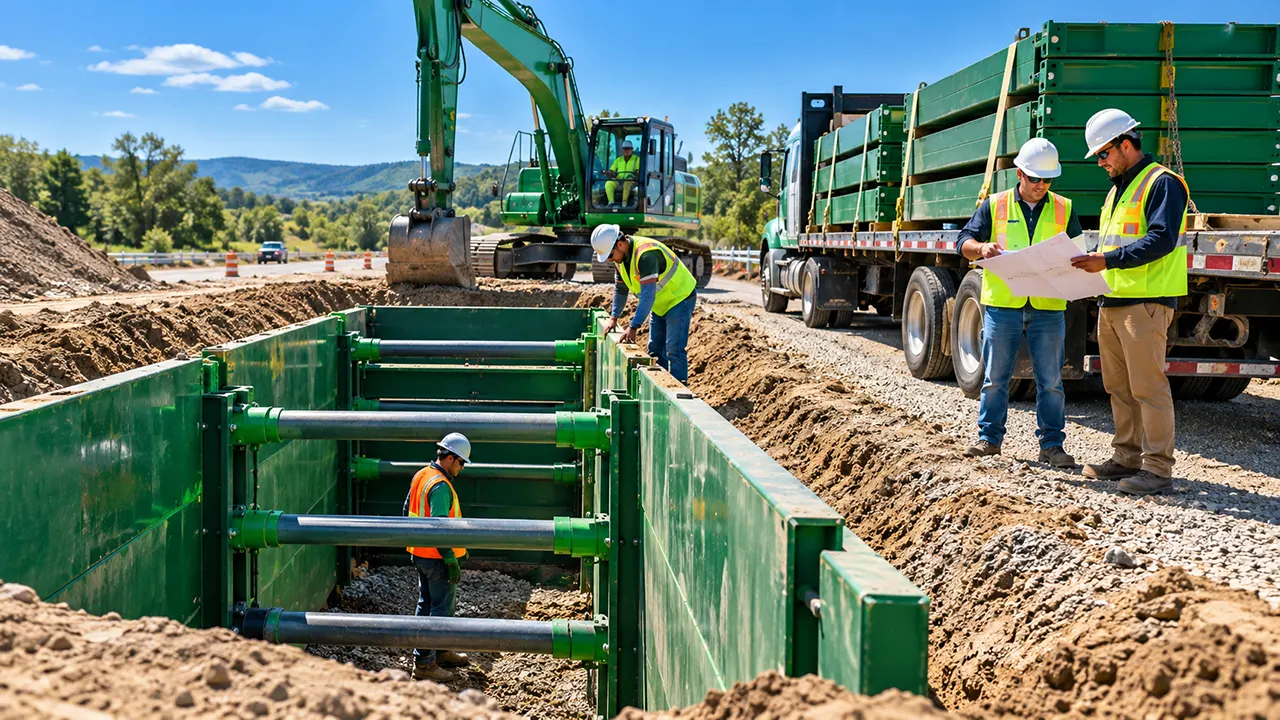
Trench safety equipment rental helps contractors access protective systems for sewer installation, utility work, drainage projects and other excavations without purchasing equipment outright. The right rental starts with accurate site information, suitable manufacturer documentation and a clear understanding of OSHA requirements. This guide explains what to ask rental providers, how to prepare a quote request and which safety decisions require qualified personnel.
Contractors can rent trench boxes, trench shields, hydraulic shoring and other excavation protective equipment from specialist rental providers. Under OSHA’s construction excavation standard, cave-in protection is generally required for excavations 5 feet deep or greater, subject to specified exceptions. The employer must ensure that the protective system meets the applicable requirements and suits the actual site conditions.
According to the National Institute for Occupational Safety and Health (NIOSH), 373 trenching deaths occurred in the United States from 2003 through 2017, with more than 80% occurring in construction. This historical figure highlights why excavation protection deserves careful planning before equipment arrives.
Disclosure: This article contains no affiliate links. ToolGuider provides general educational information, not site-specific engineering advice or a certification of OSHA compliance.
What Trench Safety Equipment Can You Rent?
Trench safety equipment rental covers several types of protective systems and supporting equipment. The options available depend on the rental provider, location, excavation requirements and project schedule.
Start by describing the work rather than requesting a particular product by name. A sewer installation may require pipe clearance and room for connections, while a utility repair in a restricted area may have different access and installation constraints.
Trench boxes and trench shields
A trench box, also called a trench shield, is a protective structure placed inside an excavation to shield workers if surrounding soil collapses. It typically uses two strong side panels connected by spreaders.
Trench boxes are commonly used for sewer lines, water mains, utility installation and similar projects. Rental catalogs may offer steel and aluminum models in different dimensions and configurations.
Before requesting a trench box rental, identify the intended excavation dimensions and work requirements. The rental provider can use this information to discuss available equipment, but the employer’s competent person and other qualified professionals must determine whether the proposed system is suitable.
A trench box does not prevent every cave-in or make the surrounding ground stable. It protects workers within its intended operating limits when properly selected and used.
Hydraulic trench shoring
Hydraulic shoring rental provides access to systems that use hydraulic cylinders and supporting members to brace excavation walls. Depending on the system, components may include vertical shores, rails and other structural supports.
Hydraulic shoring differs from a trench shield because it supports the excavation walls rather than simply providing a protective enclosure. Its suitability depends on the specific system, soil conditions, excavation geometry and applicable design requirements.
Discuss the following with a qualified rental specialist:
- The excavation depth and width.
- The intended shoring configuration.
- Soil classification and groundwater conditions.
- Nearby utilities, structures and traffic loads.
- Manufacturer instructions and applicable design data.
Do not assume that hydraulic shoring is automatically suitable for unstable soil or every excavation depth.
Other excavation safety equipment
Specialist rental catalogs may also include the following equipment.
| Equipment | Potential purpose |
|---|---|
| Slide rail shoring | Provides a configurable shoring system for certain excavation layouts |
| Manhole boxes and braces | Supports protective arrangements for specific manhole and utility work |
| Road plates | Covers designated openings or provides temporary crossing surfaces when properly specified and installed |
| Trench bridges and guardrails | Helps manage crossing and edge-protection hazards |
| Confined-space retrieval equipment | Supports applicable rescue or retrieval arrangements where required |
| Ground protection mats | Helps manage ground conditions and equipment access in suitable applications |
Availability and suitability vary by provider. Additional equipment does not replace the protective system or other precautions required for the excavation.
For example, a road plate placed over an opening is not automatically an adequate cave-in protective system. Confirm its intended use, load rating, support and installation requirements.
Trench Box vs. Shoring vs. Shielding: What Is the Difference?
Trench boxes, shoring and shielding serve related but different functions. OSHA identifies sloping, benching, shoring and shielding as methods used to protect workers from cave-ins, subject to the applicable requirements.
Occupational Safety and Health Administration
| Method | Main function | Key consideration |
|---|---|---|
| Trench box or trench shield | Shields workers inside the protected area | Must be suitable for the excavation and used within its rated limitations |
| Hydraulic shoring | Uses supports to brace excavation walls | System configuration and design data must match the site conditions |
| Other shoring systems | Supports soil or structures using an appropriate arrangement | Requires suitable components and an applicable design |
| Sloping | Cuts back the excavation walls | Needs adequate space and appropriate soil assessment |
| Benching | Forms horizontal levels or steps in excavation walls | Only appropriate where permitted by the applicable soil and excavation requirements |
How trench shielding differs from soil-support systems
Shielding and shoring are not interchangeable terms.
A trench shield is designed to protect workers within its protected space from cave-in effects. A shoring system supports the excavation walls to help prevent movement or collapse. The distinction matters because the equipment’s function, configuration and permitted use affect how it must be selected and installed.
Neither approach removes the need to assess groundwater, adjacent structures, surcharge loads, underground utilities and changing site conditions.
Which option should you discuss with a safety professional?
There is no universal best trench protection system.
A contractor should provide the actual site information and work requirements to the employer’s competent person and, where applicable, a registered professional engineer or other qualified design professional. A rental provider can explain its equipment range and documentation, but equipment availability alone does not establish suitability.
The practical objective is to identify a protective system that meets the applicable OSHA requirements and is appropriate for the planned work.
What Information Should You Give a Trench Rental Provider?
A complete quote request helps the provider identify potentially suitable equipment, check availability and explain delivery requirements. It also reduces delays caused by missing dimensions or unclear site conditions.
Use this checklist before contacting a trench safety rental company.
Excavation dimensions and work requirements
Collect the project information that is available and verified:
- Excavation depth, width and length.
- Required working space and pipe or structure clearance.
- Intended use, such as sewer installation, drainage or utility repair.
- Expected rental start date and project duration.
- Number of work areas requiring protection.
- Any known restrictions on equipment placement or movement.
Do not estimate dimensions simply to obtain a quicker quote. If the excavation layout is still changing, tell the provider which measurements are preliminary.
Soil conditions, groundwater and nearby loads
Soil conditions influence the selection and design of protective systems. OSHA’s excavation guidance identifies soil analysis, nearby structures and loads from equipment or stored materials as important planning considerations.
Share information about:
- Soil classification and how it was established.
- Groundwater, seepage or expected water accumulation.
- Recent rain, drainage issues and potential runoff.
- Nearby buildings, foundations, roadways and retaining walls.
- Traffic, machinery, stockpiles and other loads close to the excavation.
- Underground utilities and obstructions.
These details are not merely administrative. A change in water conditions or an excavator operating near the trench edge can affect the hazards and the protective measures needed.
Site access and equipment handling
The provider also needs to understand how equipment will reach the work area.
Confirm the delivery entrance, available working space, overhead obstructions, ground conditions and restrictions on unloading. Ask about equipment weight, approved lifting points, handling requirements and any transport arrangements the provider expects the customer to make.
Do not assume that a delivery truck can reach the excavation or that the equipment can be moved into position using whatever machinery is already on site.
A practical rental quote template
Use the following message as a starting point when contacting a rental provider.
Subject: Trench Safety Equipment Rental Quote Request
We are planning an excavation project and would like information about suitable trench safety equipment available for rent.
- Project location: [City, State]
- Type of work: [Sewer, utility, drainage or other]
- Excavation dimensions: [Depth, width and length]
- Known soil and groundwater conditions: [Details]
- Nearby utilities, structures or loads: [Details]
- Expected rental dates: [Start date and duration]
- Site access and delivery restrictions: [Details]
Please confirm equipment availability, relevant manufacturer documentation, delivery and pickup arrangements, rental terms, and any additional charges. We will have the proposed protective system reviewed for suitability under the applicable site conditions and safety requirements.
Thank you.
This template organizes the commercial inquiry. It does not replace the employer’s excavation planning, inspection or protective-system design responsibilities.
How Much Does Trench Safety Equipment Rental Cost?
Trench safety rental prices depend on the equipment, configuration, location and rental terms. A single national price would be misleading without comparable quotes for the same equipment and rental period.
The commercial rental pages reviewed for this guide provide equipment information and quote-request options, but they do not establish a consistent, verified national rate for comparable trench safety systems. Request a current quote for the actual project rather than relying on an unsupported average.
Rental duration and additional charges
Ask the provider to itemize the commercial terms before you book.
| Cost factor | What to confirm |
|---|---|
| Rental rate | Daily, weekly or monthly rate and minimum rental period |
| Equipment configuration | Included panels, spreaders, shores and accessories |
| Delivery and pickup | Transportation charges, distance and scheduling |
| Loading and handling | Who supplies lifting equipment and qualified operators |
| Rental extensions | Notice requirements and additional billing |
| Return conditions | Cleaning, damage, missing components and inspection terms |
| Additional services | Any separately priced engineering, technical support or training |
A low initial rate may not represent the lowest total project cost. For a short excavation, transport and minimum rental periods may matter more than the advertised equipment rate. For a longer project, extension terms and changing site requirements deserve closer attention.
How to compare rental quotes fairly
Ask each provider to quote the same equipment requirements, delivery location and rental dates. Make sure the quoted configuration and included services are comparable.
Do not compare prices alone. A quote that omits required components, delivery or documentation may not be equivalent to another provider’s offer.
Most importantly, do not select a cheaper system that has not been established as suitable for the job. Commercial savings must not override protective-system requirements.
How Do OSHA Excavation Protective-System Requirements Apply?
OSHA’s construction excavation rules appear in 29 CFR Part 1926, Subpart P. The central provisions include 29 CFR 1926.651, Specific Excavation Requirements and 29 CFR 1926.652, Requirements for Protective Systems. Employers must apply the relevant provisions to their actual excavation and work conditions.
The 5-foot rule and its exceptions
Under 29 CFR 1926.652(a)(1), each employee in an excavation must be protected from cave-ins by an adequate protective system unless the excavation is made entirely in stable rock or the excavation is less than 5 feet deep and a competent person finds no indication of a potential cave-in.
This is a requirement for appropriate cave-in protection, not a universal requirement to rent a trench box. Sloping, benching, shoring and shielding may be appropriate where the applicable standard permits them and the selected system meets its requirements.
A competent person’s determination for a shallow excavation must be based on actual conditions. Contractors should not treat the depth exception as automatic permission to enter an excavation without protection.
What changes for excavations more than 20 feet deep?
OSHA applies additional design requirements to protective systems for excavations more than 20 feet deep. Under 29 CFR 1926.652(b) and (c), applicable methods include designs prepared or approved by a registered professional engineer and qualifying tabulated-data methods prepared or approved by a registered professional engineer. The precise permitted method depends on the relevant regulatory provisions.
Do not interpret this threshold as meaning that excavations 20 feet deep or less are exempt from design requirements. All protective systems must satisfy the applicable standard, and the selected design method must be appropriate for the system and site.
When a protective system uses manufacturer tabulated data, confirm the applicable depth, soil conditions, configuration and other limitations. A system that is rated for one configuration is not automatically approved for another.
Competent-person responsibilities and inspections
OSHA requires inspections of excavations, adjacent areas and protective systems by a competent person before work and as needed throughout the shift, when employee exposure can reasonably be anticipated. Inspections are also required after rainstorms or other hazard-increasing occurrences. Employees exposed to identified dangerous conditions must be removed from the hazardous area until appropriate precautions are taken.
The competent person must be capable of identifying existing and predictable hazards and authorized to take prompt corrective action. These responsibilities go beyond checking whether a trench box appears undamaged.
Use the official OSHA construction eTool for trenching and excavation to review the relevant hazards and inspection requirements. The employer remains responsible for implementing the required protections.
What Should You Verify Before Accepting Rented Equipment?
Before equipment is put into service, confirm that the delivered items match the intended configuration, the applicable documentation is available and any damage or discrepancy has been addressed.
A rental agreement and a delivery receipt are not proof that a protective system is suitable for the excavation.
Equipment condition and configuration
Check the delivered equipment against the rental documentation and the manufacturer’s instructions. The inspection should be performed by personnel qualified for the task, with the competent person addressing the relevant safety requirements.
Verify:
- Equipment identification and model information.
- Panel, spreader, shore and accessory configuration.
- Visible damage, deformation, cracks or missing components.
- Required pins, connections and locking components.
- Manufacturer markings and rated limitations.
- Any restrictions on lifting, placement, use or removal.
Do not use damaged or questionable equipment until its suitability has been evaluated and the necessary corrective action has been taken. OSHA’s protective-system standard addresses the use and evaluation of damaged materials and equipment.
Manufacturer documentation and design data
Ask for the documentation that applies to the actual equipment and proposed configuration.
Depending on the system, this may include manufacturer instructions, tabulated data, allowable configurations, depth and soil limitations, assembly instructions, lifting instructions and applicable engineering documentation.
Compare the delivered model and configuration with those records. If the proposed use falls outside the stated limits, do not assume that a verbal assurance or a similar-looking product makes the arrangement acceptable. Obtain the required written approval or an appropriate design before use, as applicable under OSHA’s standard.
Delivery, installation, movement and removal
Confirm the planned sequence for receiving and handling the equipment. Ask the provider what lifting equipment, handling procedures and installation instructions apply, and establish who is responsible for each part of the process.
The employer must ensure that installation, use, movement and removal comply with the applicable requirements and system instructions. Rental personnel may provide technical information or services, but their involvement does not automatically transfer the employer’s safety obligations.
Plan removal before the excavation begins. Changes in excavation conditions, nearby structures, groundwater or equipment positioning may require reassessment rather than simply continuing with the original arrangement.
Which Trench Safety Rental Provider Should You Contact?
For US contractors, three useful starting points are Sunbelt Rentals, United Rentals and Cat Rentals. Their public catalogs describe trench safety and shoring equipment, but the best choice for a project depends on local availability, the required configuration, delivery arrangements and applicable technical support.

Sunbelt Rentals
A candidate for contractors comparing trench shielding, shoring and engineered trench safety solutions.
Confirm the local branch’s equipment range, delivery coverage and available technical support.
Visit the trench safety rental catalog

United Rentals
A candidate for comparing trench boxes, aluminum shields, hydraulic shoring and related accessories.
Ask which equipment configurations are available for the project location and dates.
Visit the trench safety and shoring catalog

Cat Rentals
A candidate for contractors seeking trenching and shoring equipment through its rental network.
Verify the available equipment, rental terms and delivery options with the relevant provider.
Visit the trenching and shoring catalog
These are starting points for a quote inquiry, not a ranked list of providers or a recommendation that any specific product is suitable for a particular excavation.
Questions to ask before booking
Before accepting a quote, ask the rental provider:
- Is the requested equipment available for the complete rental period?
- What dimensions, configurations and accessories are included?
- Which manufacturer instructions and applicable design records will be supplied?
- What are the delivery, unloading, pickup and extension charges?
- What lifting, installation, movement and removal instructions apply?
- Who provides any separately contracted technical services or engineering support?
- What should the site team do if the actual excavation conditions differ from the information supplied?
Record the answers in the project documentation. Resolve important gaps before delivery rather than relying on assumptions once work is underway.
Frequently Asked Questions
1. Can a trench box be used in every soil condition?
No. A trench box must be suitable for the excavation conditions and used within its applicable manufacturer specifications and design limitations. Soil classification, groundwater, excavation geometry, adjacent structures and nearby loads can affect the protective-system requirements. The employer’s competent person and other qualified professionals must assess the actual conditions rather than assume that one box works for every trench.
2. Does renting a trench box guarantee OSHA compliance?
No. Renting equipment does not establish compliance by itself. The employer must ensure that the protective system meets applicable OSHA requirements, that it is suitable for the excavation, and that required inspections and other safety measures are performed. The equipment must also be used in accordance with its applicable instructions and design limitations. A rental provider’s product description is not a substitute for the required site assessment.
3. What documents should be available at the jobsite?
Keep the documentation applicable to the selected protective system, including manufacturer instructions and relevant tabulated data or engineering design records. Where the regulatory requirements call for written approval or an engineered design, ensure that the necessary records are available. The precise documents depend on the system and its design method. Confirm the requirements with the competent person and qualified design professional where applicable.
4. What should you do if site conditions change after equipment delivery?
Stop the affected work and keep employees out of any area where a hazard may exist until the competent person evaluates the changed conditions and appropriate precautions are implemented. Changes such as unexpected groundwater, heavy rainfall, new surface loads or movement near adjacent structures can affect excavation safety. Do not assume the original equipment selection remains suitable simply because the equipment was acceptable when delivered.
5. Can a rental provider choose the trench protection system for my project?
A rental provider can explain available products, manufacturer specifications and rental options. However, the employer remains responsible for meeting applicable safety requirements, and site-specific design decisions must be handled by the appropriate qualified personnel. Ask the provider what technical support is available, but do not treat a commercial recommendation as automatic approval of the proposed protective system.
Make Your Trench Safety Rental Inquiry With Confidence
Before requesting a trench safety equipment rental quote, assemble the verified excavation dimensions, site-condition information, expected rental period and delivery requirements. Then compare providers based on the equipment and documentation available for your project, not just the initial price.
Start with Sunbelt Rentals, United Rentals or Cat Rentals to discuss available options. Have the proposed protective system assessed for your actual site conditions before work begins.
For safety-critical decisions, the right next step is not to guess which trench box fits. It is to obtain the relevant technical information, verify the applicable requirements and ensure the system is appropriate for the job.
