


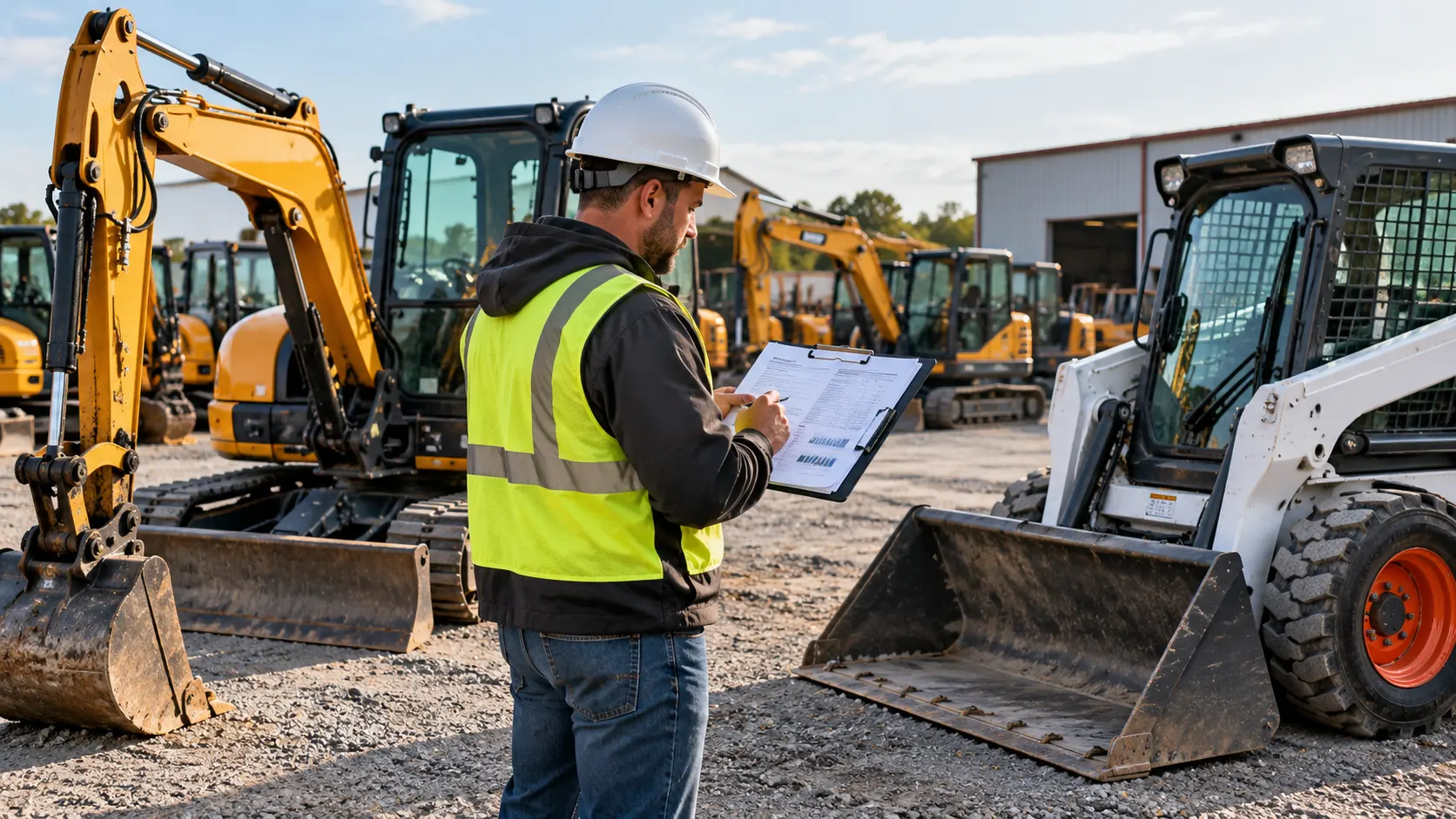
Renting construction equipment is often a better fit for short projects, uncertain demand, and specialized machines. Buying may cost less over time when a contractor uses the same machine regularly and can spread ownership costs across enough productive work. The right choice depends on comparable rental quotes, financing, maintenance, utilization, and resale value.
Contractors face a difficult choice when a new project requires an excavator, skid steer, loader, or other heavy equipment. Renting avoids a large purchase commitment, while buying can provide long-term access to a machine. However, neither the rental rate nor the purchase price tells the whole story.
The best way to compare renting and buying construction equipment is to calculate the total cost over the same period. This guide explains the main expenses, shows how to calculate the construction equipment break-even point, and provides an editable worksheet you can use with your own quotes.
Construction Equipment Rental vs. Ownership: Key Cost Differences
Renting charges you for access to equipment over an agreed period. Ownership requires an investment in the machine and ongoing expenses, even when it sits idle. To make a fair comparison, consider both the cost of obtaining the machine and the cost of keeping it available for work.
| Cost factor | Renting equipment | Owning equipment |
|---|---|---|
| Initial cash requirement | Usually a rental deposit and initial charges, if required | Purchase deposit or full purchase price |
| Financing | Usually no equipment purchase loan | Interest or other capital costs may apply |
| Maintenance and repairs | Depends on the rental agreement and damage terms | Owner generally bears maintenance and repair costs |
| Insurance | Depends on contract requirements and existing coverage | Owner must budget for applicable coverage |
| Storage | Often avoided when equipment is returned | May require secure storage or yard space |
| Transport | Delivery and pickup fees may apply | Transport to each job may still be necessary |
| Equipment availability | Depends on rental fleet and demand | Machine is available when operational, subject to maintenance |
| Resale value | No resale proceeds | Owner may recover part of the purchase cost |
| Flexibility | Easier to change equipment as projects change | Selling or replacing a machine takes time and money |
The exact allocation of maintenance, insurance, damage, and transport costs depends on the agreement and equipment type. Read the rental contract rather than assuming the provider covers every expense.
The key distinction: Rental costs tend to follow the period of access, while ownership costs continue during idle periods. That makes equipment utilization a central part of the decision.
How to Calculate the Total Cost of Renting Construction Equipment
Construction equipment rental cost includes more than the advertised daily rate. A contractor should compare the full quote for the expected rental period, including all charges that apply to the project.
The basic formula is:

Other fees can include delivery, pickup, attachments, damage waivers, fuel, cleaning, and taxes where applicable. Avoid adding charges that the rental provider has already included in its package price.
Compare rental rates for the actual duration
Rental companies may offer daily, weekly, and monthly pricing. The cheapest option depends on how long you need the equipment and the provider’s billing rules.
For example, a published 2026 rate sheet from TerBeest Trucking & Rentals lists a mini excavator at $500 per day, $1,500 per week, and $3,000 per month. The company states that delivery, pickup, and fuel are additional. These are that provider’s published rates, not a national average or a guaranteed quote for your location.
This illustrates why multiplying the daily rate by every working day can overstate the cost of a longer rental. Request quotes for the daily, weekly, and monthly options that match your schedule.
Before comparing prices, confirm:
- The equipment model, capacity, and required attachments.
- The start date, expected return date, and billing rules.
- Delivery and collection charges.
- Fuel, cleaning, damage, and other applicable fees.
- The terms for breakdowns, replacement equipment, and extensions.
For additional rate examples and rental-planning guidance, see ToolGuider’s construction equipment rental guide.
How to Calculate Heavy Equipment Ownership Costs
The purchase price is only the starting point. A machine can lose value, require repairs, consume storage space, and tie up cash that the business could use elsewhere. A sound comparison accounts for these expenses over a defined ownership period.
For a simplified economic comparison, use:

Where:
- P = purchase price.
- S = expected resale proceeds at the end of the ownership period.
- N = ownership period in years.
- K = annual financing interest or appropriately calculated capital cost.
- M = annual maintenance and repair costs.
- A = annual insurance and storage costs.
- T = annual transport costs.
- O = other annual ownership costs.
The formula estimates an annual economic cost, assuming the recurring expenses are expressed per year and the purchase price and resale proceeds cover the same ownership period.
Purchase price, financing, and cost of capital
If you finance a machine, interest is a real cost of borrowing. If you pay cash, the money still has an opportunity cost because it cannot be used for other business needs.
Caterpillar distinguishes equipment loans, finance leases, operating leases, and rentals because they have different payment structures and ownership outcomes. Compare the actual terms offered to your business rather than assuming every financing arrangement has the same cost.
For an economic model that already accounts for purchase price minus resale value, do not add loan principal repayments as another expense. Principal repayments are cash outflows, but counting them on top of the full capital cost would distort the comparison.
Depreciation and expected resale value
Depreciation reduces the machine’s value over time. For this simplified economic model, the difference between purchase price and expected resale proceeds represents the total value lost during the ownership period.
For example, a machine bought for $60,000 and sold for an assumed $36,000 after five years has an estimated value loss of $24,000, or $4,800 per year when spread evenly across five years.
That calculation is a planning assumption, not a prediction of actual resale value. Machine hours, maintenance history, model demand, and market conditions can all affect the final sale price.
Do not add a separate depreciation expense to the purchase-price-minus-resale calculation. That would count the same value loss twice.
Maintenance, repairs, insurance, storage, and transport
Use service records, insurance quotes, and actual operating plans wherever possible. If you are evaluating a machine you do not yet own, request maintenance estimates from a dealer or qualified service provider.
Include expenses that the owner must bear, such as routine servicing, unexpected repairs, insurance, secure storage, and transport between jobs. If a machine requires expensive attachments, include their acquisition and resale values consistently as well.
Tax depreciation is different from the economic value-loss estimate used here. For US federal income tax purposes, the IRS says the agreement must first be characterized as a lease or conditional sales contract to determine the applicable treatment. Consult a qualified tax professional for your circumstances.
Construction Equipment Break-Even Point: The Formula
The construction equipment break-even point is the amount of equipment use at which renting and owning cost the same over the comparison period. Below that point, renting may cost less; above it, ownership may become more economical, provided the model includes all relevant costs and both options meet the project’s needs.
For a simplified annual comparison:

This formula assumes a comparable daily rental cost and an annual ownership cost. It does not replace a detailed cash-flow model when rental packages, financing schedules, or costs vary substantially.
Worked example: A hypothetical mini excavator
The following figures are illustrative assumptions for October 2026. They are not a verified purchase quote, financing offer, or universal rental rate.
| Input | Illustrative assumption |
|---|---|
| Purchase price | $60,000 |
| Expected resale value after five years | $36,000 |
| Ownership period | 5 years |
| Annual capital cost | $2,880 |
| Annual maintenance and repairs | $3,000 |
| Annual insurance and storage | $2,000 |
| Annual transport | $1,000 |
| Comparable rental cost | $300 per working day |
The annual capital cost of $2,880 assumes a 6% annual cost applied to the average of the assumed purchase and resale values:

This is an illustrative opportunity-cost convention, not a lender’s quoted interest rate.
First, calculate annual value loss:

Then calculate the annual ownership cost:

Finally, calculate the break-even rental days:

Under these assumptions, annual ownership cost equals about 46 equivalent rental working days. If the machine is needed for substantially fewer days, renting may be cheaper. If it is needed for more days, ownership may have the lower modeled cost.
However, this result is only a screening estimate. The $300 rental cost is a simplified comparable-day assumption, not a verified quote for this exact machine. Actual weekly or monthly packages, delivery fees, downtime, and other expenses may change the result.
What if the machine never reaches break-even?
Buying can still be justified for operational reasons, such as guaranteed access to a specialized machine or the need to respond quickly to urgent jobs. But those benefits should be weighed against the additional cost and the cash tied up in equipment.
If the machine remains idle for most of the year, revisit the purchase decision before committing capital. A rental quote for the expected workload may be a better benchmark than a generic industry utilization rule.
How Equipment Utilization Rate Changes the Decision
Equipment utilization rate measures how much a machine is used relative to a defined period or available capacity. For a rent-versus-buy comparison, productive working days or operating hours are usually more useful than simply counting calendar days.
For example, a machine available for 200 scheduled working days but used productively on only 60 days has a productive-day utilization rate of 30%, using those 200 days as the denominator.
Estimate realistic use
Review the project pipeline, historical equipment logs, and seasonal workload. Estimate the actual days or hours the machine will perform useful work, rather than assuming it will be busy whenever it is available.
A high utilization rate can spread fixed ownership costs across more work. Low utilization can leave the business paying for equipment that generates little value. Rental can help when demand is uncertain, provided the machine remains available when needed.
Test low, medium, and high utilization scenarios
Use the same ownership assumptions and comparable rental pricing across each scenario. The table below applies the hypothetical annual ownership cost of $13,680 and the simplified $300 rental cost per working day.
| Productive rental-equivalent days per year | Modeled rental cost | Modeled ownership cost | Lower modeled cost |
|---|---|---|---|
| 30 | $9,000 | $13,680 | Renting |
| 45 | $13,500 | $13,680 | Renting |
| 60 | $18,000 | $13,680 | Owning |
| 100 | $30,000 | $13,680 | Owning |
These scenarios exclude additional rental fees and assume that the annual ownership cost stays constant. They illustrate the calculation, not a forecast of what a specific contractor will spend.
Test changes in the assumptions
A useful comparison should include at least one less favorable scenario. Ask what happens if resale value falls, repairs rise, work is delayed, or rental pricing changes.
- Lower resale value: increases the economic cost of ownership.
- Higher maintenance costs: reduces the financial advantage of buying.
- Higher rental rates: can make ownership economical at a lower number of working days.
- Lower utilization: makes fixed ownership expenses harder to justify.
- Unexpected downtime: can increase repair costs or force the business to rent a replacement.
A decision based on one optimistic forecast is less reliable than one that remains reasonable when the assumptions change.
When Renting or Buying Construction Equipment Makes More Sense
The better option depends on the machine’s role in your business, not just its price. Consider how predictable the workload is, whether the equipment is essential to daily operations, and what happens when it is unavailable.
When renting is the stronger financial choice
Renting is often worth considering when:
- You need a machine for one project or a short period.
- Demand changes with the season or project schedule.
- You need specialized equipment for occasional work.
- Buying would put too much pressure on working capital.
- You want to evaluate a machine before making a purchase commitment.
Renting can also help contractors respond to temporary increases in workload without buying equipment that may sit idle after the project ends.
When buying may be the better choice
Ownership deserves closer consideration when:
- The machine has a predictable workload across multiple projects.
- Comparable rental costs exceed realistic ownership costs.
- Equipment availability is important to meeting deadlines.
- The business has the cash flow and operational capacity to maintain the machine.
- Expected resale value and ownership costs are supported by reasonable estimates.
Buying is not automatically cheaper just because the machine is used frequently. Expensive repairs, poor resale value, high financing costs, or prolonged downtime can change the outcome.
Why a hybrid fleet can work well
Many contractors do not need to choose one strategy for every machine. They can own the equipment that supports regular, predictable work and rent additional or specialized machines when project demand increases.
For example, a contractor might own a frequently used skid steer but rent a larger excavator for a particular earthmoving project. This approach allows the contractor to retain core equipment while avoiding unnecessary investment in machines that are rarely needed.
The key is to evaluate each machine separately. A profitable ownership decision for one piece of equipment does not automatically justify purchasing the rest of the fleet.
Editable Rent vs. Buy Construction Equipment Cost Worksheet
Use the following worksheet to organize your own figures. You can copy the tables into a spreadsheet and replace the example assumptions with actual quotes, finance terms, maintenance estimates, and resale estimates.
Rental-cost inputs
| Input | Your value | Unit or guidance |
|---|---|---|
| Equipment model and capacity | ______ | Match the machine to the purchase option |
| Daily rental rate | $______ | Per billable day |
| Weekly rental rate | $______ | Per rental week |
| Monthly rental rate | $______ | Per rental month |
| Expected rental duration | ______ | Days, weeks, or months |
| Delivery and pickup | $______ | Total for the comparison period |
| Attachments and additional fees | $______ | Include only applicable charges |
| Other rental costs | $______ | Fuel, cleaning, or other applicable expenses |
| Total rental cost | $______ | Calculate for the entire period |
Ownership-cost inputs
| Input | Your value | Unit or guidance |
|---|---|---|
| Purchase price | $______ | Include required attachments |
| Expected resale value | $______ | At the end of the ownership period |
| Ownership period | ______ | Years |
| Annual capital or financing cost | $______ | Avoid counting principal twice |
| Annual maintenance and repairs | $______ | Use service estimates or records |
| Annual insurance and storage | $______ | Combined or itemized |
| Annual transport | $______ | Include relevant movements |
| Other annual ownership costs | $______ | Add applicable costs |
| Annual ownership cost | $______ | Use the same cost convention throughout |
Calculate the break-even result
For a simple annual comparison, first calculate:

Then calculate:

Finally, compare the result with your expected productive days per year.
If your actual rental agreement uses discounted weekly or monthly packages, calculate the cost of those packages directly rather than treating every day as a separate daily rental. For multi-year decisions, compare cumulative costs and cash flows over the same ownership and rental period.
Important limitation: This worksheet is a simplified decision aid, not accounting or tax advice. It assumes consistent periods and cost definitions. A detailed model may need to account for taxes, working-capital effects, financing cash flows, changing maintenance costs, and the time value of money.
A Practical Checklist Before You Decide
Before signing a rental agreement or financing a purchase, work through this checklist.
Pre-decision checklist
- Confirm the machine model, capacity, and attachments.
- Obtain comparable rental quotes for the expected project duration.
- Estimate productive days or hours using your actual workload.
- Get a purchase price and financing estimate.
- Budget for maintenance, repairs, insurance, storage, and transport.
- Estimate resale value at the end of the comparison period.
- Calculate break-even using consistent cost assumptions.
- Test a lower-utilization or higher-cost scenario.
- Check availability, downtime arrangements, and contract terms.
Frequently Asked Questions
1. Is it cheaper to rent or buy a mini excavator?
It depends on the number of productive days, the rental package, purchase price, financing, maintenance, and resale value. Compare a complete rental quote with the estimated cost of owning the same class of machine over an equivalent period. Include delivery and attachments where applicable, and test the result against realistic project schedules before making a commitment.
2. How many days per year should you use equipment before buying?
There is no universal number of days that applies to every machine or contractor. Calculate annual ownership cost and divide it by the comparable rental cost per working day to estimate a simple break-even point. Use actual quotes and realistic ownership assumptions because discounted monthly rentals, financing costs, and resale value can materially change the threshold.
3. Should you buy used construction equipment instead of renting?
Buying used equipment may reduce the initial purchase price, but the decision also depends on condition, maintenance history, expected repairs, resale value, and financing availability. Compare the cost of a suitable used machine against the rental cost for the work you expect to complete. An independent inspection and a realistic repair budget can help you avoid underestimating ownership costs.
4. How does equipment financing affect the break-even point?
Financing can increase ownership costs through interest and fees, while the loan structure affects cash flow and the timing of payments. Compare financing offers using their actual terms, and distinguish economic cost from cash flow. Do not add loan principal repayments to a model that already counts the purchase cost less resale value, because doing so can double-count the capital expenditure.
5. Can you rent equipment long-term instead of buying it?
Yes. Long-term rental can suit projects with predictable durations when preserving capital, flexibility, or access to replacement equipment matters. However, monthly rental rates and contract terms vary, so compare the total cost over the planned period with the economic cost of ownership. Check renewal terms, availability, maintenance responsibilities, and fees before choosing a long-term arrangement.
Make Your Decision With Comparable Numbers
The most defensible rent-versus-buy decision comes from your workload, actual quotes, and a realistic view of the machine’s value over time. Use the worksheet to identify the break-even point, then check whether the result still holds when your schedule or costs change.
Before committing, compare construction equipment rental options and obtain a purchase and financing estimate for the same equipment class. The goal is not simply to find the lowest advertised price. It is to choose the option that supports your projects without creating unnecessary costs or tying up capital you need elsewhere.
