


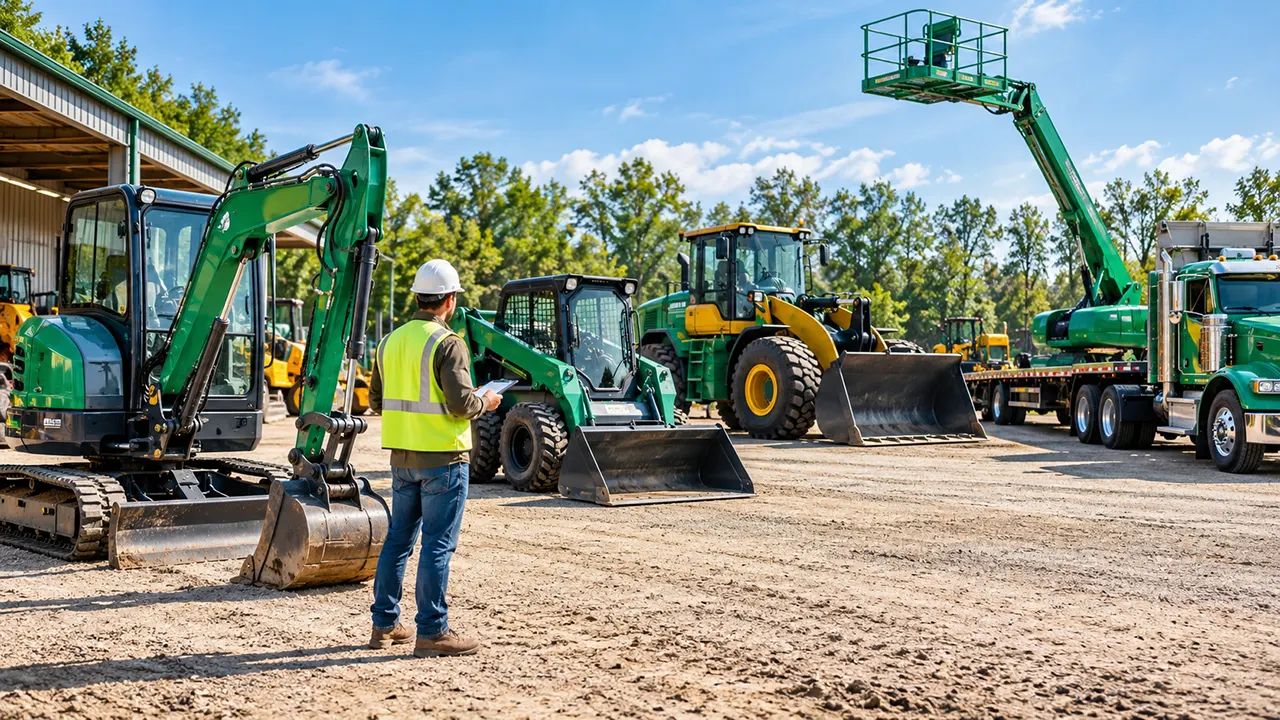
Construction equipment rental can help you complete a project without buying expensive machinery. But the advertised rental rate is only part of the cost. Delivery, attachments, fuel, insurance or damage waivers, operating-hour limits, and return conditions can all affect your final bill.
This guide explains how to choose the right equipment, compare rental companies, estimate your total cost, and decide when renting makes more sense than buying. It also includes a practical cost worksheet you can use before requesting a quote.
Affiliate disclosure: This draft does not yet contain verified affiliate links. If qualifying affiliate links are added before publication, clearly disclose the relationship and explain that ToolGuider may earn a commission without increasing the reader’s cost.
What Construction Equipment Rental Means for Contractors
Construction equipment rental allows a contractor to use machinery for an agreed period without purchasing it outright. Rental companies may offer equipment by the hour, day, week, or month, depending on the machine and the provider’s terms.
For a small contractor, renting can make a specialized machine available for a single project without the long-term costs of ownership. Larger construction businesses may also rent equipment to cover peak workloads, replace a machine temporarily, or access attachments they do not use often.
The American Rental Association projected combined US construction and industrial equipment and general tool rental revenue of $83.5 billion for 2026, with 3.4% growth forecast in its August 2026 update. This figure covers multiple rental categories, not construction machinery alone.
How construction equipment rental works
The process usually follows these steps:
- Define the work, site conditions, and required machine capacity.
- Request quotes from suitable rental companies.
- Compare the rental period, included hours, attachments, transport, and protection terms.
- Reserve the equipment and arrange delivery or collection.
- Inspect the machine and document its condition when it arrives.
- Use the equipment within the agreed operating limits.
- Arrange the return or collection, following the provider’s off-rent procedure.
Practical tip: Confirm exactly when rental charges begin and end. A machine that has stopped working on your site may still generate charges until the provider’s required return or off-rent process is complete.
When renting makes sense for a project
Renting often suits contractors who need a machine for a short project, have uncertain future demand, or require equipment outside their usual fleet. It can also help businesses avoid committing capital to a machine that may sit unused between jobs.
However, renting is not automatically cheaper. Frequent rentals, long projects, transport costs, and limited local availability can change the calculation. Compare the complete cost of each option before deciding.
Types of Construction Equipment You Can Rent
The best machine depends on the task, ground conditions, working space, required capacity, and site access. Choosing by equipment name alone can lead to a machine that is too small for the job or unnecessarily expensive.
Excavation and earthmoving equipment


Common rental options include:
- Mini and compact excavators: Useful for landscaping, utility trenches, drainage work, and restricted residential sites.
- Standard and large excavators: Used for deeper excavation, bulk earthmoving, demolition support, and larger civil projects.
- Backhoe loaders: Combine a front loader with a rear digging arm for jobs requiring both capabilities.
- Skid steers and compact track loaders: Handle material movement, grading, site cleanup, and attachment-based tasks.
- Wheel loaders: Move aggregate, soil, and other bulk materials.
- Bulldozers and motor graders: Support heavy earthmoving, rough grading, and road construction.
Before booking an excavator, check its operating weight, digging depth, reach, bucket capacity, and transport requirements. For a skid steer, consider rated operating capacity, tire or track configuration, and attachment compatibility.
Lifting, access, and material-handling equipment


Typical options include scissor lifts, boom lifts, telehandlers, forklifts, and cranes. Each serves a different purpose.
- Scissor lifts provide a raised work platform for suitable vertical access.
- Boom lifts reach elevated work areas that may be difficult to approach directly.
- Telehandlers lift and place materials using a telescopic boom.
- Forklifts move palletized loads within their rated operating limits.
- Cranes lift suspended loads according to their configuration and capacity.
Check the required working height, platform or load capacity, ground conditions, setup area, and overhead hazards. Crane selection requires additional attention to load charts, lifting configuration, and site-specific planning.
Compaction, concrete, and paving equipment
Contractors may rent plate compactors, trench rollers, smooth-drum rollers, concrete mixers, concrete saws, asphalt rollers, and related machinery.
Choose compaction equipment based on the soil or material, required compaction depth, access, and project specifications. Concrete and paving equipment should match the material, work area, and production requirements.
Demolition and jobsite support equipment
Demolition and site preparation may require hydraulic breakers, concrete crushers, material handlers, or suitable loaders. Supporting equipment can include portable generators, light towers, water pumps, temporary fencing, and dewatering systems.
Confirm that any attachment is compatible with the host machine. Hydraulic flow, pressure, mounting systems, and machine capacity can determine whether an attachment is suitable.
How to match equipment capacity to the job
Before choosing a machine, answer five questions:
- What task must it complete?
- What capacity, reach, depth, or working height is required?
- How much space is available around the work area?
- Can the machine be delivered, unloaded, and transported safely?
- Which attachments and operating requirements apply?
A compact machine can be the better choice on a restricted site, but only if it meets the work requirements. A lower rental rate does not compensate for equipment that cannot complete the job safely or efficiently.
How Construction Equipment Rental Costs and Rates Work
Construction equipment rental costs vary by machine class, size, location, rental period, availability, and contract terms. The daily rate is a useful starting point, but the most meaningful comparison is the total cost for the period you actually need the equipment.
Daily, weekly, and monthly rental rates
Rental companies may offer several billing periods. Weekly or monthly packages can reduce the effective cost per working day, but the best option depends on the actual schedule and the provider’s billing rules.
The following published 2026 examples illustrate how rates vary. They are reference points, not guaranteed quotes or national averages.
| Equipment | Published rental reference | Important qualification |
|---|---|---|
| Mini excavator | $150-$400 per day | Range reported in a March 2026 pricing guide; machine size and market matter. |
| Excavators across different classes | $719 per day, $2,021 per week, and $5,108 per month | Updated March 2026 figures reported by DOZR from rental quotes across the US and Canada. |
| Small-frame skid steer | $175-$290 per day | Published-rate observations recorded August 20, 2026. |
| Compact track loader | $250-$450 per day | Published-rate observations recorded August 20, 2026. |
Sources: DOZR’s excavator rental cost guide and Mini Skid Steer Rental’s rate reference.
These figures use different equipment definitions and data methods. Do not compare them as though they represent identical machines, rental periods, or locations.
What changes the rental price
The most important price drivers include:
- Machine class and capacity: Larger or more specialized equipment may have higher rates.
- Rental duration: Daily, weekly, and monthly pricing structures differ.
- Location and availability: Local inventory, transport distance, and demand can affect the quote.
- Attachments: Specialized buckets, breakers, forks, and other accessories may cost extra.
- Operating hours: Some agreements specify included hours and additional charges for excess use.
- Delivery and collection: Heavy machinery may require dedicated transport.
- Protection and liability: Insurance requirements, damage waivers, and rental protection plans have different costs and conditions.
- Return condition: Fuel, cleaning, damage, and late-return charges may apply under the agreement.
A one-day rental can be disproportionately expensive when delivery and pickup are charged separately. For a short job, compare the complete delivered cost with the cost of collecting the equipment yourself, if that option is permitted and practical.
Equipment rental cost examples for 2026
Consider a contractor who needs a compact track loader for a short landscaping project. The published rate observations above show a daily machine-only range of $250-$450. Four rental days at that rate would produce a base rental of $1,000-$1,800 before delivery, pickup, attachments, protection, taxes, and other applicable charges.
This is an illustrative calculation, not a supplier quote. The actual bill may be higher or lower depending on the machine, rental package, and agreement.
Calculate the total rental bill with a cost worksheet
Use this worksheet when requesting quotes. Enter the amounts supplied by each rental company rather than assuming every fee applies.
| Cost component | Amount |
|---|---|
| Base rental for the selected period | $_____ |
| Delivery | $_____ |
| Pickup or collection | $_____ |
| Attachments | $_____ |
| Fuel or charging | $_____ |
| Insurance or damage waiver | $_____ |
| Overtime or excess operating hours | $_____ |
| Cleaning or decontamination | $_____ |
| Late-return or extension charges, if applicable | $_____ |
| Taxes and other disclosed fees | $_____ |
| Estimated total | $_____ |
Calculate the estimated total by adding the applicable charges to the base rental. Do not include a fee twice if it is already included in the quoted package.
The worksheet is a planning tool, not a guarantee of the final invoice. Confirm which fees apply, which are optional, and which depend on the equipment’s condition or usage.
How to compare quotes on an equal basis
Ask each provider to quote the same machine class, rental dates, attachments, delivery address, included operating hours, and protection requirements.
Compare the total for the same expected work period. A lower daily rate may not represent the better offer if the supplier charges more for delivery, includes fewer operating hours, or uses a different billing rule.
Also ask what happens if the project runs late or the equipment becomes unavailable. Understanding these conditions before booking can help prevent an avoidable scheduling problem.
Heavy Equipment vs. Specialty Construction Equipment Rental
Heavy equipment rental generally covers machinery used for excavation, earthmoving, lifting, material handling, and other major construction tasks. Specialty construction equipment rental focuses on particular jobsite needs, such as temporary power, trench safety, scaffolding, pumping, or climate control.
The distinction matters because specialty equipment may require different planning, accessories, setup, or technical support.
When general heavy equipment rental is appropriate
Consider conventional heavy equipment rental when the project requires machinery such as excavators, bulldozers, loaders, rollers, or telehandlers. A general rental provider may be able to supply several equipment categories through one branch or account.
For example, a site preparation contractor may need a compact excavator and a skid steer for the same project. Requesting both through one provider could simplify scheduling and delivery, although it is still worth comparing the combined quote with other options.
Specialty equipment for power, trenching, scaffolding, and dewatering


Specialty rental categories include:
- Temporary power generators, load banks, and electrical distribution equipment.
- Trench boxes, shoring systems, and related excavation safety equipment.
- Scaffolding, temporary structures, and access systems.
- Water pumps and dewatering equipment.
- Temporary HVAC and climate-control equipment.
- Temporary fencing and site infrastructure.
Specialty equipment deserves careful consideration when the job has a specific technical requirement or a safety-critical constraint. Confirm the equipment’s intended use, capacity, setup requirements, and any applicable standards with the provider and your qualified site personnel.
Sunbelt Rentals reported 15.1% year-over-year rental revenue growth in its North American Specialty segment for the fiscal fourth quarter ended April 30, 2026. The company attributed demand in part to power and HVAC, load banks, temporary fencing, structures and walls, trench safety, and scaffolding. This is evidence of growth at one major provider, not a guarantee of demand or availability in every category or market.
How to choose a specialty rental provider
Ask whether the provider can supply the exact system your project requires, including compatible accessories. Clarify delivery, setup responsibilities, inspection requirements, maintenance support, and emergency response arrangements.
For trench safety, for example, do not select a protective system solely by its rental price. Soil conditions, excavation depth, nearby structures, and other site factors affect the appropriate protective method. Follow applicable OSHA requirements and obtain competent-person guidance where required.
How to Choose a Construction Equipment Rental Company
The right construction equipment rental company should offer suitable equipment, a clear quote, reliable logistics, and support that matches your project requirements. National rental chains and independent local providers can both be good choices.
National rental chains vs. independent local providers
| Factor | National rental chain | Independent local provider |
|---|---|---|
| Equipment selection | May offer a broad fleet across multiple locations | Depends on local fleet size and specialization |
| Geographic reach | May support multi-site or regional projects | Often focused on a particular service area |
| Specialty equipment | May have dedicated specialty divisions | May offer strong expertise in selected categories |
| Logistics | May coordinate larger or multi-location requirements | May offer convenient local transport |
| Pricing | Quote and contract terms vary | Quote and contract terms vary |
| Best fit | Projects requiring broader coverage or multiple equipment types | Projects that suit local inventory and service coverage |
These are general considerations, not universal advantages. Verify the actual equipment, service, and terms of each provider.
Check equipment availability, condition, and maintenance
Before reserving a machine, confirm the exact model or suitable equivalent, availability for your dates, operating condition, and required attachments. Ask how the provider handles breakdowns and whether a replacement machine is available if a major failure disrupts the project.
Also check that the machine can reach the work area and operate within its capacity limits. A machine listed as available may not be suitable for your site’s access, ground conditions, or load requirements.
Compare delivery coverage, support, and quote transparency
Ask for a written quote that identifies the rental period, equipment, attachments, delivery and collection charges, protection costs, included operating hours, and applicable additional fees.
Clarify the provider’s business hours, breakdown reporting process, after-hours contact options, and return procedure. These details are particularly important when a machine is critical to keeping several workers or subcontractors productive.
Find construction equipment rental near you
For a local search, start with your project address rather than your home or office address. Delivery distance and site access can influence the quote.
You can compare local branches through the United Rentals location finder. Other options include Sunbelt Rentals and Herc Rentals. These are potential providers to investigate, not endorsements or confirmation of local inventory.
When contacting a branch, provide:
- Jobsite ZIP code and access details.
- Required equipment type and capacity.
- Rental start date and expected end date.
- Attachments and accessories.
- Delivery, unloading, and pickup requirements.
- Any operator, safety, or site-specific constraints.
Request a quote for the same specification from multiple suitable providers. This gives you a more meaningful comparison than choosing whichever company advertises the lowest starting rate.
What to Check Before Signing a Rental Agreement
A construction equipment rental agreement defines the rental period, payment obligations, equipment responsibilities, and conditions for returning the machine. Read the actual agreement before signing, because terms vary by provider and equipment type.
Rental period, minimum charges, and operating-hour limits
Check when billing begins, how the provider defines a day or week, and whether weekends or holidays affect the rental period. Some agreements specify included operating hours or charge for usage above a defined allowance.
Confirm the process for extending the rental or ending it early. Do not assume that parking the machine or telling a delivery driver you have finished automatically ends billing.
For example, United Rentals publishes contractual terms covering rental-period calculations, delivery and collection fees, and charges that may continue until the required return or collection procedure is completed. These terms illustrate why you should read the agreement rather than assume all providers use the same rules.
Insurance, damage waivers, and rental protection plans
A damage waiver or rental protection plan is not necessarily the same as an insurance policy. Coverage, exclusions, deductibles, and customer responsibilities depend on the specific arrangement.
Before accepting a protection option, ask:
- What damage or loss does it cover?
- What exclusions or deductibles apply?
- Does it cover theft, misuse, or damage during transport?
- Is separate insurance required?
- What documentation is required after an incident?
- Does the protection apply to attachments as well as the main machine?
Check your existing commercial insurance with your broker before paying for overlapping protection. Do not assume that a damage waiver removes all liability.
Damage responsibility, exclusions, and liability
Clarify who is responsible for damage, theft, improper use, unauthorized operators, and incidents involving attachments. Check whether the contract requires particular security measures, operator qualifications, or maintenance procedures.
Document existing damage before operating the equipment. Photographs, written notes, and a delivery inspection record can help establish the machine’s condition when you received it.
Extensions, off-rent confirmation, and return conditions
Ask how to request an extension and whether the provider must approve it. Confirm how to notify the company when you are finished, who arranges pickup, and when billing stops.
Return the equipment in the condition required by the agreement. Follow instructions for cleaning, refueling, securing attachments, and making the machine accessible for collection. Keep written confirmation of the return or off-rent request.
Equipment Delivery, Pickup, Fuel, and Additional Fees
Transport and operating charges can materially change the total cost of a rental. The best arrangement depends on the machine’s size, your site’s access, and the provider’s delivery options.
Delivery, collection, and heavy equipment transport
Ask whether the quote includes delivery and pickup or lists them as separate charges. Large machines may require specialized trailers, loading equipment, and route planning.
Before delivery, confirm that the site has enough room for unloading, turning, and positioning the machine. Identify restrictions such as narrow entrances, overhead obstacles, soft ground, and limited working space.
Never assume you can transport rented machinery yourself. Check the provider’s requirements, the towing vehicle’s capacity, trailer ratings, load securement obligations, and applicable transport rules before arranging collection.
Fuel, cleaning, attachments, and excess operating hours
Review the contract for fuel-return requirements, cleaning standards, attachment charges, and excess-hour fees. Some equipment may also require special handling or decontamination after particular uses.
Ask whether routine maintenance is included and what to do if the machine needs service. Do not perform repairs or modifications without the provider’s authorization.
Site access, unloading, and return preparation
Prepare the work area before the scheduled arrival. Ensure the delivery driver has clear directions and that the receiving area is ready for the machine.
At the end of the rental, follow the agreed return procedure. Take condition photographs, record any problems, remove your materials, and confirm that attachments are accounted for. A clear handoff can help avoid disputes over damage or incomplete returns.
When to Rent vs. Buy Construction Equipment
Renting is often the better fit when equipment demand is occasional, project requirements change, or a machine is needed for a short period. Buying may make more sense when utilization is high and predictable, ownership costs are manageable, and the business can support maintenance, storage, and repairs.
The decision should be based on expected use over time, not just the rental price for one job.
When renting is the better fit
Consider renting when:
- You need a machine for a single project or a short seasonal period.
- Your projects require different equipment types or attachments.
- You want to avoid committing capital to a machine with uncertain future demand.
- You lack suitable storage or the capacity to maintain another machine.
- You need temporary replacement equipment during a breakdown.
Renting may be less attractive when equipment is continuously required, delivery costs recur frequently, or the local rental fleet cannot meet your schedule.
When buying may offer better long-term value
Ownership deserves consideration when your business uses the same equipment regularly and can justify its purchase and operating costs.
However, the purchase price is only one part of ownership. Include financing, depreciation, insurance, maintenance, repairs, storage, transport, and the value of capital tied up in the machine. Also consider its expected resale value and the risk of downtime.
Compare total ownership cost with rental cost
Use this framework to evaluate a specific machine.
| Cost or factor | Rent | Buy |
|---|---|---|
| Initial capital | Usually lower upfront commitment | Purchase or financing commitment |
| Project-based usage | Can suit occasional demand | May leave the machine idle |
| Maintenance | Contract-dependent responsibilities | Owner generally manages ongoing maintenance |
| Availability | Depends on local fleet and booking | More control when the machine is ready |
| Storage | Usually not required between rentals | Must be arranged |
| Resale value | Not applicable to the renter | May offset some ownership costs |
| Long-term utilization | Repeated rental costs can accumulate | Costs can be spread across more working hours |
For a basic comparison, calculate:
Rental cost per working hour = Total rental cost /Actual productive hours
For ownership, calculate the estimated cost over the same period, including operating expenses and the net cost of acquisition after expected resale value. Divide that figure by the expected productive hours, then account for downtime and financing where appropriate.
A useful decision rule: If the machine will be used repeatedly across predictable projects, request both a long-term rental quote and an ownership-cost estimate. Compare them over the same time horizon and operating assumptions.
Construction Equipment Rental Safety Checklist
Safe equipment rental starts before the machine arrives. Select equipment appropriate for the work, confirm operator readiness, and follow applicable federal, state, and local requirements.
Inspect the machine at delivery
Use the provider’s inspection process and document the condition before operation. Check for visible leaks, damaged hoses, loose or missing components, tire or track problems, damaged guards, and obvious structural defects.
Confirm that safety devices, controls, alarms, and required documentation are present and appear serviceable. Report concerns to the rental provider before using the machine. Do not operate equipment that appears unsafe.
Confirm operator competence and equipment-specific training
Ensure the operator is competent and meets applicable training, qualification, and authorization requirements for the equipment and task. A general construction background does not automatically establish competence to operate every machine.
Review the operating manual and site procedures. Make sure workers understand the machine’s limits, blind spots, safe operating distances, and communication methods.
Check site hazards, attachments, and operating limits
Assess the work area for underground utilities, overhead power lines, unstable ground, nearby structures, pedestrian routes, and vehicle traffic. Confirm that the equipment and attachments suit the ground conditions and task.
For excavation work, protective measures depend on site conditions and the applicable requirements. OSHA’s trenching guidance addresses hazards such as cave-ins, hazardous atmospheres, falling materials, and safe access and egress. 【turn565917search7】
Apply relevant OSHA requirements
Review the applicable requirements in the OSHA Construction Industry resources and the relevant equipment-specific standards.
For trenching and excavation, consult OSHA’s Trenching and Excavation eTool. OSHA explains that excavation hazards require appropriate protective measures and inspections by a competent person when required. The correct method depends on the actual conditions and applicable rules.
A rental company supplying the machine does not remove the contractor’s responsibility to manage jobsite hazards and meet applicable safety obligations.
Construction Equipment Rental FAQs
1. Can small contractors rent heavy construction equipment?
Yes. Small contractors can rent equipment from providers that serve their location and business needs. Availability, credit requirements, deposits, insurance requirements, and delivery options vary by company. Before booking, explain the job, machine requirements, rental dates, and transport needs so the provider can determine whether it can supply suitable equipment.
2. Can you rent construction equipment for only a few hours?
Some providers offer hourly or short-duration rentals for selected equipment, while others require a minimum rental period. Availability depends on the machine, branch, and agreement. Ask for the total cost of the short rental, including transport and minimum charges, rather than assuming the price will be a simple fraction of the daily rate.
3. Can a rental company provide an operator?
Some rental providers can help arrange equipment with an operator, but this service is not available for every machine or location. Ask whether the quote includes the operator, travel time, minimum working hours, and other labor charges. You should also confirm the operator’s qualifications and responsibilities before scheduling the work.
4. How far ahead should equipment be reserved?
There is no universal booking lead time. Common equipment may be available at short notice in some locations, while specialized machinery or equipment needed during a busy construction period may require advance planning. Contact providers as soon as your schedule is reasonably clear, and confirm availability for the exact delivery date rather than relying on general fleet listings.
5. What happens if a machine breaks down during a rental?
The outcome depends on the cause of the breakdown and the rental agreement. Stop using equipment that may be unsafe, secure the area, and contact the provider using its specified reporting process. Ask how repair time, replacement equipment, transport, and rental charges are handled. Document the problem and follow the provider’s instructions rather than attempting unauthorized repairs.
6. Can a rental period be extended after booking?
Extensions may be possible, but they are not automatic. Contact the rental company before the scheduled return time and request written approval. The provider may need the equipment for another booking or may apply different rates to the extended period. Confirm the revised end time, charges, and collection arrangements so there is no uncertainty about when billing stops.
Get a Comparable Construction Equipment Rental Quote
Before choosing a rental company, prepare a clear specification for the job. Identify the equipment category, required capacity, rental dates, attachments, delivery address, and any site restrictions. Then request written quotes that cover the same requirements.
Start with the United Rentals location finder, Sunbelt Rentals, or Herc Rentals if their service areas and equipment offerings fit your project. Confirm local inventory, delivery availability, and the terms of each quote directly with the provider.
The best rental decision is the one that gets the right equipment to the site at the right time, with costs and responsibilities clearly understood before work begins. Compare the complete rental commitment, not just the advertised daily rate, and choose the option that fits your project requirements and operating budget.
