


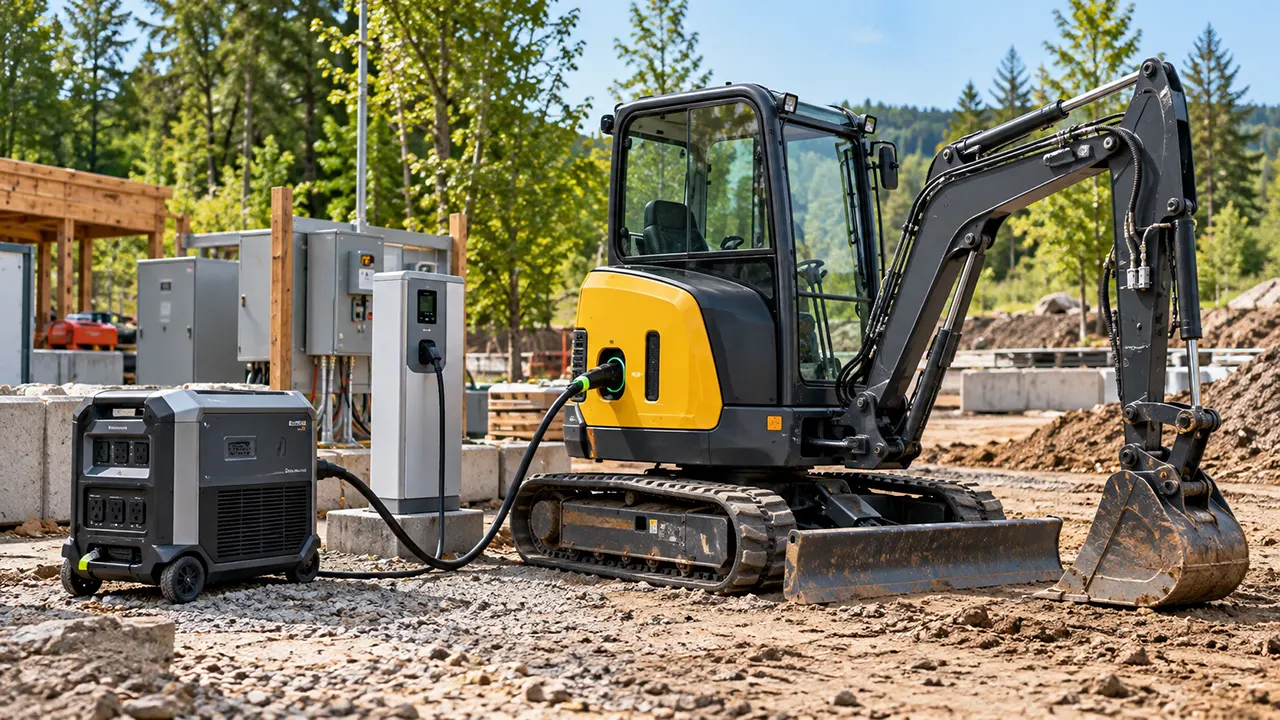
Electric construction equipment charging costs include more than the electricity used to refill a machine’s battery. Contractors may also need charging hardware, electrical installation, temporary power, battery storage, utility upgrades, and time to manage charging around work shifts. The right solution depends on the machine, the site’s available power, and how much energy the equipment uses each day.
Why Electric Construction Equipment Charging Costs More Than Electricity
Charging an electric excavator can be inexpensive when a suitable electrical supply is already available. Costs can rise when a contractor must install new circuits, rent temporary power equipment, upgrade a utility connection, or change the work schedule to accommodate charging.
The U.S. Energy Information Administration (EIA) reported an average commercial electricity price of 13.41 cents per kWh for 2025. This provides a useful starting point for estimating energy costs, but it is not a universal jobsite rate. Actual bills depend on the utility, location, tariff, and applicable demand charges.
For a contractor evaluating electric construction equipment, the financial question is not simply, “How much does one charge cost?” It is, “What will it cost to supply enough energy, at the right time, to keep the machine productive?”
Three cost categories help answer that question:
- Energy costs: Electricity drawn from the grid or another charging source.
- Power-delivery costs: Charging hardware, electrical work, temporary connections, and power-system rentals.
- Operational costs: Charging-related labor, downtime, mobilization, and production disruption.
This distinction matters when comparing jobsite charging options. A low electricity rate does not guarantee a low total cost if the site requires expensive infrastructure or the machine cannot recharge during available downtime.
How Electric Construction Equipment Charging Works
Electric construction equipment typically charges through a compatible AC or DC charging system. The power source supplies electricity to the charger, which delivers energy to the machine’s battery within the limits of the equipment’s charging system.
The exact setup depends on the machine. Some compact electric excavators use onboard AC chargers, while others can support optional off-board charging equipment. Larger machines may require substantially different power arrangements.
Before planning a charging installation, identify four things:
- The machine’s battery capacity in kilowatt-hours (kWh).
- Its maximum supported charging power in kilowatts (kW).
- The voltage, phase, current, and connector requirements.
- The charging options approved by the manufacturer.
Do not select a charger based on its power rating alone. The machine must support the charging method, and the site’s electrical system must be capable of supplying the required power.
Battery Capacity vs. Charger Power: What Determines Charging Time?
Battery capacity measures how much energy a battery stores. Charging power measures how quickly electricity can be delivered. Both affect charging time, but they describe different things.
A 32 kWh battery does not necessarily require a 32 kW charger. A compatible 3 kW charger could theoretically deliver 32 kWh in more than 10 hours before accounting for losses and charging behavior, while a higher-powered charger may reduce the time if the machine supports it.
A simple planning formula is:
\[ \text{Charging time (hours)} \approx \frac{\text{Energy required (kWh)}}{\text{Average charging power (kW)}} \]
The result is an estimate, not a guaranteed charging time. Actual charging can take longer because the battery may not accept maximum power throughout the session, charging efficiency is below 100%, and the machine may limit charging as the battery approaches full capacity.
A real equipment example
Caterpillar’s published information for the 301.9 Electric mini excavator lists a 32 kWh battery, maximum 3 kW AC charging, and an optional 9 kW DC charging solution. The machine’s supported charging configuration therefore affects how contractors plan the available charging window.
Volvo’s ECR18 Electric provides another example of model-specific charging. Its published specifications describe an onboard AC charging arrangement and an optional off-board charger with different charging times. These figures should be treated as manufacturer-stated specifications under the applicable conditions, not as universal charging rates for electric excavators.
The practical lesson is to obtain the charging specifications for the exact machine being purchased or rented. Generic charging-time estimates are useful for initial planning, but they cannot replace model-specific information.
Overnight Charging vs. Opportunity Charging
Overnight charging uses time when the equipment is not scheduled to work. Opportunity charging adds energy during planned breaks, shift changes, or other periods when the machine is idle.
Overnight charging may suit a contractor running one shift with a predictable return-to-base schedule. Opportunity charging may help where the machine operates for longer periods, but it requires a suitable charging location, compatible equipment, and enough electrical capacity during the available window.
| Operating pattern | Potentially suitable approach | Main consideration |
|---|---|---|
| One shift with overnight parking | Overnight charging | Confirm the available hours and required energy |
| One shift with scheduled breaks | Overnight plus opportunity charging | Verify that the additional charging sessions fit the work schedule |
| Multiple shifts | Higher charging capacity or planned charging windows | Check whether the machine can recharge fast enough between shifts |
| Remote or changing worksites | Mobile charging or portable power infrastructure | Account for transport, setup, energy capacity, and recharge arrangements |
Do not assume that a short break will deliver enough energy to complete the next shift. Calculate the energy required during the next operating period, then check whether the machine and charger can replenish it within the actual charging window.
What Electrical Supply Does an Electric Construction Machine Need?
The required supply depends on the machine’s charger and the electrical infrastructure available at the jobsite. Some equipment can use compatible single-phase AC power, while other charging arrangements require higher-power supplies or three-phase electricity.
Voltage alone does not establish whether a circuit is suitable. The electrician must also check current capacity, circuit protection, existing loads, cable requirements, and the charging equipment’s specifications.
Single-phase vs. three-phase power
Single-phase power can support some lower-power charging arrangements. Three-phase power can supply higher loads in suitable installations, but it is not automatically required for every electric construction machine.
Before ordering electrical work, ask the equipment dealer for the official charging requirements and give them to the electrician. The electrician can then determine whether the existing supply is adequate or whether additional equipment or a service upgrade is necessary.
A practical site-readiness checklist
- Confirm the machine’s approved charger and electrical specifications.
- Identify the available voltage, phase, and circuit capacity.
- Account for other equipment operating at the same time.
- Check whether the existing electrical panel can support the additional load.
- Ask the utility whether a service upgrade or new connection is required.
- Determine where charging equipment can be placed without obstructing work.
- Confirm cable routing, protection, and applicable electrical safety requirements.
The best time to identify a power shortage is before the equipment arrives. Otherwise, a machine can be ready for work while the site is still waiting for electrical installation.
Jobsite Charging Infrastructure Options Compared
The best charging solution depends on whether the site has sufficient grid power, how long the project will last, and how much energy the equipment needs.
Existing grid connection
Using an existing connection may minimize upfront costs when the available supply and charging equipment are compatible. However, contractors still need to confirm that the electrical panel and circuits can handle the additional load.
An existing outlet should not be assumed suitable merely because the plug fits. The complete circuit and charging arrangement must meet the manufacturer’s requirements and applicable electrical standards.
Temporary utility power
A temporary utility connection may be appropriate when a project needs more power than the site currently provides. Costs can include connection work, distribution equipment, electrical installation, utility fees, and recurring service charges.
This option deserves early investigation for longer projects. Installation lead times and utility requirements can affect when the equipment can begin working.
Portable battery energy storage
A portable battery system stores energy that can be delivered later. It may help supply compatible loads where grid capacity is limited or where power needs to be moved around a site.
However, the battery’s stored energy and continuous output must both meet the intended load. A unit with enough watt-hours but insufficient power output cannot run a load that exceeds its rated output.
Contractors should also account for how the portable battery will be recharged. A battery system does not eliminate the need for an energy source; it changes where and when that energy is stored and delivered.
Generator-supported charging
A generator may provide power where grid access is unavailable or insufficient, provided the generator, charging equipment, and electrical installation are compatible. The cost calculation must include fuel, rental, transport, maintenance, and any required distribution equipment.
Generator capacity should be assessed against the charger’s actual electrical demand and other simultaneous loads. Avoid assuming that a generator’s headline rating guarantees suitable operation under every condition.
Commercial mobile charging systems
Commercial mobile charging and battery energy storage systems may be relevant for contractors working across temporary or remote sites. Their suitability depends on usable energy, output power, recharge arrangements, deployment needs, and the machine’s charging requirements.
Obtain a configuration-specific quote before including a commercial system in a project budget. A system marketed for construction sites is not automatically compatible with every electric excavator or wheel loader.
Portable Power Stations for Construction Sites: Useful for Tools and Auxiliary Loads
Portable power stations can support certain construction-site tasks, including charging compatible cordless tool batteries, powering small electronics, and running suitable lights. They are not automatically suitable for charging electric excavators or other heavy equipment.
The products below are examples of consumer and backup-power systems that readers may investigate for auxiliary loads.
| Product | Supplied listing price | Potential auxiliary use |
|---|---|---|
| BLUETTI Elite 100 V2 | $499.00 | Compatible tool chargers, electronics, and small loads |
| Anker SOLIX S2000 | $649.98 | Longer-running compatible auxiliary loads |
| EcoFlow DELTA Pro Ultra with extra battery | $5,999.00 | Larger backup-power applications, subject to exact-model verification |
| Jackery Explorer 300 | $259.00 | Phones and low-power electronics |
| EcoFlow DELTA 3 | $599.00 | Compatible tool chargers and small equipment |
These products differ substantially in stored energy and power output. Verify the exact model, continuous output rating, supported voltage, and available capacity before selecting one for a jobsite application. The large EcoFlow listing also requires careful configuration verification because product names and specifications can differ between model generations.
How to choose a portable power station for auxiliary jobsite power
Focus on the load you need to run, rather than the largest number on the product page.
- Stored energy: Battery capacity, usually stated in Wh or kWh, helps estimate how long the unit can supply a load.
- Continuous output: The rated output in watts determines whether the unit can support the connected equipment.
- Surge capability: A short surge rating does not mean the unit can supply that power continuously.
- Charging and recharge arrangements: Check the inputs, recharge time, and energy source available at the site.
- Environmental suitability: Confirm that the equipment is suitable for the intended work environment and can be protected from weather, dust, impact, and other site hazards.
A compact power station may be a reasonable purchase for a crew that needs to charge small electronics or compatible tool batteries. It should not be marketed as a primary electric excavator charging system without verified compatibility and sufficient power and energy capacity.
What Does Electric Construction Equipment Charging Cost?
The total cost depends on the energy consumed, the price of electricity, the infrastructure required, and any additional expenses caused by charging.
Start by calculating the electricity used to recharge the machine. Then add the costs associated with supplying that electricity and managing the charging process.
Calculate the electricity cost
Use this formula:
\[ \text{Electricity cost} = \text{Grid energy (kWh)} \times \text{Electricity rate (\$/kWh)} \]
If a machine requires 24 kWh of energy in its battery each day and the charging system operates at an assumed 90% efficiency, the grid must supply approximately:
\[ \frac{24}{0.90}=26.67\text{ kWh} \]
At an illustrative electricity rate of $0.1341 per kWh, the energy cost would be approximately:
\[ 26.67\times \$0.1341=\$3.58 \]
This is a hypothetical example using the EIA’s 2025 national average commercial electricity rate. It is not a quote or a prediction for a specific jobsite.
Account for the full cost of charging
| Cost component | What to include |
|---|---|
| Electricity | Grid energy consumed during charging |
| Charging equipment | Purchase, rental, or lease cost of compatible chargers |
| Electrical installation | Circuits, wiring, distribution equipment, and installation labor |
| Utility work | New connections, service upgrades, and applicable utility fees |
| Temporary power | Rental, mobilization, setup, and recurring service costs |
| Battery storage | Rental or ownership cost, recharge energy, and relevant operating expenses |
| Demand charges | Applicable charges based on the utility’s actual tariff and billing rules |
| Operational impact | Additional labor and charging-related production delays |
| Other expenses | Maintenance, fuel for generator-supported systems, and other site-specific costs |
Not every project incurs every cost. A site with suitable existing power may avoid a new utility connection, while a remote project may need temporary power or mobile storage.
Infrastructure costs also need an appropriate time horizon. A charger purchased for a long-term fleet should not be allocated to a single day of work without accounting for its expected use. Conversely, a temporary installation for a short project may require a larger share of its cost to be assigned to that project.
How demand charges affect the budget
Some commercial electricity tariffs include demand charges based on measured peak demand during a billing period. These charges are separate from the cost of energy consumed.
Where demand charges apply, simultaneous charging can affect the site’s peak load. A contractor should review the actual tariff and consider whether charging schedules or load management can reduce avoidable peaks without interfering with production.
Do not estimate demand charges using a generic national rate. Their calculation depends on the specific utility tariff, billing interval, and applicable customer rules.
Worked Example: Calculate a Jobsite’s Charging Cost
Consider a hypothetical contractor operating one electric mini excavator for 22 days in a month. Assume the machine requires 24 kWh of battery energy per operating day, charging efficiency is 90%, and the electricity rate is $0.1341 per kWh.
| Input | Assumption |
|---|---|
| Daily battery energy used | 24 kWh |
| Charging efficiency | 90% |
| Daily grid energy required | 26.67 kWh |
| Electricity rate | $0.1341/kWh |
| Operating days per month | 22 |
| Monthly grid energy | 586.67 kWh |
| Estimated monthly electricity cost | $78.68 |
The energy cost is relatively straightforward to calculate. The more difficult part is determining the additional cost of making the power available.
Suppose the contractor also has the following illustrative expenses:
| Additional cost | Hypothetical amount |
|---|---|
| Charging hardware and installation | $3,600 one-time |
| Temporary power rental | $250 per month |
| Demand charges | Not yet determined |
| Charging-related downtime | Not yet determined |
If the $3,600 installation cost is allocated evenly over 12 months, the monthly allocation is $300. Adding the assumed $250 monthly rental and the $78.68 electricity cost produces a modeled monthly total of $628.68 before demand charges, downtime, and other expenses.
These figures are illustrative assumptions, not current market quotes. A real project should use actual contractor bids, rental rates, utility tariffs, and measured or manufacturer-supported energy estimates.
The example shows why electricity cost alone can be misleading. The installation and temporary power expenses may have a larger effect on the budget than the energy consumed by the machine.
Use a Charging Cost Calculator Before Choosing a Power Solution
A useful electric construction equipment charging calculator should allow contractors to estimate costs for their own machine and site rather than relying on a single generic example.
The calculator should request:
- Battery capacity and daily battery energy use.
- Electricity price per kWh.
- Charging efficiency.
- Operating days per month.
- Charging hardware and installation cost.
- Monthly rental and utility fees.
- Demand charges, where applicable.
- Charging-related downtime and its estimated cost.
It should calculate grid energy, electricity cost, infrastructure allocation, and the total of the entered costs separately. It should also allow users to compare scenarios, such as existing grid power versus temporary power or portable battery storage.
For more advanced planning, include charger power and available charging hours. These inputs help determine whether the proposed charging setup can replenish the required energy within the available window.
The calculator should clearly label assumptions and exclusions. Its output is an estimate for planning, not an electrical design, utility quote, or guarantee of equipment performance.
How to Plan Charging Schedules, Cable Routing, and Site Safety
A charging plan should fit the jobsite’s operating schedule and physical layout. The charging area needs sufficient electrical capacity, safe access, and a cable route that does not create avoidable hazards for workers or moving equipment.
Plan the charging window
Identify when the machine can be parked and connected without interrupting planned work. Confirm that the available charging window is long enough for the required energy, using the machine’s supported charging rate rather than the charger’s maximum advertised output.
For multiple machines, map their charging requirements against the available supply. A schedule that works for one machine may exceed the site’s capacity when several chargers operate at once.
Protect charging cables and equipment
Plan cable routing before the charging station is installed. Keep cables away from traffic routes where possible, and use suitable protection where crossing a work area is unavoidable. Position charging equipment where workers can access it safely without creating conflicts with excavation, lifting, or material movement.
Outdoor installations require equipment suitable for the actual environment. Follow manufacturer instructions and applicable electrical requirements for weather exposure, grounding, circuit protection, and temporary wiring.
Follow applicable electrical safety requirements
The Occupational Safety and Health Administration (OSHA) publishes construction electrical requirements covering wiring protection and temporary wiring. Review the applicable provisions in OSHA 29 CFR 1926.404 and OSHA 29 CFR 1926.405.
Do not improvise charging connections or assume that a consumer power station, extension cord, or ordinary outlet is appropriate for heavy equipment. Have a qualified electrical professional assess the installation and confirm the required protection, equipment ratings, and site conditions.
Questions to Ask the Equipment Dealer and Electrician
Before committing to an electric construction machine or a charging installation, get clear answers to the following questions.
Questions for the equipment dealer
- What are the battery’s usable capacity and typical energy consumption under the planned working conditions?
- Which onboard and off-board chargers are compatible with this exact model?
- What voltage, phase, current, and connector does each charging option require?
- What charging time should we expect for the energy needed between shifts?
- Is the charger included in the purchase or rental, or is it an additional expense?
- What charging limitations or environmental conditions should we account for?
Questions for the electrician or utility
- Can the existing electrical service supply the required load?
- Will the installation need a new circuit, distribution equipment, transformer, or service upgrade?
- What will the installation cost, and how long will the work take?
- Can multiple chargers operate at once without exceeding the available capacity?
- Does the applicable utility tariff include demand charges or time-of-use pricing?
- What protection, cable routing, and installation requirements apply to the site?
Ask for written specifications and a detailed estimate. That gives the project team a stronger basis for comparing charging arrangements and identifying costs before delivery.
Recommended read: Electric vs. Diesel Mini Excavator
Frequently Asked Questions About Electric Construction Equipment Charging
1. How much does it cost to charge an electric excavator?
The cost depends on the energy required by the machine, charging efficiency, and the electricity rate. Calculate grid energy by dividing the energy delivered to the battery by charging efficiency, then multiply by the applicable rate. For a full project estimate, add infrastructure, rentals, demand charges, and charging-related downtime where applicable.
2. Can an electric excavator charge from a standard outlet?
Some compact electric machines support charging from compatible lower-power AC supplies, but this depends on the model and charger. A standard outlet should not be assumed suitable without checking the manufacturer’s electrical requirements and the circuit’s capacity. Larger machines or faster charging arrangements may require a dedicated circuit or a different electrical supply.
3. How long does it take to charge electric construction equipment?
Charging time depends on the energy needed, the machine’s supported charging power, and the charging system’s behavior during the session. Dividing required energy in kWh by average charging power in kW gives a useful initial estimate. Manufacturer specifications should be used to confirm the expected time for the actual machine.
4. Can a portable power station charge an electric excavator?
A portable power station should only be used for excavator charging when its output, stored energy, connections, and electrical characteristics are confirmed compatible with the machine’s approved charging system. Many consumer power stations are better suited to auxiliary loads such as electronics, lights, and compatible tool chargers. Check the complete charging arrangement before making a purchase.
5. Does an electric excavator need three-phase power?
Not every electric excavator requires three-phase power. The requirement depends on the machine, its onboard charger, and any optional off-board charging equipment. Obtain the exact specifications from the manufacturer, then have an electrician check whether the site’s supply can support the selected charging arrangement.
6. How do demand charges affect electric equipment charging costs?
Demand charges can increase the electricity bill when a tariff bills customers for peak demand during a defined period. Charging several machines simultaneously may increase that peak. Contractors should review the actual tariff and assess whether charging schedules or load management can reduce demand without compromising the work schedule.
7. Can several electric machines share one charging station?
Multiple machines can share charging infrastructure when the equipment supports the arrangement and the site can provide the required electrical capacity. However, sharing may introduce scheduling conflicts or increase the time each machine spends waiting to charge. Evaluate the total energy requirement, charging windows, charger compatibility, and simultaneous electrical loads before choosing a shared setup.
8. Who should verify the electrical installation before equipment delivery?
The equipment dealer should confirm the machine’s charging specifications, and a qualified electrician should assess the proposed electrical installation. The utility may also need to review a new connection or service upgrade. Complete these checks before delivery whenever possible so that the charging infrastructure is ready when the equipment arrives.
Make a Jobsite Charging Plan Before the Machine Arrives
The best charging solution is the one that supplies the required energy within the available operating schedule at a total cost the project can support. A low electricity rate is useful, but it cannot compensate for an unsuitable power supply, an incompatible charger, or a charging schedule that delays work.
Start by obtaining the machine’s charging specifications, checking the site’s available electrical service, and calculating the energy needed per shift. Then compare the full cost of existing grid power, temporary power, and suitable battery systems before committing to an installation.
Ready to estimate your jobsite charging costs? Use the calculator inputs described in this guide, then confirm the key assumptions with your equipment dealer, electrician, and utility. If you need auxiliary power for lights, electronics, or compatible tool chargers, compare portable power stations based on their actual capacity and output rather than their headline wattage.
Sources for further research
- U.S. Energy Information Administration: Electricity prices and factors affecting prices
- OSHA: Construction wiring design and protection
- OSHA: Construction wiring methods and temporary wiring
- Caterpillar: Electric construction equipment
