


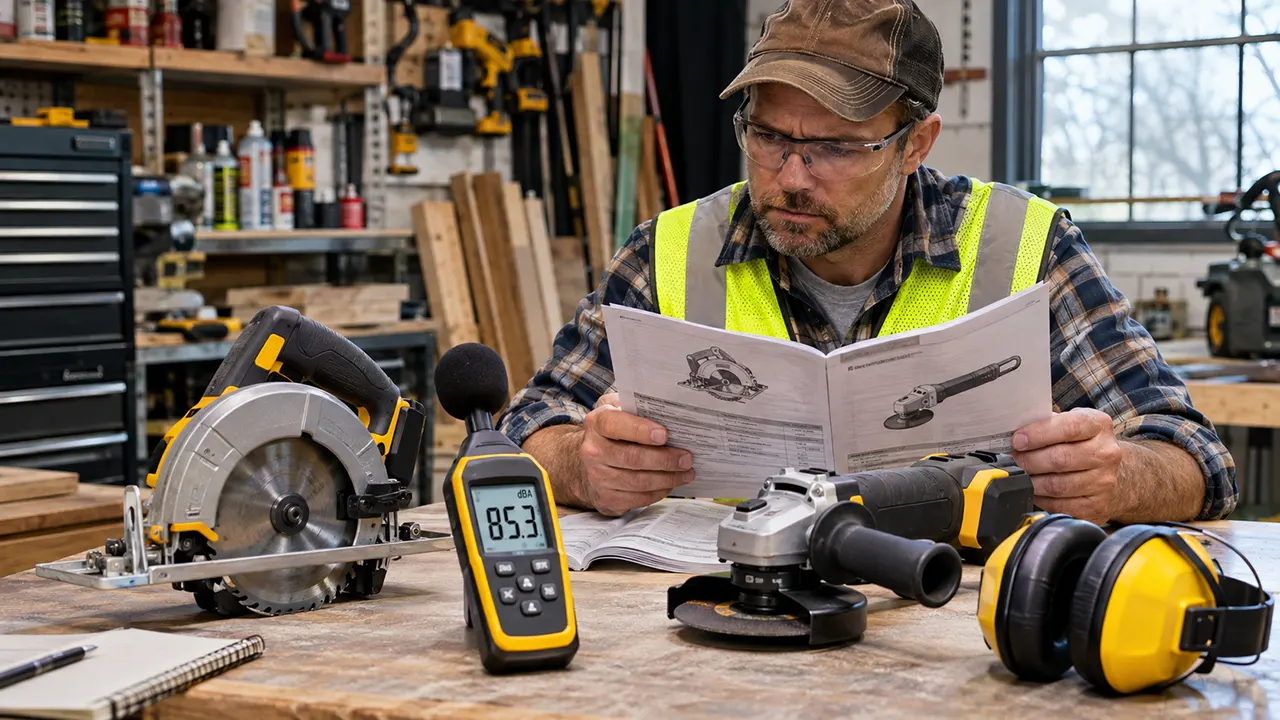
The NIOSH Buy Quiet approach helps businesses and individuals choose equipment that produces less noise. Before buying a power tool, compare its manufacturer-declared sound pressure and sound power levels, check the measurement conditions, and consider how the tool will operate in your workplace. A lower, comparable noise emission value can help reduce occupational noise exposure.
Why NIOSH Buy Quiet Matters When Choosing Power Tools
A power tool purchase can affect workplace noise exposure for years. A construction company that buys several noisy tools may expose multiple employees to unnecessary noise every working day. Replacing those tools later with quieter equipment can also cost more than considering noise during the original purchase.
The NIOSH Buy Quiet approach addresses this problem at the purchasing stage. It encourages companies to select or rent quieter machinery and tools instead of waiting until workers experience excessive noise exposure.
How power tool noise affects workers
Repeated exposure to hazardous noise can damage the sensitive structures inside the inner ear. Noise-induced hearing loss is generally permanent, but employers can prevent much of this damage through effective noise controls.
The CDC’s NIOSH guidance identifies several consequences of excessive workplace noise:
- Permanent hearing damage.
- Tinnitus, or ringing in the ears.
- Reduced ability to hear instructions and warning signals.
- Increased difficulty communicating on busy jobsites.
- Potential safety problems when workers cannot hear their surroundings.
NIOSH identifies 85 dBA over eight hours as its recommended occupational exposure limit. This is an exposure guideline, not a universal maximum rating for individual power tools.
Why quieter equipment makes financial sense
Buying quieter equipment can reduce the need for expensive noise-control measures later. It can also lower the long-term costs associated with hearing conservation programs, audiometric testing, protective equipment and workers’ compensation.
NIOSH discusses a conservative estimate of $100 in savings per dBA when purchasing quieter equipment. This is a general estimate from its Buy Quiet guidance, not a guaranteed saving for every tool or business.
For a small construction company, the practical lesson is straightforward: include noise emissions alongside price, performance, durability and maintenance when evaluating replacement tools.
What Is the NIOSH Buy Quiet Program?
The NIOSH Buy Quiet program is a prevention initiative from the National Institute for Occupational Safety and Health. It encourages employers to purchase or rent quieter equipment to reduce workers’ exposure to hazardous noise.
NIOSH also wants manufacturers to develop quieter products by creating greater demand for low-noise machinery and tools. Buy Quiet is part of the broader Prevention through Design approach, which considers workplace hazards during the design and purchasing process rather than relying only on protective measures after equipment enters service.
How businesses can implement Buy Quiet
A practical Buy Quiet program does not need to begin with an expensive technology project. A company can start by recording the noise emissions of its existing equipment and using that information when purchasing replacements.
NIOSH describes three levels of organizational commitment:
- Beginner level: Purchase replacement machinery that produces less noise than the equipment being replaced.
- Cost-benefit level: Select the quieter option that provides the best overall value.
- Highest commitment: Purchase the quietest available equipment, regardless of price.
A business can also establish a written purchasing policy, maintain an equipment noise inventory and educate employees about the benefits of quieter machinery.
What the 2026 NIOSH update means for power tool buyers
The CDC’s NIOSH resource Eliminate or Reduce Noise displays an October 28, 2026 update date. It provides practical guidance on comparing equipment noise levels, requesting manufacturer data and measuring equipment before purchase.
One example compares battery-powered and gas-powered landscaping equipment. The company measured approximate crew exposures of 78-82 dBA TWA for the battery-powered equipment and 92-99 dBA TWA for the gas-powered equipment.
These results came from a particular workplace comparison. They do not establish that every battery-powered tool is quieter than every gas-powered alternative.
The important lesson is to evaluate actual equipment and workplace exposure rather than assuming that a particular power source guarantees lower noise.
Where to Find Power Tool Noise Specifications
Manufacturers often publish noise emission information in their instruction manuals, technical documents and product specifications. However, these figures are not always easy to find on retail product pages.
If you cannot locate the information, contact the manufacturer and request the declared sound pressure and sound power levels.
Check the manufacturer’s instruction manual
Look for a section named Noise/Vibration Information, Noise Emission Values or something similar.
A manufacturer may provide:
- A-weighted sound pressure level.
- A-weighted sound power level.
- Measurement uncertainty.
- The applicable test standard.
- Conditions under which the noise measurements were obtained.
For example, Bosch manuals for professional power tools include separate sound pressure and sound power declarations. They also identify the relevant EN 62841 test standard and uncertainty value.
Check the manufacturer’s technical support
If a product listing only displays a general noise rating, request the complete noise declaration.
Ask the manufacturer:
- Is the published value sound pressure or sound power?
- Is the figure A-weighted?
- Which test standard was used?
- Was the tool measured under load or without load?
- What uncertainty value applies?
- Are measurements representative of the intended application?
These questions help prevent misleading comparisons between products.
Use NIOSH historical power tool research carefully
NIOSH has published research and historical power tool noise data. These resources can help readers understand noise differences between tool categories and operating conditions.
However, historical laboratory results should not be presented as current specifications for newly released products. Always identify the tested models, publication date and measurement method when using older research.
Sound Power Level vs. Sound Pressure Level: What’s the Difference?
Sound power level and sound pressure level describe different acoustic properties. They are related, but they are not interchangeable.
Understanding this distinction is essential when comparing power tools because manufacturers may publish both values in the same manual.
Source characteristic
Lw / LWA
Sound power level
Describes the total acoustic power emitted by a source. It is determined using a specified measurement method and is useful for comparing the noise emissions of equipment.
Measurement position
Lp / LpA
Sound pressure level
Describes the sound pressure at a particular position. The measured level changes with distance, the surrounding environment and other measurement conditions.
What does sound power level (Lw) mean?
Sound power describes the acoustic energy emitted by a source per unit of time. Its value is expressed relative to a reference sound power and is commonly reported in decibels.
The A-weighted version is written as LWA.
Because sound power is a source-related quantity, it is useful when comparing equipment tested using equivalent procedures.
What does sound pressure level (Lp) mean?
Sound pressure describes the acoustic pressure variation measured at a particular location. Its value depends on where the measurement takes place.
For example, a worker standing close to a circular saw may experience a different sound pressure level from someone standing several meters away.
Manufacturers commonly report the A-weighted sound pressure level as LpA.
Why are sound power and sound pressure numbers different?
A tool can have a sound power declaration of 106 dB(A) and a sound pressure declaration of 98 dB(A). This does not mean that the tool produces two conflicting noise levels.
The figures represent different acoustic quantities measured or calculated using different procedures.
You should never subtract the two values and treat the difference as a universal conversion factor. The relationship depends on the measurement method, test environment and source characteristics.
How measurement distance changes sound pressure
Distance affects the sound pressure reaching the listener.
In an ideal free-field environment, doubling the distance from a point-like sound source reduces sound pressure level by approximately 6 dB. Real workshops and construction sites contain reflective surfaces, multiple sources and obstacles, so the actual reduction may differ.
OSHA explains this distance relationship in its occupational noise guidance. Occupational Safety and Health Administration
The practical lesson is simple: a sound pressure measurement is meaningful only when its measurement position and conditions are understood.
How to Understand dBA Ratings and Measurement Uncertainty
A decibel rating is a logarithmic measurement, not a simple linear scale. This means a small numerical difference can represent a substantial change in acoustic energy.
What does dBA mean?
The abbreviation dBA refers to a sound level measured using A-weighting.
A-weighting adjusts the measured frequency response to approximate the sensitivity of human hearing. Manufacturers commonly use dB(A) in power tool noise declarations.
For example, a manual might state:
- Sound pressure level: 84 dB(A).
- Sound power level: 92 dB(A).
- Measurement uncertainty: K = 3 dB.
These are three different pieces of information. The first describes sound pressure, the second describes sound power, and the third describes uncertainty.
How decibels work on a logarithmic scale
A 3 dB increase represents approximately twice the sound energy or intensity. A 10 dB increase represents ten times the sound intensity.
Consider two tools performing the same task under equivalent measurement conditions:
| Tool | Sound level |
|---|---|
| Tool A | 96 dB |
| Tool B | 106 dB |
Tool B has a sound intensity approximately ten times higher than Tool A at the same measurement reference. This does not mean that people perceive it as exactly ten times louder.
NIOSH’s archived Buy Quiet resource uses a comparison of two circular saws rated at 107 and 96 dBA to illustrate the value of selecting quieter equipment.
What does the K uncertainty value mean?
Manufacturers may include a value such as K = 3 dB or K = 5 dB alongside their noise declarations.
This value represents measurement uncertainty under the applicable measurement procedure. It is not another operating noise level.
For example:
| Specification | Manufacturer declaration |
|---|---|
| Sound pressure | 84 dB(A) |
| Sound power | 92 dB(A) |
| Uncertainty | K = 3 dB |
Do not automatically add or subtract K to create a new noise rating. Record it when comparing manufacturer specifications and follow the applicable standard’s interpretation.
Why loaded and unloaded measurements matter
A power tool may produce different noise emissions depending on whether it is running freely or performing its intended task.
- Unloaded operation: The tool runs without performing the main work.
- Loaded operation: The tool performs an operation such as cutting, drilling or grinding.
The material, accessory, motor load and operating condition can all affect the noise produced.
For this reason, an unloaded noise measurement should not automatically be treated as representative of the noise generated during actual work. The NIOSH powered hand tool research provides examples of differences between loaded and unloaded measurements.
Recommended read: How to choose Magnetic Tool Holder Strips
Comparing Real Power Tool Noise Specifications
Manufacturer manuals provide useful examples of how different power tools declare their noise emissions. The following table uses three Bosch Professional models with published noise specifications.
| Tool | Model | Sound pressure (LpA) | Sound power (LWA) | Uncertainty |
|---|---|---|---|---|
| Circular saw | Bosch GKS 18V-68-2 | 98 dB(A) | 106 dB(A) | 3 dB |
| Angle grinder | Bosch GWS 18V-8 | 84 dB(A) | 92 dB(A) | 3 dB |
| Drill/driver | Bosch GSR18V-52 | 78 dB(A) | 86 dB(A) | 5 dB |
Sources: Bosch circular saw manual, Bosch angle grinder manual and Bosch drill/driver manual.
Important: This is a manufacturer-specification reference table, not a ranking of the quietest power tools. The tools perform different tasks and use different product-specific test standards. The figures should not be used to conclude that the drill is universally quieter than the circular saw or grinder.
Circular saw noise specifications
The Bosch GKS 18V-68-2 manual declares a sound pressure level of 98 dB(A) and a sound power level of 106 dB(A), with K = 3 dB.
The manufacturer identifies EN 62841-2-5 as the applicable measurement standard. The manual also warns that actual noise emissions can change with the application, accessories and equipment condition.
Angle grinder noise specifications
The Bosch GWS 18V-8 manual declares 84 dB(A) sound pressure and 92 dB(A) sound power, with K = 3 dB.
Its noise emission values are determined according to EN IEC 62841-2-3. The manual also notes that grinding certain thin metal sheets or materials with large vibrating surfaces can increase noise emissions significantly.
Drill/driver noise specifications
The Bosch GSR18V-52 manual declares 78 dB(A) sound pressure and 86 dB(A) sound power, with K = 5 dB.
These figures are determined according to EN 62841-2-1. The manual explains that actual emissions can change depending on the application, accessories and maintenance condition.
How to interpret the comparison table
Use the table to understand how manufacturers present noise information, not to choose a winner across unrelated tool categories.
When comparing two circular saws, for example, prioritize their sound power declarations if both manufacturers provide values determined under equivalent test conditions. Also check the sound pressure figures, test standards and uncertainty values.
For a purchasing decision, the intended application matters just as much as the published number.
How to Compare Two Power Tools Fairly
Comparing two tools requires more than looking at their advertised decibel ratings. You need to establish whether the figures describe the same acoustic quantity and whether the measurement conditions are comparable.
Compare the same noise measurement type
Start by identifying whether each manufacturer reports LpA or LWA.
Never compare a sound pressure value from one tool against a sound power value from another. Both may use dB(A), but they describe different acoustic properties.
Check the test standard and operating conditions
Find the test standard listed in the manufacturer manual.
Different tool categories may use different parts of the IEC 62841 series. Even within the same category, test procedures and applications must be checked before assuming two measurements are equivalent.
Also check whether the manufacturer measured the tool under load, without load or under another defined operating condition.
Keep measurement distance consistent
If you measure two tools yourself, use the same microphone position and distance.
For example, measuring one drill 50 cm from the microphone and another 1 meter away will not provide a fair comparison.
NIOSH specifically recommends maintaining the same microphone distance and measurement duration when comparing equipment.
Account for measurement uncertainty
Record the K value alongside each manufacturer’s declared noise level.
A declaration of 90 dB(A) with K = 3 dB should not be treated as an infinitely precise measurement. Consider the uncertainty when interpreting small differences between competing products.
Compare tools performing the same task
A drill and a circular saw perform different operations. Their noise characteristics are therefore not directly interchangeable.
For meaningful purchasing decisions, compare:
- Similar tool categories.
- Equivalent operating applications.
- The same acoustic measurement type.
- Comparable test standards.
- Similar operating conditions.
- Measurement uncertainty.
The ToolGuider Buy Quiet Comparison Checklist
Use this checklist before purchasing replacement equipment.
- Identify the exact manufacturer and model number.
- Find the official noise declaration in the instruction manual.
- Record sound pressure and sound power separately.
- Identify the applicable test standard.
- Record the measurement uncertainty.
- Check the operating conditions and measurement position.
- Compare equivalent models and consider expected workplace exposure.
For businesses, maintain these results in an equipment noise inventory. Update the inventory whenever new tools are purchased or older equipment is replaced.
Are Battery-Powered Power Tools Quieter?
Battery-powered tools can reduce noise in some applications, but they are not automatically quieter than corded or gas-powered alternatives.
The result depends on the tool design, motor, application, material, accessories and operating conditions.
Battery-powered versus gas-powered equipment
The NIOSH landscaping example provides a useful illustration. In that particular workplace, battery-powered equipment produced lower crew noise exposures than the gas-powered equipment used for comparison.
However, the result should not be generalized to every power tool. A battery-powered circular saw can still produce substantial noise while cutting dense material.
Cordless versus corded tools
Both cordless and corded tools can produce substantial operating noise.
A cordless design may eliminate noise from a separate gasoline engine or generator in some applications. However, the actual cutting, drilling or grinding process can remain a major noise source.
Do not assume that removing a power cord automatically reduces acoustic emissions.
What should buyers consider?
When choosing between battery-powered and corded equipment, evaluate:
- Manufacturer-declared noise emissions.
- Intended workload.
- Motor and mechanical design.
- Cutting or grinding accessories.
- Operating speed and load.
- Battery runtime and replacement costs.
- Maintenance requirements.
The best option is the tool that meets your performance needs while producing lower noise emissions under comparable operating conditions.
When Is Hearing Protection Necessary for Power Tools?
Hearing protection decisions should consider actual occupational noise exposure, not just the noise rating printed on a tool.
A manufacturer-declared sound pressure level does not automatically tell you how much noise a worker receives during an entire shift.
NIOSH recommended exposure limit
NIOSH recommends limiting occupational noise exposure to 85 dBA over eight hours, using a 3 dB exchange rate.
This means that as exposure increases by 3 dB, the recommended exposure duration is reduced by half.
For example:
| Noise exposure | NIOSH recommended duration |
|---|---|
| 85 dBA | 8 hours |
| 88 dBA | 4 hours |
| 91 dBA | 2 hours |
| 94 dBA | 1 hour |
| 97 dBA | 30 minutes |
These are exposure-duration examples based on the NIOSH recommended exposure limit, not safe operating guarantees for every individual.
OSHA occupational noise requirements
The Occupational Safety and Health Administration has separate regulatory requirements.
For general industry:
- An eight-hour TWA of 85 dBA triggers the hearing conservation program requirement.
- An eight-hour TWA of 90 dBA is the permissible exposure limit under the OSHA general industry noise standard.
- OSHA uses a 5 dB exchange rate for its permissible exposure calculations.
These requirements should not be confused with the NIOSH recommended exposure limit. Construction employers must also follow the applicable construction noise standard, including its exposure limits and hearing protection requirements.
Choosing appropriate hearing protection
Common hearing protection options include:
- Earplugs: Fit inside the ear canal and are useful for many noisy work environments.
- Earmuffs: Cover the outer ears and can be convenient for workers who frequently put on and remove protection.
- Combination protection: Earplugs and earmuffs may be appropriate for particularly high-noise environments.
Check the Noise Reduction Rating (NRR), fit and suitability for the workplace. An advertised NRR should not be interpreted as a guaranteed reduction in a worker’s actual exposure.
Hearing protection should complement noise reduction at the source and other appropriate workplace controls.
Measuring workplace noise exposure
A sound level meter can help identify noisy tools and work areas. Personal noise dosimeters are useful when evaluating an employee’s exposure throughout a working shift.
The NIOSH Sound Level Meter App is another useful reference for compatible iOS devices. NIOSH reports accuracy within ±2 dBA under its validation conditions. It should not replace a professional occupational noise assessment when regulatory compliance or a formal exposure evaluation is required.
FAQs: NIOSH Buy Quiet power tools
1. What is the NIOSH Buy Quiet initiative?
NIOSH Buy Quiet is an occupational noise prevention initiative that encourages businesses to purchase or rent quieter machinery and tools. It helps employers reduce workplace noise exposure by considering equipment noise emissions during purchasing decisions. Companies can implement it through equipment inventories, purchasing policies and manufacturer noise comparisons.
2. What is a good noise rating for a power tool?
There is no single noise rating that makes every power tool safe or suitable. The right comparison depends on the tool category, application, measurement type and operating conditions. Look for lower manufacturer-declared noise emissions among comparable models, then assess actual workplace exposure and hearing protection requirements.
3. Is sound power higher than sound pressure?
Sound power and sound pressure measure different acoustic properties. Neither should be interpreted as a universally higher or lower measurement. Their numerical relationship depends on the source, measurement conditions and acoustic environment. Compare sound power with sound power and sound pressure with sound pressure.
4. Can two power tools with the same dBA rating sound different?
Yes. Two tools can have the same A-weighted noise rating but different frequency characteristics, operating patterns and sound quality. Their actual noise can also change with workload, accessories and the surrounding environment. A single dBA value does not describe every aspect of how a tool sounds.
5. Are cordless power tools always quieter?
No. Cordless power tools are not universally quieter than corded alternatives. Battery-powered equipment can reduce noise in some applications, especially when replacing gasoline-powered machinery. However, the motor, cutting mechanism, material and workload also influence noise emissions. Compare actual manufacturer specifications instead of relying on the power source alone.
6. Does a power tool below 85 dBA require hearing protection?
An individual manufacturer’s rating below 85 dBA does not automatically establish that hearing protection is unnecessary. Workplace exposure depends on measurement position, operating duration and other noise sources. Employers should evaluate total occupational exposure and follow applicable safety requirements before making hearing protection decisions.
7. Can I use a phone app to measure power tool noise?
A phone app can provide an initial indication of sound levels, but its accuracy depends on the device, microphone and measurement conditions. The NIOSH Sound Level Meter App is validated for compatible iOS devices under specified conditions. Use appropriate professional instruments for formal occupational exposure assessments.
8. Where can I find manufacturer noise emission values?
Check the product’s instruction manual, technical data sheet and official manufacturer documentation. Look for sound pressure, sound power, A-weighting and measurement uncertainty. If the information is missing, contact the manufacturer and request the complete noise declaration.
Make Noise Specifications Part of Your Next Power Tool Purchase
Choosing a power tool should involve more than comparing its price, battery capacity or motor performance. Noise emissions also deserve attention, particularly when equipment will be used regularly in workshops, construction sites or other occupational environments.
The NIOSH Buy Quiet approach gives businesses a practical way to make noise reduction part of their purchasing decisions. Start by checking manufacturer specifications, comparing equivalent tools and recording the results.
Before your next power tool purchase, compare the actual noise declarations rather than relying on marketing claims such as quiet or low noise. A well-informed purchasing decision can help reduce unnecessary workplace noise and support a safer working environment.
Useful next step: Explore ToolGuider’s power tool buying guides to compare equipment specifications, features and suitability for your work.
Sources and technical references
- NIOSH: Eliminate or Reduce Noise – Buy Quiet, equipment comparison and 2026 guidance.
- NIOSH: Buy Quiet – Historical initiative and circular saw comparison.
- OSHA: Occupational Noise Exposure – General industry requirements.
- OSHA: Noise Exposure and Distance – Noise reduction through distance.
- Bosch GKS 18V-68-2 Manual – Circular saw noise declaration.
- Bosch GWS 18V-8 Manual – Angle grinder noise declaration.
- Bosch GSR18V-52 Manual – Drill/driver noise declaration.
- NIOSH Sound Level Meter App – Noise measurement resource.
