


Published on: September 17, 2025 | Updated on: September 17, 2025
Finding the best metal detector for gold is crucial for successful prospecting. This guide covers top models, essential features, and expert tips to help you unearth those precious nuggets and flakes.
Gold prospecting is an adventure that calls to many, promising the thrill of discovery and the allure of precious metal. But stepping into this exciting world can feel overwhelming, especially when it comes to choosing the right gear. The sheer variety of metal detectors on the market can make your head spin, leaving you wondering which one will truly help you find gold and which might just be a waste of your hard-earned cash. Don’t worry, I’ve been there, and I’m here to guide you through it.
Why Finding the Right Gold Detector Matters
Choosing the best metal detector for gold isn’t just about picking any device that beeps. Gold is notoriously tricky to detect, often found in mineralized ground or as tiny flakes that can be masked by other signals. A detector specifically designed for gold prospecting will have the sensitivity, frequency, and ground balancing capabilities needed to cut through these challenges. Using a general-purpose detector might mean missing out on valuable finds or wasting time digging up worthless junk.
Understanding Gold Prospecting Frequencies
The frequency at which a metal detector operates is perhaps the most critical factor when searching for gold. Higher frequencies are generally better for detecting small gold nuggets and flakes because they are more sensitive to the tiny targets. Lower frequencies tend to penetrate deeper and are better for larger targets, but they are less effective for the fine gold often found in placer deposits. Many dedicated gold detectors operate in the higher frequency range, often between 15 kHz and over 70 kHz.
Key Features to Look for in a Gold Detector
Beyond frequency, several other features make a metal detector shine in gold country. Look for robust ground balancing capabilities, which allow the detector to ignore the interfering signals from mineralized soil. Adjustable discrimination is also important, though for pure gold prospecting, many prefer to dig most targets to avoid missing small gold pieces. Lightweight design and comfortable ergonomics are essential for long days in the field.
Top Metal Detectors for Gold: Our Field-Tested Picks
After countless hours swinging coils over mineralized soil, I’ve found a few detectors that consistently perform. These aren’t just good for gold; they are exceptional tools that have proven their worth in real-world prospecting scenarios. Each offers a different balance of features and price points, ensuring there’s a top contender for nearly every prospector.
Minelab GPX 6000: The Professional’s Choice

The Minelab GPX 6000 stands out as a top-tier gold detector, renowned for its exceptional sensitivity and ease of use. It utilizes advanced technology to automatically adjust to ground conditions, making it incredibly effective in highly mineralized areas where other detectors struggle. Its dual-voltage (DVT) and GeoSense-T technology work together to provide clear signals even from the smallest gold nuggets.
Pros: Unmatched sensitivity to small gold, excellent ground balancing, user-friendly with automatic settings, lightweight.
Cons: High price point, may be overkill for beginners or occasional prospectors.
Garrett AT Gold: A Versatile and Robust Option
Garrett is a name synonymous with reliable metal detectors, and the AT Gold is a testament to that reputation. This detector is fully submersible, making it ideal for prospecting in and around water. It operates at a higher frequency, which is excellent for detecting small gold. The adjustable threshold and ground balance give you fine-tuned control over your search.
Pros: Waterproof, good sensitivity for gold, durable construction, competitive price for its capabilities.
Cons: Can be a bit noisy in highly mineralized ground without careful adjustment, requires more manual tuning than some high-end models.
Nokta Makro Gold Finder 2000: Budget-Friendly Powerhouse
For those on a tighter budget who still want serious gold-finding capability, the Nokta Makro Gold Finder 2000 is a fantastic option. It’s designed specifically for gold prospecting with a high operating frequency. It’s simple to use, with just a few controls, and is surprisingly sensitive to small targets. Its lightweight design makes it comfortable for extended use.
Pros: Excellent value for money, very sensitive to small gold, simple operation, lightweight.
Cons: Limited features compared to more expensive models, not waterproof.
Beyond the Detector: Essential Gold Prospecting Accessories
Having the best metal detector for gold is only part of the equation. To maximize your success and make your prospecting trips more efficient and enjoyable, you’ll need a few key accessories. These tools can significantly improve your chances of finding gold and make the process of recovery much smoother.
Coils: Tailoring Your Detector’s Reach
The coil is your detector’s “eye” on the ground. Different coil sizes and types are better suited for different conditions. Smaller coils are generally more sensitive to tiny targets and better for maneuvering in tight spots or highly mineralized ground. Larger coils offer greater depth penetration and wider coverage, which can be useful for sweeping larger areas for bigger nuggets. Many gold detectors come with a standard coil, but investing in an additional specialized coil can boost your find rate.
Pinpointers: Locating Every Speck
Once your detector signals a target, a pinpointer is indispensable for pinpointing its exact location in the soil. These small, handheld devices are highly sensitive and help you avoid digging unnecessarily large holes, saving you time and effort. A good pinpointer can mean the difference between recovering a tiny gold flake and losing it in the excavated dirt.
Digging Tools: Essential for Recovery
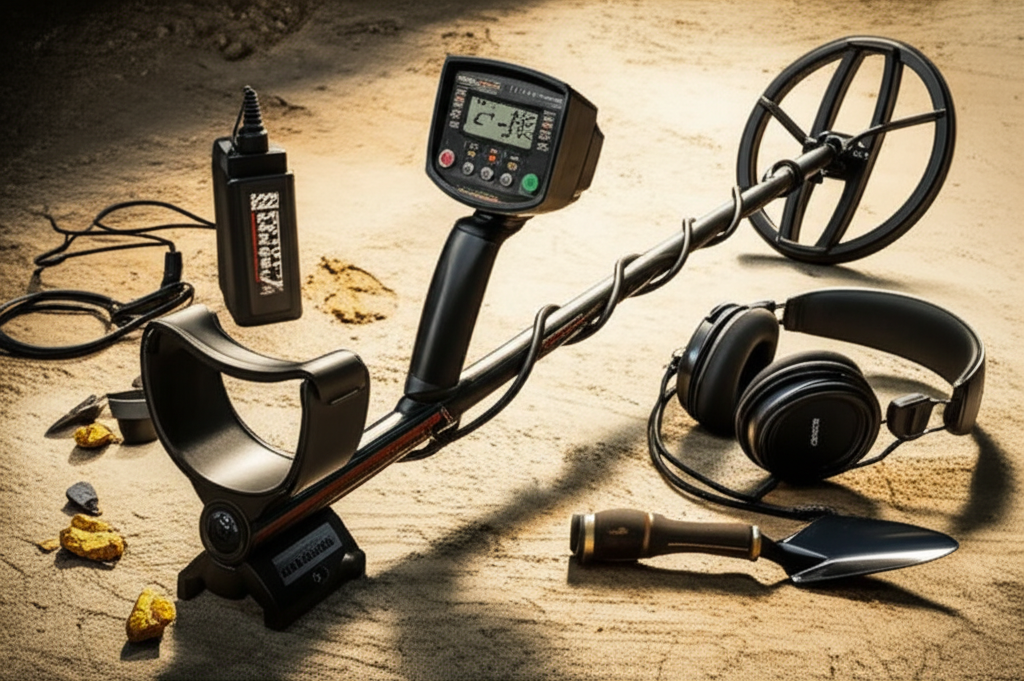
You’ll need robust digging tools to extract your finds. A sturdy digging trowel or a specialized prospecting shovel is crucial for cutting plugs of soil cleanly. A gold pan is, of course, a fundamental tool for separating gold from sediment, especially in stream beds or areas where gold has been washed. Don’t forget a small vial or container to safely store your precious discoveries.
Understanding Gold Bearing Terrains
Gold can be found in various geological settings, and knowing where to look is as important as having the right detector. Placer gold deposits are formed when gold erodes from its primary source (lode deposits) and is transported by water, accumulating in stream beds, gravel bars, and ancient river channels. Lode deposits are veins of gold embedded within hard rock. Understanding the geology of your prospecting area will greatly influence your search strategy and the type of detector that will perform best.
Ground Balancing: Your Secret Weapon Against Mineralization
Many gold-rich areas are characterized by highly mineralized soil. This mineralization can create false signals or mask the faint signals from gold. Effective ground balancing is the detector’s ability to distinguish between the mineralized soil and the metallic signal of gold. Most dedicated gold detectors have automatic or manual ground balancing features that allow you to tune out these unwanted ground effects, letting you hear the gold.
Coil Selection for Different Gold Types
When hunting for gold, the coil you use can make a significant difference. For extremely small gold flakes or very fine gold dust, a small, high-frequency elliptical coil is often the best choice. These coils offer superior sensitivity to tiny targets and allow you to probe tight crevices and mineralized areas with precision. For larger nuggets or sweeping vast areas, a larger, more general-purpose coil might be more efficient, providing better depth and coverage.
Tips for Maximizing Your Gold Finds
Beyond the gear, your technique and knowledge play a huge role in successful gold prospecting. Patience is key, as is persistence. Learn to interpret your detector’s signals, and don’t be afraid to dig targets that might seem marginal. Researching the geological history of your prospecting area can provide invaluable clues about where gold might be concentrated. Always follow local regulations regarding prospecting and claim ownership.
Frequently Asked Questions About Gold Detectors
What is the best metal detector for beginners looking for gold?
For beginners, the Garrett AT Gold or the Nokta Makro Gold Finder 2000 are excellent starting points. They offer good gold-detecting capabilities without being overly complex or prohibitively expensive, making them ideal for learning the ropes of gold prospecting.
How deep can a gold metal detector find gold?
Depth is influenced by many factors, including the size of the gold nugget, the detector’s frequency and technology, coil size, and ground mineralization. High-end gold detectors with specialized coils can detect small nuggets at depths of several inches to over a foot in ideal conditions.
Is a VLF or Pulse Induction (PI) detector better for gold?
Very Low Frequency (VLF) detectors, especially those operating at higher frequencies, are excellent for general gold prospecting and can discriminate between different types of targets. Pulse Induction (PI) detectors are generally better for highly mineralized ground and can offer greater depth but typically cannot discriminate and will signal on all metals.
Can I use my regular coin-shooting metal detector for gold?
While some general-purpose detectors with high frequencies and good ground balancing can find gold, they are usually not as sensitive or as effective as detectors specifically designed for gold prospecting. You’ll likely miss smaller nuggets and struggle more in mineralized soil.
How important is ground balancing for gold detection?
Ground balancing is critically important. Gold is often found in mineralized soil, which can produce strong signals that can mask or mimic gold signals. Proper ground balancing allows the detector to ignore these mineral effects, making it easier to detect actual gold targets.
What is the role of the coil in gold detecting?
The coil is how your detector senses metal. For gold, smaller, higher-frequency coils are often preferred because they are more sensitive to the tiny targets characteristic of gold. Different coil shapes and sizes are better for different prospecting scenarios, such as tight spaces or open areas.
Final Verdict: Your Path to Gold
Choosing the best metal detector for gold is a significant step towards realizing your prospecting dreams. Whether you opt for a high-end professional model like the Minelab GPX 6000, a versatile all-rounder like the Garrett AT Gold, or a budget-friendly powerhouse like the Nokta Makro Gold Finder 2000, remember that the right tool, combined with knowledge and persistence, will significantly increase your chances of unearthing those coveted gold nuggets. Happy hunting!
