


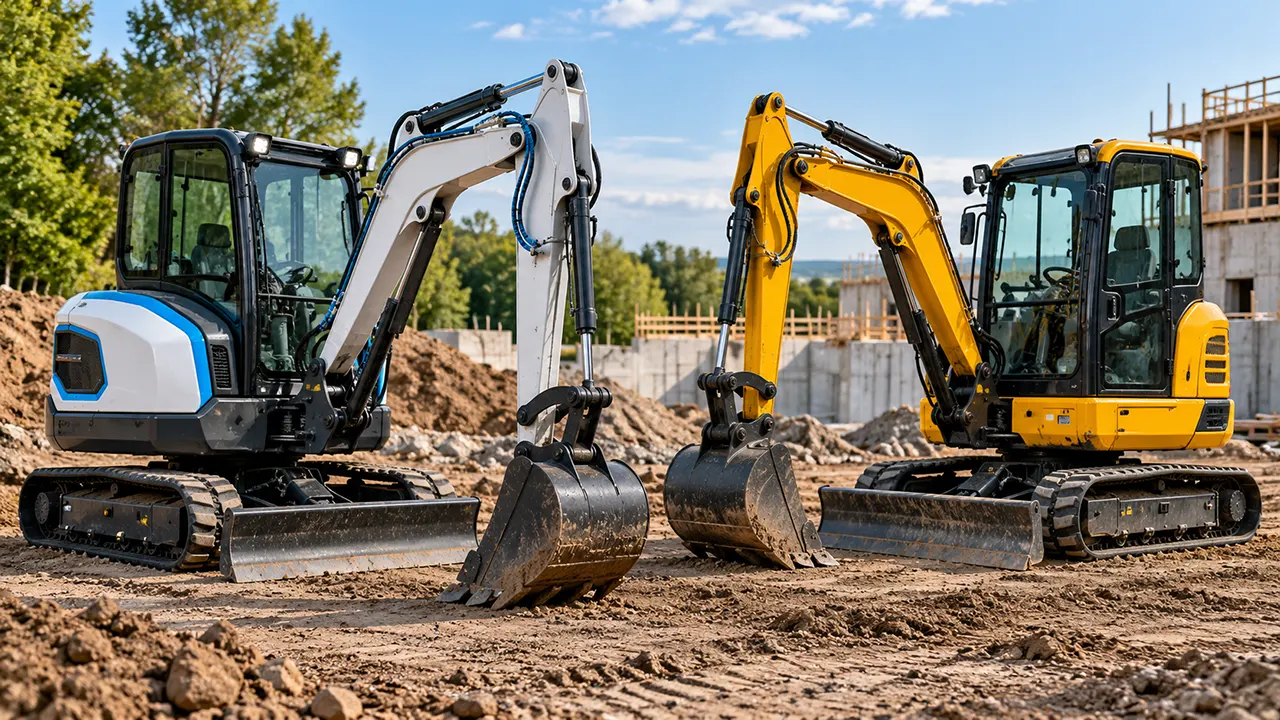
An electric mini excavator can cost less to operate than a diesel machine, but the savings depend on how often you use it, what you pay for energy, and how you charge it. The JCB 19C-1E and JCB 19C-1 offer a useful comparison because they share key machine characteristics. The best choice comes down to total ownership cost, jobsite needs, and productive working time.
If you are buying a mini excavator for a US construction, landscaping, or utility business, the purchase price is only part of the decision. You also need to account for fuel or electricity, maintenance, charging downtime, financing, and resale value.
Affiliate disclosure: This article contains no affiliate links. It uses manufacturer documentation and published information to compare the machines.
Electric vs. diesel mini excavators: Which is better?
An electric mini excavator is often the better fit for indoor work, noise-sensitive locations, and jobs with reliable charging access. A diesel mini excavator is often more practical for remote sites, long shifts, and work where refueling is easier than recharging. Neither power type guarantees a lower total cost for every contractor.
| Factor | Electric mini excavator | Diesel mini excavator |
|---|---|---|
| Upfront cost | Requires a machine quote and may involve additional charging costs | Published starting prices may be available |
| Energy cost | Depends on electricity consumption and the actual utility rate | Depends on fuel consumption and delivered diesel price |
| Runtime | Limited by battery capacity and workload | Limited mainly by fuel supply and operating conditions |
| Refueling or charging | Requires a compatible electrical supply and sufficient charging time | Can refuel relatively quickly where diesel is available |
| Routine maintenance | No diesel engine or engine oil system | Requires engine-related servicing |
| Indoor operation | No exhaust emissions at the machine’s point of use | Produces exhaust that requires suitable ventilation and controls |
| Noise | Generally quieter during operation | Engine noise adds to overall machine noise |
| Resale | Future battery condition and buyer demand matter | Engine condition, service history, and buyer demand matter |
The table describes typical differences. Exact performance, operating costs, and service requirements depend on the specific model and configuration.
How do the JCB 19C-1E and 19C-1 compare?
The JCB 19C-1E is a battery-electric version of the JCB 19C-1 diesel mini excavator. JCB describes the electric model as retaining the diesel machine’s key digging and hydraulic characteristics. That makes the pair a useful starting point for evaluating the effect of changing the power source without deliberately comparing machines from different size classes.
JCB
+2
Purchase price and financing
JCB’s US website lists the 19C-1 diesel model starting at $33,995. The electric 19C-1E page asks buyers to request a price, so a current, directly comparable US retail price was not available in the published information reviewed for this article.
JCB
+1
That missing electric quote matters. Without it, you cannot accurately calculate the electric model’s purchase premium or determine how long operating savings might take to recover the difference.
Before comparing financing offers, request quotes for both machines with the same configuration, delivery terms, applicable fees, and warranty coverage. Check the interest rate, loan term, down payment, and any required charging equipment. A financing promotion can change monthly payments, but it does not automatically make one machine cheaper over its full ownership period.
Digging performance and attachments
JCB states that the electric model retains the key performance characteristics of its diesel counterpart, including digging capability and hydraulics. Its published electric-model specifications include a maximum digging depth of approximately 2.81 meters and bucket tearout of 18 kN. Confirm the specifications for the exact US configuration before treating those figures as a purchasing guarantee.
JCB
+1
For your own comparison, check:
- Maximum digging depth and reach.
- Bucket tearout and lifting capability.
- Auxiliary hydraulic flow and pressure.
- Compatibility with breakers, thumbs, augers, and other attachments.
- Whether continuous hydraulic attachment use reduces available battery runtime.
A machine that costs less per hour is not necessarily cheaper to use if it takes longer to finish the job or cannot run the attachment you need.
Noise and exhaust
The electric JCB produces no exhaust emissions at the machine’s point of use. JCB also reports that operator-station noise is 10 dB lower than on the diesel version. That can be valuable for indoor work and locations where noise affects workers, residents, or nearby businesses.
JCB
+1
Electric power does not mean the entire jobsite is emission-free. Electricity generation, material transport, and other equipment still have environmental impacts. The practical benefit is that the excavator itself does not produce diesel exhaust while operating.
How much does each mini excavator cost to operate per hour?
Electricity can be less expensive than diesel fuel on an energy-cost basis, but a reliable comparison needs actual energy consumption for each machine. Manufacturer claims about lower running costs are useful context, not a substitute for measured consumption and a transparent cost model.
Electric excavator electricity cost
Calculate electricity costs using the energy drawn from the grid, including charging losses.
\[ \text{Electricity cost per hour} = \text{kWh consumed per hour} \times \text{Electricity price per kWh} \]
For example, if a machine draws 4 kWh from the grid per operating hour and the electricity rate is $0.15 per kWh, its electricity cost would be $0.60 per operating hour. These are illustrative inputs, not measured consumption or a verified JCB operating-cost figure.
The actual rate may differ because of commercial electricity tariffs, demand charges, time-of-use pricing, and the availability of charging at the jobsite.
Diesel mini excavator fuel cost
Calculate diesel fuel cost using the amount of fuel consumed per operating hour.
\[ \text{Fuel cost per hour} = \text{Gallons consumed per hour} \times \text{Diesel price per gallon} \]
For illustration, a diesel excavator consuming 0.8 gallons per hour at $4.00 per gallon would cost $3.20 per operating hour in fuel. Those figures are hypothetical and should not be presented as measured consumption for the JCB 19C-1.
Fuel use changes with engine load, idle time, digging conditions, travel, and attachment use. Obtain consumption records or credible data for the specific machine and workload before using a number in a purchasing decision.
Compare total hourly costs, not just energy
Use the same operating-hour basis for both machines:
| Cost component | Electric | Diesel |
|---|---|---|
| Energy | Grid electricity, including charging losses | Diesel fuel |
| Routine maintenance | Electric-machine service requirements | Engine and machine service requirements |
| Repairs | Electrical, hydraulic, undercarriage, and other repairs | Engine, fuel system, hydraulic, undercarriage, and other repairs |
| Downtime | Charging delays and repair downtime | Refueling delays and repair downtime |
| Ownership | Financing and depreciation | Financing and depreciation |
Keep purchase financing and depreciation separate when reporting operating cost per hour. They belong in the broader total cost of ownership calculation.
How long can an electric mini excavator run compared with diesel?
The JCB 19C-1E manufacturer page advertises approximately five hours of operation for a standard application. Actual runtime depends on the workload, battery configuration, and operating conditions. JCB also offers different charging options, so the electrical supply available at the jobsite affects how quickly the machine can return to work.
JCB
+1
Light workloads
Light excavation, intermittent digging, and periods of low hydraulic demand may allow the battery to last longer than a demanding continuous-duty application. However, do not assume that a published runtime will apply to every job.
Track operating hours, battery charge before and after each task, and the attachments used. Those records provide a better estimate for your own work than a generic runtime claim.
Mixed workloads
Many landscaping and construction jobs involve digging, moving material, repositioning the machine, and waiting for other workers. This mixed pattern can differ significantly from continuous heavy digging.
Estimate runtime from the work you actually perform. If the machine must finish a full shift, consider whether charging during breaks, overnight charging, or access to a second machine is practical.
Demanding workloads and attachments
Continuous heavy digging or operating a high-demand hydraulic attachment can shorten runtime. In an Equipment World review and test run published in July 2024, a JCB product representative explained that continuous hydraulic hammer use could reduce the stated five-hour runtime to about three hours. That is a reported example, not a universal runtime guarantee.
YouTube
Charging versus refueling
Diesel machines have a practical advantage when fuel is available and the job requires continuous operation. Electric machines can be convenient when they can charge overnight or during planned breaks, but charging speed depends on the charger and electrical supply.
JCB publishes charging options for the 19C-1E, including 110V, 230V, and higher-voltage charging configurations. Confirm the exact charger available with the US machine and the installation requirements before buying.
JCB
+1
The key question is not simply how long the battery lasts. It is whether the machine can complete the required work within the time available, including charging and any resulting delays.
What does a five-year ownership-cost comparison show?
A five-year comparison should include the initial investment, annual operating expenses, financing, downtime, and the value of each machine at the end of the period. Do not assume the electric machine wins solely because it uses electricity instead of diesel.
Calculate annual operating costs
Use the following formula for both machines:
\[ \text{Annual operating cost} = \text{Energy or fuel} + \text{Maintenance} + \text{Other operating costs} \]
For the electric machine, include charging losses, electricity charges, maintenance, and other operating expenses. For the diesel machine, include fuel, maintenance, repairs, and other operating expenses.
Then calculate annual operating savings:
\[ S = O_d – O_e \]
Here, \(O_d\) is the diesel machine’s annual operating cost and \(O_e\) is the electric machine’s annual operating cost. Positive savings mean the electric machine costs less to operate under the assumptions used.
Include the purchase premium and infrastructure
The initial investment difference is:
\[ \Delta I = I_e – I_d \]
Include the electric machine’s purchase price, necessary charging equipment and installation, and other initial costs. Subtract only incentives that are verified and applicable to the buyer and machine.
A proper five-year comparison should then account for financing costs, downtime, any battery-related expenses, and resale value. Battery replacement should not be treated as inevitable within five years, but its cost and warranty coverage are relevant risks to investigate.
Understand the payback period
A simple payback estimate is:
\[ \text{Payback years} = \frac{\Delta I}{S} \]
This formula works only when annual savings are positive and reasonably stable. If the electric machine costs more to operate, there is no operating-cost payback under those assumptions.
Illustrative example: Suppose the electric machine and required charging setup cost $15,000 more than the diesel alternative, and the electric machine saves $5,000 per year in operating costs. The simple payback would be three years. These figures are hypothetical and are not a verified price premium or savings estimate for the JCB machines.
For a more accurate result, compare the cumulative cash flows year by year. Include financing, changes in annual utilization, electricity and diesel prices, downtime, maintenance, and expected resale value. This helps show whether savings are large enough to justify the extra initial investment.
When should you choose an electric mini excavator?
An electric mini excavator is worth serious consideration when the work environment rewards quiet operation, the machine’s capability matches the job, and charging can fit into the operating schedule.
Choose electric when:
- You regularly work indoors or in noise-sensitive locations.
- The machine can charge overnight or during planned breaks.
- You have a reliable electrical supply at the jobsite or base.
- Lower local exhaust emissions offer a clear operational benefit.
- The expected operating savings justify the additional investment.
The electric model is less suitable when charging access is uncertain, shifts require uninterrupted heavy work, or the cost of electrical infrastructure is disproportionate to annual utilization.
When is a diesel mini excavator the better choice?
Diesel is often the practical choice when jobs move between remote sites, fuel is easy to obtain, and downtime for charging would disrupt the work schedule.
Choose diesel when:
- You need long or unpredictable shifts without charging breaks.
- You work at remote locations with limited electrical access.
- Your attachment and workload requirements demand a careful runtime assessment.
- The purchase premium for electric equipment cannot be justified by expected savings.
- Your local dealer has better service access or parts availability for the diesel configuration.
A diesel machine still needs appropriate maintenance, exhaust controls, and safe operating practices. The right decision depends on the work, not on a blanket preference for one power source.
What should you verify before buying?
Use this checklist before requesting a final quote:
- Machine configuration: Match operating weight, digging depth, hydraulics, and attachment requirements.
- Electric purchase premium: Obtain a written quote for the electric model and necessary charging equipment.
- Charging infrastructure: Confirm voltage, charging rate, installation cost, and compatibility with your worksite.
- Warranty: Verify battery and machine coverage, duration, operating-hour limits, and exclusions.
- Service access: Check dealer support, technician availability, and parts lead times.
- Operating costs: Use actual electricity rates, delivered diesel prices, and credible consumption data.
- Financing: Compare the complete terms rather than advertised monthly payments alone.
- Resale value: Ask about comparable used machines, but treat future resale estimates as uncertain.
- Incentives: Confirm current eligibility and application requirements before subtracting any incentive from the purchase cost.
Frequently asked questions
1. Is an electric mini excavator cheaper to operate than diesel?
It can be. Electricity may cost less than diesel fuel for the same amount of useful work, and electric machines avoid diesel engine servicing. However, the actual savings depend on energy consumption, electricity rates, maintenance, utilization, charging downtime, and repair costs. Compare real machine data and the same workload before making a purchase decision.
2. How many hours can an electric mini excavator run on one charge?
Runtime varies by model, battery configuration, workload, and attachment use. JCB advertises approximately five hours for a standard application for the 19C-1E, but demanding continuous work can reduce runtime. Ask the dealer for estimates based on your intended duty cycle rather than assuming the advertised figure will cover every shift.
3. How much does it cost to charge an electric mini excavator?
Multiply the electricity drawn from the grid by your electricity price per kilowatt-hour. Include charging losses and any applicable demand charges. For example, 20 kWh drawn at $0.15 per kWh costs $3.00. This is an illustrative energy calculation, not a verified full-charge cost for a specific excavator.
4. Can an electric mini excavator handle demanding digging?
Some electric mini excavators are designed to match the digging characteristics of comparable diesel models. JCB states that the 19C-1E retains the key performance characteristics of the 19C-1. Buyers should still verify digging depth, breakout force, hydraulic flow, and attachment compatibility for the exact machine configuration.
5. How much does an electric excavator battery replacement cost?
A verified replacement cost for the JCB 19C-1E was not established in the sources reviewed. Request a written estimate from an authorized dealer and confirm battery warranty coverage, exclusions, and replacement procedures. Avoid treating an unverified battery price or assumed replacement interval as a known five-year ownership expense.
6. Can you charge an electric mini excavator at a remote jobsite?
You can if the site has a compatible electrical supply or a suitable charging solution. Confirm the voltage, current capacity, charger compatibility, installation requirements, and charging time before taking the machine to a remote location. If dependable charging is unavailable, diesel may be more practical.
7. Are electric mini excavators eligible for US tax incentives?
Eligibility depends on the specific program, machine, buyer, location, and purchase circumstances. Do not assume that an electric excavator qualifies for a particular federal or state incentive. Verify current requirements with the relevant government agency or a qualified tax professional before including an incentive in the cost model.
Make the decision using your own numbers
The JCB 19C-1E is a credible candidate for contractors who value low noise, no exhaust emissions at the machine’s point of use, and reduced engine-related servicing. The JCB 19C-1 remains a practical alternative for work that depends on flexible refueling and uninterrupted operation.
Before choosing, obtain comparable written quotes and calculate the cost per productive hour for your actual workload. You can also explore the ToolGuider electric mini excavator guide for additional model research.
The best machine is the one that meets your job requirements and delivers the stronger total ownership case, not necessarily the one with the lowest energy bill.
