


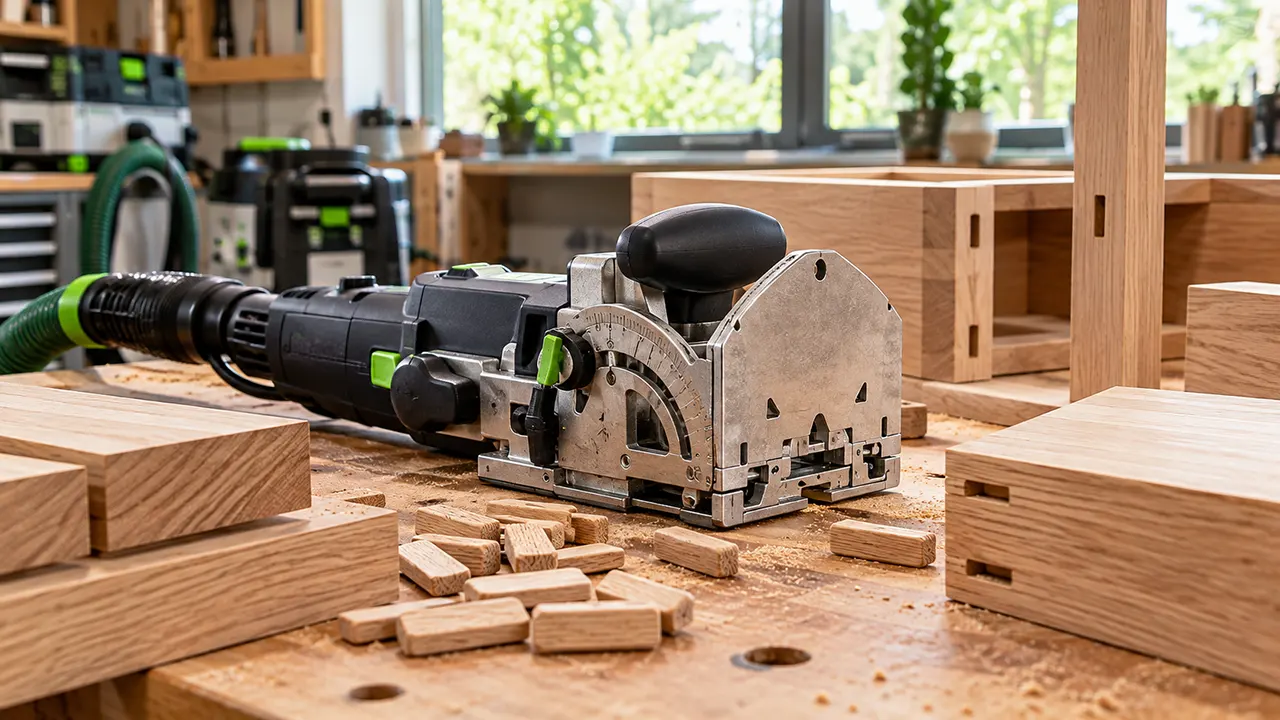
If you build furniture, cabinets, tables, doors, or other woodworking projects, you may have heard of the Festool Domino joiner.
It is a premium loose-tenon joinery tool designed to cut matching mortises quickly and accurately. Festool’s DOMINO system uses separate tenons that fit into those mortises to create strong, hidden joints.
But there is a bigger question in 2026:
Is a Festool Domino still worth the money when the new cordless DFC 500 costs $1,279 and Kreg now sells the Edge loose-tenon joiner for $499.99?
For professional woodworkers and frequent furniture makers, the answer can still be yes. For occasional DIY users, a doweling jig, biscuit joiner, or less expensive loose-tenon system may make more financial sense.
Here’s what you should know before buying one.
Quick Answer: Is the Festool Domino Worth It?
The Festool Domino is worth considering if you frequently build furniture, cabinets, frames, or other projects that need fast, repeatable loose-tenon joints. The cordless DFC 500 is currently listed by Festool USA at $1,279, while the corded DF 500 RQ-Set starts at $1,359. The DFC 500 adds cordless mobility but does not include a battery or charger in the E-Basic configuration.
If you only make furniture occasionally, the high price may be difficult to justify. The new Kreg Edge provides a much cheaper cordless route into loose-tenon joinery at $499.99 for a kit with a 4.0Ah battery and charger.
The key question is not whether the Domino works. It is whether its speed, precision, indexing system, and mature ecosystem will save you enough time to justify the premium.
What Is a Festool Domino Joiner?
A Festool Domino joiner is a specialized woodworking machine that cuts elongated mortises into wood.
You then insert a separate wooden DOMINO tenon into the mortise. When the matching mortise is cut in the second workpiece, the tenon connects the two pieces.
This is called loose-tenon joinery or floating-tenon joinery.
Traditional mortise-and-tenon joinery normally requires you to create the mortise in one workpiece and the tenon as part of the other workpiece. A loose-tenon system creates matching mortises in both pieces and uses a separate tenon.
The result is a hidden joint that can provide strong resistance to twisting while making furniture assembly much faster.
Festool positions the DOMINO system for applications including frame construction, panel joinery, stable miters, thin stock, round-profile joints, and removable connectors.
How Festool Domino Joinery Works
The basic process is simple.
- Mark the joint location.
- Position the Domino joiner.
- Set the fence and mortise depth.
- Plunge the cutter into the workpiece.
- The machine creates an elongated mortise.
- Repeat the cut on the mating workpiece.
- Apply glue.
- Insert the DOMINO tenon.
- Assemble the joint.
The special cutting action allows the machine to create the elongated mortise without requiring you to manually remove material in several steps.
That is one reason the Domino is attractive for repeated furniture joinery.
Why the elongated mortise matters
A traditional round dowel creates a round hole.
A DOMINO creates a wider elongated mortise. That gives you some assembly adjustment in the direction of the elongated slot while maintaining a strong connection across the joint.
For furniture makers, this can make alignment and assembly easier.
What’s New About the Festool DFC 500 in 2026?
The DFC 500 is Festool’s cordless DOMINO joiner.
It uses Festool’s 18V battery system and is designed to provide the same general DOMINO workflow without a power cord getting in the way.
Festool USA currently lists the DFC 500 E-Basic from $1,279.
The official specifications include:
| Specification | DFC 500 |
|---|---|
| Power | 18V battery |
| No-load speed | 18,500 RPM |
| Weight | 7.5 lb |
| Maximum routing depth | 28 mm |
| Routing height adjustment | 5–30 mm |
| Mitre routing | 0–90° |
| Cutter sizes | 4, 5, 6, 8, 10 mm |
| Depth settings | 12, 15, 20, 25, 28 mm |
| Dust connection | 27 mm |
Why cordless matters
Cordless operation is particularly useful when working on large furniture pieces, panels, frames, or projects away from a convenient power outlet.
You can move the tool around the work instead of bringing the workpiece to the machine.
That benefit was also apparent in Bob Vila’s 2026 hands-on testing. Its testers liked being able to move the DFC 500 around larger workpieces and reported fast matching mortises and useful indexing points for repetitive work.
What Comes With the DFC 500?
This is an important detail when comparing prices.
The DFC 500 E-Basic is not a complete battery starter kit.
Festool’s listing shows the tool in an E-Basic configuration, so someone entering the Festool 18V ecosystem may also need to budget for a compatible battery and charger.
That means the $1,279 sticker price does not represent the complete cost for every buyer.
If you already own compatible Festool 18V batteries, the equation becomes much more attractive.
If you do not, calculate the complete setup before deciding.
Festool DF 500 vs DFC 500 vs DF 700
Festool offers several DOMINO machines, but they are not interchangeable versions of the same tool.
| Model | Best suited to | Power | Max depth |
|---|---|---|---|
| DF 500 | Furniture and cabinet joinery | Corded | 28 mm |
| DFC 500 | Furniture and cabinet joinery with cordless mobility | 18V cordless | 28 mm |
| DF 700 | Larger and heavier joinery | Corded | 70 mm |
The DF 500 RQ-Set is currently listed by Festool USA from $1,359, while the DFC 500 starts at $1,279.
The DFC 500 and DF 500 use the same general 4–10 mm DOMINO cutter range and offer 12–28 mm depth settings.
The DF 700 is the larger-format option for applications where deeper and larger joints are needed.
Which should you choose?
Choose the DFC 500 if cordless mobility matters and you already have the Festool battery ecosystem.
Choose the DF 500 if most of your work happens in a workshop and you prefer corded operation.
Choose the DF 700 if your projects require much larger loose-tenon joints.
For most furniture and cabinet work, the DF 500 and DFC 500 are the more relevant choices.
Festool DFC 500 vs Kreg Edge
This is the most interesting woodworking-tool comparison of 2026.
The reason is simple:
The price difference is huge.
Kreg currently lists the Edge 20V Ionic Drive Loose Tenon Joiner Kit at $499.99, including a 4.0Ah battery and charger. The bare tool is $449.99.
Festool’s DFC 500 is currently $1,279.
That puts the difference at roughly $779 before considering additional battery or accessory costs.
| Feature | Festool DFC 500 | Kreg Edge |
|---|---|---|
| Current U.S. price | $1,279 | $499.99 kit |
| Cordless | Yes | Yes |
| Battery system | Festool 18V | Kreg 20V Ionic Drive |
| Cutter speed | 18,500 RPM | 18,500 RPM |
| Cutter sizes | 4, 5, 6, 8, 10 mm | 5, 6, 8, 10 mm |
| Max mortise depth | 28 mm | Manufacturer specifies 7/16″–2-3/8″ material range; manual mode supports thicker stock |
| Fence range | 0–90° | 0–90° |
| Included battery | No in DFC 500 E-Basic | Yes |
| Positioning features | DOMINO indexing system | Edge stops and auto-centering accessories |
Kreg’s official specifications confirm 5, 6, 8 and 10 mm cutter compatibility, 18,500 RPM, a 0–90° adjustable fence, auto-centering accessories, configurable edge stops, and a stability base.
Is the Kreg Edge a Domino killer?
Not necessarily.
The Wood Whisperer had hands-on time with a pre-production Kreg Edge and described it as clearly aimed at the same type of loose-tenon joinery as the Domino, but specifically argued that it should not simply be considered a “Domino killer.”
Popular Woodworking also describes the Edge as serious competition for the Domino and emphasizes that the Festool machine has long been the benchmark in this category.
The better question is:
What do you get by spending roughly $779 more on the Festool?
For some users, the answer is a mature professional system, established workflow, precise positioning, and integration with an existing Festool setup.
For others, the Kreg Edge may provide enough capability at a dramatically lower price.
Festool Domino vs Biscuit Joiner
A Festool Domino is not simply a premium biscuit joiner.
Both machines can create hidden joints, but they use different connectors.
A biscuit joiner cuts slots for thin, compressed-wood biscuits.
A Domino cuts mortises for larger loose tenons.
Domino advantages
- Strong floating-tenon-style connection
- Good resistance to twisting
- Repeatable positioning
- Useful for furniture frames
- Excellent for panel and cabinet work
- Can handle miter joints
Biscuit joiner advantages
- Lower cost
- Simple alignment work
- Useful for panel alignment
- Mature and widely available system
- Often sufficient for occasional woodworking
If your main goal is panel alignment, you may not need a Domino.
If you regularly build furniture frames and want fast, repeatable loose-tenon joints, the Domino becomes much more compelling.
Festool Domino vs Dowels
Dowels are another major alternative.
A doweling jig can create strong hidden joints at a fraction of the price of a Domino.
The trade-off is workflow.
With a Domino, the machine is designed specifically around cutting matching loose-tenon mortises.
A doweling system requires careful positioning and drilling of round holes.
Choose dowels when:
- Budget matters.
- You make furniture occasionally.
- You already own a good doweling jig.
- You don’t need the Domino’s workflow.
Choose Domino when:
- You make many repeated joints.
- Speed matters.
- You value easy positioning.
- You build professional furniture or cabinets.
- You want a dedicated loose-tenon system.
Neither method is universally “better.”
They solve the same broad problem in different ways.
Festool Domino vs Pocket Screws
Pocket screws are even more different.
Pocket-hole joinery is excellent when you need:
- Fast assembly
- Accessible joints
- Easy disassembly
- Low equipment cost
- Practical cabinet construction
But pocket screws are often visible or require plugs when appearance matters.
A Domino joint can remain hidden.
For high-end furniture, the hidden nature of the joint can be a major reason to choose a loose-tenon system.
Is Festool the Only Domino Joiner?
No—but Festool is the company behind the DOMINO system and DOMINO brand.
Other companies now sell loose-tenon joiners that perform a similar type of work.
The Kreg Edge is the most obvious current U.S. competitor because it is a cordless loose-tenon joiner designed around the same general concept. Kreg officially calls it a Loose Tenon Joiner, not a Domino.
That’s an important distinction.
DOMINO refers to Festool’s system.
Loose-tenon joiner is the broader category.
So terms such as “Kreg Domino” are better avoided when discussing the products accurately.
What Does a Festool Domino Really Cost?
The tool price is only one part of the ownership cost.
Consider these expenses:
1. The machine
The DFC 500 is currently listed from $1,279 in the U.S.
2. Battery and charger
The DFC 500 E-Basic does not include them.
If you’re new to Festool’s 18V ecosystem, add the appropriate battery and charger to your budget.
3. Cutters
Different joint sizes require different cutter sizes.
4. DOMINO Tenons
You will need compatible DOMINO tenons for the joints you make.
5. Dust extraction
Festool provides a 27 mm dust-extraction connection on the DFC 500.
The Kreg Edge takes a different approach, with built-in chip-relief slots intended to reduce debris buildup and minimize the need for dedicated extraction during shorter work sessions.
The real lesson
Don’t compare:
$1,279 vs $499.99
and stop there.
Compare the complete workflow you will actually use.
Festool Domino Joiner Review
Because ToolGuider did not physically test the DFC 500, this review is based on official specifications, current pricing, and independent hands-on testing rather than pretending we personally used the tool.
Precision and repeatability
This is where the Domino’s appeal becomes obvious.
Bob Vila’s 2026 testing found that the DFC 500 made matching elongated mortises quickly and accurately, while its indexing points helped with repetitive placement.
For someone building many similar joints, repeatability can be worth more than raw motor power.
Speed
The Domino is designed around a very specific task.
Set the tool.
Position it.
Plunge.
Repeat.
That workflow can be dramatically faster than building traditional mortise-and-tenon joints by hand.
Cordless mobility
The DFC 500’s biggest practical difference from the traditional DF 500 is mobility.
Festool’s 2026 launch material specifically positions the DFC 500 as a cordless tool for strong, repeatable joints without the constraint of a cord.
Ergonomics
The DFC 500 weighs 7.5 pounds according to Festool.
That is not a lightweight hobby tool.
But for a professional joinery machine, the important question is whether the weight and design make repeated positioning comfortable and controlled.
Dust management
The DFC 500 has a 27 mm dust-extraction connection.
If you already own a compatible dust extractor, this is a straightforward part of the workflow.
If you’re buying the entire system from scratch, include dust extraction in your overall budget.
Value
This is where the DFC 500 becomes difficult to rate universally.
At $1,279, it is expensive.
But the price may be easier to justify for a professional furniture maker who uses it every week than for someone who makes a dining table once a year.
When Is a Festool Domino Worth It?
The Domino becomes easier to justify as your workload increases.
It makes sense when:
- You build furniture frequently.
- You make many repeated joints.
- You build cabinets.
- You make tables and frames.
- You frequently work with miter joints.
- You value speed.
- You value repeatability.
- Your time has meaningful monetary value.
- You already own Festool batteries and accessories.
It is harder to justify when:
- You are a casual DIYer.
- You make only a few furniture projects each year.
- You mostly build simple outdoor projects.
- Your budget is limited.
- A doweling jig already meets your needs.
- You mainly need panel alignment rather than structural joinery.
Who Should Buy the Festool DFC 500?
The DFC 500 is particularly attractive for a woodworker who:
- Already owns Festool 18V batteries.
- Frequently works away from a fixed power outlet.
- Builds furniture or cabinets.
- Makes many repeated joints.
- Wants cordless mobility.
- Values the established DOMINO system.
Its 18V platform, 28 mm maximum routing depth, 0–90° mitre range, and 4–10 mm cutter compatibility make it a versatile standard-size DOMINO machine.
Who Should Buy the Corded DF 500?
The DF 500 RQ-Set may make more sense when:
- Your work is mostly in a workshop.
- You don’t need cordless mobility.
- You prefer continuous corded operation.
- The included accessories fit your workflow.
- You don’t already have the Festool battery ecosystem.
The current U.S. price is $1,359, only $80 above the DFC 500’s listed starting price, although the configurations are not identical.
Who Should Buy the DF 700?
The DF 700 DOMINO XL is the better direction when you’re working with larger stock and need substantially deeper joints.
Think about:
- Large tables
- Thick doors
- Beds
- Large frames
- Heavy furniture
- Thick slabs
For ordinary cabinet and furniture joinery, the DF 500 or DFC 500 is usually the more appropriate class of tool.
Who Should Buy the Kreg Edge Instead?
The Kreg Edge deserves serious consideration if the price of the Festool is difficult to justify.
The current $499.99 kit includes:
- Edge joiner
- 4.0Ah battery
- Charger
- Narrow Stock Guide
- Stability Base
- 6 mm cutter
- Sample 6 mm tenons
Kreg also supports 5, 6, 8 and 10 mm cutters and tenons.
Choose Kreg if:
- You want cordless loose-tenon joinery at a lower price.
- You are starting from scratch.
- You don’t need the Festool ecosystem.
- You are a serious hobbyist or value-focused woodworker.
Choose Festool if:
- You use the system heavily.
- You already own Festool tools.
- Workflow and precision matter more than initial price.
- The tool will earn its cost through repeated use.
How to Find a Festool Domino Deal
If you’re shopping for a Festool Domino, don’t look only at the headline price.
Compare:
- DF 500 vs DFC 500
- Basic vs complete sets
- Battery inclusion
- Included cutters
- Included stops and accessories
- Warranty
- Authorized dealer status
- Current promotions
- Availability
The current Festool USA product listings are a good starting point for checking official specifications and pricing.
A “deal” on a bare tool may not be cheaper for you if you still need to purchase batteries, chargers, cutters, and other accessories.
Festool Domino Joiner: Pros and Cons
Pros
- Fast loose-tenon joinery
- Excellent repeatability
- Hidden joints
- Strong, twist-resistant connections
- Useful for furniture and cabinet work
- Excellent for repeated production work
- DFC 500 provides cordless mobility
- Wide range of DOMINO accessories and tenons
- 0–90° fence adjustment
Cons
- Very expensive
- DFC 500 E-Basic requires separate battery and charger
- Consumables add to the ownership cost
- Overkill for many occasional DIY projects
- Requires investment in a dedicated joinery ecosystem
Final Verdict: Is the Festool Domino Worth It in 2026?
Yes—if you will use it enough.
The Festool Domino remains one of the most compelling dedicated solutions for fast, repeatable loose-tenon joinery.
The new DFC 500 makes the system more flexible by removing the power cord. Festool currently lists it at $1,279, with 18V operation, 18,500 RPM, 28 mm maximum routing depth, 0–90° mitre routing, and 4–10 mm cutter compatibility.
Independent 2026 testing also gives the DFC 500 meaningful support. Bob Vila’s testers praised its fast matching mortises, cordless mobility and indexing system.
But the buying decision is more complicated than it was before.
The Kreg Edge now offers cordless loose-tenon joinery for $499.99 with a battery and charger.
That makes the question much more interesting:
Do you need the Festool DOMINO system, or do you simply need a good loose-tenon joiner?
If you are a professional furniture maker, cabinetmaker, or serious woodworker who will use the machine constantly, the Festool’s workflow and mature ecosystem can justify the premium.
If you’re an occasional woodworker, the Kreg Edge, doweling jig, or even a biscuit joiner may deliver better value.
For most buyers, the best Domino is not the most expensive one. It is the one you will use often enough to earn its cost.
Frequently Asked Questions
What is a Festool Domino joiner?
A Festool Domino joiner is a specialized loose-tenon machine that cuts elongated mortises for DOMINO Tenons. It is designed for fast, repeatable furniture, cabinet, frame, panel, and other woodworking joints.
Is Festool the only Domino joiner?
No. Festool owns the DOMINO system and brand, but other manufacturers sell loose-tenon joiners. The Kreg Edge is a current cordless alternative in the U.S. market.
How much does the Festool DFC 500 cost?
Festool USA currently lists the DFC 500 E-Basic from $1,279. The E-Basic configuration does not include a battery and charger.
How much does the Festool DF 500 cost?
Festool USA currently lists the DF 500 RQ-Set from $1,359.
Is the Festool Domino better than a biscuit joiner?
They serve different purposes. A Domino uses loose tenons and is particularly suited to furniture and structural-style joinery, while a biscuit joiner uses thin biscuits and can be a more economical choice for alignment and lighter joining applications.
Is a Domino better than dowels?
Not universally. Dowels can produce strong joints at much lower equipment cost. A Domino’s main advantage is its dedicated workflow, fast positioning, elongated mortises, and repeatability.
Is the Kreg Edge a Festool Domino alternative?
Yes. The Kreg Edge is a loose-tenon joiner aimed at the same general type of joinery. It is considerably cheaper than the DFC 500, but it uses Kreg’s own 20V Blue Ion battery ecosystem.
Is the DFC 500 cordless?
Yes. The DFC 500 runs on Festool’s 18V battery system.
What size DOMINO can the DFC 500 use?
The DFC 500 supports 4, 5, 6, 8 and 10 mm DOMINO slot cutters, with depth settings of 12, 15, 20, 25 and 28 mm.
Is the Festool Domino worth buying for DIY?
For occasional DIY work, usually not. Its price is difficult to justify unless you frequently build furniture or need the speed and repeatability of a dedicated loose-tenon system.
Related ToolGuider Guides
If you’re building a complete woodworking-tool setup, these guides may also help:
A track saw can handle accurate panel cuts before the Domino handles the joinery, while a cordless brad nailer can help with trim, cabinet backs, temporary positioning, and other assembly tasks.
