


Published on: November 9, 2025 | Updated on: November 9, 2025
Master metal detector troubleshooting to solve common issues, boost your finds, and turn frustrating hunts into rewarding discoveries. This guide offers practical, step-by-step solutions for every detectorist.
Metal detecting is an amazing hobby. You can find old coins, lost jewelry, and historical relics. But sometimes, your metal detector doesn’t work right. This can be very frustrating when you’re out hunting for treasure. Don’t worry! Most metal detector problems have simple fixes. I’ve spent years in the field with all kinds of detectors. I’ve learned how to solve many common issues. This guide will walk you through essential metal detector troubleshooting. We’ll cover everything from faint signals to false alerts. You’ll learn how to get your detector working perfectly again. This will help you find more treasures and enjoy your hunts more.
Why Your Metal Detector Might Be Acting Up
Understanding common metal detector problems helps you fix them faster and get back to finding treasures. Your metal detector might seem mysterious when it acts up. Several factors can cause performance issues. These range from simple settings to external interference. Recognizing these causes is the first step to effective troubleshooting. It’s like a doctor understanding symptoms before treating a patient.
Your metal detector is a sensitive piece of equipment. It works by sending out a signal and listening for echoes. Anything that disrupts this process can cause problems. This could be low batteries, a loose connection, or even nearby electrical sources. Sometimes, the ground itself can affect how it works. Understanding these basic principles helps demystify why your detector might be acting up. We’ll explore these common culprits in detail.
The Absolute Basics: Batteries and Connections
Before diving into complex issues, always check the simplest things: your batteries and all cable connections. This is the most common reason for a metal detector to misbehave. If your detector is weak or won’t turn on, the batteries are usually the issue. Even if your detector turns on, weak batteries can cause erratic behavior and false signals. Always use fresh, good-quality batteries.
Check all connections to ensure they are secure. This includes the coil cable, headphones, and any other accessories. A loose coil cable is a frequent cause of phantom signals. Wiggle them gently to make sure they are snug. A loose connection can let in moisture or just not make good contact. This prevents the detector from sending or receiving signals properly.
Understanding False Signals and How to Stop Them
False signals are annoying noises that make you dig for nothing, but troubleshooting can eliminate them. False signals are signals that don’t come from a target. They can be loud beeps or chirps that lead you on a wild goose chase. These phantom signals are one of the most frustrating parts of metal detecting. They waste your time and can make you lose confidence in your machine.
There are several reasons for false signals. These include electromagnetic interference (EMI), ground mineralization, and incorrect settings. EMI can come from power lines, cell phones, or even other metal detectors nearby. Ground mineralization is caused by minerals in the soil, which can fool your detector. Understanding these causes is key to fixing the problem.
Electromagnetic Interference (EMI)
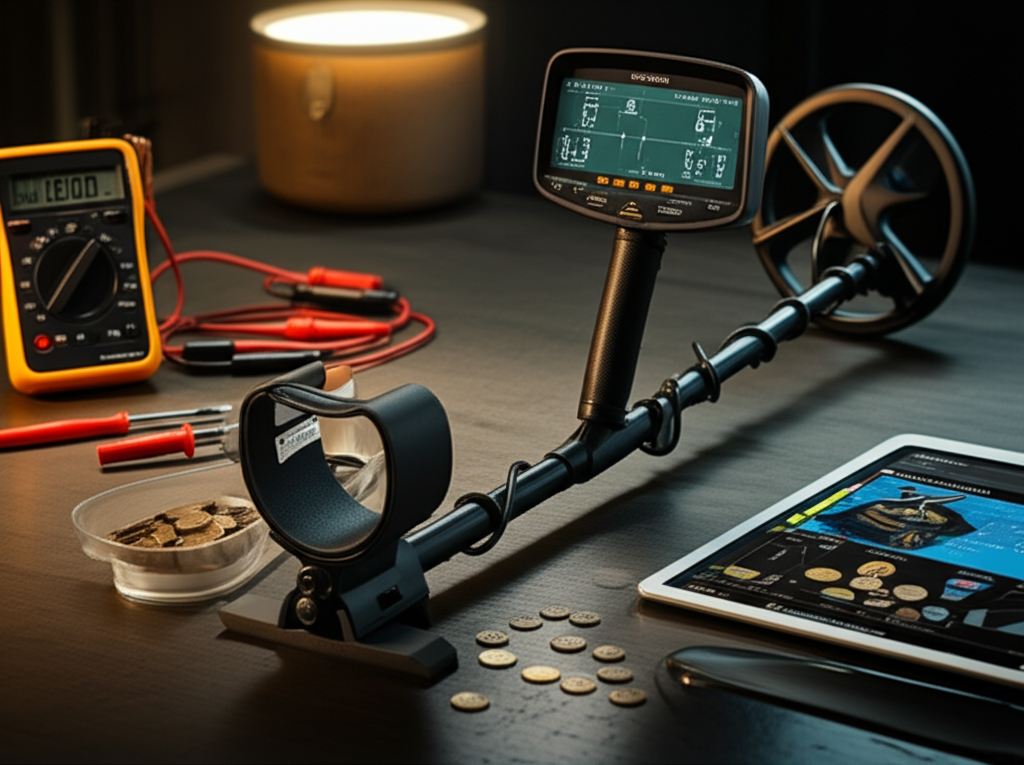
EMI is like radio static for your metal detector, often caused by electronics or power lines. Your metal detector works with electrical signals. Other electrical devices can interfere with these signals. This interference is called Electromagnetic Interference, or EMI. It can come from power lines, buried utility boxes, or even your own cell phone. Sometimes, other detectorists nearby can cause EMI.
When EMI is strong, it can overwhelm your detector’s ability to pick up real targets. This results in constant chatter or loud, false signals. The best way to deal with EMI is to move away from the source. If you’re hunting near power lines, try a different spot. Turn off any electronic devices you are carrying, like cell phones or GPS units, if possible.
Ground Mineralization Issues
Different soils have different minerals that can affect your detector’s performance. The ground you are searching in can also cause false signals. This is called ground mineralization. Some soils contain a lot of iron or other minerals. These minerals can mimic the signal of a metal object. Your detector might “see” the minerals as a target.
Most metal detectors have a feature called “ground balance.” This helps the detector ignore the minerals in the soil. Some detectors do this automatically, while others require manual adjustment. If you’re getting a lot of false signals, try adjusting your ground balance. Check your detector’s manual for specific instructions. Different terrains require different settings.
Coil Sensitivity and Other Settings
Adjusting your metal detector’s sensitivity and other settings can help reduce false signals. Your metal detector has many settings that you can adjust. One of the most important is sensitivity. If your sensitivity is set too high, your detector can become unstable. It might pick up tiny changes in the ground or EMI. This leads to constant false signals.
Try lowering the sensitivity setting a little. You want to find a balance. You want the detector to be sensitive enough to find targets. But not so sensitive that it’s constantly chattering. Other settings like discrimination and threshold can also affect false signals. Experiment with these settings to find what works best for your detector and your hunting conditions.
Weak or Faint Signals: What’s Going On?
If your metal detector is giving weak signals, it might be missing targets or picking them up poorly. A weak or faint signal is a signal that is barely audible or very inconsistent. This is the opposite of a loud, clear signal. It can make you unsure if there’s a target or not. It’s frustrating when you think you might have a target but can’t be sure.
There are several reasons why you might be getting weak signals. The target might be small, deep, or made of a less conductive material. It could also be that your detector settings are not optimal for the conditions. Let’s explore how to improve signal strength. Getting a good signal is crucial for finding those hidden treasures.
Target Depth and Size
Deeper or smaller targets naturally produce weaker signals for your metal detector. The depth and size of a target are key factors. A small coin buried deep will naturally produce a weaker signal than a large object near the surface. Your detector’s ability to pick up faint signals depends on its design and settings. Some detectors are better at finding deep targets than others.
If you suspect a target is deep, try increasing your sensitivity slightly. Also, try sweeping the coil slower and more deliberately. Sometimes, a different coil can help. Larger coils can often detect deeper targets. Smaller coils are better for pinpointing and can be more sensitive to small objects.
Coil Type and Sweep Speed
Using the right coil and sweeping at the correct speed are vital for strong target signals. The type of coil you use can significantly impact your finds. Different coils have different strengths. A larger coil covers more ground and can detect deeper. A smaller coil is more precise and better for trashy areas or finding small items.
Your sweep speed is also very important. Sweeping too fast can cause you to miss targets. It means your coil doesn’t spend enough time over the object. Try to sweep your coil at a consistent, moderate pace. Imagine you are painting the ground with your coil. This ensures you give each spot enough attention.
Ground Balance and Settings
Correctly setting your ground balance and other detector features can boost weak signals. As we discussed with false signals, ground balance is crucial. If your ground balance is not set correctly for the mineralization in the soil, it can mask faint signals. A properly balanced detector will ignore the ground minerals. This allows weaker target signals to come through clearly.
Experiment with your detector’s sensitivity and gain settings. Be careful not to set them too high, which can cause instability. Sometimes, adjusting the discrimination setting can help. If you have too much discrimination, you might be filtering out weaker signals from desirable targets. Understanding your detector’s manual is key here.
When Your Detector Won’t Turn On
If your metal detector refuses to power on, the solution is usually simple and related to its power source. This is perhaps the most alarming issue a detectorist can face. You’re ready to hunt, and your detector is completely dead. This can be a showstopper for your treasure hunting plans. Fortunately, this is often the easiest problem to fix.
The vast majority of “won’t turn on” issues are related to the power supply. This means batteries or the power connection. Before you assume your detector is broken, go through these basic checks. They are quick and can save you a lot of worry and potential repair costs.
Battery Check and Replacement
Always start with fresh batteries; depleted or improperly installed batteries are the most common cause of a non-responsive detector. This is the number one reason a detector won’t turn on. Check that your batteries are installed correctly. Make sure the positive and negative ends are in the right place. Even a slightly misaligned battery can prevent power.
If the batteries are installed correctly, try a fresh set. Batteries can lose their charge even if they haven’t been used recently. Use high-quality batteries for best performance. Some detectors have a battery indicator; if yours does, check it. If it shows low, replace them immediately.
Battery Compartment and Contacts
Inspect the battery compartment for corrosion or debris that might be preventing a good connection. Look inside the battery compartment. Are there any signs of corrosion? Corrosion looks like a white or greenish powder. It can build up on the battery contacts. This prevents electricity from flowing.
You can clean battery contacts gently with a pencil eraser or a cotton swab dipped in white vinegar. Make sure to dry them thoroughly afterward. Also, check that the battery compartment door closes properly. A loose door can interrupt the power connection.
Dealing with a Chattering or Unstable Detector
A detector that chatters or behaves erratically is often affected by environmental factors or settings. A chattering detector is one that makes a lot of noise without a clear target. It’s constantly beeping, buzzing, or making other sounds. This makes it very hard to hear actual target signals. It’s like trying to listen to a quiet conversation in a noisy room.
This instability can be caused by several things. These include strong EMI, highly mineralized ground, or settings that are too sensitive. It’s important to identify the cause to correct it. Stable operation is key to successful metal detecting.
Environmental Factors
External influences like power lines or nearby electronics can cause your detector to chatter. As mentioned before, EMI is a major cause of chattering. Power lines, underground cables, and even mobile phones can emit signals that interfere with your detector. If you notice your detector chattering when you are near certain structures, this is likely the cause.
Another environmental factor is the ground itself. Highly mineralized soil can cause your detector to react. This is especially true if your ground balance is not set correctly. Beaches with wet salt sand are notorious for causing instability. In these situations, you need to adjust your settings or move to a different area.
Detector Settings and Coil Issues
Incorrect settings or a faulty coil can also lead to a constantly chattering metal detector. If your detector’s sensitivity is set too high, it can become unstable. It will pick up every little change in the ground or electromagnetic field. Lowering the sensitivity can often solve this problem. You might also need to adjust the threshold setting. The threshold is a low hum your detector makes.
A damaged or faulty coil can also cause chattering. Check the coil cable for nicks or cuts. Ensure the coil is screwed on tightly to the control box. If you suspect the coil itself is damaged, you might need to test it with a known good coil.
Coil Issues: The Heart of Your Detector
Your metal detector’s coil is crucial; problems with it directly impact your ability to find targets. The coil is the part of your detector that actually “sees” underground. It’s a critical component. If your coil isn’t working correctly, your entire detector will suffer. Issues with the coil are common and have specific troubleshooting steps.
Coil problems can range from simple loose connections to physical damage. It’s important to inspect your coil regularly. Treating your coil with care will prevent many potential issues. A well-maintained coil is essential for good performance.
Inspecting the Coil for Damage
Visually check your coil for cracks, deep scratches, or damage to the cable and connector. Carefully examine the entire coil. Look for any cracks or deep gouges. These can allow moisture to enter the coil. Moisture inside the coil can cause erratic signals or complete failure.
Pay close attention to the coil cable. Check for any cuts, kinks, or fraying. Ensure the cable is not being pinched anywhere. Also, inspect the connector where the coil cable plugs into the control box. Make sure it’s clean and not damaged.
Coil Cable and Connections
A loose or damaged coil cable is a frequent source of signal loss or erratic detector behavior. The cable connecting the coil to the control box is vital. If this connection is loose, your detector might not receive signals properly. This can result in weak signals or no signals at all.
Make sure the cable is securely plugged into the control box. Some detector models have a screw-on connector for added security. Ensure this is tightened. If the cable appears damaged, it might need professional repair or replacement. Never try to repair a coil cable yourself unless you have specific expertise.
Pinpointing Your Finds: A Crucial Skill
Accurate pinpointing helps you find targets faster, reducing digging and increasing your success rate. Once your metal detector signals a target, you need to pinpoint its exact location. This is the process of finding the center of the target. Good pinpointing skills are as important as having a good detector. They save you time and effort.
Digging a large plug of dirt when the target is small is wasteful. It can also damage the target. Learning to pinpoint accurately will make your digs much cleaner and more efficient. Most detectors have a pinpoint mode, or you can learn to do it by ear.
Using Your Detector’s Pinpoint Mode
Most modern metal detectors have a dedicated pinpoint mode to help you find the exact target location. Many metal detectors have a special “pinpoint” button or mode. When you activate this mode, the detector’s tone will change. It usually becomes more constant and the pitch or volume increases as you get closer to the target.
To use it, center your coil over the target area. Then, activate the pinpoint mode. Slowly move the coil around. Listen for the strongest signal. This strongest signal indicates the center of the target. This feature is invaluable for precise location.
Manual Pinpointing Techniques
Even without a pinpoint mode, you can accurately locate targets by listening to signal changes. You can also pinpoint targets without a special mode. Sweep your coil over the target area from different directions. Listen for the loudest, clearest signal. Mark the spot where the signal is strongest.
Try sweeping from north to south, then east to west. The point where these two strongest signals overlap is the center of your target. This takes practice but is a very effective method. Combining this with your detector’s audio cues will help you zero in on your prize.
Digging Tools: Essential for Recovery
Having the right digging tools makes recovering your finds much easier and prevents damage. Once you’ve pinpointed your target, you need to dig it up. The right digging tools are essential. They help you retrieve your treasure without damaging it or the ground. Using a poor tool can lead to frustration and lost finds.
Your choice of digging tools depends on the terrain and the type of targets you expect. A good trowel is a must-have for most situations. For tougher ground, you might need a specialized digging tool. Always aim for minimal disturbance.
Choosing the Right Tools
Select tools appropriate for your soil type and target depth to ensure successful and clean recoveries. For soft soil, a sturdy trowel is usually sufficient. For harder, compacted ground, a digging spade or a military-style entrenching tool can be more effective. Many detectorists use a digging knife as well. This is useful for cutting plugs of turf cleanly.
Consider a digging scoop. This tool is designed to remove soil and then sift it. This is very helpful in sandy or loose soil. Always carry a finds pouch to keep your treasures safe. Also, remember to fill in your holes neatly.
Best Practices for Digging
Always dig cleanly, recover your target, and meticulously fill your holes to preserve the environment. When you dig, try to cut a neat plug of turf. Lift the plug carefully and set it aside. Then, dig the soil underneath to retrieve your target. Use your pinpointer to confirm you have the target in your dug soil.
Once you’ve recovered your treasure, carefully replace the soil. Then, put the turf plug back on top. Pat it down firmly. Leave the area looking as if you were never there. This practice is essential for maintaining good relations with landowners and keeping digging spots open. Respecting the environment is paramount.
Advanced Troubleshooting and Maintenance
Regular maintenance and understanding advanced features can keep your metal detector in top condition. Beyond the basic troubleshooting steps, there are things you can do to keep your detector in good working order. This includes regular cleaning and understanding more advanced features. Proper care will extend the life of your detector. It will also ensure it performs at its best.
Think of your detector like any other tool. The better you care for it, the more reliable it will be. This section covers some key aspects of advanced care. It will help you get the most out of your treasure hunting adventures.
Cleaning and Storage
Keep your metal detector clean and store it properly to protect it from damage and the elements. After each hunt, clean your detector. Wipe down the control box, shaft, and coil. Use a damp cloth, but never submerge any part of the detector in water unless it’s specifically designed to be waterproof.
Store your detector in a dry place, away from extreme temperatures. A protective cover or a dedicated carrying bag is a good investment. This will shield it from dust, dirt, and accidental bumps. Proper storage prevents damage and keeps your detector ready for the next outing.
Firmware Updates and Manuals
Keeping your detector’s firmware updated and knowing your manual are key to optimal performance. Many modern metal detectors have firmware that can be updated. Check the manufacturer’s website periodically for updates. These updates can sometimes improve performance or fix bugs.
Always keep your detector’s user manual handy. It is an invaluable resource for understanding all the features and settings. It also contains specific troubleshooting advice for your model. Don’t be afraid to refer to it often.
Frequently Asked Questions (FAQ)
What is the most common metal detector problem?
The most common metal detector problem is related to batteries. This includes low batteries, dead batteries, or batteries installed incorrectly. Always start your troubleshooting with a fresh set of good-quality batteries.
Why does my metal detector keep beeping randomly?
Random beeping is usually caused by electromagnetic interference (EMI) from nearby electronics or power lines, highly mineralized ground, or settings that are too sensitive. Try moving away from potential EMI sources or adjusting your detector’s sensitivity and ground balance settings.
Can water damage my metal detector?
Yes, water can damage most metal detectors unless they are specifically designed to be waterproof. Moisture getting into the control box or coil can cause electrical shorts and irreparable damage. Always check your detector’s waterproof rating.
How often should I check my coil cable?
You should inspect your coil cable before and after every hunt. Look for any cuts, kinks, or damage. Ensure the connection to the control box is secure. A damaged cable can lead to erratic signals or complete signal loss.
What should I do if my detector suddenly stops working?
First, check the batteries and all connections. If those are fine, try turning it off and then back on again. If the problem persists, consult your detector’s manual for specific troubleshooting steps for your model. If you still can’t resolve it, contact the manufacturer or a repair service.
Conclusion: Troubleshooting for More Treasures
By understanding and applying these metal detector troubleshooting steps, you can overcome common issues and significantly improve your treasure hunting success. Metal detector troubleshooting might seem daunting at first. But by breaking down the problems into simple, manageable steps, you can solve most issues. Remember to always start with the basics: batteries and connections. Then, move on to understanding signals, environmental factors, and settings.
A well-functioning metal detector is your key to unlocking hidden treasures. Don’t let frustrating problems stop you from enjoying your hobby. With this guide, you have the knowledge to tackle common issues. This will help you spend more time finding exciting finds and less time worrying about your gear. Happy hunting!
