


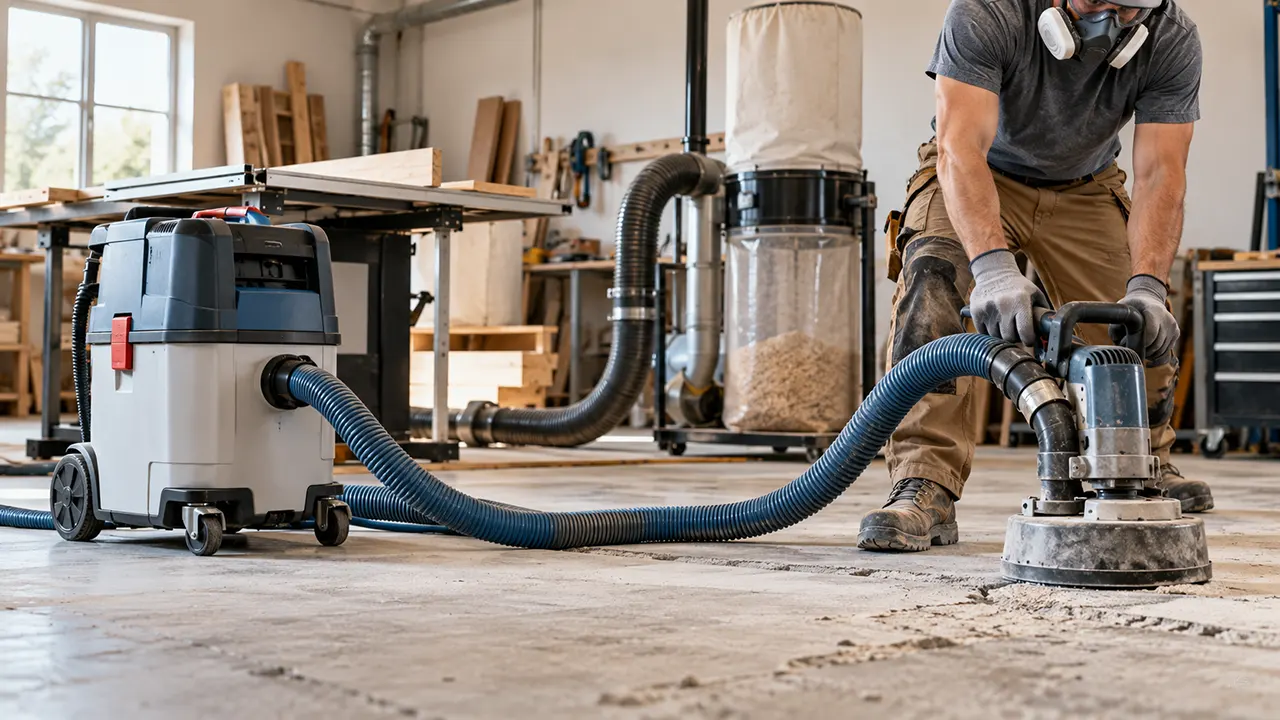
A dust collection system captures dust at its source or removes airborne particles from a workspace. The right system depends on the material, tool, airflow requirements, filtration, and work environment. Portable dust extractors suit many power tools, stationary collectors serve woodworking machines, and wet-dust controls help manage dust during specific construction tasks. For silica-generating work, follow the applicable OSHA requirements.
Choose the Right Dust Collection System for Your Work
A contractor grinding concrete needs a different dust control setup from a woodworker operating a table saw. The contractor may need a shrouded grinder connected to a compatible dust extractor, while the woodworker may need a stationary collector designed for the airflow demands of multiple machines.
A dust collection system should do more than make a workspace look clean. It should capture dust where it forms, move it through a suitable collection system, and prevent collected particles from escaping back into the work area. The correct design depends on the dust itself, the equipment generating it, and the level of control required.
According to NIOSH, a study of handheld concrete grinding found that the tested grinder and shroud combinations reduced dust exposure by at least 90%. That result demonstrates the value of source capture, but it does not guarantee the same reduction for every tool, material, or worksite.
Affiliate disclosure: This guide may contain affiliate links when approved product links are available. ToolGuider may earn a commission from qualifying purchases at no additional cost to you. Product specifications and recommendations should be evaluated against manufacturer documentation and the needs of your application.
What Is a Dust Collection System?
A dust collection system is equipment designed to capture, transport, separate, and contain dust or other particles generated during work. Depending on the application, it may use a portable vacuum, a stationary collector, a network of ducts, specialized filtration, or integrated water delivery.
The term covers several different technologies. A small shop vacuum, a portable HEPA dust extractor, and an industrial baghouse are not interchangeable, even though all can play a role in dust control.
How does a dust collection system work?
Most dry collection systems follow a simple process:
- Capture: A hood, shroud, tool port, or enclosure draws dust away from its source.
- Transport: A fan or vacuum moves the dust-laden air through a hose or duct.
- Separation and filtration: A separator, filter, or combination of stages removes particles from the air.
- Collection: Dust accumulates in a bag, drum, bin, or hopper for appropriate disposal.
- Air management: Filtered air is exhausted or returned to the workspace according to the system design and applicable requirements.
The system performs only as well as its weakest important component. A high-efficiency filter cannot compensate for a poorly fitted grinder shroud that allows dust to escape before capture.
Source capture versus ambient air filtration
Source capture removes dust near the point where it is generated. Examples include a vacuum connected to a sander, a shroud attached to a concrete grinder, or a hood positioned near a cutting operation.
Ambient air filtration treats air circulating through a room or workshop. It can help manage residual airborne particles, but it does not automatically prevent a worker from breathing dust released near a tool.
For most tool-generated dust, prioritize effective source capture first. Consider ambient filtration as a complementary measure when the workspace and remaining dust sources justify it.
Which Type of Dust Collection System Do You Need?
The best choice depends on the equipment, the dust load, the required airflow, and whether the work takes place in a small shop or on a construction site.
| System type | Best suited for | Main limitation |
|---|---|---|
| Portable dust extractor | Power tools, renovation, compatible concrete and woodworking tasks | Capacity and performance depend on the model and tool connection |
| Wet/dry shop vacuum | General cleanup and compatible low-to-moderate dust tasks | Not every model or filter configuration is suitable for fine hazardous dust |
| Stationary dust collector | Table saws, planers, and woodworking machines | Requires suitable ports, placement, and often ductwork |
| Cyclone separator | Removing larger debris before a downstream collector | Does not necessarily provide final fine-particle filtration |
| Industrial cartridge or baghouse collector | Manufacturing, fabrication, and higher-volume processes | Requires application-specific design, maintenance, and safety evaluation |
| Wet-dust control | Certain concrete cutting, drilling, grinding, and other specified tasks | Requires suitable water delivery, runoff management, and task compatibility |
| Ambient air cleaner | Supplementary filtration throughout a workshop | Does not replace effective source capture |
Portable dust extractors for power tools
Portable dust extractors connect directly to compatible tools using a hose, adapter, or collection shroud. Many professional models include automatic filter cleaning, collection bags, and automatic tool activation.
They are useful for contractors who move between jobs, as well as woodworkers who use sanders, routers, or other compatible equipment.
When shopping, check the extractor’s airflow, static pressure performance, filter system, capacity, hose diameter, automatic cleaning mechanism, and compatibility with your tool. For hazardous dust, verify that the complete configuration meets the requirements for the intended task.
Shop vacuums for general cleanup
A shop vacuum is often a practical choice for ordinary debris and general workshop cleanup. However, a standard wet/dry vacuum should not be assumed suitable for every fine-dust application.
For power-tool extraction, check whether the vacuum is designed for continuous collection, whether its hose fits the tool, and whether the filtration and dust-disposal arrangements are appropriate. A vacuum with a high advertised CFM rating is not automatically an effective hazardous-dust control system.
Stationary dust collectors for woodworking
Stationary collectors serve equipment such as table saws, planers, jointers, and other machines that generate significant volumes of sawdust and wood chips.
A central collector can supply multiple machines through ductwork, but the design must account for the airflow required at each pickup point, duct dimensions, resistance, and the number of machines operating at once.
Do not select a collector solely by horsepower or its advertised maximum airflow. Check the manufacturer’s performance information and the requirements of the machines you intend to connect.
Industrial dust collection systems
Larger manufacturing environments may need cartridge collectors, baghouses, wet scrubbers, downdraft tables, or other engineered controls.
These systems address different contaminants and operating conditions. Welding fumes, combustible metal dust, pharmaceutical powders, and ordinary woodworking debris can require substantially different designs. Industrial applications involving combustible dust need a qualified hazard assessment and suitable fire and explosion protection rather than a generic collector selection.
How to Choose a Dust Collection System for Your Application
Start with the material and the tool. Then select the collection method, verify the required airflow, and confirm that the filter and disposal system suit the dust being generated.
Concrete grinding, drilling, and masonry work
Concrete and masonry work can generate respirable crystalline silica, a serious occupational hazard. A suitable setup may include a tool shroud, compatible hose, portable dust extractor, and filtration designed for the task.
NIOSH recommends matching the vacuum to the work, maintaining adequate airflow, using a suitable pre-filter or cyclone where appropriate, and managing filter and collection-container changes to reduce dust release.
Before buying, check the applicable OSHA Table 1 entry. Requirements vary by tool and task, and may specify a particular dust-control method, collector performance, filter efficiency, or respiratory protection.
Drywall sanding and renovation
Drywall sanding produces fine dust that can spread beyond the immediate work area. A sanding system with effective extraction can capture dust through the sanding head before it disperses.
Look for a compatible sanding attachment, suitable hose diameter, manageable weight, effective filtration, and a vacuum that maintains airflow as the filter loads. A NIOSH study of five commercially available vacuum sanding controls found exposure reductions ranging from 80% to 97% under the studied conditions. These historical results support source capture but should not be treated as guaranteed performance for every modern product.
Table saws, planers, and woodworking shops
Woodworking machines can produce both coarse chips and fine airborne dust. The collector must handle the volume and particle characteristics generated by the machine.
A table saw may need extraction below the blade and an additional upper guard or hood to capture dust thrown into the air. NIOSH research found that an improved table-saw control design reduced dust emissions by more than 90% in laboratory testing.
For a small shop, consider which machines will run together, the available floor space, and the practicality of duct routing. A larger collector is not automatically better if the duct system cannot deliver adequate airflow to the pickup points.
General workshop cleanup and mixed-use environments
For ordinary cleanup, a wet/dry vacuum may be sufficient. If you also plan to connect it to a power tool, check its suitability for sustained extraction and the manufacturer’s recommended accessories.
For a mixed workshop, avoid choosing one system simply because it can connect to several tools. A setup suitable for sawdust may not provide the filtration, containment, or regulatory compliance needed for concrete or other hazardous dust.
How Much Airflow Does a Dust Collection System Need?
There is no single CFM figure that works for every dust collection system. Required airflow depends on the tool, capture hood, material, duct or hose dimensions, and the resistance created by the complete system.
CFM, static pressure, and air velocity explained
- CFM (cubic feet per minute): The volume of air moved per minute.
- Static pressure: A measure of the pressure available to overcome resistance from hoses, ducts, filters, and other components.
- Air velocity: The speed at which air travels through a hose or duct.
These measurements describe related but different aspects of performance. A collector may advertise high free-air CFM while delivering considerably less airflow once connected to a restrictive hose and a loaded filter.
For stationary woodworking systems, compare performance data at the expected operating resistance and check the airflow required by each connected machine. For construction dust extraction, follow the tool manufacturer’s specifications and the applicable task requirements.
Hose diameter, length, and tool connections
A narrow, long, or sharply bent hose can restrict airflow. Poorly fitting adapters and leaking connections can also undermine dust capture.
Before buying, verify:
- The hose diameter and connection type recommended for your tool.
- The permitted hose length and routing.
- Whether adapters restrict the airflow path.
- Whether the extractor provides a way to monitor airflow or filter condition.
- Whether the manufacturer specifies an airflow requirement for the intended application.
The goal is not to maximize CFM in isolation. It is to deliver the airflow needed to capture and transport the dust at the source.
HEPA Filters, Filter Efficiency, and Automatic Cleaning
Filtration must match the particles being collected and the requirements of the application. A filter’s efficiency rating does not, by itself, establish that the entire collection system is suitable for a particular hazardous material.
HEPA filtration versus other filter ratings
OSHA’s construction silica standard defines a HEPA filter as at least 99.97% efficient at removing particles of 0.3 micrometers in diameter. Some specific dust-collection provisions in OSHA Table 1 instead specify a filter with at least 99% efficiency. These are different thresholds, and neither should be generalized into a universal rule for every collector.
When comparing products, distinguish between:
- The filter’s stated efficiency.
- The filtration stages used by the complete system.
- The effectiveness of the tool shroud or capture hood.
- The way dust is contained during emptying and filter replacement.
- Any requirements imposed by the task or workplace standard.
When automatic filter cleaning matters
Fine dust can accumulate on a filter and restrict airflow. Automatic cleaning mechanisms help remove that buildup, allowing the collector to maintain performance during suitable operating conditions.
This feature is particularly useful for demanding extraction work, but it does not eliminate filter maintenance. Check how the mechanism works, whether it interrupts suction, how replacement filters are obtained, and whether the dust being collected is compatible with the equipment.
Pre-filters, cyclones, bags, and filter replacement
A cyclone separator can remove larger particles before they reach the main filter. Collection bags may simplify disposal, while specialized systems can support safer handling of hazardous material.
The right arrangement depends on the dust and the equipment. Follow the manufacturer’s instructions for cleaning, bag changes, filter replacement, and disposal. Never assume that opening a container or shaking a filter is safe for every type of dust.
OSHA Silica Dust Collection Requirements for Construction
OSHA’s construction silica standard, 29 CFR 1926.1153, requires covered employers to limit worker exposure to respirable crystalline silica and take specified protective measures. Employers may follow the task-specific controls in Table 1 or use the alternative exposure assessment approach allowed by the standard.
How OSHA Table 1 applies
Table 1 covers listed construction tasks and specifies the controls and respiratory protection required under the conditions described. Depending on the task, the control may involve water delivery, a dust collection shroud, specified airflow and filtration, filter cleaning, or other measures.
For example, certain handheld grinder tasks specify at least 25 CFM of airflow per inch of wheel diameter, a filter with at least 99% efficiency, and a cyclone pre-separator or filter-cleaning mechanism. Other tasks have different requirements. Always consult the current entry for the exact tool, task, and operating conditions.
What to verify before purchasing
- Identify the task and material that generate silica dust.
- Locate the applicable OSHA Table 1 entry or determine whether the alternative exposure assessment method applies.
- Check the required control method and the tool manufacturer’s airflow recommendations.
- Verify filter efficiency, cleaning features, and any specified collection accessories.
- Review the employer’s exposure control plan and any applicable respiratory protection requirements.
A product advertised as a HEPA dust extractor is not automatically compliant with every silica-related task. Compliance depends on the complete setup and how it is used.
For official guidance, consult OSHA’s construction silica resources and 29 CFR 1926.1153.
Dust Extractor vs Shop Vac vs Dust Collector
The best choice depends on the job rather than the name printed on the equipment.
| Buying factor | Dust extractor | Shop vacuum | Stationary dust collector |
|---|---|---|---|
| Typical use | Connected power tools and jobsite extraction | Cleanup and compatible tools | Fixed woodworking machines |
| Mobility | Usually portable | Usually portable | Often fixed or semi-mobile |
| System design | Often optimized for tool connection and filtration | Varies widely by model | Designed for higher-volume collection |
| Main selection concern | Tool compatibility, airflow, filtration | Filter suitability and intended duty | Airflow at the machine and duct design |
| Hazardous dust use | Only when the complete setup is suitable | Only when the complete setup is suitable | Requires application-specific design and filtration |
Common compatibility mistakes
- Buying a vacuum based only on its advertised CFM.
- Assuming that a HEPA filter makes an unsuitable tool connection effective.
- Using a woodworking collector for hazardous silica dust without verifying suitability.
- Connecting several machines without checking the required airflow.
- Ignoring collection-bag capacity, filter cleaning, or safe disposal.
How to Compare Dust Collection Systems Before Buying
A useful comparison should account for purchase price, actual use, accessories, ongoing costs, and the consequences of inadequate dust control.
Products worth evaluating
Makita VC4210L
A portable extractor candidate for compatible concrete and woodworking tasks. Makita publishes a 148 CFM rating, 92 inches of water lift, automatic filter cleaning, and a three-stage filtration system. The manufacturer’s stated system capture efficiency is 99.95%, so do not misrepresent that figure as a 99.97% HEPA rating.
Product Details -VC4210L: Manufacturer specifications
Bosch VAC090AH
A portable extractor candidate to compare for compatible jobsite applications. Confirm current manufacturer specifications, filter configuration, accessories, and availability before assigning a specific use-case recommendation.
JET DC-1100VX-CK
A stationary woodworking collector candidate. JET lists a 1.5 HP configuration and a 1,100 CFM rating. Verify the operating airflow, filtration configuration, and machine compatibility for the intended shop.
These products serve different use cases, so they should not be ranked against one another as if they were direct substitutes. ToolGuider has not independently tested them, and exact approved affiliate URLs were not provided. Use verified affiliate links only when the appropriate product and retailer listing have been confirmed.
Calculate the total ownership cost
The purchase price is only one part of the cost. Compare the cost of replacement filters, collection bags, hoses, adapters, cleaning mechanisms, maintenance, and any required accessories.
For a stationary system, installation and ductwork can also affect the overall investment. For a portable extractor, consider whether the supplied hose and adapters fit your tools or require additional purchases.
Dust Collection Setup and Maintenance Checklist
A well-chosen system still needs correct installation and regular care.
Before starting work
- Inspect hoses, adapters, shrouds, and connections.
- Check the filter and collection container.
- Confirm that the system is suitable for the material and task.
- Verify that airflow is adequate according to the manufacturer’s guidance.
- Follow the applicable dust-control and respiratory protection requirements.
During operation
Watch for a drop in suction, a loaded-filter indicator, unusual noises, damaged hoses, or dust escaping around the collection hood. Stop and investigate problems rather than assuming the filter will capture dust despite a failed connection.
After work
Follow the manufacturer’s procedures for filter cleaning, bag changes, and disposal. Avoid dry sweeping or compressed-air cleaning where these methods could disperse hazardous dust. For silica-related work, follow the applicable OSHA requirements and workplace procedures.
Frequently Asked Questions
1. Is a dust extractor better than a shop vacuum?
A dust extractor is often the better starting point for sustained power-tool extraction because some models include tool activation, filter cleaning, and filtration features designed for that purpose. However, the correct choice depends on the tool, dust type, airflow requirements, and applicable safety rules. A suitable shop vacuum can work for certain applications, but not every model is appropriate for hazardous dust.
2. Does every dust collection system need a HEPA filter?
No. Filter requirements depend on the application and the applicable standard. OSHA Table 1 specifies at least 99% filter efficiency for certain listed dust-collection tasks, while its definition of HEPA specifies at least 99.97% efficiency at 0.3 micrometers. Other tasks and materials may require different controls. Verify the relevant requirement instead of treating HEPA filtration as a universal rule.
3. Can one dust extractor serve multiple tools?
Yes, when the extractor, hoses, adapters, and collection arrangement are suitable for those tools. Check each tool’s airflow requirements and the extractor’s performance under operating resistance. If you connect several machines to one system, make sure the configuration can provide the necessary airflow at the active pickup points.
4. Does a woodworking dust collector work for concrete dust?
Do not assume that it does. Woodworking collectors are often designed for high volumes of chips and sawdust, while concrete grinding can generate hazardous respirable silica. Before using any collector for concrete work, verify its filtration, containment, tool compatibility, and suitability for the specific task under the applicable OSHA requirements.
5. Can ambient air filtration replace source capture?
Ambient filtration can supplement a dust-control system, but it should not automatically replace source capture. Capturing dust near the tool can prevent it from dispersing through the workspace in the first place. Whether additional air filtration is appropriate depends on the dust source, work environment, and exposure-control strategy.
Choose Your Dust Collection System by Task
The most reliable buying decision starts with the dust-generating operation, not the biggest CFM number or the lowest price. Match the collection method, airflow, filtration, and accessories to the tool and material, and verify the applicable safety requirements before purchasing.
If you are equipping a woodworking shop, compare stationary collectors against the airflow demands of your machines. If you are working on construction tasks that generate silica dust, begin with the relevant OSHA controls and select a compatible extraction or wet-dust system.
For ToolGuider readers, the next step is to compare equipment within the correct category and verify current specifications before buying. Use manufacturer documentation and official safety guidance to make the final decision.
