


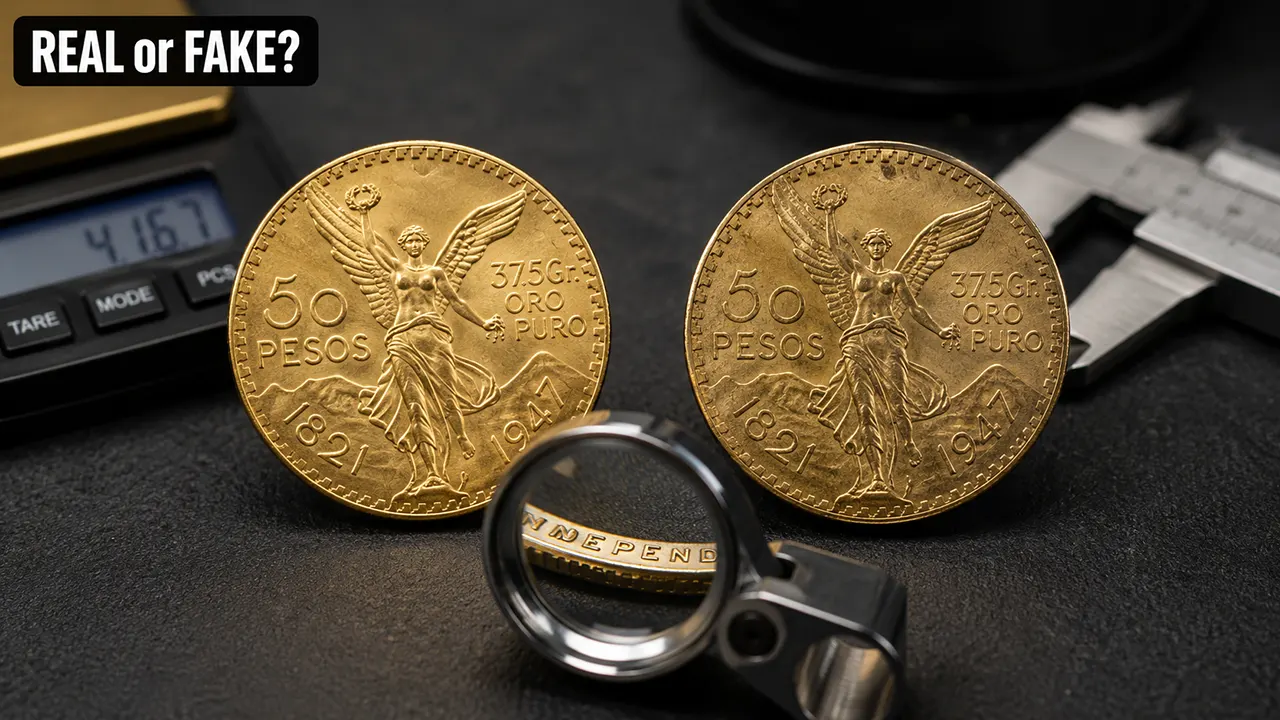
A 50 Pesos 1821–1947 coin is not automatically fake because it bears both dates. The genuine Mexican Centenario displays 1821 to commemorate Mexico’s independence and 1947 as the coin’s design date. To determine authenticity, examine the coin’s weight, dimensions, gold purity, strike quality, edge lettering, and fine design details. Professional authentication is recommended for valuable coins or uncertain cases.
If you’ve found a 50 Pesos 1821–1947 gold coin, your first question is probably simple:
Is it real or fake?
That’s a reasonable concern. The Mexican 50 Pesos Centenario is one of the world’s most recognized gold bullion coins, and its popularity has made it a frequent target for counterfeiters. Some fake coins are crude and easy to spot. Others are sophisticated enough to match the correct weight and even contain gold, making authentication far more challenging.
Many collectors are also confused by the inscription 1821–1947. It looks like the coin was produced over a span of 126 years, but that’s not what the dates mean. Understanding this detail is the first step toward identifying a genuine coin.
In this guide, you’ll learn:
- •What the dates 1821 and 1947 actually represent.
- •Why millions of genuine coins are dated 1947.
- •How to identify common signs of counterfeit coins.
- •Which home tests are useful—and which can be misleading.
- •When professional authentication is the safest choice.
By the end, you’ll have a practical process for evaluating your coin with confidence.
What Does “1821–1947” Mean on a 50 Pesos Coin?
The dates “1821–1947” do not indicate the coin was minted between those years. Instead, they commemorate two important milestones: Mexico’s independence in 1821 and the design year used for the famous 50 Pesos Centenario.
Understanding this point prevents one of the most common mistakes made by new collectors.
Why Does the Coin Say 1821?
The year 1821 marks the successful conclusion of Mexico’s War of Independence.
The 50 Pesos Centenario was introduced in 1921 to celebrate the 100th anniversary of that event. Rather than showing only the minting year, the coin permanently honors Mexico’s independence by displaying 1821 beneath the Winged Victory design.
Because of this commemorative purpose, every genuine Centenario includes 1821, regardless of when it was actually struck.
Golden Nugget
Many first-time buyers mistakenly believe 1821 is the minting year. In reality, it is a historical reference, not a production date.
Why Are So Many Coins Dated 1947?
1947 is the date found on the vast majority of genuine 50 Pesos coins in today’s market.
Although original coins were struck during several years, official restrikes produced after 1947 continued using the 1947 date. Millions of these restrikes entered the bullion market, making them far more common than original dated issues.
This often surprises new collectors because a coin dated 1947 may actually have been struck years later by the official mint.
That does not make it fake.
Are Restrikes Genuine?
Yes. Official restrikes are authentic government-issued coins, not counterfeits.
A restrike is a coin produced later using the original design and official authorization. It contains the same gold content, follows the same specifications, and trades primarily for its bullion value.
A counterfeit coin, on the other hand, is produced without authorization and attempts to imitate the genuine coin for financial gain.
Understanding this distinction helps collectors avoid one of the biggest misconceptions surrounding the Centenario.
Why Are There So Many Fake 50 Pesos Gold Coins?
The Mexican 50 Pesos Centenario contains more than one troy ounce of pure gold, making it an attractive target for counterfeiters. As gold prices rise, counterfeit operations become more profitable, increasing the number of fake coins entering the market.
Counterfeiters target buyers who rely on appearance alone.
A convincing fake can resemble the genuine design from a distance while hiding flaws that become obvious under careful inspection.
Common Types of Counterfeit Coins
Not every fake is made the same way. The most common examples include:
- •Gold-plated base-metal copies.
- •Cast replicas with soft or blurry details.
- •Replica souvenir pieces marked “COPY.”
- •Sophisticated counterfeits that closely match official specifications.
The last category is the most dangerous because some examples have the correct weight and metal content, making simple tests unreliable.
Why Weight Alone Is Not Enough
Many buyers believe weighing the coin is all that’s required.
It isn’t.
Professional counterfeit detection references document fake Centenarios that match genuine weight and metal standards while revealing flaws in strike quality, edge lettering, and surface details.
Golden Nugget
A genuine authentication always combines multiple tests. No single measurement—including weight—can prove a coin is authentic.
Official Specifications of a Genuine 50 Pesos Gold Coin
Every authentic Mexican 50 Pesos Centenario follows precise mint specifications. Matching these specifications is an important first step in authentication, although they should never be used as the only test.
In the next phase, you’ll learn how to use these specifications together with visual inspection, edge lettering, strike quality, and simple non-destructive tests to identify counterfeit coins with much greater confidence.
How to Tell if Your 50 Pesos 1821–1947 Coin Is Fake
No single test can confirm whether a 50 Pesos Centenario is genuine. The most reliable approach is to combine visual inspection, precise measurements, edge examination, and comparison with a known authentic example. Professional authenticators evaluate multiple characteristics together rather than relying on one measurement.
Think of authentication as building evidence. Every successful test increases your confidence, while inconsistencies suggest the coin deserves closer examination.
Step 1: Examine the Overall Appearance
Your first inspection should be done under bright, indirect light.
Look for:
- Sharp, well-defined lettering
- Crisp facial features on Winged Victory
- Clean feather details
- Uniform surface texture
- Even color across the entire coin
- Proper rim shape
Authentic coins have precise engraving. Counterfeit coins often appear slightly “soft” because they are cast instead of struck.
Warning Signs
- •Blurry lettering
- •Rounded design elements
- •Mushy feathers
- •Weak rim definition
- •Grainy surfaces
- •Tiny pits or bubbles
These flaws usually indicate poor manufacturing rather than normal wear. Banco de México also notes that authentic coins should have smooth, uniform surfaces without burrs or porous textures.
Expert Tip
Wear naturally smooths the highest points of a genuine coin. It does not blur every detail equally.
Step 2: Verify the Weight
Weight is one of the fastest authentication checks, but it should never be used by itself.
A genuine 50 Pesos Centenario has:
Use a digital scale capable of measuring to at least 0.01 gram. Small variations from dirt or normal wear may occur, but a significant difference is a warning sign.
Common Mistake
Many buyers assume:
“The weight is correct, so the coin must be genuine.”
That assumption is risky. Modern counterfeiters sometimes manufacture coins with nearly identical weight, making additional tests essential.
Step 3: Measure Diameter and Thickness
A genuine coin should also match official dimensions.
Use a digital caliper rather than a ruler. Even a correctly weighted coin becomes suspicious if its dimensions differ noticeably from the official specifications.
Golden Nugget
Counterfeiters can hide lighter metals by increasing thickness or diameter. That’s why professionals always compare all measurements together rather than checking only one.
Step 4: Inspect the Edge Lettering
The edge is one of the hardest parts of a coin for counterfeiters to reproduce accurately.
Authentic 50 Pesos gold coins have edge lettering with clean, evenly spaced characters.
Look for:
- •Consistent spacing
- •Sharp lettering
- •Uniform depth
- •Smooth transitions
Warning signs include:
- •Uneven spacing
- •Shallow engraving
- •Crooked letters
- •Missing characters
- •Burrs along the edge
Professional counterfeit detection guides frequently identify edge lettering as an area where fake coins reveal obvious differences.
Step 5: Check the Surface Texture
Surface texture reveals how the coin was made.
A genuine struck coin typically has:
- •Smooth open fields
- •Crisp transitions
- •Sharp relief
- •Fine detail
Counterfeit cast coins often show:
- •Tiny bubbles
- •Porous surfaces
- •Sandy texture
- •Soft transitions
- •Wax-like appearance
Banco de México notes that a slick or “soapy” feel, visible pores, or irregularities may indicate a cast imitation.
Step 6: Use the Magnet Test Correctly
Gold is not magnetic.
If a strong magnet firmly attracts the coin, it is almost certainly counterfeit.
However, this test has an important limitation. Many counterfeit coins use non-magnetic metals.
That means:
- •Attraction = strong warning sign.
- •No attraction = not proof of authenticity.
Treat the magnet test as one screening tool rather than a final answer.
Step 7: Listen to the Ping Test
Many collectors perform a gentle “ping test.”
When lightly struck, genuine gold produces a clear, long-lasting ringing sound. Counterfeit alloys often create a short, dull sound.
Although experienced collectors find this useful, the ping test should be treated as supporting evidence rather than a definitive authentication method because sound varies with handling, wear, and mounting. Community discussions frequently recommend pairing it with weight and dimensional checks instead of relying on it alone.
Common Signs of Counterfeit 50 Pesos Coins
Several warning signs appearing together deserve serious attention.
One warning sign does not automatically mean a coin is fake. Multiple inconsistencies should prompt professional authentication.
Authentication Decision Tree
Follow this simple process before buying, selling, or grading your coin.
Your coin passes every test
- ✓Weight matches.
- ✓Diameter matches.
- ✓Thickness matches.
- ✓Edge lettering looks correct.
- ✓Design details are crisp.
Next step: Consider having the coin authenticated or graded if it has significant value.
Your coin fails one test
Repeat the measurement using calibrated tools. Simple measuring errors are common.
Your coin fails several tests
Do not attempt to sell it as genuine. Instead:
- 1.Stop additional testing.
- 2.Compare it with a known authentic example.
- 3.Have it examined by a reputable dealer or third-party grading service.
This approach minimizes the risk of rejecting a genuine coin—or accepting a sophisticated counterfeit.
Restrike vs. Original: What’s the Difference?
An official restrike is a genuine coin produced by the government mint at a later date using the original design. A counterfeit is an unauthorized imitation created to deceive buyers. Understanding this difference is essential because most 1947-dated Mexican 50 Pesos coins on the market are authentic restrikes—not fakes.
Many new collectors mistakenly assume:
“If it’s a restrike, it isn’t real.”
That is incorrect.
Official restrikes were produced by the Mexican Mint and contain the same gold purity, weight, and specifications as the original issue. Their primary purpose was to satisfy investor demand after the original production period ended.
Original Coins
Original Centenarios were struck during their regular production years. Collectors often pay premiums for scarcer original dates because of their lower mintages and stronger numismatic appeal.
Official Restrikes
Official restrikes retain the 1947 date regardless of when they were actually minted. They are:
- •Genuine legal-tender coins
- •Produced by the official mint
- •Identical in gold content
- •Widely traded as bullion
For most buyers, a restrike offers the same intrinsic gold value at a lower premium than a scarce original date. Community discussions consistently advise avoiding extra payment for a seller’s claim that a 1947 coin is an “original,” because proving that distinction is generally not possible.
When Are Home Tests Enough?
Home tests are useful for initial screening, but they cannot provide absolute authentication. They help identify obvious counterfeits while reducing the chance of damaging a valuable coin.
Home testing is usually sufficient when:
- •The coin came from a trusted source.
- •Weight matches official specifications.
- •Diameter and thickness are correct.
- •Edge lettering appears normal.
- •Design details are sharp.
- •No suspicious surface defects are visible.
If every observation is consistent, the coin has passed a strong preliminary evaluation.
However, passing these checks does not guarantee authenticity. Sophisticated counterfeit coins may imitate several physical characteristics at once.
Avoid Destructive Tests
Never perform tests that permanently alter the coin. Avoid:
- •Filing
- •Scratching
- •Acid testing
- •Sanding
- •Drilling
These methods reduce value and may destroy important numismatic features.
Expert Tip
A damaged genuine coin often becomes less valuable than the cost of professional authentication.
When Should You Seek Professional Authentication?
Professional authentication is recommended whenever the coin has significant value, multiple warning signs, or uncertain provenance. Independent grading services use specialized equipment and experienced examiners that most collectors cannot access at home.
Consider professional authentication if:
- •You inherited the coin.
- •You plan to sell it.
- •You intend to insure it.
- •The coin appears unusually rare.
- •Several home tests produce conflicting results.
- •The coin may qualify for a collector premium.
Professional authentication provides confidence for both buyers and sellers.
PCGS and NGC
The two best-known third-party grading services are:
- •PCGS
- •NGC
Both authenticate coins, evaluate their condition, assign a numerical grade, and encapsulate genuine examples in tamper-evident holders. PCGS uses the widely accepted Sheldon 1–70 grading scale and documents coins that cannot be authenticated or graded.
Should You Grade Your Coin?
Not every genuine 50 Pesos coin should be graded. The decision depends on rarity, condition, and your long-term goals.
Grading Is Usually Worth It If:
- ✓The coin is an original pre-1947 issue.
- ✓It appears to have exceptional preservation.
- ✓You plan to sell through a major auction.
- ✓The coin may earn a premium above bullion value.
Grading May Not Be Worth It If:
- ✕The coin is a common 1947 restrike in average condition.
- ✕You purchased it strictly as a bullion investment.
- ✕Grading fees would exceed the likely increase in value.
Decision Framework
What Determines the Value of a Genuine 50 Pesos Coin?
Authenticity is only one part of a coin’s value. Gold content, condition, rarity, market demand, and certification all influence what buyers are willing to pay.
The main value factors include:
1. Gold Price
Every genuine Centenario contains approximately 1.2057 troy ounces of fine gold. As the gold market changes, the bullion value changes as well.
2. Original Date vs. Restrike
Original dates often command higher collector premiums. Most 1947-dated examples trade closer to their bullion value because they are common official restrikes.
3. Condition
Coins with minimal wear, original luster, and strong strike quality generally command higher prices than heavily circulated examples.
4. Certification
A professionally authenticated and graded coin is easier to sell because buyers have greater confidence in its authenticity.
Expert Best Practices
Before buying any 50 Pesos Centenario:
- •Buy from established dealers with clear return policies.
- •Compare the coin with verified reference photographs.
- •Check weight, diameter, and thickness together.
- •Inspect edge lettering carefully.
- •Request certification for expensive purchases.
- •Be skeptical of deals that seem unusually cheap.
One overlooked detail can cost hundreds or even thousands of dollars. Following a consistent authentication process is far safer than relying on instinct alone.
Common Myths About 50 Pesos 1821–1947 Gold Coins
Many collectors make authentication mistakes because they rely on common myths rather than verified numismatic information. Understanding these misconceptions can help you avoid expensive buying or selling errors.
Myth 1: Every 1947 Coin Is Rare
False.
Most 1947-dated Centenarios available today are official restrikes produced after the original issue. They are genuine coins, but they are generally valued for their gold content rather than rarity.
Myth 2: A Magnet Test Proves a Coin Is Genuine
False.
A genuine gold coin is not magnetic, but many counterfeit coins also use non-magnetic metals.
A failed magnet test is useful. A passed magnet test proves very little. Always combine it with weight, dimensions, edge inspection, and design analysis.
Myth 3: Correct Weight Means the Coin Is Authentic
False.
Modern counterfeiters can closely match the official weight of genuine coins. Professional authenticators examine multiple characteristics simultaneously, including strike quality, surface texture, edge lettering, and microscopic details.
Myth 4: Restrikes Are Fake Coins
False.
Official restrikes are authentic coins produced by the authorized mint. Counterfeit coins are unauthorized copies created to deceive buyers. Understanding this distinction is one of the most important parts of collecting Mexican gold coins.
10-Point Authenticity Checklist
Before buying, selling, or grading your coin, verify each item below.
How to Use This Checklist
- •9–10 checks passed: The coin is likely genuine, though professional authentication is still recommended for high-value pieces.
- •6–8 checks passed: More investigation is warranted before buying or selling.
- •Fewer than 6 checks passed: Treat the coin as suspicious until examined by an experienced dealer or third-party grading service.
Final Thoughts
The phrase “50 Pesos 1821–1947 fake” often leads collectors to ask the wrong question.
The better question is: “Can I confidently prove this coin is genuine?”
The answer rarely comes from a single test. Instead, build your conclusion from multiple pieces of evidence:
- •Official specifications
- •Visual inspection
- •Edge lettering
- •Strike quality
- •Surface characteristics
- •Trusted provenance
- •Professional authentication when necessary
If your coin passes these checks, you’ve taken the same systematic approach used by experienced collectors and dealers. When uncertainty remains, don’t guess. Independent authentication is almost always less expensive than making the wrong buying or selling decision.
Next Step
If you believe your coin is genuine and may carry significant value, compare it with certified examples or submit it through a reputable grading service such as PCGS or NGC. A professional opinion provides confidence, protects buyers and sellers, and can make future transactions much easier.
Frequently Asked Questions
1. Is a 50 Pesos 1821–1947 coin automatically fake?
No. The dates 1821 and 1947 are part of the official Centenario design. The first commemorates Mexico’s independence, while 1947 is the design date used on the most common official restrikes. A coin displaying both dates can be completely genuine.
2. Why are almost all 50 Pesos coins dated 1947?
After the original production period, the Mexican Mint produced official restrikes using the 1947 date. As a result, millions of authentic coins in today’s market display 1947 even though they were struck later.
3. What is the fastest way to identify a fake coin?
Begin with the basics:
•Check weight.
•Measure diameter.
•Inspect edge lettering.
•Examine strike quality.
•Compare the coin with verified reference images.
Never rely on only one test.
4. Can counterfeit coins contain real gold?
Yes. Some sophisticated counterfeits contain gold or closely match the official weight, which is why experienced authenticators examine multiple physical characteristics instead of relying solely on metal content.
5. Should I clean my coin before having it authenticated?
No.
Cleaning can permanently reduce both collector value and grading potential. If the coin appears dirty or discolored, leave it in its current condition until a professional has examined it.
6. Should I have my coin graded?
If your coin appears to be an original date, is in exceptional condition, or has significant value, professional authentication and grading can increase buyer confidence and improve resale opportunities. PCGS and NGC both authenticate genuine coins and reject pieces they determine to be counterfeit or of questionable authenticity.
