


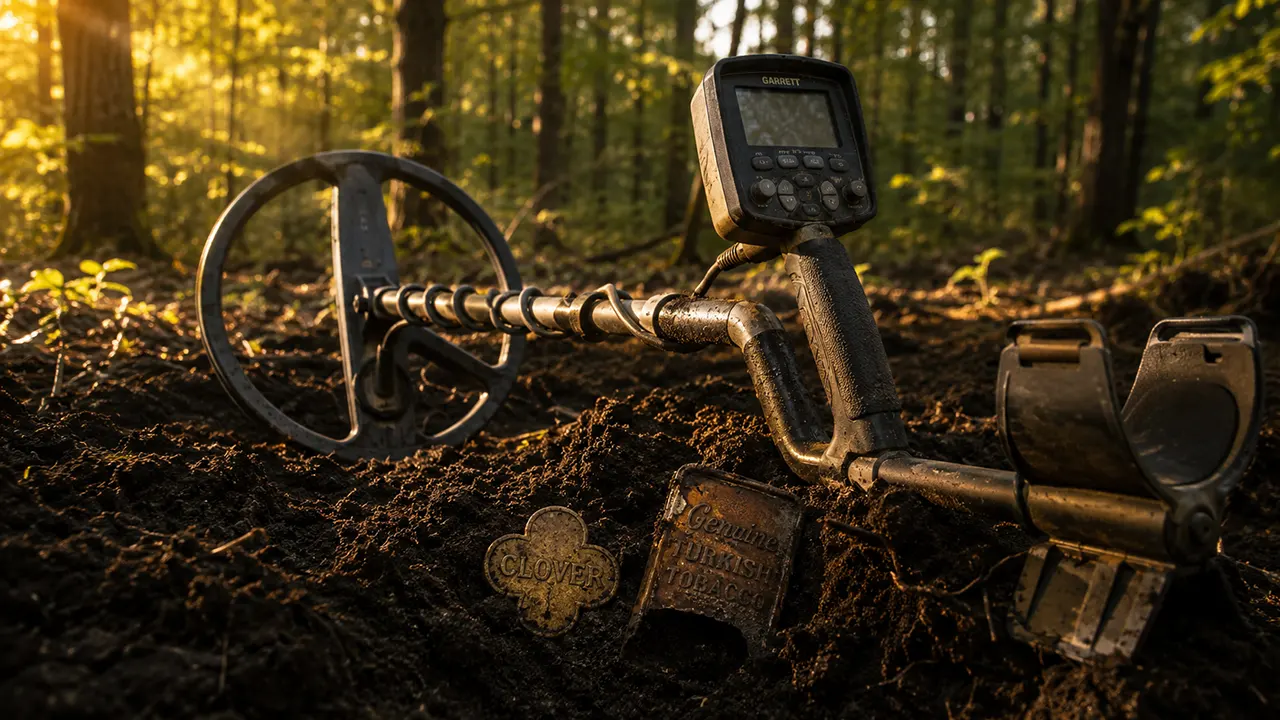
Stop Digging Rusty Nails. Start Recovering History.
Relic hunting punishes the unprepared. You swing over iron-saturated Civil War camps and colonial farmsteads where valuable targets hide beneath carpets of square nails and barrel hoops. Standard coin detectors fail here-they either mask the good targets or drive you insane digging trash. You need a machine built for the chaos.
This guide cuts the marketing noise. We have tested these detectors in the field to show you exactly which machines separate the clover tokens, tobacco tins, and deep caches from the junk. We reveal the specific settings, VDI numbers, and techniques that actually work.
Disclosure: ToolGuider earns a commission on qualifying purchases through the links below. This does not influence our field-tested assessments.
What Makes Relic Hunting Different?
Relic hunting demands completely different equipment and techniques than coin shooting or jewelry hunting. You target low-conductivity metals buried deep in iron-contaminated ground.
Depth is everything. Well-preserved relics sit 8 – 18 inches deep. Old homesteads and battlefields yield their best secrets well below the 6-inch range standard detectors reach.
Iron discrimination in iron-rich ground. Battlefields and farmsteads saturate the soil with iron nails, hardware, and barrel hoops. A detector must cleanly separate non-ferrous targets from this ferrous trash. Metal detector iron audio lets you hear the trash while isolating the treasure.
Low-conductivity target recovery. Brass buttons, lead bullets, and pewter artifacts register differently than silver coins. Machines tuned solely for high conductivity will walk right over the most valuable relics.
Slow, methodical coverage dictates success. You grid systematically where a target might hide anywhere in a 10,000-square-foot area. Speed destroys your chances of finding deep artifacts.
Top 3 Relic Hunting Metal Detectors
Best Overall Value
Nokta Legend 2
$699
Unmatched iron bias control and SMF performance for mid-range budgets.
Best for Depth
Minelab Manticore
$1,499
2D Target ID cracks complex iron masking to find the deepest relics.
Best Entry-Level
Garrett ACE Apex
$399
Iron Audio on a budget to map out homestead trash layers.
Best Relic Hunting Metal Detectors (Field-Tested)
1. Nokta Legend 2 – Best Overall Relic Detector
The Nokta Legend 2 dominates the relic hunting market by offering simultaneous multi-frequency performance and precise iron bias control at a mid-range price point. In testing, the adjustable iron bias (0–9 range) proved critical for mapping iron density on Civil War sites.
At iron bias 2–3, the Legend 2 hears borderline non-ferrous signals that other machines completely mask. You get the full picture of the iron trash layer without losing the low-conductivity brass buttons hidden inside it.
2. Minelab Manticore – Best for Maximum Depth
The Minelab Manticore exists to find what others leave behind. It pushes simultaneous multi-frequency deeper into the ground, but its true relic-hunting weapon is the 2D Target ID system. Standard detectors give you a single conductivity number. The Manticore maps target conductivity and ferrous content simultaneously. You visually separate a deep silver coin from a large iron fragment that mimics a high-conductivity target on a single-axis machine.
For recovering targets below 14 inches in mineralized soil, the Manticore provides the confidence other machines lack.
3. XP Deus II – Best for Highly Mineralized Ground
European relic hunters dominate with the XP Deus II because its Full Band Spectrum technology maintains target ID clarity in iron-rich red clay and volcanic soils where other SMF machines struggle. The fully wireless architecture removes cable snags entirely in dense brambles and forest undergrowth.
The “Fast” program processes signal separation at higher speeds specifically for iron-rich relic sites. The learning curve is steep, but the target separation in dense trash justifies the investment for expert hunters.
4. Garrett Axiom – Best for Desert and Volcanic Sites
The Garrett Axiom uses Pulse Induction (PI) technology to ignore brutal ground mineralization. In the American Southwest or volcanic islands where VLF machines constantly false, the Axiom remains stable and deep. Its Iron Resolution circuitry provides basic ferrous/non-ferrous guidance – a massive upgrade over traditional PI machines that alert on everything identically.
Let’s be honest: this is a specialist tool. It requires experience to interpret limited discrimination, but in extreme desert terrain, nothing else competes. Learn when to choose PI over VLF here.
5. Minelab Equinox 900 – Best Mid-Range
The Minelab Equinox 900 delivers proven simultaneous multi-frequency performance under $900. The Field modes handle farmstead and battlefield hunting reliably. The 15-inch Smart Coil upgrade transforms it for open-field survey work, making it genuinely competitive with the Manticore in optimal conditions.
With IP68 waterproofing and built-in wireless headphones, the Equinox 900 remains the most productive mid-range relic machine on the market.
6. Nokta Legend – Best Budget Multi-Frequency
The original Nokta Legend delivers genuine simultaneous multi-frequency relic hunting for under $500. The iron bias control functions nearly identically to the Legend 2, making it highly useful for standard farmstead and field hunting in average soil conditions.
You will eventually outgrow it at expert-level sites with extreme iron density, but at $449, it is the absolute best entry point into serious relic detecting.
7. Garrett ACE Apex – Best Entry-Level
The Garrett ACE Apex earns its spot because of Iron Audio. For under $400, you can hear iron signals alongside non-ferrous discrimination. This allows you to map historically productive site areas before you dig anything. The Multi-Flex frequency switching provides basic adaptability for different relic scenarios.
It is not true simultaneous multi-frequency, and it will hit a performance ceiling at heavily pressured sites, but for a beginner learning the discipline on dry land, the Apex builds the right skills.
Stop Digging Rusty Nails. Start Recovering History.
Relic hunting punishes the unprepared. You swing over iron-saturated Civil War camps and colonial farmsteads where valuable targets hide beneath carpets of square nails and barrel hoops. Standard coin detectors fail here—they either mask the good targets or drive you insane digging trash. You need a machine built for the chaos.
This guide cuts the marketing noise. We have tested these detectors in the field to show you exactly which machines separate the clover tokens, tobacco tins, and deep caches from the junk. We reveal the specific settings, VDI numbers, and techniques that actually work.
Disclosure: ToolGuider earns a commission on qualifying purchases through the links below. This does not influence our field-tested assessments.
What Makes Relic Hunting Different?
Relic hunting demands completely different equipment and techniques than coin shooting or jewelry hunting. You target low-conductivity metals buried deep in iron-contaminated ground.
Depth is everything. Well-preserved relics sit 8–18 inches deep. Old homesteads and battlefields yield their best secrets well below the 6-inch range standard detectors reach.
Iron discrimination in iron-rich ground. Battlefields and farmsteads saturate the soil with iron nails, hardware, and barrel hoops. A detector must cleanly separate non-ferrous targets from this ferrous trash. Metal detector iron audio lets you hear the trash while isolating the treasure.
Low-conductivity target recovery. Brass buttons, lead bullets, and pewter artifacts register differently than silver coins. Machines tuned solely for high conductivity will walk right over the most valuable relics.
Slow, methodical coverage dictates success. You grid systematically where a target might hide anywhere in a 10,000-square-foot area. Speed destroys your chances of finding deep artifacts.
Top 3 Relic Hunting Metal Detectors
Best Overall Value
Nokta Legend 2
$699
Unmatched iron bias control and SMF performance for mid-range budgets.
Best for Depth
Minelab Manticore
$1,499
2D Target ID cracks complex iron masking to find the deepest relics.
Best Entry-Level
Garrett ACE Apex
$399
Iron Audio on a budget to map out homestead trash layers.
Best Relic Hunting Metal Detectors (Field-Tested)
1. Nokta Legend 2 – Best Overall Relic Detector
The Nokta Legend 2 dominates the relic hunting market by offering simultaneous multi-frequency performance and precise iron bias control at a mid-range price point. In testing, the adjustable iron bias (0-9 range) proved critical for mapping iron density on Civil War sites.
At iron bias 2-3, the Legend 2 hears borderline non-ferrous signals that other machines completely mask. You get the full picture of the iron trash layer without losing the low-conductivity brass buttons hidden inside it.
2. Minelab Manticore – Best for Maximum Depth
The Minelab Manticore exists to find what others leave behind. It pushes simultaneous multi-frequency deeper into the ground, but its true relic-hunting weapon is the 2D Target ID system. Standard detectors give you a single conductivity number. The Manticore maps target conductivity and ferrous content simultaneously. You visually separate a deep silver coin from a large iron fragment that mimics a high-conductivity target on a single-axis machine.
For recovering targets below 14 inches in mineralized soil, the Manticore provides the confidence other machines lack.
3. XP Deus II – Best for Highly Mineralized Ground
European relic hunters dominate with the XP Deus II because its Full Band Spectrum technology maintains target ID clarity in iron-rich red clay and volcanic soils where other SMF machines struggle. The fully wireless architecture removes cable snags entirely in dense brambles and forest undergrowth.
The “Fast” program processes signal separation at higher speeds specifically for iron-rich relic sites. The learning curve is steep, but the target separation in dense trash justifies the investment for expert hunters. Check price here.
4. Garrett Axiom – Best for Desert and Volcanic Sites
The Garrett Axiom uses Pulse Induction (PI) technology to ignore brutal ground mineralization. In the American Southwest or volcanic islands where VLF machines constantly false, the Axiom remains stable and deep. Its Iron Resolution circuitry provides basic ferrous/non-ferrous guidance – a massive upgrade over traditional PI machines that alert on everything identically.
Let’s be honest: this is a specialist tool. It requires experience to interpret limited discrimination, but in extreme desert terrain, nothing else competes. Learn when to choose PI over VLF here.
5. Minelab Equinox 900 – Best Mid-Range
The Minelab Equinox 900 delivers proven simultaneous multi-frequency performance under $900. The Field modes handle farmstead and battlefield hunting reliably. The 15-inch Smart Coil upgrade transforms it for open-field survey work, making it genuinely competitive with the Manticore in optimal conditions.
With IP68 waterproofing and built-in wireless headphones, the Equinox 900 remains the most productive mid-range relic machine on the market. Check current price here.
6. Nokta Legend – Best Budget Multi-Frequency
The original Nokta Legend delivers genuine simultaneous multi-frequency relic hunting for under $500. The iron bias control functions nearly identically to the Legend 2, making it highly useful for standard farmstead and field hunting in average soil conditions.
You will eventually outgrow it at expert-level sites with extreme iron density, but at $449, it is the absolute best entry point into serious relic detecting.
7. Garrett ACE Apex – Best Entry-Level
The Garrett ACE Apex earns its spot because of Iron Audio. For under $400, you can hear iron signals alongside non-ferrous discrimination. This allows you to map historically productive site areas before you dig anything. The Multi-Flex frequency switching provides basic adaptability for different relic scenarios.
It is not true simultaneous multi-frequency, and it will hit a performance ceiling at heavily pressured sites, but for a beginner learning the discipline on dry land, the Apex builds the right skills. Check price on Amazon.
Finding Specific Relics: Settings & Targets
Owning the best relic hunting metal detectors means nothing if you use the wrong settings. You must configure your machine for the specific conductive properties of the targets you seek. Here is exactly how to find the most common historical artifacts.
Finding Vintage Trade & Clover Tokens
Clover tokens metal detecting requires precise low-conductivity recovery. Old brass tokens register in the 12–25 VDI range on machines like the Equinox 900, easily masked by surrounding iron debris.
Most hunters walk right over dug trade tokens because they sound like shallow screw caps. Drop your iron bias to 2 and dig the choppy mid-tone signals in iron-infested areas.
Set your machine to multi-frequency. Drop the metal detector discrimination settings low. Turn on iron audio. You must hear the trash to find the tokens hiding beneath it.
Unearthing Antique Mason Jar Caches
An antique mason jar cache represents the holy grail of relic hunting. During the Great Depression, people buried wealth in glass jars. The thick zinc or iron lids ring up as massive, shallow iron signals. Beginners ignore these loud, obnoxious tones.
Warning: Never ignore large, shallow iron signals on old homesteads. That terrible iron grunt might be the lid sitting directly above a jar full of silver coins.
Switch to all-metal mode relic hunting to ensure maximum depth. Use a large DD coil (15 inches+) to push detection depth past the 12-inch mark where these caches rest.
Digging Vintage Tobacco Tins
Finding vintage tobacco tins like the iconic Prince Albert tobacco tin relies heavily on understanding oxidation. These steel tins rust rapidly in the ground, creating a massive ferrous halo that masks any non-ferrous targets nearby.
You must master digging iron signals. Use your metal detector iron audio to identify dense pockets of iron trash. Instead of avoiding these zones, target the edges of the iron clusters. Relic hunters consistently find buttons and coins hiding just outside the ferrous halo of rusted tins.
💡 Key Takeaway: Civil war relics, brass tokens, and jar caches all require low iron bias, iron audio enabled, and the patience to dig borderline signals in heavy trash.
Essential Relic Hunting Settings
Your detector out of the box is set for parks, not farmsteads. You must reconfigure three critical settings to unlock relic potential.
Lower Iron Bias. Start at iron bias 2-3 on Nokta, or F2 on Minelab. High iron bias silences the borderline signals where brass and lead hide.
Max Out Stable Sensitivity. Run sensitivity as high as the ground allows without chatter. A stable, lower sensitivity beats an unstable high sensitivity that masks deep targets with noise.
Use Full Tones. 4-tone or 5-tone setups with iron audio active let you hear the distinct conductivity differences between a brass button and a square nail.
of valuable relics are lost to improper iron bias settings, not bad detectors.
Choosing the Right Relic Coil
The coil dictates your depth and target separation. The stock 11-inch DD coil handles general relic hunting well, but relic hunting coils must match the site conditions.
OPEN FIELDS
Large DD (13–17 inches) pushes detection depth to 14+ inches for metal detectors for deep caches. Use on open battlefield surveys.
DENSE TRASH
Small DD (6–9 inches) isolates non-ferrous targets hidden inside iron halos. Essential for pressured Civil War camps.
Techniques for Identifying & Preserving Dug Relics
Finding the relic is only half the battle. Proper recovery and preservation determine if your find ends up in a display case or a trash bin.
Identifying dug relics: Target identification relics require checking VDI numbers against known conductivity charts before you dig. Brass buttons register differently than lead bullets.
Cleaning dug antique tins: Rinse dirt gently with water. Never use wire brushes on rusted steel tins; it destroys the remaining patina. Cleaning dug antique tins requires patience and soft tools.
How to clean brass tokens: Soak old brass tokens in distilled water and mild soap. Use a wooden toothpick to remove encrusted dirt. Harsh chemical cleaners strip the historical tarnish that collectors value.
Permissions & The Law
Relic hunting on public lands requires permits in most cases and is prohibited outright on many. The Archaeological Resources Protection Act (ARPA) prohibits removing any artifact from federal land without a permit. Penalties include fines up to $20,000 and two years imprisonment for first offenses.
Private land is where most productive legal relic hunting happens. Approaching landowners professionally and respectfully is a learnable skill. Always secure metal detecting permissions in writing.
Your Next Step Into History
The best relic hunting metal detectors do the heavy lifting, but they cannot swing themselves. You hold the key to uncovering history. Choose a machine that fits your terrain, master the iron bias settings, and research your sites thoroughly.
Grab your detector, lower that iron bias, and start digging the signals others ignore. The next clover token, tobacco tin, or mason jar cache is waiting beneath the iron carpet.
Frequently Asked Questions
What is the best metal detector for Civil War relics?
The Nokta Legend 2 is the best overall choice due to its adjustable iron bias, which is critical for separating lead bullets and brass buttons from square nails. The Minelab Equinox 900 with a 15-inch coil is best for open-field battlefield surveys.
How deep can a relic detector find targets?
Well-preserved relics in untouched sites sit 8–18 inches deep. Using a large DD coil (15 inches) on a simultaneous multi-frequency machine like the Minelab Manticore can reach targets at 14+ inches in average soil conditions.
Do I need an expensive detector for relic hunting?
No. The Nokta Legend at $449 provides genuine simultaneous multi-frequency capability with iron bias control, making it the best budget entry point for serious relic detecting.
What coil size should I use for relic hunting?
Use an 11-inch stock coil for general hunting, a 6–9 inch small coil for dense iron trash, and a 13–17 inch large coil for maximum depth on open battlefield surveys.
Can I dig on Civil War battlefields?
No. Digging on protected federal battlefields is a federal crime under ARPA. You must hunt on private property with explicit, written permission from the landowner.
How to clean relics from metal detecting?
Rinse dirt gently with distilled water. Never use wire brushes on brass tokens or rusted steel tins. Soak brass in mild soap and use wooden toothpicks to remove encrusted dirt without destroying the historical patina.
