


Published on: October 1, 2025 | Updated on: October 21, 2026
Canadian quarters and US quarters have distinct values, with the Canadian quarter generally worth less than its US counterpart in the United States, though both hold face value in their respective countries and can have collector value based on rarity and condition.
Canadian Quarter vs US Quarter: Essential Value for Detectorists
Finding coins is a thrilling part of metal detecting, and sometimes you unearth a quarter that looks familiar but feels… different. This often leads to the question: what’s the essential value of a Canadian quarter vs a US quarter when you find one in the dirt? It’s a common puzzle for detectorists, especially those exploring areas near the border or where currency exchange might have led to coins crossing over. Understanding the differences in their value, both face value and potential collector value, can save you confusion and help you appreciate your finds. We’ll break down exactly what you need to know to identify and value these common yet distinct pieces of metal.
Understanding the Face Value: A Simple Exchange
The face value of a coin is its worth as legal tender in its home country. For a Canadian quarter, this is 25 cents in Canadian currency (CAD). Similarly, a US quarter holds a face value of 25 cents in United States currency (USD). This distinction is crucial; a Canadian quarter is not automatically worth 25 US cents.
In Canada, a quarter is a quarter, and in the US, a quarter is a quarter. The exchange rate between the two currencies dictates how much one is worth in the other’s dollars, but their inherent face value remains tied to their origin. This basic understanding is the first step in appreciating the value of your finds.
Identifying a Canadian Quarter: Key Visual Differences
Spotting a Canadian quarter amongst your finds is usually straightforward once you know what to look for. The most prominent feature is the effigy of the reigning Canadian monarch. For many years, this was Queen Elizabeth II, and more recently, King Charles III.
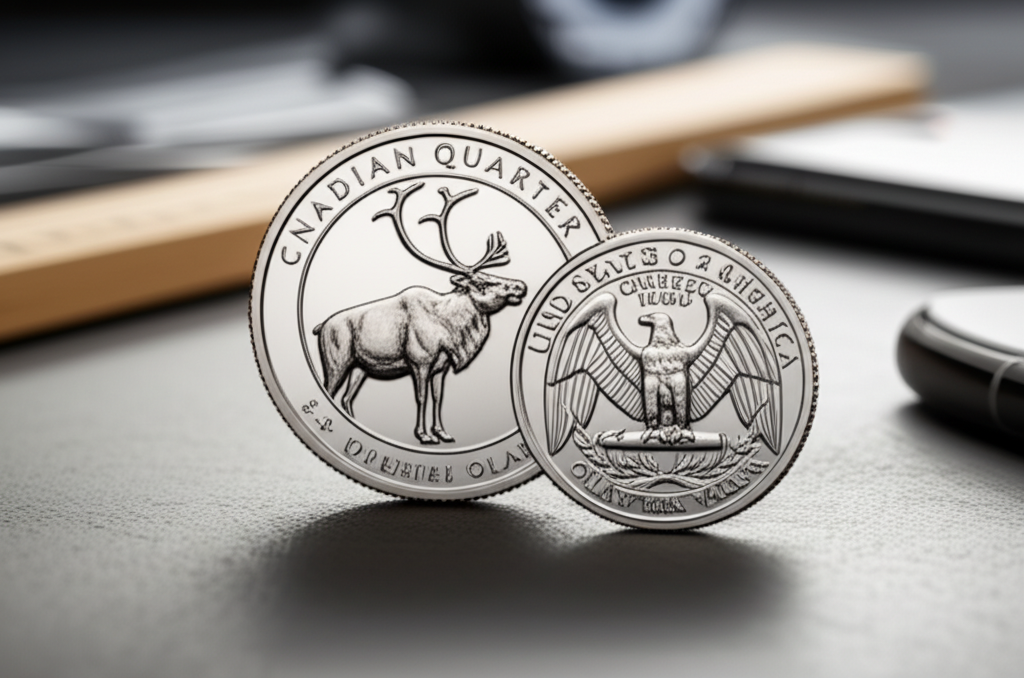
You’ll also notice distinct imagery on the reverse side. While US quarters feature a heraldic eagle on older designs and state-specific symbols on newer ones, Canadian quarters often display symbols of Canada like the Caribou, the Bluenose schooner, or the RCM (Royal Canadian Mint) logo. Pay close attention to the lettering, which will clearly indicate “Canada” or “Piastres” (though less common on quarters).
Identifying a US Quarter: Recognizing the Stars and Stripes
US quarters, on the other hand, prominently feature the profile of George Washington on the obverse (heads) side. The reverse (tails) side has undergone several design changes throughout history. The older “Washington Quarters” often featured a heraldic eagle.
More recently, the America the Beautiful Quarters Program and the American Women Quarters Program introduced a wide variety of reverse designs, each representing a national park, site, or notable woman. The lettering will clearly state “United States of America,” “E Pluribus Unum,” and “Quarter Dollar.” These visual cues are your primary tools for distinguishing between the two.
The Metal Composition: A Detectorist’s Perspective
From a metal detecting standpoint, both Canadian and US quarters share similar metallic compositions, making them react similarly to most detectors. Historically, both countries used silver in their coinage. However, modern circulating quarters are primarily made of a copper-nickel clad composition.
This means a US quarter is typically 91.67% copper and 8.33% nickel, with a pure copper core. Canadian quarters also consist of a similar copper-nickel alloy. This similarity in composition means your metal detector won’t likely differentiate between them based on their metal type alone, but rather on their size and conductivity.
Value in Circulation: The Face Value Factor
When you find a Canadian quarter in the US, or a US quarter in Canada, its face value is technically limited to what a local establishment might accept. Most businesses in the US will accept a Canadian quarter as US 25 cents, though some may refuse it or give you change based on the current exchange rate. The same applies in Canada for US quarters.
However, this is not always the case, and it’s best to assume a foreign coin might not be accepted at face value. For a metal detectorist, this means that while a Canadian quarter found in the US has no official US face value, it still holds its 25-cent Canadian value and can be exchanged for USD at a bank or currency exchange. This is a key aspect of the Canadian quarter vs US quarter value.
Collector Value: Beyond the Face
The true treasure for a detectorist often lies in collector value, which goes far beyond the face value. Both Canadian and US quarters can become valuable due to several factors: rarity, condition, historical significance, and mint errors.
For instance, older silver quarters from both countries are significantly more valuable than their clad counterparts due to the silver content alone. Proof coins, special mint issues, and coins with rare mint marks or errors can fetch substantial premiums among collectors. Understanding these nuances is vital when assessing your finds.
Rarity and Mint Errors: Unearthing True Riches
Rarity plays a huge role in a coin’s collector value. Some US quarters, like certain state quarters with limited mintages or those from specific years with low production numbers, can be worth more than face value. Similarly, Canadian quarters from specific commemorative series or those with particularly low mint runs can be highly sought after.
Mint errors are another exciting area. A Canadian quarter with a double strike, a clipped planchet, or an off-center strike can be worth considerably more than a perfect specimen. The same applies to US quarters; errors are often what collectors are actively searching for, making them potentially more valuable than regular circulation strikes.
Where Do You Find Them? Geographical Clues
The location where you find a coin can sometimes offer clues to its origin and potential value. If you’re detecting near the Canadian border, finding Canadian quarters is more probable. Conversely, if you’re deep in the US heartland, a Canadian quarter might be a more unusual find, potentially indicating a specific story behind its presence.
This geographical context can also influence collector interest. A Canadian quarter found in the US, or vice-versa, might hold a unique appeal to collectors interested in “traveler” coins or historical cross-border activity. While not a primary driver of value, it adds an interesting layer to the story of your find.
The Canadian Quarter vs US Quarter: A Detectorist’s Dilemma Solved
So, to directly address the “Canadian quarter vs US quarter” question for a detectorist: their face value is country-specific. In circulation, a US quarter is worth 25 cents USD, and a Canadian quarter is worth 25 cents CAD. When found in the other country, their acceptance at face value can be inconsistent.
However, the true value for a detectorist lies in the potential collector value, which depends on factors like silver content, rarity, condition, and mint errors, irrespective of their country of origin. Always research your finds to understand their full worth beyond the simple face value.
Frequently Asked Questions (FAQ)
Can I use a Canadian quarter in a US vending machine?
Generally, vending machines are programmed to accept only US currency. While some might accept a Canadian quarter at face value due to similar size and composition, it’s not guaranteed, and you risk losing the coin or having it rejected.
What is the silver content of older Canadian and US quarters?
Prior to 1968, most Canadian quarters were made of 80% silver. US quarters minted between 1932 and 1964 contained 90% silver. Coins minted after these dates are typically clad and have no significant silver value.
How do I tell if a quarter is silver or clad?
The easiest way is to check the edge. Silver quarters (and older clad quarters before 1965) will have a solid silver-colored edge. Modern clad quarters have a distinct copper-colored stripe in the middle of their edge, sandwiched between two silver-colored layers.
Are Canadian quarters worth more than US quarters in Canada?
No, in Canada, a Canadian quarter is worth 25 cents CAD, and a US quarter would be exchanged at the current rate, making it worth less than 25 cents CAD. Their collector values are assessed independently.
What’s the most valuable US quarter ever found?
The most valuable US quarters are typically those from the early series with high silver content, rare mint marks, or significant mint errors. For example, a 1901-S Barber Quarter in pristine condition can be worth hundreds of thousands of dollars.
What about Canadian quarters with Queen Elizabeth II?
Many Canadian quarters feature Queen Elizabeth II due to her long reign. These are common in circulation and generally only hold collector value if they are rare dates, have specific mint errors, or are in exceptionally high-grade condition.
Can a metal detector distinguish between a Canadian and US quarter?
No, a standard metal detector will not differentiate between a Canadian and a US quarter based on origin. It will detect them as a similar target due to their comparable size and metal composition (copper-nickel clad). You’ll need to visually inspect the coin to determine its nationality.
Conclusion: Appreciating Every Find
The quest for treasure with a metal detector is a journey of discovery, and understanding the nuances of your finds, like the value of a Canadian quarter vs a US quarter, enhances the experience. While their face values are tied to their country of origin, the potential for collector value opens up a world of possibilities. Always remember to identify your coins carefully, consider their condition, rarity, and any potential mint errors. Whether it’s a common clad coin or a rare silver specimen, each find tells a story. Happy hunting!
