


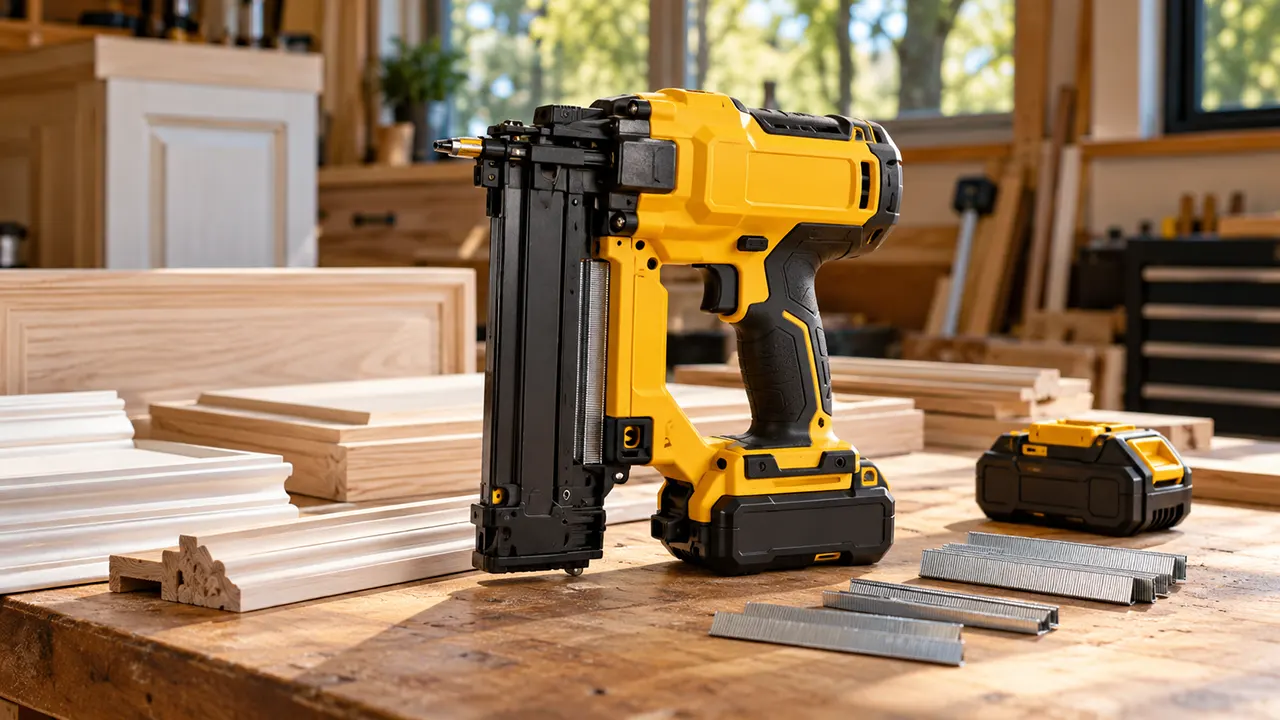
A cordless brad nailer can make trim, cabinets, furniture, and other finish-carpentry jobs much easier because it removes the compressor and air hose from the workflow. Most cordless brad nailers use 18-gauge brads, making them well suited to applications where you want a small nail hole and clean finish. The right model depends on nail size, firing mode, battery platform, application, and how often you use it.
Why Cordless Brad Nailers Are Getting More Attention in 2026
Cordless brad nailers are no longer simply a convenience option for occasional DIY work. Current models from major tool brands are designed to deliver fast, consistent fastening without requiring a compressor, hose, or gas cartridge.
The category also has a timely 2026 hook. Bob Vila’s 2026 Tool of the Year coverage selected the DEWALT 20V MAX XR Cordless 18-Gauge Brad Nailer Kit among its power-tool winners after testing new tools, including driving brads. The publication highlighted its compact design, tool-free depth adjustment, and ability to drive up to five brads per second under the stated test conditions.
DEWALT also introduced the DCN210 in April 2026 as its most compact 20V MAX 18-gauge cordless brad nailer. DEWALT lists a height of 10.2 inches and a claimed firing rate of up to five nails per second when used with the specified battery, with results varying by application.
That does not mean every cordless brad nailer is better than a pneumatic model. It does show where the category is heading: compact tools, better controls, battery-powered mobility, and less setup.
What Makes a Cordless Brad Nailer Different?
A cordless brad nailer is a battery-powered tool designed to drive small finishing nails called brads. Most models in this category use 18-gauge brads and are designed for finish carpentry tasks where a relatively small fastener is preferred.
Unlike a pneumatic brad nailer, a cordless model does not need an external air compressor and hose. That can make a noticeable difference when you are moving from room to room, working on a ladder, installing trim in an occupied home, or working somewhere without convenient access to compressed air.
The trade-off is that a cordless tool carries its power source with it. Battery size, tool weight, runtime, and the battery ecosystem therefore become part of the buying decision.
A useful way to think about the difference is simple: pneumatic nailers separate the power source from the tool, while cordless nailers put the power system into the tool itself.
Why 18-Gauge Brad Nailers Are So Popular
An 18-gauge brad is relatively thin compared with the nails used by larger finish nailers. That makes it useful when you want adequate fastening strength without leaving a large visible hole.
Brad nailers are commonly used for finish work such as trim, molding, cabinetry, furniture assembly, and other light woodworking applications. Popular Mechanics notes that 18-gauge brads are easy to conceal and that brad nailers are generally smaller than finish nailers, although they also provide less holding power.
That last point matters. An 18-gauge brad nailer is not a universal replacement for every nailer.
If the material is thick, heavy, dense, or structurally demanding, a larger fastener may be more appropriate. A finish nailer or another fastening system may provide the holding power that an 18-gauge brad cannot.
The goal is not to choose the smallest nail possible. The goal is to choose a fastener that is strong enough for the joint while leaving an appropriately small mark.
What Can You Use a Cordless Brad Nailer For?
The sweet spot for an 18-gauge cordless brad nailer is finish work where speed and clean fastening matter more than extreme holding power.
Cordless Brad Nailer for Trim
Trim is one of the most common applications for an 18-gauge brad nailer. Baseboards, small molding, casing, decorative trim, and similar pieces can often be installed quickly without dragging an air hose through the room.
The small brad also leaves a relatively small hole that can be filled and concealed before painting.
For long trim runs, a cordless model with good balance, easy depth adjustment, and reliable firing can be more important than having the highest possible firing speed.
Cordless Brad Nailer for Cabinets
An 18-gauge brad nailer can be useful for cabinet construction, trim, face frames, and other light cabinetry work when the fastener size and material thickness are appropriate.
Tight spaces are another reason to consider a cordless model. DEWALT’s DCN210, for example, is designed around a compact 10.2-inch height, while Milwaukee emphasizes compact access for its M18 FUEL 18-gauge brad nailer.
When cabinet work also involves breaking down plywood or sheet goods, a nailer is only part of the workflow. A track saw for breaking down sheet goods can handle accurate guided cuts before the brad nailer handles suitable fastening tasks.
Cordless Brad Nailer for Furniture
Brad nailers can help with furniture assembly, trim pieces, small frames, decorative components, and other woodworking applications where an 18-gauge fastener provides enough holding power.
For delicate work, pay close attention to depth control and the nose of the tool. A nail driven too deeply can damage a visible surface even when the fastener itself is appropriate.
Molding, Paneling, and Light Woodworking
An 18-gauge cordless brad nailer can also be useful for molding, paneling, craft projects, built-ins, and general finish carpentry.
The important limitation is material and joint strength. If the project depends on a large amount of structural holding power, do not choose a brad nailer simply because it is convenient.
What Size Brad Nails Does a Cordless Brad Nailer Use?
Most cordless brad nailers in this category use 18-gauge brads, but the supported nail length varies by model.
Popular Mechanics notes that nailers typically support a range of fastener lengths rather than one fixed size, and the usable length also depends on the material being fastened.
For example, the DEWALT DCN210 is an 18-gauge brad nailer, while the Makita XNB04Z accepts 18-gauge brads from 5/8 inch to 2 inches and has a magazine capacity of up to 110 nails.
Before buying nails, check the exact range listed for your nailer.
The practical rule is to choose a brad long enough to create a secure joint without driving unnecessarily deep into the material behind it. Material thickness, density, joint design, and the manufacturer’s approved fastener range all matter.
Sequential vs Contact Firing: Which Should You Use?
Firing mode affects both speed and control.
Sequential Firing
With sequential firing, the safety contact is pressed against the workpiece and the trigger is then activated to drive the nail. The sequence is designed for controlled, deliberate placement.
This is usually the better choice when accuracy matters, especially during trim and finish work.
Contact Actuation
Contact or bump-style firing allows nails to be driven more rapidly by keeping the trigger engaged and actuating the safety contact against the workpiece.
That can be useful for repetitive work where speed matters, but it requires more attention to tool handling and trigger behavior.
OSHA distinguishes sequential and contact trigger systems and notes that manufacturers can use different names for their trigger systems. OSHA also advises users to check the tool label and manual for the specific trigger operation.
Which Mode Is Better for Trim?
For precision trim installation, sequential firing is generally the more controlled choice. Contact actuation makes more sense when rapid repetitive fastening is a priority and the operator understands the tool’s operation.
Do not choose a contact mode simply because it sounds faster. Control is often more valuable than maximum firing speed when every nail will remain visible on a finished piece of trim.
Cordless vs Pneumatic Brad Nailers
Both systems can be excellent. The better choice depends on the work.
| Factor | Cordless Brad Nailer | Pneumatic Brad Nailer |
|---|---|---|
| Compressor | Not required | Required |
| Air hose | Not required | Required |
| Mobility | Excellent | Limited by hose and compressor |
| Setup | Fast | More equipment required |
| Continuous operation | Depends on battery | Depends on compressor |
| Tool weight | Usually higher | Usually lower |
| Best fit | Mobile finish work and remodeling | High-volume shop or production work |
| Battery ecosystem | Important | Not applicable |
A pneumatic nailer can still make sense for a workshop where a compressor is already available. It can also be attractive for high-volume work where continuous operation matters.
A cordless model becomes particularly appealing when setup time and mobility matter more than minimizing tool weight.
Popular Mechanics similarly notes that pneumatic nailers can be lighter and more powerful while requiring a compressor, whereas cordless nailers eliminate the hose and compressor setup.
Why Your Battery Platform Matters
One of the easiest mistakes is choosing a cordless nailer without considering the batteries you already own.
If you already use a major cordless platform, staying within that ecosystem can reduce the total cost of ownership because you may already have compatible batteries and chargers.
DEWALT 20V MAX
DEWALT’s 20V MAX platform includes several cordless nailers. Its newer DCN210 is an 18-gauge model designed around a compact form factor, while the broader range includes established 18-gauge options.
The 2026 DCN210 is particularly interesting for readers who want a compact DEWALT 18-gauge option.
Milwaukee M18
Milwaukee’s M18 FUEL 2746-20 is an 18-gauge cordless brad nailer using the company’s REDLITHIUM battery system. Milwaukee lists tool-free depth adjustment, tool-free jam clearing, sequential and contact actuation, and a brushless POWERSTATE motor.
For existing M18 users, the battery ecosystem can be a stronger reason to choose this tool than any isolated specification.
Ryobi ONE+
Ryobi’s P322 is an 18V ONE+ HP brushless 18-gauge AirStrike brad nailer. Ryobi lists single sequential and contact actuation modes, tool-free jam release, tool-free depth adjustment, and a claimed capacity of up to 2,250 nails per charge under its stated conditions.
Ryobi currently lists multiple 18-gauge cordless brad nailers within its ONE+ system, including the P322 and P321 models.
Makita LXT
Makita’s XNB04Z is an 18V LXT brushless 18-gauge brad nailer. Makita lists a 5/8-inch to 2-inch nail range, sequential and bump-fire modes, tool-less depth adjustment, and an anti-dry-fire mechanism. The company also claims up to 4,250 nails per charge with a 5.0Ah battery, with the stated result dependent on its testing conditions.
Starting From Scratch
If you do not already own batteries, compare the complete ecosystem rather than the bare-tool price.
A $150 tool can become a much more expensive purchase if you also need a battery and charger. Conversely, a more expensive nailer can make sense if you plan to add several other cordless tools from the same platform.
2026 Cordless Brad Nailers Worth Watching
This section is intentionally different from a generic “best nailers” ranking. These are current models that help illustrate the main choices in the cordless 18-gauge market.
DEWALT DCN210
The DCN210 is the standout 2026 model to watch because it combines a current product launch with the year’s award attention.
DEWALT describes it as its most compact 20V MAX 18-gauge brad nailer. The manufacturer lists a 10.2-inch height, tool-free depth adjustment, tool-free jam release, and a claimed rate of up to five nails per second when using the specified battery.
Bob Vila’s 2026 Tool of the Year coverage also selected the DEWALT 20V MAX XR Cordless 18-Gauge Brad Nailer Kit as a power-tool winner after testing it for applications including trim and cabinetry.
DEWALT DCN680
The DCN680 represents the established DEWALT 20V MAX 18-gauge approach. It is worth considering for buyers already invested in the DEWALT platform who want a proven cordless brad-nailer design rather than necessarily choosing the newest model.
Milwaukee M18 FUEL 2746-20
The Milwaukee M18 FUEL is a professional-oriented option with a brushless motor, nitrogen air-spring mechanism, tool-free depth adjustment, tool-free jam clearing, LED lighting, and both sequential and contact actuation.
Its strongest argument is not simply the feature list. For someone already invested in M18 batteries, platform compatibility can simplify the entire cordless tool setup.
Ryobi ONE+ HP P322
The P322 is an interesting value-oriented choice for homeowners and DIY users already using the ONE+ ecosystem. Ryobi lists its brushless HP system, selectable firing modes, tool-free adjustments, and up to 2,250 nails per charge under its stated conditions.
Craftsman V20 CMCN618
The Craftsman CMCN618 is another platform-focused option. Craftsman lists a brushed motor, tool-free depth adjustment, tool-free jam and stall release, and a claimed capacity of up to 420 nails per charge using the specified 1.5Ah battery and test conditions.
A kit version includes a 1.5Ah battery, charger, and sample 18-gauge brads.
Makita XNB04Z
The Makita XNB04Z stands out for buyers already invested in 18V LXT. It has a brushless motor, 5/8-inch to 2-inch 18-gauge nail range, sequential and bump-fire modes, tool-less depth adjustment, and anti-dry-fire protection.
What Features Actually Matter?
Specifications only become useful when you connect them to the work.
Nail Range
Check the minimum and maximum brad length before buying. A nailer that cannot accept the fastener length your project requires is the wrong tool regardless of its motor or battery.
Battery Platform
If you already own cordless tools, platform compatibility can save money and reduce the number of batteries and chargers you need.
Firing Modes
Sequential firing favors controlled placement. Contact actuation favors faster repetitive work. Having both gives you more flexibility.
Depth Adjustment
Tool-free depth adjustment is especially useful when moving between different materials or changing how deeply the nail head sits below the surface.
Jam Release
A tool-free jam-release mechanism can save time when a fastener becomes stuck. It is a small feature that becomes much more valuable when you use the nailer frequently.
Dry-Fire Lockout
Dry-fire protection can prevent the tool from driving an empty magazine into your workpiece. Popular Mechanics identifies dry lockout as a useful feature because firing without a fastener can leave unwanted marks in finished material.
Nose Visibility
A compact nose can make precise nail placement easier, especially around narrow trim, cabinetry, and confined areas.
Weight and Balance
Do not judge weight from the tool body alone. A cordless nailer carries a battery, so the complete working weight matters more than the bare-tool specification.
How to Choose the Right Cordless Brad Nailer
Use this decision path before comparing individual models.
Already own a battery platform? Start with compatible models from that platform.
Mostly install trim and molding? Prioritize balance, depth control, nose visibility, and reliable sequential firing.
Build cabinets or furniture? Look closely at the tool’s compactness, nail range, depth adjustment, and access around tight joints.
Do occasional DIY projects? A kit with a battery and charger can make more sense than a bare tool.
Do frequent professional finish work? Consider ergonomics, firing speed, battery capacity, jam clearing, and the availability of additional batteries.
Already own a compressor? Compare cordless convenience against the lighter weight and continuous operation of your pneumatic setup.
The best cordless brad nailer is therefore not necessarily the fastest or most expensive model. It is the one that matches your materials, workload, battery platform, and fastening requirements.
How to Use a Cordless Brad Nailer Safely
A brad nailer may look like a small finish tool, but it still launches a fastener with enough force to cause serious injury.
OSHA says nail guns are associated with an estimated 37,000 emergency-room visits each year, based on CDC information, and notes that research found nail-gun injury risk was twice as high with multi-shot contact triggers as with single-shot sequential triggers.
Use these basic precautions:
- Wear appropriate eye protection.
- Read the manufacturer’s operating instructions before use.
- Keep your hands away from the nose and the path of the fastener.
- Understand exactly how the selected trigger mode works.
- Do not carry the tool with your finger on the trigger.
- Keep the tool pointed away from yourself and others.
- Remove the battery before clearing a jam or performing maintenance.
- Secure the workpiece whenever practical.
- Check the work area for hidden electrical wires, pipes, or other hazards before fastening.
- Follow the manufacturer’s instructions for approved fasteners and operating conditions.
OSHA also warns about unintended discharge, double firing, and the hazards created when contact or single-actuation triggers are carried with the trigger squeezed.
Safety is not a reason to avoid cordless nailers. It is a reason to understand the tool before using its fastest firing mode.
Common Cordless Brad Nailer Buying Mistakes
Choosing by Voltage Alone
A 20V label does not automatically make one nailer better than another. Motor design, firing mechanism, ergonomics, nail range, controls, and battery platform all matter.
Ignoring Your Battery Ecosystem
Buying a new platform for one nailer can make the true cost much higher than the bare-tool price suggests.
Using the Wrong Gauge
An 18-gauge brad nailer is excellent for many finish applications, but it does not provide the same holding power as a larger finish nailer.
Buying the Wrong Nail Length
Always check the manufacturer’s approved fastener range. Do not assume every 18-gauge nailer accepts every 18-gauge brad.
Buying Only for Maximum Firing Speed
A high firing rate is not automatically useful when you are carefully positioning trim. Precision can matter more than raw speed.
Comparing a Bare Tool With a Complete Kit
A tool-only price and a kit price are not equivalent. Check whether the purchase includes the battery, charger, bag, and accessories you actually need.
Assuming Cordless Always Beats Pneumatic
Cordless removes the compressor and hose, but pneumatic tools can still be attractive for high-volume work, particularly when a suitable compressor is already available.
Frequently Asked Questions
Are cordless brad nailers worth it?
Cordless brad nailers can be worth it when mobility, fast setup, and freedom from a compressor matter. They are especially convenient for trim installation, remodeling, cabinetry, and mobile finish work. If you already own a compatible battery platform, the value can be even stronger. A pneumatic model may still make more sense for high-volume shop work or when you already have an appropriate compressor.
Can a cordless brad nailer replace a pneumatic brad nailer?
For many trim and finish-carpentry tasks, yes. A good cordless brad nailer can remove the need for a compressor and air hose while providing fast fastening. However, pneumatic nailers remain useful when low tool weight, continuous operation, or existing shop equipment is more important than mobility. The right choice depends on the workflow rather than the power source alone.
Can you use an 18-gauge brad nailer for cabinets?
Yes, an 18-gauge brad nailer can be useful for suitable cabinet assembly, trim, face frames, and other light cabinetry work. The correct nail length and holding power still depend on the joint and materials. For heavier structural connections, a larger fastener or different fastening method may be more appropriate.
What is the difference between sequential and contact firing?
Sequential firing requires a controlled sequence involving the safety contact and trigger for each nail. Contact actuation allows faster repetitive firing by using the safety contact while the trigger is engaged. Sequential firing generally provides more deliberate placement, while contact actuation is designed for faster repetitive work. Always follow the specific manufacturer’s instructions because trigger terminology can vary.
How long should brad nails be?
The correct brad length depends on the material thickness, joint, and nailer. Cordless 18-gauge nailers support different length ranges. For example, Makita’s XNB04Z accepts 5/8-inch to 2-inch 18-gauge brads. Always check the exact range specified for your nailer before buying fasteners.
Is an 18-gauge brad nailer enough for trim?
For many trim and molding applications, an 18-gauge brad nailer is a practical choice because the small fastener leaves a relatively small hole. However, the required holding power depends on the trim, substrate, material thickness, and installation method. Larger finish nailers may be more appropriate for heavier or thicker pieces.
Should you buy a tool-only nailer or a kit?
Choose a tool-only model if you already own compatible batteries and a charger. A kit can be the better choice if you are entering a battery platform for the first time because it typically combines the nailer with the required battery and charger. Compare the complete purchase cost rather than looking only at the tool price.
The Bottom Line
If your work involves trim, cabinets, furniture, molding, or light finish carpentry, an 18-gauge cordless brad nailer can be one of the most convenient fastening tools in a cordless workshop. Start with the battery platform if you already own one, then check nail range, firing modes, depth adjustment, weight, nose visibility, and jam-clearing features.
The 2026 DEWALT DCN210 shows how the category continues to move toward more compact cordless designs, while models from Milwaukee, Ryobi, Makita, and Craftsman show that there is no single battery ecosystem that fits every buyer.
The smartest purchase is not simply the cordless brad nailer with the most impressive specification. It is the one whose fastener range, firing controls, battery system, size, and workflow match the jobs you actually do.
