


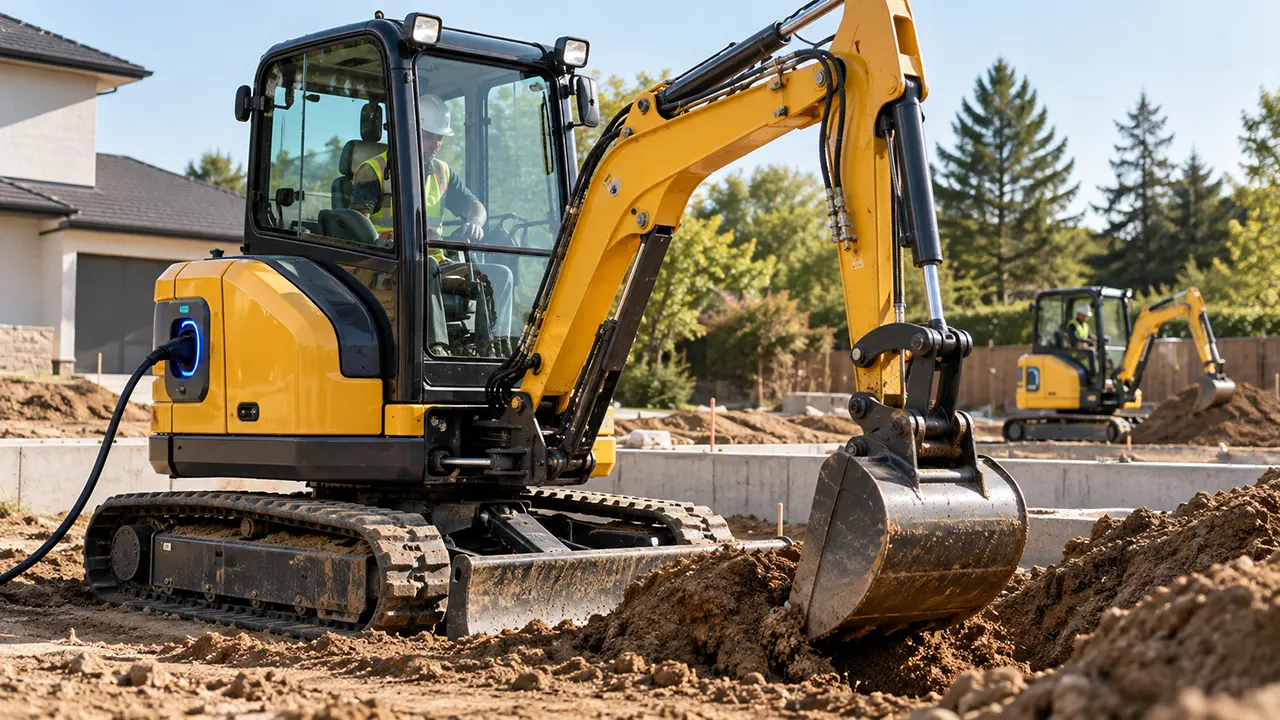
An electric mini excavator can be a smart investment for contractors who work in residential areas, enclosed spaces, or noise-sensitive jobsites. It replaces a conventional engine with a rechargeable battery and electric motor. However, the right choice depends on digging requirements, battery runtime, charging access, purchase price, and daily workload.
For contractors who need long shifts in remote locations, a diesel excavator may remain more practical. The goal is to compare the complete cost and capabilities of each machine before requesting a dealer quote.
What Is an Electric Mini Excavator?
An electric mini excavator is a compact excavating machine powered by a battery and electric motor instead of a conventional gasoline or diesel engine. It uses electric power to operate the hydraulic system, move the tracks, and control the boom, arm, and bucket.
Battery-electric excavators produce no exhaust emissions at the point of use. They can therefore be useful in enclosed spaces where exhaust extraction would otherwise be required, subject to the site’s safety requirements.
Battery-electric vs. gasoline and diesel mini excavators
| Feature | Battery-electric | Diesel | Gasoline |
|---|---|---|---|
| Energy source | Rechargeable battery | Diesel fuel | Gasoline |
| Exhaust at point of use | None | Yes | Yes |
| Noise | Generally lower | Generally higher | Generally higher |
| Refueling or recharging | Requires charging access | Fuel supply | Fuel supply |
| Engine maintenance | No combustion engine | Engine servicing required | Engine servicing required |
| Best-fit applications | Indoor, urban and suitable short-shift jobs | Remote sites and demanding duty cycles | Some small, budget-focused machines |
Electric equipment still requires hydraulic, track, undercarriage, and attachment maintenance. Battery care and charging infrastructure also become part of ownership.
Who benefits most from electric compact equipment?
Electric mini excavators are worth considering if you:
- Work inside buildings or in enclosed construction areas.
- Complete landscaping and utility jobs near residential properties.
- Need lower operating noise.
- Have predictable work schedules and reliable charging access.
- Can use the machine’s battery capacity efficiently throughout the working day.
They may be less suitable for remote sites without reliable electricity or operations that require continuous heavy digging beyond the available battery runtime.
4 Electric Mini Excavators to Compare
The following machines provide a useful starting shortlist for US contractors. Specifications come from manufacturer documentation, while advertised prices are identified separately from manufacturer pricing.
The comparisons below are based on published specifications, not hands-on testing by ToolGuider. Confirm the exact configuration, availability and final quote with an authorized dealer.
1. Bobcat E10e: Best for Narrow Access

The Bobcat E10e is designed for compact work areas. Its retractable undercarriage lets the operator reduce the machine’s width to access narrow spaces and expand it again for a wider working stance.
Published specifications include an 11.5 kWh lithium-ion battery, a 2,648 lb operating weight, and a maximum digging depth of 76.9 inches. Bobcat also lists a 28-inch minimum width and an estimated four-hour runtime.
Best for: Residential landscaping, narrow access routes and suitable indoor projects.
Limitations: Its compact size and digging capacity may not suit contractors who need greater reach, lifting capacity or sustained heavy excavation.
Price: Request a current dealer quote. Do not assume the gasoline-powered E10 and electric E10e have similar prices.
View Bobcat E10e specifications and dealer options
2. Volvo ECR18 Electric: Best for Compact Professional Work

The Volvo ECR18 Electric offers more operating weight and digging capability than the smallest electric excavators.
Volvo lists a 16 kWh battery, an operating weight of 3,950 to 4,120 lb, and an indicative runtime of three to five hours, depending on the application. Its published charging options range from onboard charging to optional fast chargers.
Best for: Contractors who need compact dimensions but require more capability than a one-ton machine provides.
Limitations: The available runtime depends on the work performed, and faster charging may require specialized electrical infrastructure.
Published US configuration price: $70,775. Volvo lists an optional 48V, 240A fast charger for $6,623 and a 360A high-power charger for $8,583. The listed chargers require 480V three-phase input. Verify the current price and configuration with the dealer.
View Volvo ECR18 Electric specifications and configuration
3. Volvo ECR25 Electric: A Larger Compact Option

The Volvo ECR25 Electric is a candidate for contractors who need a larger compact machine for professional excavation tasks.
The published US specifications list a 20 kWh battery, an operating weight of approximately 5,908 to 6,129 lb, and up to four hours of indicative runtime. These figures should be confirmed against the exact machine generation and configuration being offered.
Best for: Buyers who need a larger compact excavator and have a suitable charging plan.
Limitations: A larger machine can increase transport requirements and acquisition costs. The battery capacity alone does not establish how much work it can complete per charge.
Price: Obtain a current dealer quotation. Used listings are not equivalent to new-machine MSRP.
View Volvo ECR25 Electric specifications
4. JCB 19C-1E: Best for Indoor and Noise-Sensitive Applications

The JCB 19C-1E is designed for applications where noise, exhaust emissions at the point of use, and working conditions matter.
JCB states that the machine can operate for approximately five hours on a standard application. It also lists 110V, 220V and 480V charging options. Actual charging time depends on the charging equipment, supply and battery state.
Best for: Indoor construction, urban work, residential areas and other suitable noise-sensitive sites.
Limitations: Contractors should confirm the charging setup, dealer support and runtime expected for their specific workload.
Price reference: MachineryTrader listed a 2026 JCB 19C-1E at $39,900. This is an advertised equipment listing, not a guaranteed manufacturer price or nationwide quote.
MachineryTrader.com
View JCB 19C-1E specifications and request a price
Quick comparison
| Model | Battery | Published runtime | Price status |
|---|---|---|---|
| Bobcat E10e | 11.5 kWh | Estimated 4 hours | Dealer quote |
| Volvo ECR18 Electric | 16 kWh | 3-5 hours | $70,775 published configuration price |
| Volvo ECR25 Electric | 20 kWh | Up to 4 hours, subject to configuration verification | Dealer quote |
| JCB 19C-1E | Confirm exact configuration | About 5 hours on a standard application | $39,900 advertised listing |
Runtime figures are manufacturer-stated estimates, not directly comparable test results. Pricing also varies by machine condition, configuration, attachments and dealer terms.
How Long Does an Electric Mini Excavator Run on One Charge?
An electric mini excavator may run for several hours per charge, but the actual working time depends on the machine, digging intensity, attachment use, operating mode and conditions at the jobsite.
For example, Volvo lists three to five hours of indicative runtime for the ECR18 Electric. It also notes that continuous grading can produce a different runtime from other applications.
Volvo Construction Equipment
Manufacturer-rated runtime vs. actual work time
A runtime estimate is not a guarantee that the excavator will complete a full shift without recharging.
Consider three types of work:
- Intermittent landscaping: The operator alternates between digging, positioning, moving materials and taking breaks.
- Continuous grading: The machine works for extended periods with fewer pauses.
- Demanding excavation: Heavy digging and sustained hydraulic use may increase energy consumption.
These tasks place different demands on the battery. When comparing models, ask the dealer for runtime estimates based on work similar to yours.
How to estimate runtime for your workload
Use this simple planning formula:
\[ \text{Estimated runtime} = \frac{\text{Usable battery energy (kWh)}}{\text{Average power demand (kW)}} \]
For illustration, a machine with 16 kWh of usable battery energy and an average power demand of 4 kW would run for approximately four hours.
This is a mathematical example, not a measured runtime for a specific excavator. The usable energy and average power demand must be confirmed or estimated from the actual machine and work conditions.
Practical tip: Ask for a demonstration on a representative job. A machine that handles your normal workload for the required shift is more valuable than one with a larger battery that does not fit your site or digging needs.
How Long Does It Take to Charge an Electric Mini Excavator?
Charging time depends on battery capacity, charger output, charging losses, the starting battery level and the electrical supply available.
Volvo’s ECR18 Electric documentation illustrates the difference between charging methods. It lists approximately five hours for onboard charging and up to one hour for certain compatible offboard fast-charging arrangements. The faster option requires appropriate charging equipment and electrical infrastructure.
Charging supply and compatible charger types
Do not assume every electric excavator supports every household outlet or fast charger.
Before buying, verify:
- The machine’s approved input voltage and charging connector.
- Whether the onboard charger is included.
- The charging time from the electrical supply you actually have.
- Whether a dedicated circuit or commercial electrical installation is required.
- Whether fast charging is supported and what equipment it requires.
A standard household outlet may be suitable for some machines, while others need a more substantial supply for practical charging times.
Plan charging around your daily schedule
If your machine can complete the morning’s work and recharge during an available break or overnight, a slower charging setup may be sufficient. If it must work multiple shifts, faster charging or a different operating plan may be necessary.
Ask the dealer to document the expected charging time from your intended starting battery level to your target charge level. This gives you a more useful operating plan than a single headline charging figure.
Electric vs. Diesel Mini Excavator Operating Costs
Electric excavators can reduce energy costs and eliminate several combustion-engine maintenance tasks. However, the financial advantage depends on purchase price, local electricity and diesel prices, annual operating hours, charging equipment and maintenance needs.
Electricity vs. diesel cost per operating hour
You can estimate the energy cost of an electric excavator using:
\[ \text{Electricity cost per hour} = \text{kWh consumed per hour} \times \text{Electricity price per kWh} \]
For a diesel machine:
\[ \text{Diesel cost per hour} = \text{Gallons used per hour} \times \text{Diesel price per gallon} \]
Use measured or manufacturer-supported consumption data whenever possible. Do not compare an electric machine working lightly with a diesel machine performing heavy excavation.
Maintenance and service differences
A battery-electric excavator has no conventional combustion engine, engine oil or exhaust system. That can reduce certain servicing requirements.
However, it still needs inspections and maintenance for hydraulic systems, tracks, undercarriage components, attachments, electrical connections and other machine parts. Battery condition, warranty coverage and charging equipment also matter.
The amount saved on maintenance depends on the machine, operating conditions and the maintenance schedule of the diesel alternative.
Calculate operating cost for your own workload
For a useful ownership comparison, collect these inputs:
- Expected annual operating hours.
- Electricity price and energy consumption.
- Diesel price and fuel consumption for a comparable machine.
- Purchase price and financing costs.
- Annual maintenance and repair costs.
- Charging equipment and installation costs.
- Expected ownership period and resale value.
Then compare total costs over the same period. This prevents a lower hourly energy cost from hiding a substantially higher purchase price or infrastructure expense.
How Much Does an Electric Mini Excavator Cost?
Electric mini excavator prices vary by size, battery capacity, attachments, charger, machine condition and dealer configuration. Published prices should be treated as starting points rather than guaranteed final costs.
New-machine prices and dealer quotations
Use the Volvo ECR18 Electric’s published configuration price as one documented example and obtain quotes for other machines you are considering. For the JCB 19C-1E, distinguish the advertised $39,900 listing from a manufacturer MSRP. A used machine may have different hours, battery condition, warranty coverage and included equipment.
When requesting quotes, ask for a complete breakdown of the machine, attachments, freight, delivery, taxes and charging equipment.
Charging equipment and electrical installation
The charger may be included, optional or supplied in a separate configuration. Installation can also add costs if the jobsite needs a new circuit, higher electrical capacity or three-phase power.
Before purchasing, confirm that the charging setup is compatible with the machine and available at every location where you expect to operate it.
Total cost of ownership
A useful ownership calculation includes:
\[ \begin{aligned} \text{Total ownership cost} ={}& \text{Purchase price}\\ &+\text{Charging infrastructure}\\ &+\text{Energy and maintenance}\\ &+\text{Financing and downtime}\\ &-\text{Resale value} \end{aligned} \]
This framework helps you compare electric and diesel equipment over the same ownership period. Include battery replacement only when supported by a reasonable scenario or documented cost, not as an assumed expense for every machine.
Battery warranty, replacement and resale
Ask the dealer how the battery warranty is measured, what capacity or performance thresholds apply, and whether labor is covered. Also confirm the availability of replacement batteries, diagnostic support and local service.
Resale value can be difficult to predict when equipment has limited used-market history. A strong warranty and established dealer network may therefore be important parts of the purchase decision.
Which Jobs Are Best for Electric Mini Excavators?
Electric mini excavators are particularly attractive when the advantages of low noise and zero exhaust emissions at the point of use outweigh the constraints of charging and battery capacity.
Indoor demolition and enclosed spaces
Battery-electric equipment can be useful inside buildings where exhaust extraction would otherwise be needed. Site ventilation, battery charging arrangements and all applicable safety requirements still need to be considered.
Residential landscaping and utility installation
Small excavators can be useful for trenching, garden work and utility installations near homes. Confirm digging depth, attachment compatibility, access width and expected runtime before choosing a machine.
Urban and noise-sensitive construction
Electric equipment can help reduce noise at sites near residences, schools and other sensitive locations. Whether it is suitable for work outside normal hours still depends on local rules, site restrictions and the machine’s actual noise characteristics.
Remote sites and continuous heavy work
Remote projects can be challenging if charging access is limited. Contractors who need long periods of continuous heavy excavation should confirm runtime under representative conditions and compare the charging logistics with a diesel alternative.
When Is a Diesel Mini Excavator the Better Choice?
A diesel machine may be the more practical option when a job requires extended operation away from electrical infrastructure, rapid refueling, or a machine configuration that is not readily available in electric form.
Diesel may also be preferable if the electric alternative cannot meet the required digging performance, attachment needs, transport limits or budget.
Do not choose a powertrain based only on energy cost. A machine that cannot complete the job within the available working time may create more downtime and expense than a less efficient machine that suits the operation.
Electric Mini Excavator Buying Checklist
Before requesting a quote, confirm the following:
- Digging depth, reach and breakout force match the job.
- Operating weight and transport arrangements suit the site.
- Machine width allows access through gates, corridors or other restricted spaces.
- Battery capacity and runtime are appropriate for the planned workload.
- The charging supply and connector are compatible with the machine.
- The complete quote includes required chargers, attachments, freight and delivery.
- Battery warranty and replacement arrangements are documented.
- Local service, spare parts and technical support are available.
- The dealer can demonstrate the machine under representative working conditions.
- The total cost of ownership compares favorably with a suitable diesel alternative.
A dealer demonstration should focus on the actual work you need to complete. Test the digging performance, controls, access, attachment operation and charging workflow rather than judging the machine by specifications alone.
Frequently Asked Questions
1. Can an electric mini excavator work a full eight-hour shift?
It depends on the model, workload and charging plan. Manufacturer runtime estimates often describe several hours of operation under specified conditions, not necessarily eight hours of continuous digging. A contractor may complete a full shift through intermittent work and scheduled charging, but should verify the expected duty cycle with the dealer.
2. Can an electric mini excavator charge from a regular household outlet?
Some models support household-level charging, but compatibility depends on the machine’s onboard charger, voltage requirements and connector. Other charging arrangements require dedicated equipment or a commercial electrical supply. Check the exact manufacturer’s charging instructions before assuming your existing outlet will work.
3. What is the smallest electric mini excavator available in the US?
The Bobcat E10e is one compact battery-electric option. Bobcat lists a 2,648 lb operating weight and a retractable undercarriage that narrows to 28 inches. Availability and the best choice depend on the required digging performance, access width and local dealer inventory.
4. Does an electric mini excavator require less maintenance than diesel?
It can require less maintenance associated with combustion engines because it has no conventional engine oil or exhaust system. However, hydraulic components, tracks, undercarriage parts and other systems still need servicing. Battery health, charging equipment and warranty coverage also affect ownership costs.
5. Is a used electric mini excavator worth buying?
A used electric excavator can be worth considering if its price, battery condition, service history and warranty status are acceptable. Ask for documented battery diagnostics, charging records, operating hours, repair history and confirmation that replacement parts are available. Compare these risks with the savings against a new machine.
6. Can an electric mini excavator run hydraulic attachments throughout a workday?
It depends on the machine’s hydraulic specifications, the attachment’s power demand and the battery capacity. Attachments that require sustained hydraulic flow can affect runtime. Verify auxiliary hydraulic flow, pressure and compatibility, then ask the dealer to estimate runtime with the specific attachment and workload you intend to use.
Choose Your Electric Mini Excavator With Confidence
The best electric mini excavator is the one that matches your digging requirements, charging access and daily schedule without adding unnecessary ownership costs.
Shortlist two or three suitable models, obtain complete dealer quotes, and request runtime estimates for your actual work. That will give you a more reliable basis for deciding whether electric equipment makes financial and operational sense for your business.
Next step: Visit the official manufacturer pages above and contact the relevant dealers for current availability, a complete configuration quote and a demonstration.
