


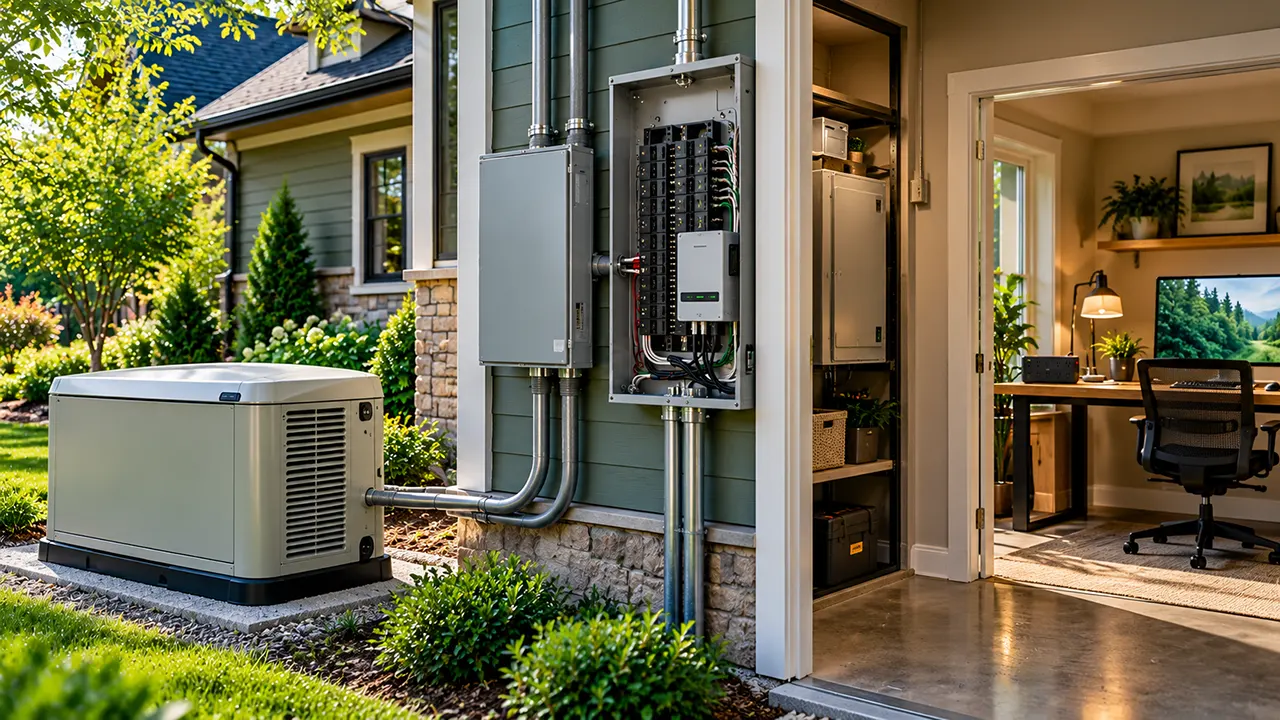
Why Whole Home Surge Protection Matters After a Generator Install
A generator keeps your home powered when utility power fails, but backup power and surge protection are not the same thing. A whole-home surge protective device (SPD) is designed to limit transient overvoltage that can damage electronics, appliances, HVAC controls, and other connected equipment. That distinction becomes especially important when a generator and automatic transfer switch are added to a home’s electrical system.
What Is Whole-Home Surge Protection?
Whole-home surge protection uses a permanently connected surge protective device to help limit transient voltage surges throughout a home’s electrical system. Unlike a plug-in surge strip that protects equipment connected directly to it, a panel-mounted SPD is connected to the home’s electrical distribution system and can protect multiple circuits.
A surge can enter through the utility supply, occur during electrical switching, or be generated by equipment inside the home. The SPD responds to the transient event by providing a controlled path that limits the voltage seen by connected equipment.
What a whole home surge protector can protect
A properly selected and installed SPD can help protect electrical and electronic equipment connected to the protected system, including:
- HVAC equipment and electronic controls
- Refrigerators and freezers
- Washing machines and dishwashers
- Televisions
- Computers and home-office equipment
- Networking equipment
- Smart-home devices
- Other hardwired or connected electronics
The important word is help. Surge protection reduces the risk and severity of transient overvoltage; it does not make electrical equipment immune to every possible electrical event.
What whole home surge protection does not do
A whole-home SPD is not a backup power system. It does not keep your lights on during an outage, and it should not be confused with a UPS, voltage regulator, or generator.
It also should not be treated as a guarantee against direct lightning damage or every possible power-quality problem. The home’s electrical system, grounding and bonding, SPD selection, installation, and the path of the incoming surge all affect the protection provided.
How Does a Whole-Home Surge Protector Work?
Most residential SPDs use components that respond rapidly when voltage rises above the device’s intended operating range. Metal-oxide varistors (MOVs) are commonly used in surge-protection systems because their electrical behavior changes as voltage rises.
During normal operation, the SPD remains essentially inactive. During a transient event, it becomes conductive and diverts or limits surge energy so the protected circuit experiences a lower voltage than it otherwise would.
The key idea is simple: an SPD is designed to limit a short-duration voltage event, not to supply power.
That is why a generator and an SPD solve two different problems. The generator supplies electricity. The SPD deals with transient overvoltage.
Whole Home vs Point-of-Use Surge Protection
Whole-home and point-of-use surge protection are best understood as complementary layers rather than competing choices.
| Feature | Whole-home SPD | Point-of-use SPD |
|---|---|---|
| Typical location | Main panel, service equipment, or distribution panel | Outlet or near the equipment |
| Coverage | Multiple circuits | Connected equipment |
| Hardwired equipment | Can protect equipment connected to protected circuits | Usually cannot directly protect hardwired loads |
| Electronics | Broad system-level protection | Local protection |
| Generator system | Can be integrated into the electrical distribution strategy | Useful as an additional layer |
| Typical example | Panel-mounted SPD | Plug-in surge protector |
A whole-home SPD can address equipment that a plug-in power strip cannot directly reach, such as hardwired HVAC equipment. Eaton recommends a two-stage approach using service-entrance and point-of-use protection for electronic equipment, illustrating why panel-level protection does not necessarily make every plug-in SPD unnecessary.
Why sensitive electronics may still need point-of-use protection
Sensitive equipment can benefit from additional local protection, particularly when it includes delicate electronics or when other conductive paths could allow a transient to reach the equipment.
For example, a home office might use whole-home surge protection at the electrical panel while computers, monitors, networking equipment, and other sensitive devices use an appropriate point-of-use device.
The goal is layered protection rather than assuming one device has to do everything.
What Causes Electrical Surges?
Electrical surges are short-duration increases in voltage that can stress or damage electrical and electronic equipment.
Lightning
Lightning is one of the most powerful sources of transient electrical energy. A nearby strike can induce or introduce a surge into electrical systems even when the strike does not directly hit the house.
Whole-home surge protection can reduce exposure to some transient events, but no residential SPD should be presented as absolute protection against a direct lightning strike.
Utility switching
Utility systems routinely switch electrical loads and equipment. These events can create transient disturbances that travel through the electrical distribution system.
Motors, compressors, and other electrical equipment
Equipment inside a home can also create transients. Motors, compressors, and other inductive loads can produce voltage disturbances when they switch on or off.
Generator transfers and power restoration
The transition between utility power and generator power is another reason surge protection deserves attention in generator-backed homes. Schneider Electric notes that transferring a home’s power source from utility power to a generator can create a voltage spike, and that generators themselves can be a source of spikes and surges.
This does not mean every generator produces dangerous surges during every transfer. It means the generator system should be evaluated as part of the home’s overall surge-protection strategy.
Does a Generator Protect Your Home From Surges?
No. A generator and a whole-home surge protector perform different functions.
A generator’s primary job is to produce electrical power when the normal utility source is unavailable. A surge protective device is designed to limit transient overvoltage.
That distinction matters because a home can have reliable backup power and still need surge protection.
Some generator systems may include surge-protection components, but you should never assume that simply installing a generator means the entire house has a properly coordinated SPD system. Check the generator, transfer-switch, panel, and SPD documentation.
The safest approach is to evaluate the complete electrical system rather than treating the generator as a substitute for surge protection.
Is a Generator Transfer Switch a Surge Protector?
Not automatically. A transfer switch and an SPD have different primary functions.
An automatic transfer switch (ATS) monitors the available power sources and transfers the home’s electrical load from utility power to generator power, or back again. A surge protective device limits transient voltage.
Some transfer-switch systems can include surge protection or be supplied as part of equipment packages that include an SPD. Eaton, for example, offers residential automatic transfer-switch equipment with complete home surge protection. But that is a feature of specific equipment, not a universal characteristic of every transfer switch.
What a transfer switch actually does
The transfer switch controls which electrical source supplies the home’s selected loads.
Depending on the system, those sources may include:
- Utility power
- Standby generator power
- Other approved backup sources
The transfer switch is therefore part of the power-transfer system, not automatically the home’s surge-protection system.
How to verify whether your system has an SPD
Check the exact model documentation for:
- Surge protective device specifications
- UL 1449 listing information
- SPD Type
- Surge current rating
- Voltage and system compatibility
- Protection modes
- Installation instructions
Do not rely on the words “surge protection” in a general product description if you need to determine exactly what protection is installed.
Where Should Surge Protection Go With a Generator?
The correct location depends on the electrical architecture and the equipment being protected. There is no single placement that applies to every generator installation.
Schneider Electric’s emergency-power guidance identifies several possible SPD locations, including the generator output, generator distribution equipment, automatic transfer switch, downstream panels, and control or communication circuits.
Service entrance
A service-entrance SPD can address surges entering through the utility side of the electrical system.
Main electrical panel
A panel-mounted SPD can provide protection for circuits distributed from the main electrical panel.
Generator side
Generator output equipment may also require consideration, particularly where the generator or generator distribution equipment can contribute to transient events.
Transfer switch
The ATS can be an important point in a generator-backed system because it is where the electrical source changes. Whether an SPD belongs there depends on the system design and the equipment manufacturer’s requirements.
Downstream equipment
Sensitive loads may require additional protection downstream. Communication and data circuits can also require separate consideration because a power SPD does not automatically protect every conductive path entering a device.
The key lesson is that surge protection should be designed around the complete electrical system, not added as an isolated accessory.
Type 1 vs Type 2 Surge Protective Devices
Type 1 and Type 2 SPDs are not simply two different strength levels of surge protector.
Under UL 1449 classifications, the distinction is primarily associated with where the permanently connected SPD is installed in relation to the service equipment overcurrent protection.
| Characteristic | Type 1 SPD | Type 2 SPD |
|---|---|---|
| Connection | Permanently connected | Permanently connected |
| Typical position | Can be installed ahead of service equipment overcurrent protection and can also be used on the load side | Load side of service equipment overcurrent protection |
| Typical application | Service-entrance applications and other approved locations | Main or branch distribution panels |
| External overcurrent device | Depends on the specific product and installation | Installation generally uses the specified overcurrent protection |
| Main point | Installation position and application | Installation position and application |
Schneider Electric states that Type 1 and Type 2 primarily refer to the SPD’s location within the electrical distribution system. Eaton’s UL 1449 application guidance similarly distinguishes Type 1 devices from Type 2 devices by installation position.
This is why it is better to think of Type 1 vs Type 2 as an installation and system-configuration question, rather than simply “outside surge vs inside surge.”
Which type is used in residential systems?
Both types exist in residential applications. The correct choice depends on the electrical system, the intended installation point, the product’s listing, and the manufacturer’s installation instructions.
Do not select an SPD solely because its Type number sounds more powerful.
How to Choose a Whole-Home Surge Protector
Choosing an SPD involves more than looking for the largest advertised surge-current number.
Match the electrical system
Start with the home’s electrical configuration.
Check:
- System voltage
- Phase
- Wiring configuration
- Grounding arrangement
- Service equipment
- Panel compatibility
An SPD designed for one electrical configuration is not automatically appropriate for another.
Check the SPD Type
Determine whether the intended installation requires a Type 1 or Type 2 device, or whether a particular product is listed for both applications.
The product’s certification and installation instructions should control the decision.
Look for UL 1449
UL 1449 is the key safety and performance standard commonly associated with surge protective devices in the United States.
A product’s listing should be verified rather than inferred from generic terms such as “surge suppressor” or “whole-house protection.”
Understand surge current rating
Surge current capacity is commonly expressed in kiloamps, or kA.
A larger number can look attractive, but it should not be the only specification you consider. Two SPDs can have different ratings across several important electrical characteristics.
Use the complete specification sheet to evaluate the device.
Check MCOV
MCOV means Maximum Continuous Operating Voltage.
It describes the maximum continuous voltage the SPD is designed to withstand under specified conditions without entering its surge-protection response.
MCOV needs to match the electrical system appropriately. A larger number is not automatically better.
Check VPR
VPR means Voltage Protection Rating.
It provides a standardized indication of the voltage level associated with the SPD’s tested protection performance.
VPR should be considered alongside the device’s voltage configuration and other specifications.
Check nominal discharge current
Nominal discharge current, commonly written as In, is another SPD specification used in UL 1449-related product information.
Current manufacturer specifications show that In can differ between models even when the products are sold for similar residential applications.
Check SCCR
SCCR means Short-Circuit Current Rating.
This matters because the SPD must be suitable for the electrical environment in which it is installed. Eaton’s current SPD specifications, for example, list SCCR alongside surge current capacity, In, voltage and protection modes.
Look at protection modes
Protection modes describe which conductors are being protected.
Depending on the electrical system, specifications may include combinations such as:
- Line-to-neutral
- Line-to-ground
- Neutral-to-ground
- Line-to-line
The appropriate protection modes depend on the electrical configuration.
Check status indicators
Many residential SPDs provide visual indicators showing whether the protective components are operating normally.
This can make maintenance easier because an SPD is not necessarily a permanent, never-needs-attention component.
Follow the manufacturer’s installation requirements
The breaker, conductor size, connection method, enclosure, mounting location, and other installation details must follow the specific product instructions.
Never assume that two SPDs can be installed using exactly the same method simply because they look similar.
Where Is a Whole-Home Surge Protector Installed?
A whole-home SPD is typically connected to the electrical distribution system rather than plugged into an ordinary receptacle.
Depending on the product and system design, installation may involve:
- Main service equipment
- Main electrical panel
- Distribution panel
- Generator distribution equipment
- Transfer-switch equipment
- Other approved locations
Why installation location matters
The SPD’s connection path is part of its performance.
Eaton’s installation guidance recommends keeping SPD wiring short because conductor impedance can affect the device’s performance during a fast transient event. Its guidance also emphasizes following the specific product’s installation requirements.
This is one reason professional installation matters. An SPD with excellent specifications can still be poorly applied if the installation does not match the product’s listing and instructions.
Do not treat grounding and bonding as an afterthought
An SPD installation interacts with the home’s grounding and bonding system. The electrical system should be evaluated as a whole before adding protective equipment.
If a generator, transfer switch, service upgrade, subpanel, or SPD is being installed, the work should follow the applicable electrical code, equipment listing, and manufacturer’s instructions.
Do You Need Whole-Home Surge Protection With a Generator?
For many generator-backed homes, whole-home surge protection is a sensible additional layer rather than something to assume the generator already provides.
It deserves particular attention when:
- A standby generator is being installed
- The home has expensive electronic equipment
- HVAC equipment contains electronic controls
- The home has extensive smart-home equipment
- The electrical system is being upgraded
- Sensitive computers or networking equipment are important
- The area experiences frequent electrical disturbances
- The generator and transfer switch documentation calls for or supports SPD protection
The decision should still be based on the actual electrical system.
A professional electrician can determine whether an existing SPD is already installed, whether the generator or ATS includes surge protection, and whether additional protection is appropriate.
Common Whole-Home Surge Protection Mistakes
Assuming the generator provides all surge protection
A generator supplies backup power. That does not automatically tell you whether the entire home has an appropriately rated SPD.
Assuming every transfer switch includes an SPD
Some do. Some do not. Check the exact equipment documentation.
Choosing only by kA rating
Surge-current capacity is only one specification. Voltage compatibility, MCOV, VPR, In, SCCR, protection modes, listing and installation requirements also matter.
Ignoring electrical-system compatibility
The SPD must match the home’s voltage, phase and wiring configuration.
Ignoring grounding and installation requirements
An SPD is part of an electrical system. Its installation cannot be separated from the requirements of the panel, service equipment and grounding/bonding system.
Removing every point-of-use surge protector
Whole-home protection and point-of-use protection can work together. Sensitive electronics may benefit from additional local protection.
Assuming surge protection means power-quality protection
An SPD is designed primarily for transient overvoltage. It is not a substitute for a generator, UPS, voltage regulator, or other equipment designed for different power-quality problems.
Whole-Home Surge Protection FAQ
Does a whole-house surge protector protect against lightning?
It can help reduce the effects of some lightning-related surges, but it should not be described as guaranteed protection against a direct lightning strike. The home’s electrical system, SPD design, installation, grounding, and the path of the lightning event all matter.
Does a generator need a surge protector?
A generator and SPD perform different functions, so a generator should not automatically be treated as the home’s surge protector. Schneider Electric notes that generator transfers and generators themselves can be sources of spikes or surges. The complete generator, transfer-switch and electrical-panel configuration should be evaluated.
Does a transfer switch protect against power surges?
Not necessarily. A transfer switch primarily transfers electrical loads between power sources. Some transfer-switch products include surge protection, but this is equipment-specific. Check the exact model documentation for an SPD and its specifications.
What is the difference between Type 1 and Type 2 surge protectors?
The primary distinction is their intended installation position within the electrical distribution system. Type 1 SPDs can be installed in applications on the service side and may also be used on the load side, depending on the listing. Type 2 SPDs are intended for installation on the load side of the service equipment overcurrent protection.
Is whole-home surge protection worth it?
For a home with expensive electronics, electronic HVAC controls, smart-home equipment, or a standby generator, whole-home surge protection can be a useful additional layer of protection. Its value depends on the electrical system, local conditions, equipment exposure and proper installation.
Does whole-home surge protection protect HVAC systems?
A properly installed panel-level SPD can help protect electrical equipment connected to protected circuits, including hardwired HVAC equipment. However, protection is not absolute, and other conductive paths or equipment-specific requirements may need separate consideration.
Do I still need surge strips with whole-home protection?
Possibly. Whole-home protection and point-of-use protection can complement each other. Sensitive electronics such as computers, networking equipment and home-office devices may benefit from additional local protection.
How long does a whole-house surge protector last?
There is no single lifespan that applies to every SPD. Its condition depends on the number and severity of transient events and the design of the device. Many products include status indicators that show whether the protective components remain operational.
Can a whole-house surge protector protect against brownouts?
Not by itself. Surge protective devices are intended primarily for transient overvoltage. Brownouts and sustained low voltage are different power-quality problems that may require different equipment or system-level solutions.
Does a whole-home SPD protect the generator?
An SPD can be installed at appropriate points within a generator-backed electrical system, but that does not mean one panel-mounted device automatically protects every part of the generator system. Generator output, transfer equipment, downstream panels and other circuits may need to be evaluated separately.
Where should an SPD be installed with a standby generator?
The correct location depends on the system design. Possible locations can include service equipment, generator output equipment, an automatic transfer switch and downstream distribution panels. Schneider Electric identifies several of these locations in its emergency-power guidance.
The Practical Takeaway
If you are adding a generator to your home, do not stop the electrical-protection conversation at “the generator is installed.”
Treat the generator, transfer switch, electrical panel, whole-home SPD and point-of-use protection as parts of one electrical system. First determine what protection your existing equipment already provides. Then select any additional SPD based on the actual electrical configuration, its UL listing, Type, voltage compatibility and complete technical specifications.
For most homeowners, the best next step is not buying the device with the biggest kA number. It is having the generator and electrical distribution system evaluated together so the surge-protection strategy matches the equipment that is actually installed.
